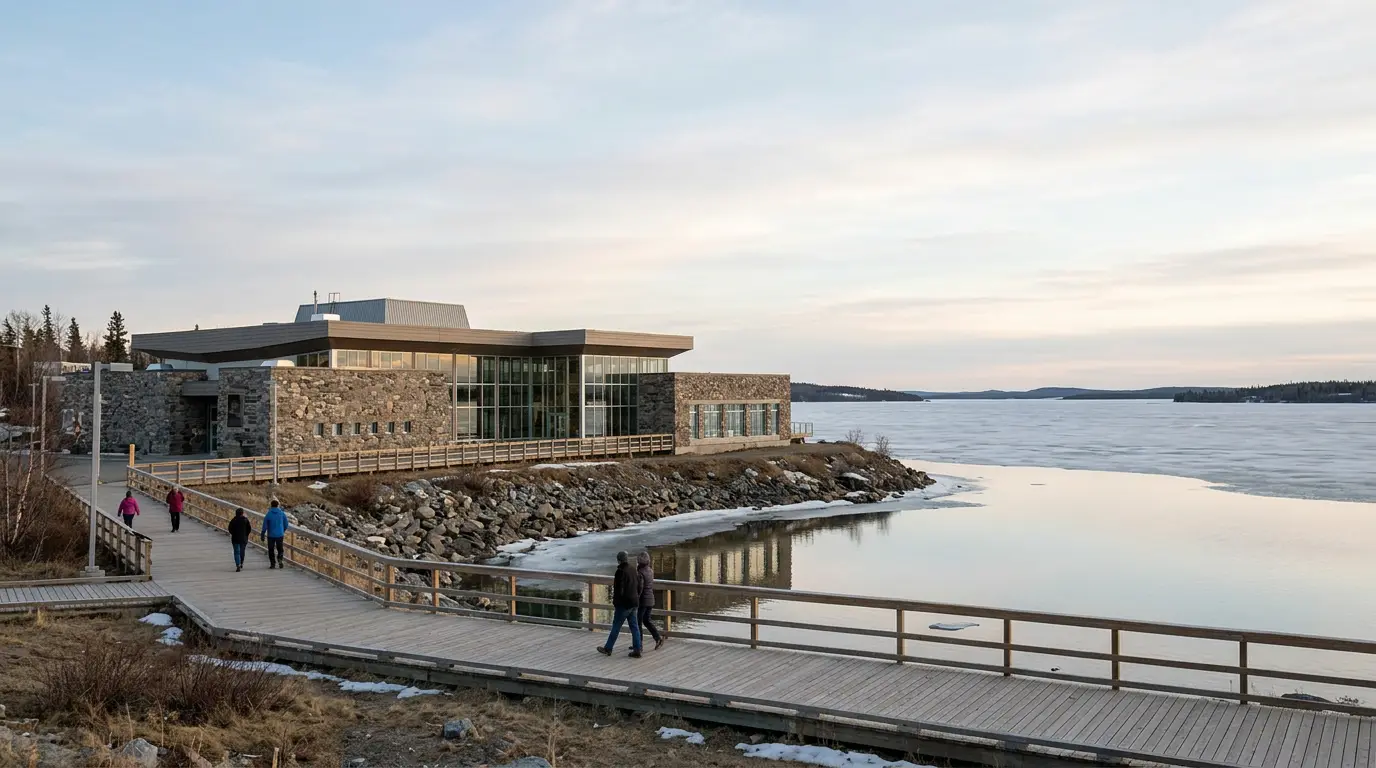
The ice road that turns a frozen lake into a winter highway
The Yellowknife-Dettah ice road is a 6 km route across Back Bay that opens in December and runs through April[1]. It connects Yellowknife to the Dene community of Dettah, and for the people who live there, it is a commute. For everyone else, it is one of the strangest drives in Canada: a plowed lane on a frozen inland sea, hemmed by houseboats frozen into the ice and clusters of ice fishing shacks with woodsmoke curling from their stovepipes.
The ice road is the most visible piece of a much larger network. The Northwest Territories maintains roughly 20 ice roads across 12 communities each winter[1], from the Mackenzie Valley crossings that link the Dehcho and Sahtu regions to the seasonal lifelines that supply remote communities before the spring thaw. The Yellowknife-Dettah stretch is the most accessible of these, running six kilometers from downtown to a community of roughly 200 people. For lodging, aurora tours, and the full destination overview, the Yellowknife Northern Lights hub covers what you need to build the rest of the trip around.
In March, the road turns into something closer to a winter promenade. Snowmobiles, joggers, kite-skiers, kick-sledders, and fat bikes share the surface. Hand-carved ice sculptures and the Snowking snow castle appear along the route. You can drive it in 15 minutes or walk it in an hour and a half, stopping to watch the ice road maintenance crews flood the surface at night to keep it smooth.
- Distance: 6 km across Back Bay and Houseboat Bay
- Season: December through April, when lake ice is thick enough to support vehicle traffic
- Access: Drive from downtown Yellowknife (follow the signs for Dettah) or join a guided ice road tour that includes stops at the houseboat community and ice fishing camps
Fishing through 4 feet of ice on Great Slave Lake
Great Slave Lake is one of the world's legendary fishing destinations, the kind of water body where Northern Pike and Lake Trout reach sizes you tell your friends about and they do not believe you. In winter, the entire lake freezes solid enough to drive trucks on, and the fishing shifts from boats to heated huts on the ice[2].
The setup is simpler than most visitors expect. Operators maintain heated ice fishing huts with wood-burning stoves, pre-drilled holes, and seating for up to six people. You sit inside, drop a line through the ice, and wait. The huts are warm enough to take your jacket off inside, even when outside temperatures are running at -30°C. Packages are available from multiple operators and generally include gear, bait, and an experienced guide who knows where the fish are holding at that point in the season.
614
Ice fishing season on the lake runs from December through May, but the best window is late March through May[2]. By then, the days are long enough that the fish become more active near the surface, drawn up by the increasing light. Northern Pike, the lake's most sought-after winter species, hunt aggressively in the shallows as the ice begins to thin. Lake Trout tend to stay deeper but bite reliably throughout the winter. Walleye and Whitefish round out the catch, and local guides clean and fillet what you land.
If you have never ice-fished before, the barrier to entry is low. The operator runs the auger, baits the hook, and reads the ice conditions. You bring warm boots and the willingness to sit still for an hour or two.
- Species: Northern Pike, Lake Trout, Walleye, Whitefish
- Best window: Late March through May, when longer daylight brings fish closer to the surface
- Typical setup: Heated hut with woodstove, pre-drilled holes, seating for up to six, guide included
- What to wear: Insulated boots rated for -30°C or below. The hut is warm, but your feet are on the ice floor.
Dogsledding the Dene way: kennels, bannock, and stories in a log cabin
Dogsledding in Yellowknife is not a theme-park recreation. The best operations are run by Dene families who grew up with sled dogs as winter transportation, not as a commercial activity they learned for the tourism market. The difference shows in the dogs themselves — named individually, handled as working partners rather than livestock — and in what happens after the sled ride ends.
Tugáh Northern Experiences runs out of a family kennel on Curry Drive, on the south shore of Kam Lake, five minutes by cab from downtown. A traditional dogsledding tour runs $150[3] per adult and $65[4] for children under 12, covering roughly 1.5 hours from arrival to departure[4]. The sled run itself is about 20 minutes across the frozen lake, but the time back at the kennel is where the experience deepens. The musher, a member of the family, leads you into a traditional log cabin heated by a woodstove. Furs and traps hang on the walls. Bannock fries in a cast-iron pan. Coffee and tea circulate while the musher tells stories about winter traplines, about particular dogs and the seasons they ran, about what the Dene relationship with sled dogs looked like before snowmobiles arrived.
Other operators run dogsledding tours in the Yellowknife area, including North of 60 Aurora Adventures and Bucket List Tour Company, but Tugáh is the Indigenous-owned option where the cultural component is not an add-on. The full tour page is at the Yellowknife Dog Sledding Tour listing, with current pricing, seasonal dates, and booking links.
Featured · Destination
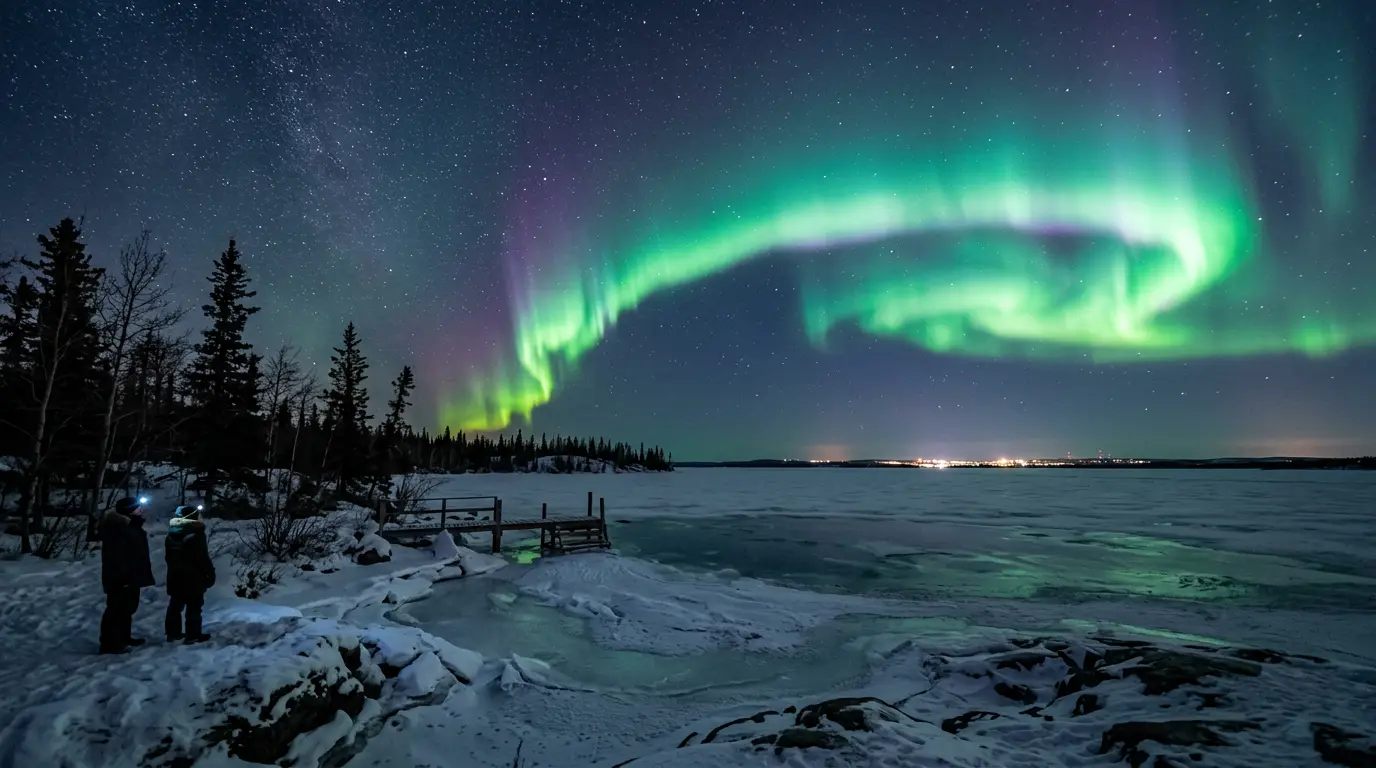
Yellowknife Northern Lights
Yellowknife sits beneath the auroral oval: up to 240 aurora nights per year. Guide to seasons, viewing spots, Indigenous-led tours, and cold-weather planning.
If you want to combine the daytime run with aurora viewing, Tugáh also runs an Aurora Viewing by Dogteam evening tour at $250[6] per person. It includes a shorter sled ride away from city lights, cabin warm-up time, and storytelling under whatever the sky is doing that night.
- Tugáh Northern Experiences: $150/[3] adult, $65/child under 12, 1.5 hours
- North of 60 Aurora Adventures: dogsledding tours, roughly 2 hours (check with the operator for current pricing)
- Season: December through March, when Kam Lake is frozen solid
- What to bring: Thermal base layers, ski goggles (wind off the lake at sled speed is the real variable)
Snowking's palace on ice: Yellowknife's winter festival on Back Bay
The Snowking Winter Festival begins each winter on February 1st, and the venue is the headline: a snow castle built on the frozen surface of Back Bay, constructed entirely from snow and ice by a crew led by the Snowking himself[7]. It is not a small sculptural installation. The castle is a functioning venue with performance spaces, ice slides, a gallery for ice art, and a stage that hosts theatre, live music, magic shows, and community dance nights across the following weeks, including the NIC Carving Symposium, a four-day ice-carving competition held March 5–8.
The festival is the closest thing Yellowknife has to a winter cultural anchor. Locals treat it as a social season: the castle becomes the default weekend destination through the winter, and the programming shifts week to week so there is always something new. The ice slides alone keep children occupied while parents drink hot chocolate and listen to whoever is on the main stage that afternoon.
When the thaw comes, the castle melts back into the lake it was built on.
The castle itself is a construction feat. Crews begin building in February, compacting snow into forms and carving it into rooms, corridors, and arches. The structure lasts as long as the cold holds, which in a typical Yellowknife winter means several weeks into March. When the thaw comes, the castle melts back into the lake it was built on.
Entry to the festival grounds is free for children and low-cost for adults. Specific programming, ticket links, and the season's performance lineup are posted on the festival website each January.
- Dates: Begins February 1st each winter; NIC Carving Symposium March 5–8
- Venue: Snow castle on Back Bay, frozen Great Slave Lake
- What to expect: Theatre, live music, magic shows, ice slides, art exhibitions, community dances
- Cost: Festival grounds free or low-cost; some performances ticketed separately
Dene culture, city tours, and eating well at minus 30
Yellowknife's cultural life is rooted in the Yellowknives Dene First Nation, and several Indigenous-owned operators run tours that place the city's physical landscape inside its human one. These are not museum-style cultural overviews. They are invitations into living Dene traditions, led by people from the communities they describe.
B. Dene Adventures runs Dene Cultural Tours at $120 per person[8]. The experience covers Dene history, land-use traditions, and the stories tied to the specific places around Great Slave Lake. The company also runs other tours, including an evening aurora-viewing experience with traditional drumming and storytelling. The full tour page is at Aurora Viewing Under the Dene Skies, with current pricing and booking details.
Great Slave Lake Tours offers an Aboriginal Net Fishing and Fish Fry experience at $125[10] per person, minimum four people[10]. The tour combines traditional Indigenous net-fishing techniques with a fish fry on the frozen lake, the kind of meal where the cold sharpens your appetite and the fish came out of the water that same day.
For city tours, My Backyard Tours runs a Signature City Tour at $95[11] per person in small groups[11]. The route covers Old Town, with its gold-rush-era buildings and floating houseboat community; the Legislative Assembly, whose interior holds A. Y. Jackson paintings from the Group of Seven; and Somba K'e Park, the civic plaza whose name means "money place" in the Dene language. Bucket List Tour Company offers a longer City Tour covering the same territory at a slower pace.
When the cold makes you hungry, Yellowknife's food scene is small but specific. Woodyard Brewhouse on Kam Lake Road pours local craft beer and serves a menu built around Northern ingredients. Arctic char, a cold-water salmonid with a cleaner, milder flavour than farmed Atlantic salmon, appears on menus across town, sometimes as sashimi. Bannock, the traditional Indigenous quick-bread fried in a pan, is served at several cafes and is the one thing almost every tour operator includes — hot, crisp-edged, and better than it has any right to be given it is flour, baking powder, and lard.
- B. Dene Adventures: Cultural Tour $120[8]; other tours (city tour, aurora viewing), check with the operator for current pricing
- Great Slave Lake Tours: Aboriginal Net Fishing and Fish Fry $125 (min 4)
- My Backyard Tours: Signature City Tour $95
- Bucket List Tour Company: City Tour covering Old Town, Legislative Assembly, and houseboat community
- Where to eat: Woodyard Brewhouse (craft beer, Northern menu), any spot serving Arctic char or bannock
The practical bit: season windows, what to book ahead, and what to wear
Yellowknife's winter activities operate on distinct seasonal calendars, and booking the right window determines which ones overlap. Here is how the main activities line up:
- Ice roads: December through April. The Yellowknife-Dettah ice road is the first to open and the last to close. March adds the snow castle and ice sculptures along the route.
- Ice fishing: December through May, with the best window in late March through May when longer daylight draws fish closer to the surface[2]. Heated huts make the cold manageable, but March and April are more comfortable than January.
- Dogsledding: December through March, when snow cover on the lakes is reliable. Tugáh runs three daily departures at 11:00 AM, 12:30 PM, and 2:00 PM through the season[4].
- Snowking Winter Festival: Begins February 1st each winter, with the NIC Carving Symposium March 5–8. This is the activity that anchors a winter trip. Everything else on this list runs concurrently in March.
- Cultural tours and city tours: Most run year-round with reduced winter schedules. Contact individual operators for winter hours, especially Dene cultural tours that move between ice-road and highway access depending on the season.
March is the sweet spot. You get the Snowking castle, good ice fishing in lengthening daylight, dogsledding at the tail end of its season, and daytime temperatures averaging -10.8°C instead of January's -27°C[12]. You also get 11 to 13 hours of daylight, enough to do two activities in a day plus an evening event. If you want to add aurora viewing to the trip, March is also the best month for that: equinox geomagnetic activity peaks combine with winter's clear, dry skies. The timing breakdown is in the best time for northern lights in Yellowknife guide.
What to wear: Yellowknife's winter is a dry cold, which sounds reassuring until you stand still on a frozen lake for an hour. The strategy is layers and coverage.
Recommended tours
Tours are selected for quality, not commission. I earn a small fee if you book — at no extra cost to you.
- Base layer: Merino wool or synthetic thermal top and bottom. Cotton is useless once it gets damp, and you will sweat inside a heated hut or a moving sled.
- Mid-layer: Fleece or down jacket. The goal is insulation you can vent when you warm up.
- Outer layer: Windproof shell jacket and insulated snow pants. Wind on the ice road or the sled runners is the variable that makes -20°C feel like -35°C.
- Feet: Insulated boots rated to -40°C, wool socks, no cotton. Your feet are on ice for ice fishing and on metal sled runners for dogsledding. These are the first body parts to go numb.
- Hands: Mittens beat gloves. Heated hand warmers are not cheating.
- Face: Balaclava or neck gaiter, ski goggles for the sled. Sunglasses fog the moment you breathe into a gaiter; goggles seal better and protect against snow glare.
Featured · Article
What Is Astrotourism? The Complete Beginner's Guide
Astrotourism means travel built around dark skies: meteor showers, auroras, the Milky Way. What it means, where to go, and how to plan your first trip.
What to book ahead: The Snowking festival does not require advance booking for general entry, but specific performances may sell out. Dogsledding with Tugáh fills weekend afternoon slots fast; book two weeks out in peak season (December through February). Ice fishing operators need at least a day's notice to set up huts. City tours run on-demand and can usually be booked same-day, though small-group tours with My Backyard Tours fill ahead.
Yellowknife is a small city, roughly 20,000[15] people, and the winter tourism infrastructure is sized for it. Operators here are not running industrial-scale operations with endless capacity. Call or email directly rather than relying on third-party booking platforms; the response is faster and you often get better availability than what an aggregator shows.
- Best overall month: March (Snowking, good fishing, dogsledding tail-end, bearable cold, long daylight, equinox aurora bonus)
- Coldest but clearest skies: December through February
- Warmer alternative: Late March through April for ice fishing, but dogsledding ends and the snow castle melts