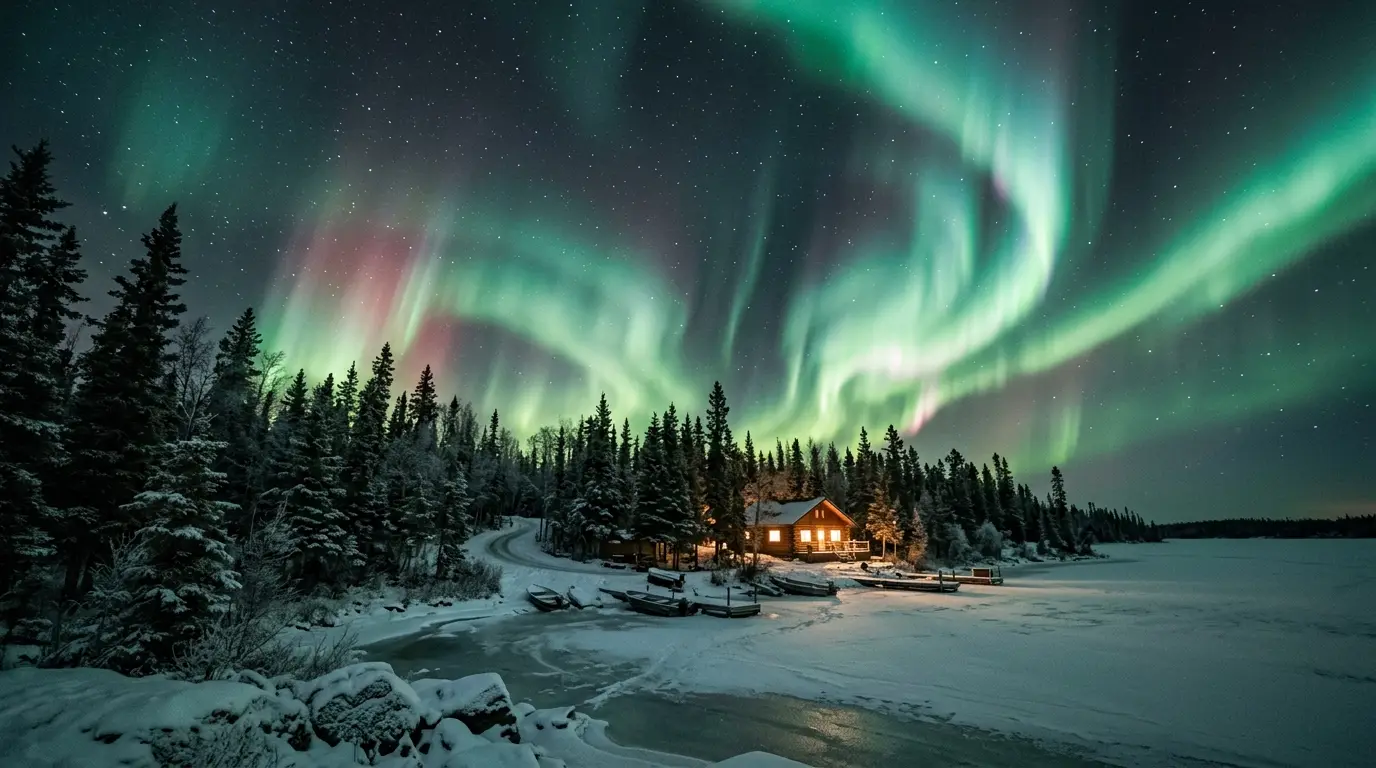

What worth it means for an aurora trip to Yellowknife
"Worth it" splits into three numbers most travel writing skips past: sighting odds per night, all-in cost per night of darkness, and backup value if the aurora does not appear. Yellowknife wins decisively on the first, costs roughly the same or slightly more than Fairbanks on the second once you factor in the connecting flight, and delivers the weakest backup of any major aurora destination on the third.
That last piece is the honest assessment most tourism copy buries. Yellowknife at 62°N on the Canadian Shield is a government-and-mining town with roughly 20,300 residents[1], not a Nordic harbour with whale-watching and fjord cruises. If the sky stays cloudy for your entire stay (unlikely but possible during the October-November transition gap[2]), you are in a subarctic city with 5 to 6 hours of daylight and a handful of daytime activities, not Reykjavík. Every decision in this article flows from that framing: Yellowknife is an aurora-first, aurora-almost-only destination, and the question is whether its sighting odds are high enough to justify the trip without a strong Plan B.
For most people, the answer is yes, conditionally: book March instead of January, give yourself three to four nights minimum, and understand that the cold is the real variable, not the aurora. The aurora season splits into fall (mid-August through early October) and winter (mid-November through early April), with a distinct October-to-mid-November cloud gap that catches travelers who book on autopilot. For a full month-by-month breakdown of the seasonal trade-offs, including the Russell-McPherron equinox peaks that make March the strongest statistical month, see the best time for northern lights in Yellowknife guide, or the Yellowknife aurora by month comparison for how August, September, October and April stack up against each other specifically.
The real cost of a four-night Yellowknife aurora trip
A four-night Yellowknife trip runs well above budget-backpacker territory at mid-range, excluding the international flight that gets you to a Canadian hub — confirm current pricing directly with airlines and operators before booking. That figure breaks down into flights, accommodation, aurora tours, and winter clothing, all of which run higher than a comparable trip to Fairbanks or Tromsø.
| Cost category | Yellowknife (4 nights, CAD) | Fairbanks (4 nights, USD) | Tromsø (4 nights, USD) |
|---|---|---|---|
| Domestic/regional flights | Varies by season; confirm with airline | $300-$500 | $200-$400 |
| Accommodation per night | Varies by season; confirm with hotel | $150-$250 | $85-$200 |
| Aurora tours per night | Varies by operator; confirm current rate | $100-$200 | $100-$180 |
| Clothing rental per night | Varies by operator; confirm current rate | $25-$40 | $30-$50 |
| Mid-range total (excl. int'l) | Typically runs higher than Fairbanks or Tromsø | $1,500-$2,500 | $1,100-$2,200 |
Flights to Yellowknife
Yellowknife Airport (YZF) has daily jet service from Edmonton (1.5 hours), Calgary (2 hours), Vancouver (2.5 hours), Toronto (4 hours), and Ottawa (4 hours) via Air Canada, WestJet, Air North, and Canadian North[4]. International visitors connect through Edmonton or Calgary, adding a further domestic-leg fare on top of the international flight to those hubs. This varies by season and carrier, so confirm current fares before booking. There is no rail service to Yellowknife; the only road approach is a 1,500+ kilometer drive from Edmonton[6] on winter highways most casual visitors will not want to attempt. Fly-in only is the honest situation for virtually every international traveler.
Accommodation
Mid-range hotels like the Explorer Hotel and Nova Inn charge peak-season (November through March) rates well above shoulder-season pricing. Confirm current rates directly with the hotels before booking. Budget accommodation is scarce: Yellowknife has few hostels or dorm options, unlike Tromsø where budget travelers can bring down the nightly average significantly. Aurora Village sells bundled packages (hotel, aurora viewing, airport transfers, winter clothing) that reduce per-night costs slightly over booking each component a la carte.
Aurora tours and winter gear
Group viewing at Aurora Village charges per person per night for heated teepee access, hot drinks, guides, and hotel pickup. Confirm current pricing directly with the operator. Independent aurora hunting along the Ingraham Trail costs nothing beyond transport (rental car or taxi), but in -30°C conditions, the difference between a heated shelter and sitting in a parked car is not academic. Winter clothing rental adds a per-night charge for a five-piece set (parka, insulated pants, boots rated to -40°C, mitts, face mask); confirm current rates with the rental operator.
The all-inclusive Lac La Martre Adventures (Tłı̨chǫ Adventures Ltd.) Northern Lights Experience, a three-night package at a remote fly-in lodge on Lac La Martre, runs $3,275 CAD per person[10]. That is the high end. The low end, flying from Calgary or Edmonton, staying at a cheaper hotel, and doing one guided night plus two independent viewing nights, comes in well under the high end excluding the international inbound flight.
Why Yellowknife's sighting odds genuinely beat the competition
Yellowknife's core value proposition is its sighting probability, and the advantage is structural, not anecdotal. Two factors combine to produce the highest per-night aurora odds of any accessible destination: magnetic-latitude position and continental-clear-sky climate.
The city sits near 68°N magnetic latitude even though its geographic coordinate is 62.45°N, because Earth's north magnetic pole, currently in the Canadian Arctic north of Ellesmere Island, bends the auroral oval south over the Northwest Territories[12]. The practical result: overhead aurora is visible at Kp 2, and any clear night at Kp 3 or above delivers a strong, well-structured display directly above you rather than at the horizon. Compare this to Fairbanks (~64°N magnetic), where you need Kp 3+ for comparable coverage, or Iceland (~65°N magnetic), where Kp 4+ is often required for overhead displays. For a detailed breakdown of the Kp mechanics, see the Kp Index Explained guide.
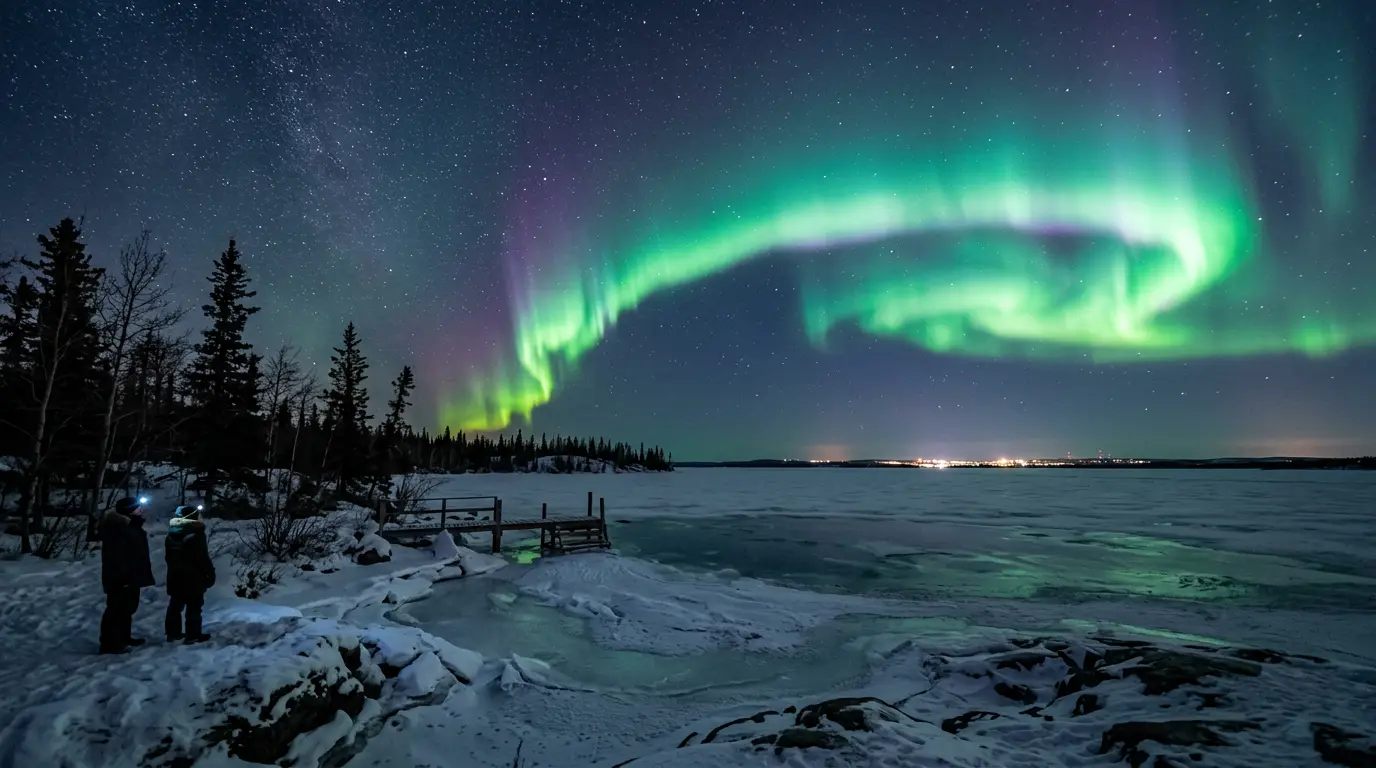
Featured · Destination
Yellowknife Northern Lights
Yellowknife sits beneath the auroral oval: up to 240 aurora nights per year. Guide to seasons, viewing spots, Indigenous-led tours, and cold-weather planning.
The second factor, and the one that matters more night-to-night than geomagnetic activity, is sky clarity. Yellowknife has a subarctic continental climate (Köppen Dfc) with less than 300 mm of annual precipitation[13]. Winter skies from late November through March sit under a stable arctic high-pressure system that suppresses cloud formation for weeks at a stretch. Coastal aurora destinations (Iceland, Tromsø, Lofoten) fight the opposite fight: the North Atlantic pumps moisture into the air year-round, and cloud cover, not solar activity, is the primary variable that decides whether you see anything at all. In Yellowknife, if the sky is dark and clear, the aurora is almost certainly visible; the threshold is low enough that quiet solar-wind conditions still produce displays.
Aurora Village, Yellowknife's largest and most established tour operator, reports a 98% success rate over a three- to four-night stay[8]. That figure is a tour-operator statistic, not an independently verified peer-reviewed number, so it should be read as indicative rather than guaranteed. But the structural advantages are independently verifiable: a destination parked under the auroral oval with some of the lowest winter humidity and cloud-cover probability on the continent will deliver more aurora hours per night than any coastal competitor at the same Kp level. The question is not whether Yellowknife has the highest odds, it is whether the odds are high enough to justify the discomfort and the premium.
The binding constraint is cold, not clouds
Every major aurora destination has a binding constraint, the factor that actually limits your viewing time regardless of what the forecast says. In Iceland and Tromsø, the constraint is cloud cover. In Yellowknife, it is extreme cold. This distinction shapes the trip in ways that matter more than the cost line items.
January temperatures average -21.6°C during the day and -29.4°C overnight[18], with extremes below -40°C not uncommon[14]. That is significantly colder than Tromsø (January averages -2°C to -7°C, warmed by the Gulf Stream) and marginally colder than Fairbanks (January averages -17°C to -28°C, comparable but with more Chinook-style warm-air incursions from the Pacific). The practical impact is not that you cannot go outside: sustained outdoor viewing beyond 30 to 60 minutes without heated shelter becomes genuinely dangerous unless your cold-weather gear is rated to -40°C.
-51.2°C
Tour operators design their entire experience around this constraint. Aurora Village provides 21 heated teepees on a frozen lake, each with a wood stove, plus a warming dining hall with hot drinks and snacks[8]. The rhythm is step outside, watch the aurora for 15 to 30 minutes, step back inside to warm up, repeat. Independent aurora hunters face a harder version of the same equation: sitting in a rental car with the engine idling at -30°C burns fuel fast, and walking far from the vehicle requires gear that most travelers do not own. The how to see the northern lights guide covers the layering system and cold-weather preparation that applies here: multiple thermal base layers, a parka rated to -40°C, insulated boots with at least 400g Thinsulate or equivalent, mitts (not gloves), and a face mask or balaclava.
The cold is a double-edged blade. It generates the clearest skies because cold arctic air holds almost no moisture — ice crystals that might form low cloud instead sublimate — which is why Yellowknife's winter sky clarity is unmatched. But it also limits how long you can comfortably view, and it makes the logistics of simply existing outside more demanding than anything a traveler from a temperate climate has likely experienced. Tour operators make this manageable. Independent travelers need to budget for proper gear and plan for shorter viewing windows.
If the aurora skips you: what Yellowknife offers during the day
The honest answer is less than Iceland or Tromsø, but more than nothing, and the quality of what does exist depends on the month you book. Yellowknife is a subarctic mining-and-government town of roughly 20,000 people on the north shore of Great Slave Lake[1]. It is not a scenic Nordic harbour, it does not have a fjord cruise or a whale-watching fleet or a Blue Lagoon, and its winter restaurant scene is small (Bullocks Bistro for Great Slave Lake fish, a few pubs, the Explorer Hotel dining room for business-traveler staples). Anyone expecting Tromsø's waterfront dining and Sami cultural programming is looking at the wrong destination.
What Yellowknife does offer during the day, particularly from February through March when daylight stretches past eight hours, includes some genuine experiences that Nordics-focused aurora destinations cannot replicate:
- Dogsledding with Tugah Northern Experiences, an Indigenous-led operator, starts at $150 CAD per person for 1.5 hours and includes an aurora dogsledding option at $250 CAD per person[15]. The experience is hands-on, Dene-guided, and set in the boreal Shield landscape rather than a manicured Nordic resort trail.
- Dene Indigenous cultural tours are available through operators like B. Dene Adventures, offering guided experiences that share Dene traditions and land-based knowledge, a cultural layer that Fairbanks and Tromsø do not have an equivalent for.
- Ice fishing on Great Slave Lake in heated shacks is available through local operators; confirm current rates directly. It is a low-key, genuinely local activity that visitors do alongside Yellowknifers rather than in a tour-group bubble.
- The Snowking Winter Festival, running throughout March, builds an entire snow castle on frozen Back Bay with theatre, music, ice slides, art installations, and community events[17]. It is the single richest daytime experience Yellowknife offers and is worth planning a March trip around.
- Snowmobiling and cross-country skiing are available through rental operators, with local trail networks accessible within minutes of downtown.
If your window is December or January, when daylight shrinks to 5 to 6 hours and temperatures bottom out, the daytime backup is genuinely thin. You will spend most daylight hours indoors, and the value of the trip rests almost entirely on the aurora delivering. The best aurora viewing spots in Yellowknife guide covers the complete map of where to set up at night, including the free Ingraham Trail pull-offs that independent travelers use to avoid paying for tours.
The segmented verdict: who should book, who should skip
The honest answer splits by traveler type, not by a single number. Here is where Yellowknife earns its fly-in premium, and where it does not:
Worth it for:
- Aurora-first travelers who prioritize sighting probability above everything else. If your single goal is to maximize the odds of seeing the northern lights, and you can tolerate cold for the best statistical hand on the planet, Yellowknife is the strongest answer in the accessible aurora-chasing world. Book March for the equinox geomagnetic peak combined with improving temperatures, or mid-November through February for the highest clear-sky probability with the understanding that the cold is punishing.
- Cold-weather enthusiasts and winter photographers. Photographers who can manage camera batteries at -30°C (spares in interior pockets, hand warmers taped to the lens barrel) get compositions that do not exist anywhere else: Great Slave Lake foregrounds with the aurora reflecting on ice, teepee silhouettes against green sky, the flat Shield-country horizon that puts the aurora dead center without mountains cutting into the frame.
- Travelers seeking Indigenous cultural immersion. The Dene tourism angle is not a marketing veneer. Aurora Village offers teepee aurora viewing, and Indigenous-led operators like Tugah Northern Experiences and B. Dene Adventures add traditional storytelling and land-based knowledge, a cultural layer that Fairbanks, Tromsø, and Abisko do not offer in any comparable form.
Not worth it for:
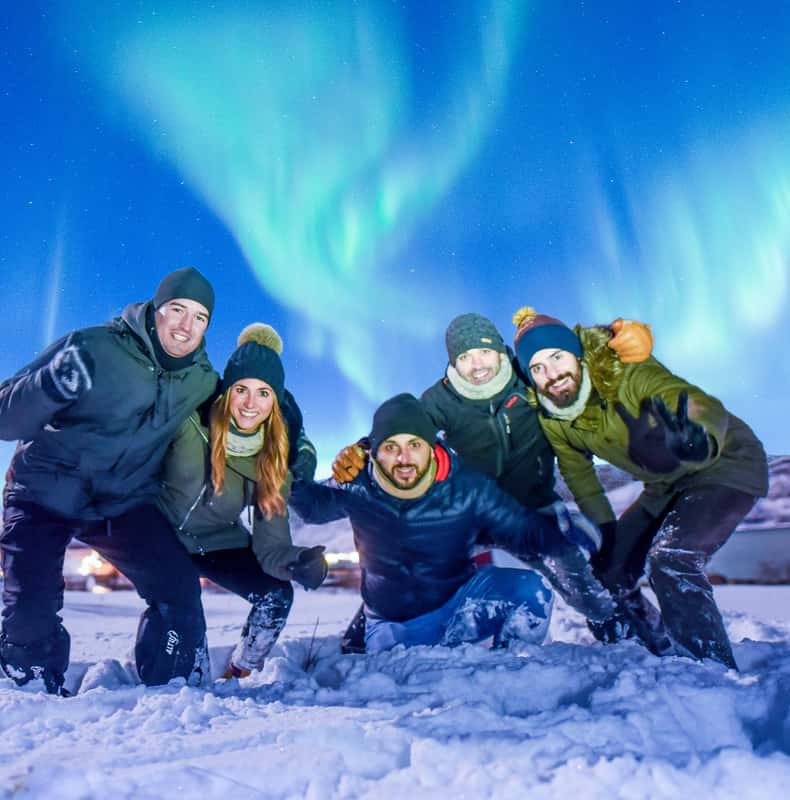
Recommended tours
Tours are selected for quality, not commission. I earn a small fee if you book — at no extra cost to you.
- Budget travelers. A four-night mid-range trip, excluding international flights, with no hostel-tier accommodation to bring the floor down, is a premium price point. The best time to see northern lights in Fairbanks guide covers the more budget-accessible North American alternative; Tromsø's dorm options open a similar European door.
- Travelers who dislike or cannot tolerate extreme cold. This is not about being uncomfortable. -30°C sustained ambient temperature with wind chill pushing below -40°C is dangerous without proper gear and limits how long you can be outside regardless of preparation. If the idea of wearing four thermal layers and still only managing 20-minute intervals outside drains the appeal rather than adds to it, pick Tromsø or Abisko.
- Aurora-plus-scenery travelers who want a dramatic daytime fallback. Yellowknife's winter landscape is flat boreal Shield: snow-covered pines, frozen lake, low rocky outcrops. It is beautiful in a stark, quiet way, but it is not Iceland's waterfalls and glaciers or Tromsø's fjords. If the aurora fails to deliver, the daytime experience will not rescue the trip the way it does in those destinations.
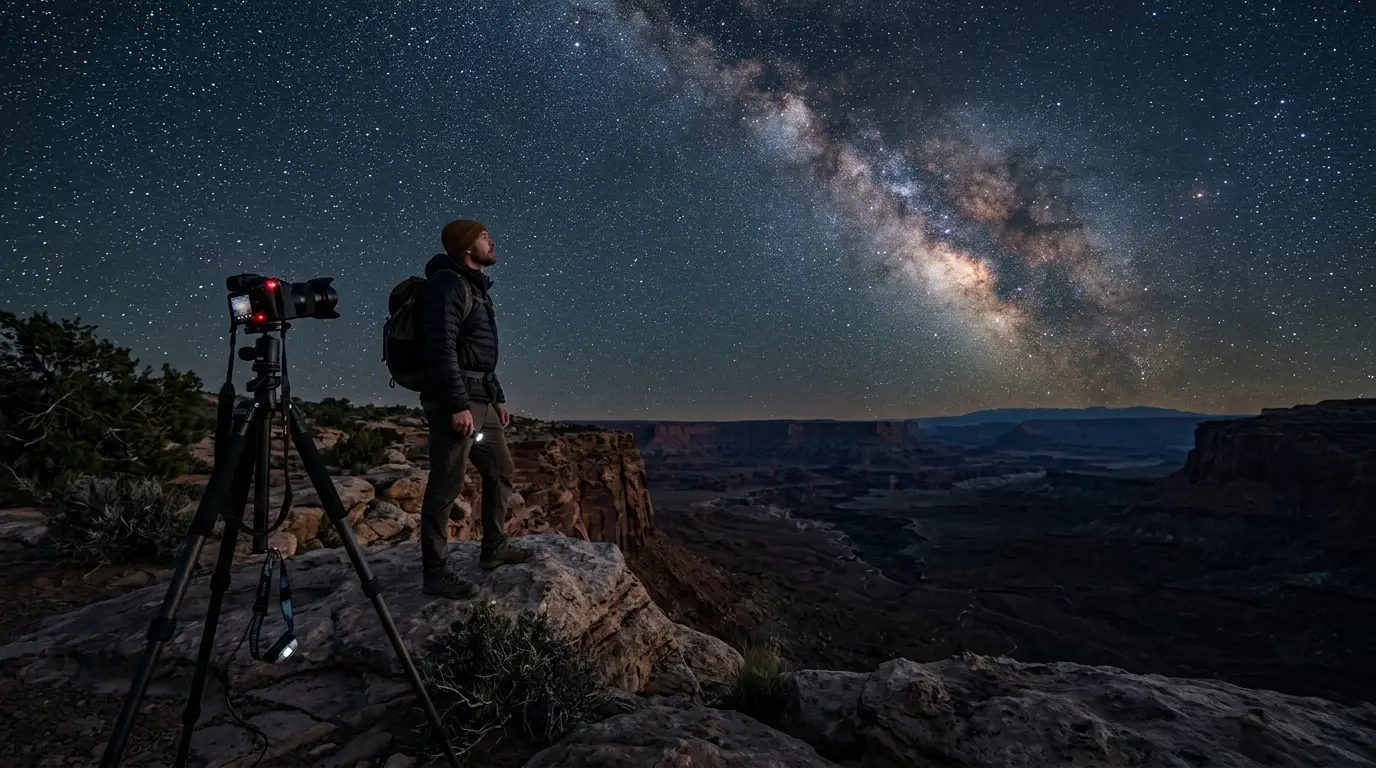
Featured · Article
What Is Astrotourism? The Complete Beginner's Guide
Astrotourism means travel built around dark skies: meteor showers, auroras, the Milky Way. What it means, where to go, and how to plan your first trip.
Break-even for:
- Experienced aurora chasers who have already been to Iceland, Tromsø, or Fairbanks and want the next step up in probability. If you already have Nordic or Alaskan aurora under your belt and the question is where do I go to maximize clear-sky nights, Yellowknife is the answer.
- Solo travelers with high cold tolerance who can self-navigate via the Ingraham Trail without paying for guided tours every night and want a destination where the aurora is the point, not the backdrop.
Final honest line: if you have three to four nights to spend, want the highest aurora odds money can buy, and are willing to dress for a subarctic winter and accept that the town itself is not the attraction, Yellowknife is worth the trip. If you want a comfortable winter holiday where the aurora is one element among many, book Tromsø.