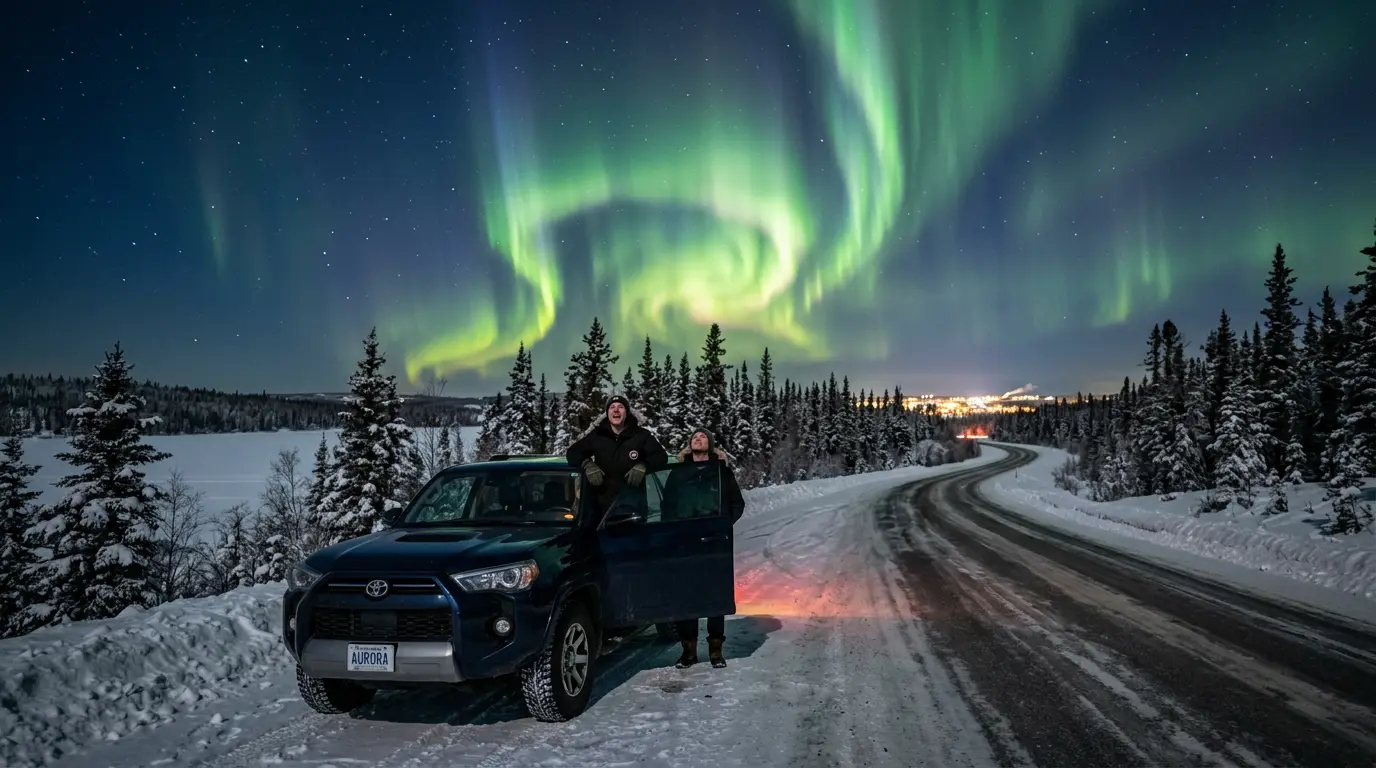

The fly-in reality: no train, no practical road
You cannot take a train to Yellowknife. No passenger rail line reaches the Northwest Territories capital, and none has ever been built. This is not a gap in service or a seasonal suspension; the tracks end hundreds of kilometres south of Great Slave Lake, and no government or private operator has proposed extending them. If you have read about aurora travellers arriving by rail at Abisko on the Malmbanan railway or at Fairbanks on the Alaska Railroad, you are comparing fundamentally different transport infrastructure. Yellowknife was never rail-connected.
The only overland alternative is a multi-day drive up the Mackenzie Highway (NWT Highway 1) from Edmonton, followed by the Yellowknife Highway (NWT Highway 3) for the final stretch into the city. In summer, on dry roads with no construction, the drive takes 16 to 18 hours of near-continuous travel. There are stretches of more than 200 km with no fuel, no cell signal, and no services beyond the occasional truck stop. In winter, when most aurora visitors travel, the highway ices over, whiteout conditions are common, and a breakdown can strand you for a full day in temperatures that drop past -40°C. NWT Tourism does not recommend this drive as an arrival strategy for travellers on a fixed itinerary.
618,177
The practical summary: Yellowknife is a fly-in destination. The airport handled 618,177 passengers in 2025, making it the busiest airport in the Northwest Territories[2]. For what to do once you land, the full Yellowknife northern lights destination guide covers the lodges, tours, and seasonal timing beyond your arrival.
The four direct-flight gateways
Every commercial flight into Yellowknife departs from one of four Canadian cities: Edmonton (YEG), Calgary (YYC), Vancouver (YVR), or Toronto (YYZ). There are no direct flights from any other city, domestic or international. Six airlines serve YZF, but only three, Air Canada, WestJet, and Air North, operate the southern routes that aurora travellers use. The other three carriers (Canadian North, Air Tindi, and North-Wright Airways) primarily serve NWT communities on regional routes.
Edmonton (YEG) is the workhorse. With approximately 112 direct flights to Yellowknife per month across five carriers and a flight time of about 1 hour 45 minutes, it is the most frequent, most competitive, and generally cheapest gateway[3]. Air Canada Express operates multiple daily flights on regional jets, while WestJet, WestJet Encore, Air North, and Air Tindi add capacity that keeps prices lower than any other route. If you are connecting from anywhere in western Canada or the US, Edmonton is the default choice.
| Gateway | Flights/month | Flight time | Best for |
|---|---|---|---|
| Edmonton (YEG) | ~112 | ~1h 45m | Cheapest fares, most choice |
| Calgary (YYC) | ~52 | ~2h 15m | US Mountain West connections |
| Vancouver (YVR) | ~49 | ~2h 40m | Asia / US West Coast arrivals |
| Toronto (YYZ) | Seasonal (Aug–Oct) | ~4h | Europe / eastern US connections |
Calgary (YYC) runs about 52 direct flights per month with WestJet and WestJet Encore, clocking in at about 2 hours 15 minutes. Calgary is the stronger hub if you are connecting from the US Mountain West, the Prairies, or international flights through YYC's growing long-haul network. The Calgary route is frequent enough to be reliable but not so crowded that you will see the same price competition that the Edmonton corridor generates.
Vancouver (YVR) sees about 49 flights per month on Air Canada Express year-round, with Air North adding seasonal capacity in summer. Flight time is about 2 hours 40 minutes. Vancouver is the natural gateway for travellers arriving from Asia, the US West Coast, and Australia. The Air Canada Express service on this route uses regional jets rather than turboprops, which matters if you are checking photography gear; overhead bin space is tighter on smaller aircraft.
Toronto (YYZ) is the longest haul of the four, at about 4 hours. Air Canada runs this route seasonally, typically from August through October, using mainline aircraft, Airbus A319 or A320 jets. Toronto is the primary connection point for travellers arriving from Europe and the eastern US during that window; outside it, connecting through Edmonton or Calgary is the more reliable option. The flight crosses two time zones; you gain two hours heading west, so a midday departure from Toronto lands in Yellowknife by mid-afternoon local time. Air North also operates seasonal direct flights to Yellowknife from Ottawa (YOW) in July and August, and from Whitehorse (YXY)[3], useful for combining an aurora trip with Yukon travel.
All flights are domestic — connecting from outside Canada
Yellowknife Airport has no scheduled international flights. Every passenger arriving from outside Canada must clear customs and immigration at one of the four gateway airports before boarding the domestic leg to YZF[3]. This means adding a connection time buffer that accounts for customs processing, baggage recheck, and domestic terminal transfer at either Vancouver (YVR), Calgary (YYC), Edmonton (YEG), or Toronto (YYZ).
A practical rule of thumb: allow at least 2 hours of connection time at any of the four hubs if you are arriving on an international flight. Vancouver and Toronto in particular can have long immigration queues during peak hours (14:00 to 18:00 local). If your international flight lands at 16:00, do not book a Yellowknife connection at 17:30. Give yourself three hours and spend the extra time at an airport restaurant rather than missing the last flight of the day to YZF.
The Canada Border Services Agency (CBSA) does maintain a presence at YZF, but only for general aviation, private aircraft with 15 or fewer passengers[4]. Commercial international arrivals do not clear at Yellowknife. If you are flying privately, you can arrange clearance; if you are flying commercially, you clear at the gateway. Once your arrival logistics are sorted, the best time for northern lights in Yellowknife guide covers the month-by-month seasonal picture for timing your trip around peak aurora activity.
What a connection through Edmonton looks like
Edmonton is the most popular connection airport for Yellowknife travellers, and the transfer is straightforward. YEG is a single-terminal airport. Air Canada domestic flights to Yellowknife depart from the same terminal where international arrivals emerge. You walk from customs to domestic departures in under 10 minutes. WestJet and Air North also operate from the same terminal. The Edmonton-Yellowknife corridor runs enough daily frequencies that a missed connection is usually fixable within a few hours rather than requiring an overnight stay.
Yellowknife Airport (YZF): what to expect
Yellowknife Airport is small enough that you will walk from the gate to baggage claim in under two minutes, but it is a fully equipped National Airports System facility, not a bush strip. The terminal has a main concourse with a handful of gates, a restaurant open for flight hours, vending machines, free WiFi, and car rental desks for National, Enterprise, Hertz, and Budget. The baggage claim belt is one carousel; there is no getting lost.
Getting from the airport into downtown Yellowknife is a short drive. Taxis idle outside arrivals whenever a flight lands. A cab to any downtown hotel runs about CAD 15 to 20. The airport runs year-round despite subarctic winter conditions: YZF is built for cold-weather operations, and flight cancellations are more often caused by southern-connection weather than by conditions in Yellowknife itself.
The first thing you will feel stepping off the plane, if you arrive in winter, is the cold. Not the snow, the dry, biting air that hits your face the moment the cabin door opens. In January, that air can be -30°C at the jetbridge. Dress your warmest layer for the arrival, or have it accessible in your carry-on. The terminal interior is heated and comfortable, but the walk across the tarmac on a regional-aircraft arrival is 30 seconds of exposed cold that you will feel.
Getting around once you land
Yellowknife is compact. The airport is a short cab ride from downtown, the Old Town district is a short walk from the city centre, and most hotels cluster within a radius that you can cover on foot in under 15 minutes. You do not need a rental car in Yellowknife if you are staying downtown and booking aurora tours that include hotel pickup, and most do.
Taxis are the simplest arrival option. City Cab and Aurora Taxi are the two main companies, with vehicles queued outside arrivals during flight hours. A ride to any downtown hotel costs about CAD 15 to 20. Rideshare services like Uber and Lyft are not reliably available; a few drivers may appear on the app during peak hours, but do not count on it. Hotel shuttles operate for several properties: the Explorer Hotel, Chateau Nova, and a few others run dedicated vans. Check whether your hotel offers pickup when you book.
Featured · Destination
Yellowknife Northern Lights
Yellowknife sits beneath the auroral oval: up to 240 aurora nights per year. Guide to seasons, viewing spots, Indigenous-led tours, and cold-weather planning.
A rental car is useful for one specific reason: reaching the Ingraham Trail (NWT Highway 4), a paved road running roughly 70 km east of town with pull-offs that offer dark-sky views away from city lights. If you plan to photograph the aurora independently rather than joining a guided tour, a rental gives you the freedom to drive out to a quiet pull-off and set up for several hours. The airport rental desks (National, Enterprise, Hertz, Budget) handle the process in minutes. Book ahead in aurora season; inventory is limited, and winter rates run higher than summer. If you are booking guided aurora tours and staying downtown, skip the rental. The cost and the cold-idling hassle are not worth it. For a comfortable base within minutes of the airport, the Explorer Hotel is the closest full-service hotel to YZF, with aurora wake-up calls and shuttle service.
What flights cost and when to book
Yellowknife is a remote subarctic destination with limited competition, and you will feel that in the fare. Expect to pay noticeably more than a comparable-distance route to a well-served hub: Edmonton is typically the cheapest of the four gateways, Toronto the most expensive, with Vancouver and Calgary falling in between. There is no reliably cheap flight to YZF. You are paying for a thin route to a small airport at the edge of the continent.
Edmonton-YZF is the cheapest corridor, period. Five carriers competing on roughly 112 flights per month keeps fares lower than any other route into Yellowknife. If saving money is your primary variable, fly into Edmonton from wherever you live and book the Edmonton-YZF leg separately. You will often save CAD 200 to 400 versus booking a single through-ticket from Toronto or Vancouver.
Recommended tours
Tours are selected for quality, not commission. I earn a small fee if you book — at no extra cost to you.



Book 6 to 8 weeks out for the best balance of availability and price. Booking further ahead does not reliably lower fares on thin northern routes, and booking inside three weeks of departure during aurora season (November through March) risks sold-out flights at inflated last-seat prices. Air North is worth checking alongside Air Canada and WestJet: it is a smaller carrier with a loyal northern customer base, and its fares on the Edmonton and Vancouver routes can undercut the majors, particularly if you book directly on the airline's website rather than through a search aggregator.

Featured · Article
What Is Astrotourism? The Complete Beginner's Guide
Astrotourism means travel built around dark skies: meteor showers, auroras, the Milky Way. What it means, where to go, and how to plan your first trip.
Seasonal variation is real but not enormous. Summer fares (June through August) run slightly lower than winter because the visitor mix shifts toward government and resource-industry travellers. Winter fares climb during the peak aurora months of December through March, but the difference is usually CAD 100 to 200, not double. The bigger variable is availability: late December and March are the busiest periods, and flights on those dates sell out. If your travel window is flexible, mid-January and early February offer the best combination of seat availability, moderate fares, and peak clear-sky aurora conditions. For what to pack once your flights are set, the full cold-weather gear checklist covers the layering system and cold-weather gear that subarctic aurora vigils demand.