
When to go: Iceland's aurora season runs late August to mid-April

Iceland's aurora season runs from late August through mid-April, the stretch when the sky at 64°N gets dark enough, for long enough, to actually see the lights.[1] Outside that window, the country's far-northern latitude works against you: from roughly early May through early August, the midnight sun keeps the sky too bright for aurora to register, even on nights when the geomagnetic activity overhead is genuinely strong. The season boundary has nothing to do with solar activity and everything to do with darkness.
Inside those eight months, though, not every week is equal. The two strongest stretches are September and March, when equinox geomagnetic activity lines up with nights that are dark enough but not brutally short. November through January give you the longest, darkest nights of the entire year, but as the next few sections work through, darkness alone does not win you a sighting. February and March add a second draw: they overlap with Iceland's stable ice-cave season, so a single trip can combine both. The Northern Lights in Iceland hub has the full country-wide picture on where to base yourself; this guide is about picking the dates.
Timeline
  1. Late Aug

    Season opens

    Skies get dark enough at 64°N for aurora to register again after the summer's midnight sun.

  2. Sep

    Equinox peak #1

    Geomagnetic activity runs measurably higher than during the solstice months.

  3. Nov-Jan

    The darkness paradox

    Longest nights of the year, but also Iceland's stormiest, cloudiest stretch.

  4. Feb-Mar

    Ice-cave overlap

    Aurora season meets peak ice-cave season, with clearing skies.

  5. Mar

    Equinox peak #2

    Second equinox boost, paired with the season's best odds of clear skies.

  6. Mid-Apr

    Season closes

    Nights shorten too fast for reliable dark-sky viewing as spring light returns.

Why September and March are the real sweet spot

September and March are the two months nearly every serious Iceland aurora guide points to first, and the reasoning is specific rather than folklore. Around the spring and autumn equinoxes, Earth's magnetic axis lines up more favorably with the solar wind's magnetic field, a geometry known as the Russell-McPherron effect, named after the astrophysicists who first described it in 1973. The practical result: geomagnetic activity in September and March runs measurably higher than it does around the June or December solstices.
That statistical boost lands on top of genuinely workable conditions. Both months give you a solid stretch of real darkness every night, without December's near-total blackout, and the weather is milder than deep winter, which matters when you are standing outside on a hillside for two hours waiting for a show. Equinox timing does not guarantee a display on any single night. It shifts the odds, not the certainty.

What is the Russell-McPherron effect?

Named for Christopher Russell and Robert McPherron, who first modeled it in 1973, the effect comes down to geometry rather than solar behavior. Earth's magnetic field tilts relative to its orbit, and twice a year, at the equinoxes, that tilt happens to align more efficiently with the interplanetary magnetic field carried on the solar wind. When the two fields line up well, more solar particles funnel into Earth's magnetosphere and, eventually, into the auroral oval above Iceland. It is not unique to Iceland; every high-latitude aurora destination benefits from the same effect every March and September.

The winter paradox: Iceland's darkest nights are also its cloudiest
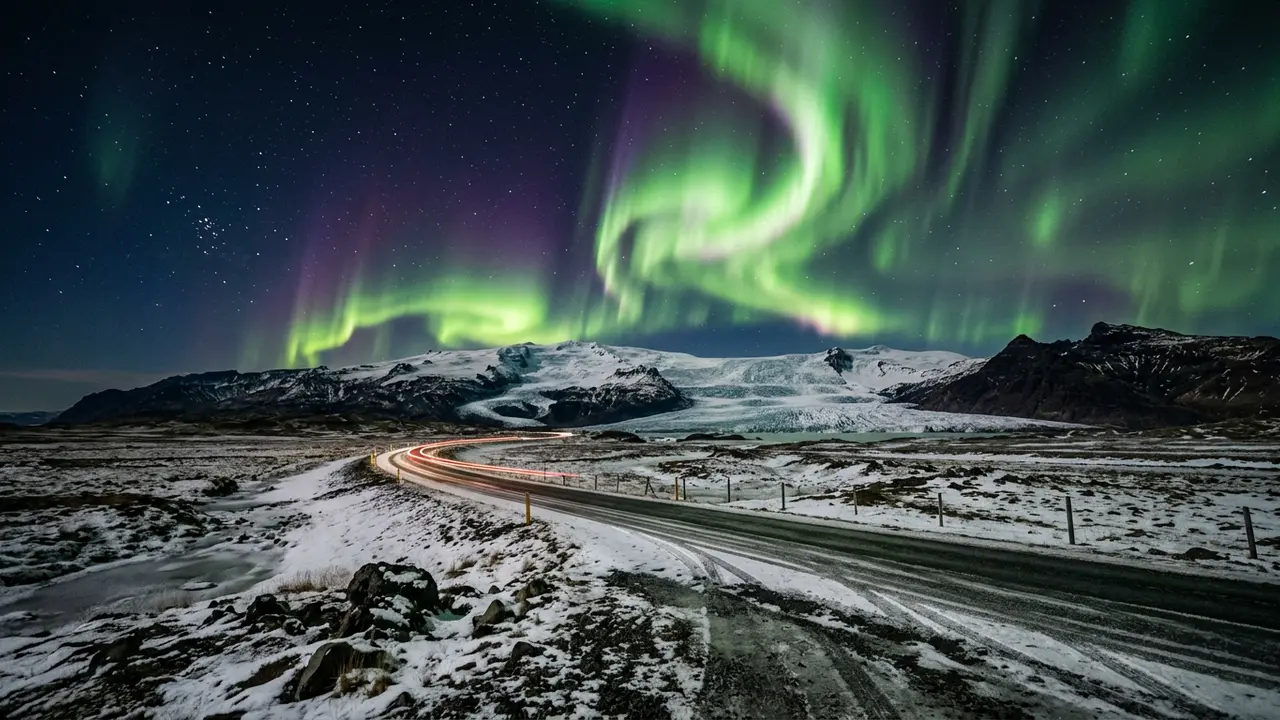
November, December, and January hand you the longest, darkest nights of the entire Icelandic year, roughly 19 to 20 hours of darkness against just 4 to 5 hours of daylight at the depth of winter.[6] On paper, that should make deep winter the best aurora window on the calendar.
In practice, it is often the weakest. Iceland's maritime climate, the point where the warm Gulf Stream meets cold air pouring down from the Arctic, is what keeps the country mild for its latitude, and it is also what generates the frequent Atlantic storm systems and persistent low-cloud cover that roll through the same November-to-January stretch.

Featured · Destination

Northern Lights in Iceland

Iceland's whole-country aurora guide: best regions to base in, aurora season Sep–Mar, ice caves, winter driving reality, and where cloud cover ends every plan.

None of this means winter is a wash. A clear night in December, when it happens, gives you the longest viewing window of the year. It just means that betting on darkness alone, without checking the forecast, is the single most common mistake first-time visitors make, the same trap that catches travelers chasing Fairbanks' aurora season, where deep winter is cold but comparatively drier and clearer than Iceland's coastal weather.

Cloud cover, not the Kp index, decides most nights

Most aurora advice fixates on the Kp index, the 0-9 scale that measures geomagnetic disturbance. In Iceland it matters, but it is the second-most important number on the page. The first is cloud cover, and it is not close.[1] A modest Kp reading under a clear sky beats a strong Kp reading under an overcast one, every time, because cloud simply blocks the light from reaching you.
Meteorologists measure sky cover in oktas, eighths of the sky covered by cloud. Optimal aurora viewing needs no more than 3 oktas, about 37.5% coverage; experienced photographers can still work through 4 or 5 oktas. Full overcast, 8 oktas, blocks the aurora outright, no matter how strong the geomagnetic storm happening above the cloud deck.
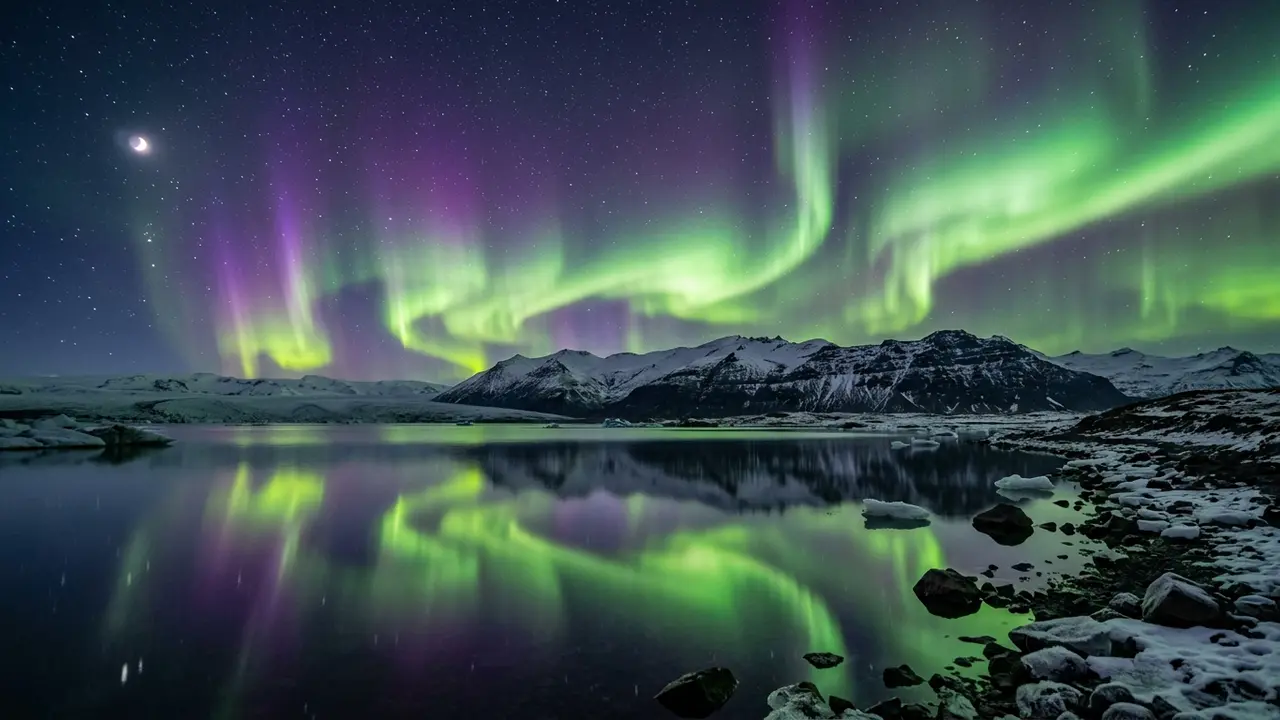
Green and violet aurora curtains rippling over a still Icelandic lake and snow-dusted mountains at night, illustrating the best time to see the northern lights in Iceland during the September and March equinox peaks

Green and violet aurora curtains rippling over a still Icelandic lake and snow-dusted mountains at night, illustrating the best time to see the northern lights in Iceland during the September and March equinox peaks

Iceland's own Kp thresholds run a little more forgiving than higher-latitude spots, because the country sits directly under the auroral oval:
  • Kp 2 produces a faint glow on dark horizons, easy to miss
  • Kp 3 is visible from northern regions like Akureyri
  • Kp 4 or higher is the sweet spot: visible nationwide, including from Reykjavik's outskirts
  • Kp 5 reaches even suburban Reykjavik, despite the city's light pollution
  • Kp 6 and above produces a brilliant, whole-sky display[4]
For the physics of what actually produces the display, what causes the northern lights covers the solar-wind mechanics this guide will not repeat; for a deeper breakdown of the scale itself, see the Kp index explained.
Forecasting both numbers together is the actual skill. Vedur.is, the Icelandic Meteorological Office, publishes an aurora forecast updated every three hours, layered directly onto the country's own cloud-cover maps rather than a generic Kp number alone.[5] NOAA's Space Weather Prediction Center supplies a three-day geomagnetic outlook, and real-time community visibility reports fill the gap between both forecasts and what is actually happening outside your window right now.

Month-by-month: daylight hours, cloud risk, and the ice-cave overlap

The table below lines up the full aurora season against three things that actually decide whether a trip is worth booking: how many daylight hours you are working with, roughly how likely the sky is to cooperate, and whether Iceland's ice caves are open at the same time. Daylight figures are for Reykjavik at 64°N; the south coast and Ring Road towns run within an hour or so of these numbers.[6]
MonthDaylight hoursAurora darknessCloud-cover riskIce caves
Sep~12hGood, equinox boostModerate, improvingNot yet open
Oct~10hGoodModerateClosed
Nov~5.5hVery darkHighOpens
Dec~4hDarkest monthHighest of the yearOpen
Jan~5hVery darkHigh, easing late monthPeak (from Jan 15)
Feb~8hDarkness shorteningImproving, clearerPeak (to Feb 15)
Mar~12hEquinox boostBest odds of the seasonOpen, less stable
September and March bookend the table for a reason. Both give you roughly 12 hours of daylight, which means a normal-length evening viewing window rather than an entire day spent waiting for dark, and both carry the equinox activity boost from earlier in this guide. December is the opposite case: only about 4 hours of daylight and the year's shortest day around December 21, but also, per the winter paradox above, some of the least reliable skies of the season.
Iceland's ice caves, carved into the Vatnajökull and Langjökull glaciers, are open from November through March.[7] February and March narrow the calendar down to Iceland's single best combo window: aurora season, ice-cave season, and, per the winter paradox above, improving cloud cover, all overlapping at once.

Combining aurora and ice caves: the January 15-February 15 window

Tour operators who run both ice-cave and aurora trips point to the same three-and-a-half-week stretch: roughly January 15 to February 15. Cave formations are most stable before spring meltwater starts reshaping them, daylight has stretched back into a workable morning-and-afternoon window, and the season's clearing skies are starting to show up. Book both halves of the trip separately: a daytime glacier tour for the caves, an evening slot for the aurora. Guides are explicit that the two are not typically combined into a single outing.

Where to base yourself, and how to plan around Iceland's weather

Iceland's weather is not uniform, and where you stand matters almost as much as when you go. The Reykjanes Peninsula, which includes Reykjavik itself, sits closest to the coast and picks up frequent fog and low cloud from the thermal contrast between warm ocean and cold land. The Westfjords and the central highlands, by contrast, typically run clearer, because they sit further from that specific coastal effect.[4] None of this is absolute. Iceland's weather changes fast enough that a clear forecast for Reykjavik and an overcast one for Vík can both be wrong by 10pm.
That unpredictability is the real argument for flexibility over fixed dates. Even inside September, March, or the January-February ice-cave window, a single night's forecast can go either way, and aurora sightings are never guaranteed regardless of season, Kp forecast, or how far in advance you booked.[1] Two practical adjustments do the most to raise your odds:
  • Stay longer than one or two nights. Three or more gives you a spare night when the first forecast falls through.
  • Stay flexible on location, not just dates. A rental car, or a tour with a driver willing to chase clear sky, lets you drive away from a cloud bank rather than wait it out.
Pin your dates to September, March, or the ice-cave overlap window first, then check vedur.is and a short-range Kp forecast in the final days before you go. When to stargaze covers the broader framework for cross-referencing moon phase, season, and weather that applies to any dark-sky destination, Iceland included. Once you've picked a window, Iceland's aurora forecast walks through reading vedur.is's cloud and activity maps together for the final go/no-go call.