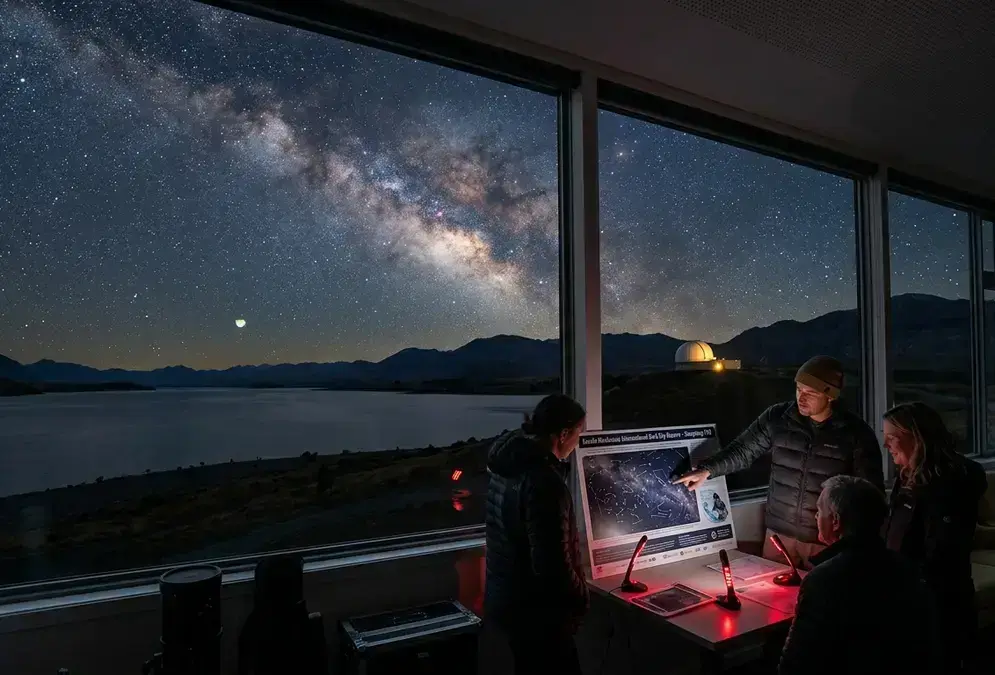

What makes Aoraki Mackenzie a Gold Tier dark sky reserve
Start with the rating, because everything else in this FAQ hangs off it. Aoraki Mackenzie holds Gold Tier status, the highest classification the International Dark-Sky Association awards, and its sky rates Bortle Class 2 on the nine-level Bortle Dark-Sky Scale, a truly dark site where the Milky Way casts a faint shadow on a clear night[1]. Only three other reserves on Earth share that top tier: Namibia's NamibRand, Ireland's Kerry International Dark-Sky Reserve, and Central Idaho in the United States. For travelers used to the more common Silver or Bronze tier reserves scattered across Europe and North America, Gold Tier is a different order of dark: the sky is measurably darker, not simply farther from a city.
The reserve was designated in June 2012, and at the time it was the largest dark-sky reserve anywhere in the world and the only one of its kind in the Southern Hemisphere. Seventeen months later, in November 2013, it moved up to Gold Tier[2]. That timeline matters because it shows the rating wasn't handed out for scenery; it tracks measured sky darkness, checked and re-earned. The Mackenzie Basin got there by doing very little: the region never grew a city large enough to threaten its own sky, and local lighting rules keep what light exists shielded and low.
Featured · Destination
Aoraki Mackenzie Stargazing
Aoraki Mackenzie is one of only four Gold Tier Dark Sky Reserves on Earth: Bortle 2 skies over Lake Tekapo, the Southern Cross, and Mount John Observatory tour.
For the full destination guide, from lodging to logistics, see Aoraki Mackenzie Stargazing.
When to go: New Zealand's stargazing season runs backwards
If you've read a stargazing guide for anywhere in the Northern Hemisphere, forget the rule of thumb. New Zealand's winter falls in June, July, and August, not December, and it's the strongest season here, not the weakest. Winter delivers up to 15 hours of darkness in June, while summer evenings in December through February don't show the galactic core in the sky at all[3]. That's not a small difference; it's the difference between planning a trip around the Milky Way's brightest, densest band and planning one without it.
The reason comes down to geometry, not weather. From the Northern Hemisphere, the center of the Milky Way skims low along the southern horizon, fighting through the thickest slab of atmosphere on the skyline. From Aoraki Mackenzie during the southern winter, it climbs directly overhead[4]. There's no narrow hour to plan around and no alarm to set; the core is up there for most of the night. Autumn (March through May) and spring (September through October) split the difference: real darkness without deep winter cold, though neither gets the same billing as June through August in most planning guides.
15 hours
None of this means summer is a wasted trip, only a different one. This FAQ covers the season question at a glance; for the full month-by-month breakdown, moon-phase timing, and shoulder-season trade-offs, read Best Time for Stargazing at Aoraki Mackenzie.
Do you need a tour, or can you stargaze on your own?
You can do this without booking anything. The reserve is open 24/7, and Lake Tekapo's shoreline pullouts are free and dark enough on their own for naked-eye viewing. If the point of the trip is looking through a proper telescope rather than just standing under the sky, that's a different booking. Dark Sky Project runs the Summit Experience from Mount John Observatory, New Zealand's largest professional research observatory[5]: a 1-hour-45-minute guided session inside the private dome using a 16-inch telescope, led by working astronomy guides. Adult tickets run $219 NZD, with tickets for children aged 10 and up priced at $169; younger children aren't admitted[6].
Build the honest odds into the plan, not just the ticket. Cloud cover cancels a meaningful share of tours depending on season, and tours depart once the sun sits 8 degrees below the horizon, after civil twilight ends, so timing shifts with the season too. Even summer nights at the observatory's summit can turn colder than the daytime forecast suggests, and Dark Sky Project loans extreme cold-weather jackets to anyone who shows up under-dressed[7]. A cancelled night isn't a wasted one either: the operator runs an indoor Alternative Weather Experience when the sky doesn't cooperate.
Book at least two nights rather than one. A single scheduled evening against those odds is close to a coin flip; two or three nights turns the first clear sky into a bonus instead of the only shot you get. Book directly through Dark Sky Project's own site rather than a third-party reseller, and confirm current pricing before you travel; operators revise rates season to season.
What you'll actually see, and how cold it gets
Four objects separate this sky from anything visible north of the equator. The Southern Cross is circumpolar here, visible every single night of the year and never dipping below the horizon. The Large Magellanic Cloud, a companion galaxy roughly 170,000 light years away[13], holds an estimated 10 billion stars and is bright enough to see with the naked eye; its smaller companion stays visible year-round too. Point a telescope at Omega Centauri and you're looking at the sky's most striking globular cluster, approximately 10 million stars packed into a spherical mass that resolves, through even a modest telescope, into a grainy field of individual points rather than the fuzzy smudge it shows to the unaided eye[8].
Recommended tours
Tours are selected for quality, not commission. I earn a small fee if you book — at no extra cost to you.
- Southern Cross: circumpolar, visible every night of the year
- Large and Small Magellanic Clouds: naked-eye dwarf galaxies, visible year-round
- Omega Centauri: globular cluster, best through a telescope
- Galactic core: winter only, June through August
That's the sky's real trade-off: three of these four sights don't care what month you book, and only the fourth, the galactic core, forces the timing decision covered above. As for the cold: dress for alpine lake country, not for whatever the daytime temperature suggested. Layered clothing matters as much as picking the right month, and standing still for two hours after midnight is colder than walking around during the day ever hints at — see Aoraki Mackenzie stargazing gear for what actually holds up at that summit.
Best spots inside the reserve
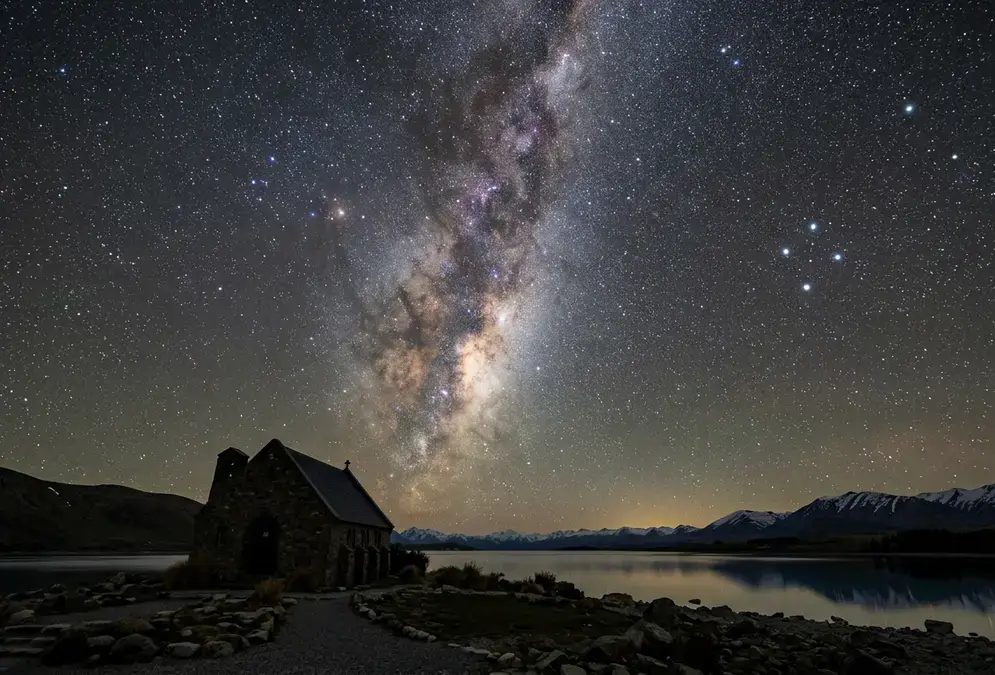
Mount John Observatory is the professional hub, home to Dark Sky Project's guided tours and New Zealand's largest research observatory. For stargazing without a booking, Lake Tekapo's shoreline pullouts are free, dark, and close to town. The Church of the Good Shepherd, a small stone chapel on the lakeshore, is one of the country's most photographed structures, and it earns that reputation as a foreground rather than a subject: a low, dark silhouette against the lake and the galactic arch, framed by the Southern Alps behind it[9]. It's busy with day-trippers and tour buses in daylight, so visit at sunrise, sunset, or after full dark instead. The church itself charges no entry fee, though a volunteer guide is typically on hand only mid-morning to mid-afternoon, Wednesday through Sunday, and the grounds close around Sunday worship[10]; a small chapel isn't built for crowds either way, so early or late is genuinely kinder to the experience, not just quieter for photos.
Twizel, a quieter town a short drive south of Tekapo, is worth knowing about if Tekapo's small hotel stock is booked out, which happens fast during peak season. Deeper into the national park, Aoraki/Mount Cook Village pairs stargazing with daytime hiking beneath New Zealand's tallest peak, for anyone building a longer South Island itinerary around this trip rather than a single overnight stop.
Wherever you base yourself, book the room early. For a stay built around the sky itself, this Lake Tekapo hotel puts a skylight directly above the bed in its lake-view rooms, an easy walk from the Tekapo shoreline.
Read next · Lodge
Galaxy Boutique Hotel
At Galaxy Boutique Hotel, skylights above the bed frame the Milky Way in the only Dark Sky Reserve south of the equator. Lake Tekapo, no telescope required.
Getting there: the long-haul reality
Be honest about the commitment before you book flights. Of the destinations covered on this site, Aoraki Mackenzie is among the most remote: there's no short regional hop the way there is to Tromso from Oslo, or to Lapland from Helsinki. Budget a long-haul flight into Auckland or Christchurch, a possible domestic connection, and then several hours behind the wheel south into the Mackenzie Basin before you see a single star.
Once you're on the South Island, the drive itself is straightforward and genuinely scenic, particularly the Lindis Pass route from Queenstown. Rent a car regardless of which city you fly into, and book it alongside your flights rather than after landing; Christchurch and Queenstown are compact airports, and stock runs low during the same peak months Tekapo's own hotel rooms sell out. There's no meaningful public transport into the Mackenzie Basin, and driving yourself is the only way to chase a clearer patch of sky if the forecast shifts on short notice.
If you're weighing this against Chile's Atacama, know the two aren't interchangeable. Atacama earns its reputation from bone-dry, high-altitude desert; Aoraki Mackenzie earns its from a working alpine lake district that simply never lost its sky to development, with a public research observatory built into the trip itself. Both are worth the flight. Neither is a quick add-on to a different itinerary. For technique once you're there, Milky Way Photography Guide covers the camera settings this sky rewards.