
Why Abisko's daylight needs its own plan
Abisko sits well north of the Arctic Circle, and during aurora season the nights run long enough that even a clear, promising forecast still means hours of waiting for the show to actually start. A three or four-night stay built around chasing the northern lights leaves real daylight hours in between, and the village itself is small: a rail stop, the STF-run Abisko Turiststation, a national park visitor center, and not a great deal else to fill an afternoon on repeat.
That's where four genuinely different daytime activities come in, all within reach of the village or a short transfer east toward Kiruna, and none of them competing with the stargazing that brought you here in the first place. A trailhead for one of Sweden's most famous long-distance trails, the Kungsleden, starts right outside the lodge door. A short canyon walk, worth keeping separate in your head from the after-dark stargazing spot of the same name, fills a half-day on its own. Husky dog-sledding and a walk-in visit to ICEHOTEL both sit a short transfer toward Kiruna, easy to combine into one longer day trip rather than four separate outings.
| Activity | Duration | Booking | Distance from Abisko |
|---|---|---|---|
| Kungsleden day-hike | 1-2 hours out-and-back (or 6-7 days for the full trek) | None required | Trailhead at the village |
| Abiskojåkka Canyon walk | About 25 minutes | None required | Trailhead at Visitor Center |
| Husky dog-sledding | About 2 hours on snow, half-day total | Book ahead | Oinakka, near Kiruna (transfer included) |
| ICEHOTEL day visit | 1-2 hours self-paced, or with a 1-hour guided tour | No pre-booking required | Jukkasjärvi, near Kiruna |
None of this requires a car, special gear, or a favorable Kp index reading. That's worth remembering on the third grey, overcast afternoon of a trip that was supposed to be all aurora, when how the Kp index works for predicting the northern lights starts to feel like the only reading material left.
Hike the northern end of the Kungsleden
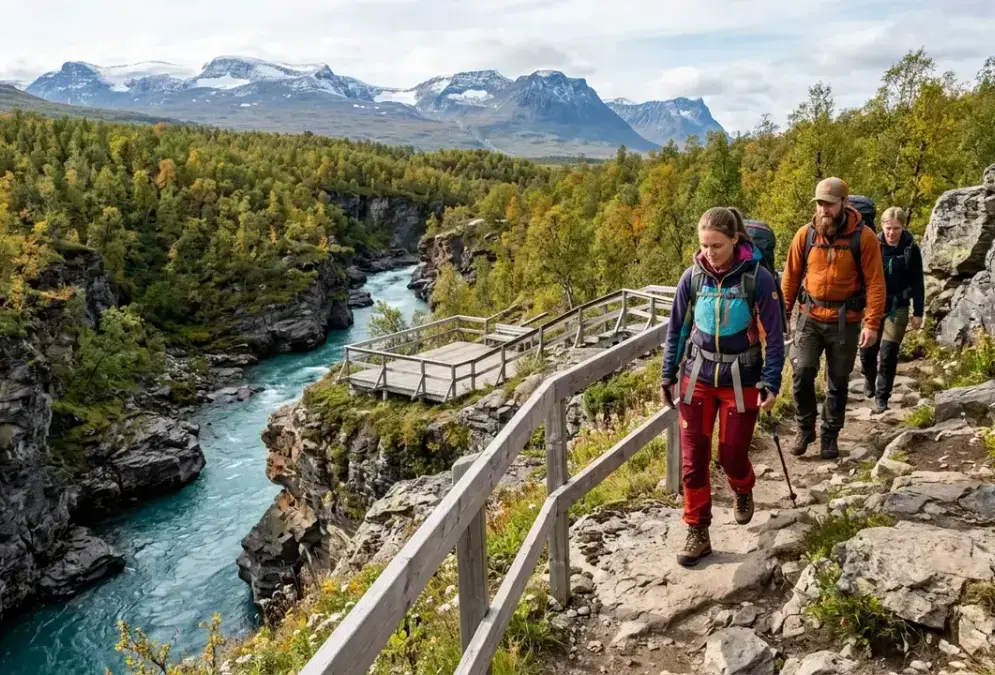
The Kungsleden ("the King's Trail") is Sweden's best-known long-distance hiking route, and its northern starting point sits right next to Abisko Turiststation, marked by a wooden trail-map structure at the edge of the village; the path leads straight into Abisko National Park through mountain birch forest, reachable from Kiruna by train or bus in well under two hours, or by overnight sleeper from Stockholm.[1]
You don't need to commit to the full trek to get something out of it. The classic stretch, from Abisko south to Nikkaluokta, typically takes 6 to 7 days[2] for hikers carrying full gear between STF huts, an undertaking that needs its own separate trip. What works on a stargazing itinerary is walking the trail's opening miles as an out-and-back: no official source publishes a single day-hike distance from the trailhead, so treat it as flexible. Walk in through the birch forest for an hour or two, turn around when you've had enough, and you've covered ground that thru-hikers spend a full week finishing.
6-7 days
Bring layered clothing regardless of season, and check the aurora forecast apps worth using before you commit an entire clear-forecast evening to a long walk instead of the sky. The trail runs through open subarctic terrain with little shelter, and weather on this stretch changes faster than it does down at the village.
Abiskojåkka Canyon: the daytime walk, not the night stargazing spot
If you've read about Abiskojåkka Canyon as a sheltered spot for stargazing on a rough night, this is the same canyon by day, and it earns its own visit. The marked Kanjon loop trail, following yellow trail marks, starts at the Abisko Visitor Center and runs about a mile, roughly 25 minutes at an easy pace, along the canyon rim.[3]
The trail follows the turquoise Abiskojåkka river, carved by glacial meltwater on its way into Lake Torneträsk, with a national-symbol golden-crown marker and a picnic spot partway along, plus a bridge further north where the trail continues.[4]
None of that is about the sky. Go at midday for the light on the water, not after dark for the stars, and save the after-dark version of this same trail for the best stargazing spots in Abisko, where the canyon reappears as a sheltered night-sky pick rather than a daytime hiking itinerary.
Husky dog-sledding near Kiruna
Round out a daytime plan with a husky dog-sled excursion, run out of the small village of Oinakka, just outside Kiruna and close to ICEHOTEL. Open Arctic wilderness out here means birch scrub, frozen wetland, the kind of flat white terrain that swallows sound the way only fresh snow can.
A musher steers each sled, which carries up to four guests, over a 10 to 12km circuit split into two roughly 30-minute segments, with a stop partway through at an Arctic camp for fika, hot drinks and cinnamon rolls, the Swedish coffee break that shows up on almost every winter excursion in this part of the country. Round-trip transportation from Abisko and Björkliden is included, though there's no dining at the camp itself, so pack your own lunch, and the minimum age on this particular tour runs around five, a policy worth confirming directly since other operators working the same Kiruna-area circuit may set it differently.[5]
Book ahead. Slots on the popular afternoon departures fill first during peak aurora season, when everyone staying at the STF lodge is chasing the same handful of daylight hours.
See ICEHOTEL without booking a room
An overnight in one of ICEHOTEL's ice rooms, paired with an aurora chase, is its own separate trip, and its own separate booking — the ICEHOTEL Kiruna aurora experience pairs a night in the ice suites with a guided snowmobile aurora chase, if that's the version you're after. You don't need either to see the place.
Day visitors can buy tickets on-site in Jukkasjärvi with no pre-booking required, walk the art suites and public areas, and tour the ICEBAR without ever reserving a room. Day-visitor hours run 10:00 to 18:00 daily through the season, the complex is cash-free and card-only, and guided day-visitor tours run at noon and 4pm in English (10am and 2pm in Swedish), roughly an hour long, covering the artistic context and creation process behind that year's ice sculptures. The ICEBAR itself keeps pouring for day visitors too: cocktails in glasses carved from ice, roughly 200 to 300 SEK a drink, thermal ponchos provided so you're not shivering through the first sip.[6]
11am-6pm
Exact day-ticket admission pricing shifts by season and isn't something ICEHOTEL's own booking page states as a fixed year-round figure, so confirm the current cost directly rather than budgeting around whatever number turns up in a search result.
Fitting it all into an aurora-chasing trip
None of these four activities needs a clear sky, which is the whole point: slot one per daylight stretch across a three or four-night stay, and you've built a trip that doesn't collapse into a small hotel bar every time the forecast turns cloudy. The Kungsleden trailhead and Abiskojåkka Canyon sit within walking distance of Abisko Turiststation; the husky excursion and ICEHOTEL day visit both work as a single transfer toward Kiruna, easy to combine into one longer day out.
There's a fifth option worth knowing about even though it's built for the night sky: the Aurora Sky Station chairlift up Mount Njulla, about 30 minutes each way, runs until 01:00 during aurora season.[7] Outside of aurora season, when the midnight sun keeps the sky bright around the clock, the station switches to daytime summit programming instead, since there's no darkness left to chase.
For the timing and forecasting side of a trip, that's its own separate planning problem. Start with Abisko Stargazing for the season, the blue-hole microclimate, and where to stay.
Featured · Destination
Abisko Stargazing
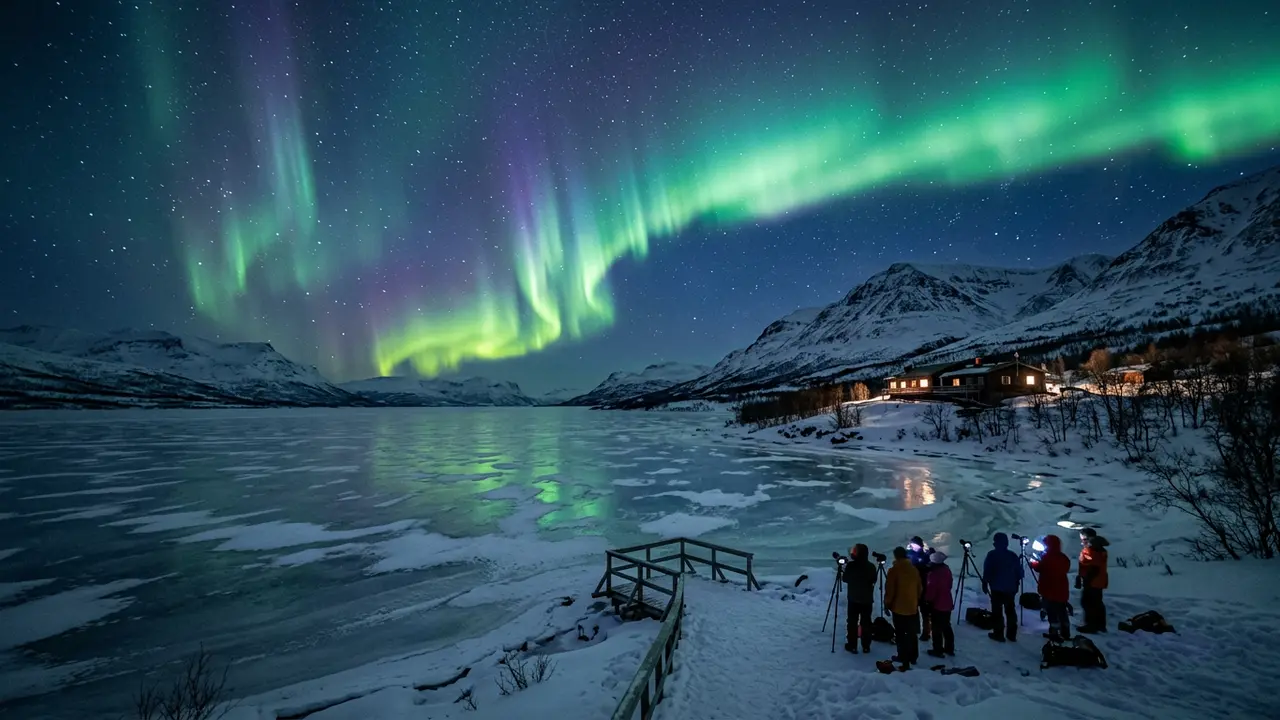
Abisko's rain-shadow microclimate keeps skies clear when nearby Arctic spots cloud over. Aurora season, the Sky Station, ICEHOTEL, and getting there by train.