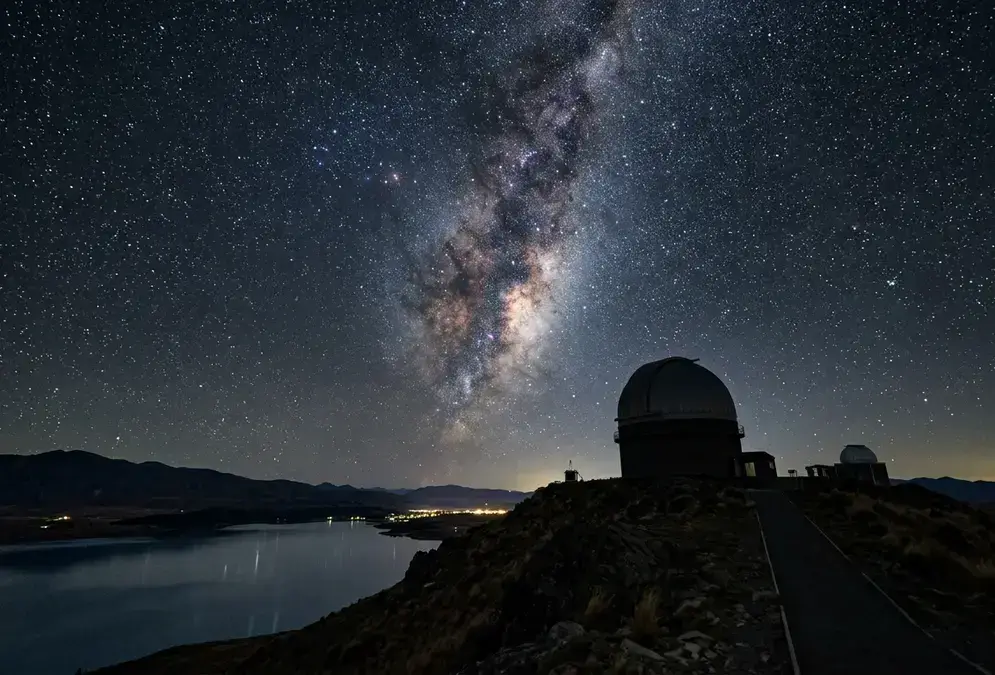

Mt John Observatory: New Zealand's largest research observatory, open to the public after dark
Most 'observatory tours' pitched to travelers are domes built for visitors, fitted with a telescope not much bigger than one you could buy at home. Mt John Observatory is not that. It's a working research facility run by the University of Canterbury, sitting on a 1,029-metre summit above Lake Tekapo, and it's New Zealand's largest professional research observatory[1]. It also sits inside the Aoraki Mackenzie International Dark Sky Reserve, one of at least four reserves on Earth to hold Gold Tier status, alongside NamibRand, Kerry, and Central Idaho, the highest rating the International Dark-Sky Association awards[12].
That combination is rare. Most public stargazing experiences are either research sites closed to visitors, or tourist domes with no research mission behind them at all. Mt John runs both at once, which is why this mountain gets its own guide rather than folding into the wider the reserve's full destination guide hub. Getting to the summit, booking the public tour correctly, and knowing what the telescope will actually show you are questions specific to this one mountain, not the reserve as a whole.
Stand on the summit at new moon and the reason for all the fuss becomes obvious fast. The reserve measures Bortle Class 2 here, dark enough that the Milky Way casts a faint shadow on the ground and the Southern Alps sit as a black cutout against a sky thick with stars most visitors have never actually seen with their own eyes[2]. That's the sky Mt John was built to study, and it's the same one the Summit Experience hands you for an hour and three-quarters.
Getting to the summit: what's actually included in the drive up
Mount John's summit road isn't something you drive yourself after dark, and the Summit Experience tour is built around that fact. Dark Sky Project checks visitors in 20 minutes before departure at its lakefront base on Motuariki Lane in Lake Tekapo township, then handles transport from the base straight to the observatory summit as part of the ticket[3]. You don't need to arrange your own way up the mountain, and you don't need a rental car parked at altitude in the dark.
Once you're up there, the walk itself is short but real: roughly 100 metres on a gravel incline, plus steps managed in the dark, rated a moderate fitness level rather than an easy stroll[5]. Dark Sky Project supplies extreme cold weather jackets as part of the tour, which matters more than it sounds; summit temperatures run noticeably colder than lakeside Tekapo, in any season. The tour officially admits guests aged 7 and up, though several operators note the experience suits ages 10 and up more comfortably, since younger children can struggle with an hour and three-quarters of standing still in the cold[5]. Travelling with young kids, or after a shorter walk back to bed once the tour ends, Lake Tekapo Lodge puts you close enough to the base to manage it.
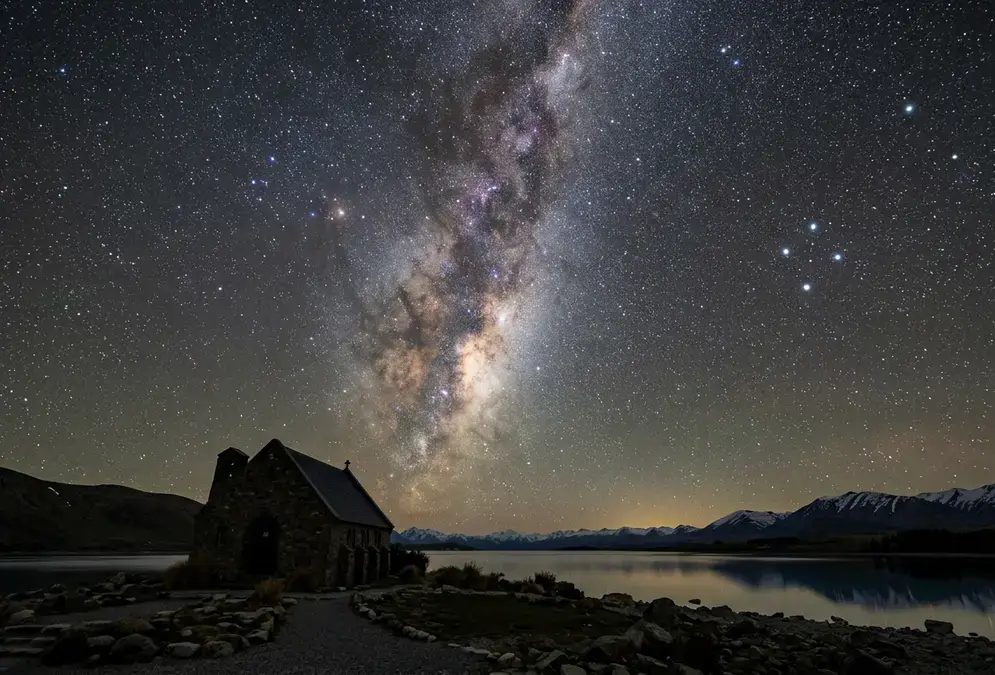
Featured · Destination
Aoraki Mackenzie Stargazing
Aoraki Mackenzie is one of only four Gold Tier Dark Sky Reserves on Earth: Bortle 2 skies over Lake Tekapo, the Southern Cross, and Mount John Observatory tour.
The Summit Experience: inside Dark Sky Project's dome
The tour runs 1 hour 45 minutes, and it bundles a fixed set of essentials, all handled before you reach the summit[3]:
- Transport from Dark Sky Project's lakefront base to the observatory
- Extreme cold weather jackets for the summit's colder air
- Naked-eye orientation with handheld laser guidance
- Guided viewing through a 16-inch telescope inside a private observatory dome
- An expert astronomy guide throughout, not a scripted walkthrough
$219 NZD
That last point is the real difference between this and a generic stargazing tour: the person standing next to the eyepiece is an expert astronomy guide, and explains what's overhead and why it matters at skies most visitors have never stood under before.
Pricing runs $219 NZD per adult and $169 NZD for children aged 10 and up, with younger children not admitted, a rate confirmed through 30 September 2026[3]. A family of four costs less as a bundle: a two-adult, two-child pass runs $353 NZD, with each extra child added at $95 NZD, and free cancellation holds up to 24 hours before departure[6]. Book directly through Dark Sky Project or through an aggregator like GetYourGuide or Viator if you're managing several South Island bookings at once, but reserve well ahead regardless: popular dates during New Zealand's summer sell out first.
What you'll actually see through a research-grade telescope
The naked-eye segment exists so you're not lost the moment the telescope eyepiece throws unfamiliar magnified detail at you. Guides trace the Southern Cross, circumpolar from this latitude and never dipping below the horizon, then point out the Large and Small Magellanic Clouds, two companion galaxies to the Milky Way visible without any equipment at all, appearing as faint, detached patches of light rather than part of the galaxy's main band[7]. None of the three ever clears the horizon from Europe or the continental United States, which is why most visitors are seeing all of it for the first time on this exact mountain.
Through the telescope itself, the guide typically works toward Omega Centauri, the sky's largest and most striking globular cluster: to the naked eye it's a hazy smudge, but through even a modest telescope it resolves into a grainy field of individual points, roughly 10 million stars packed into a spherical mass[11]. Whether the galactic core is part of the session depends entirely on when you visit. It sits directly overhead through New Zealand's winter, June through August, and drops out of the evening sky completely during summer, December through February; Best Time for Stargazing at Aoraki Mackenzie covers that calendar in full.
Weather, cancellations, and how many nights to actually build in
Book the tour and the sky still might not cooperate. Cloud cover cancels a real share of Summit Experience tours every season, and Dark Sky Project runs an Alternative Weather Experience indoors when conditions rule the summit out entirely[4]. That's not a wasted evening exactly, but it isn't the reason most people fly to the far side of the world either. If seeing the sky through the 16-inch telescope is the actual point of the trip, treat one booked night as a coin flip and build in a second. A booking that falls through on your only night in the Mackenzie Basin costs more than a slightly longer itinerary would have.
Two tools help you read the odds before you commit to a night. Dark Sky Project runs its own weather portal built specifically for checking Lake Tekapo stargazing conditions[8], and Yr.no publishes an hourly forecast for Mount John Observatory itself, broken down by cloud cover at different altitudes[9]. Check either one the afternoon of your booked session, not two days ahead; Mackenzie Basin conditions shift fast enough that Tuesday's forecast tells you very little about Thursday night. Pair whichever forecast you trust with the new-moon window, the week before and after, for the darkest possible sky regardless of season[10].
Summit Experience vs. the ground-level Southern Sky tour: which one to book
Mt John isn't the only way to stargaze inside the Aoraki Mackenzie reserve, and it's worth knowing what you're trading before you book. The Southern Sky Guided Tour runs from Dark Sky Project's lakefront base itself, no summit drive required, with a shorter session and a noticeably lower starting price aimed at first-timers and families who want the naked-eye orientation without the mountain fitness requirement or the private dome.
Neither is the wrong choice. Pick the summit if the observatory itself, the dome, the 16-inch telescope, the astronomer standing next to you, is part of what you came to see. Pick the lakefront option if you're travelling with young kids, short on time, or you'd rather spend the savings on a second night in case cloud rolls in. Either way, you're standing under the same Gold Tier sky; the only real question is how much of the mountain you want underneath you while you do it. If your trip has room for both, book the lakefront tour on arrival night as the easy warm-up, then save the summit for the clearest forecast you get.
| Feature | Summit Experience (Mt John) | Southern Sky Guided Tour (lakefront) |
|---|---|---|
| Duration | 1h 45m | 75 minutes |
| Location | Mt John Observatory summit, 1,029m | Dark Sky Project lakefront base |
| Telescope access | 16-inch telescope inside a private dome | Standard tour telescopes, no dome |
| Fitness needed | Moderate, gravel incline and steps in the dark | None, suited to beginners and families |
| Starting price | $219 NZD adult | From $57 USD |