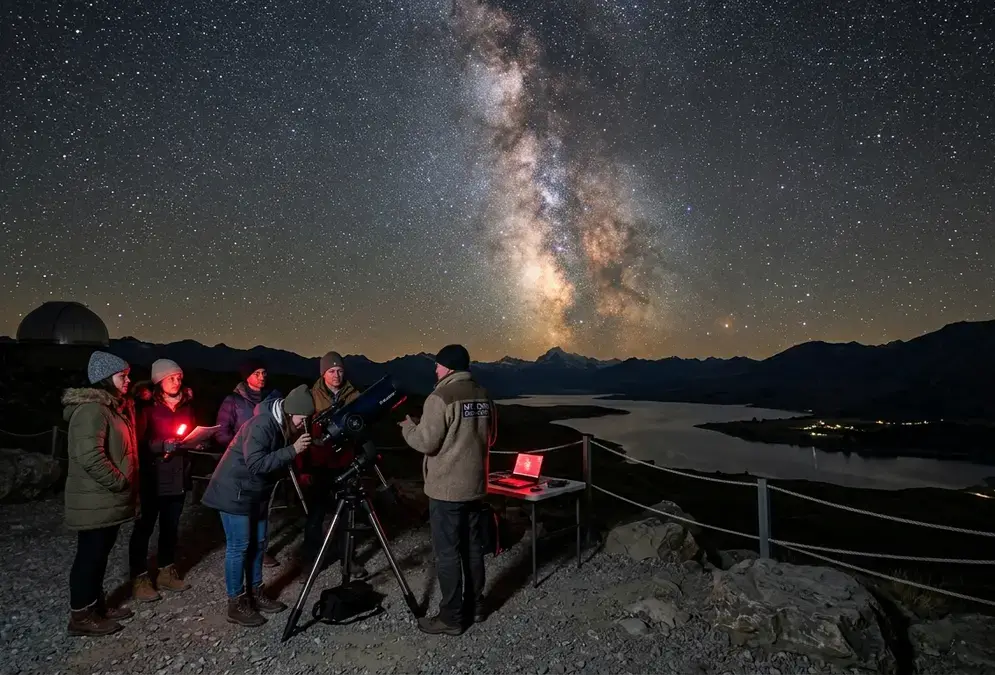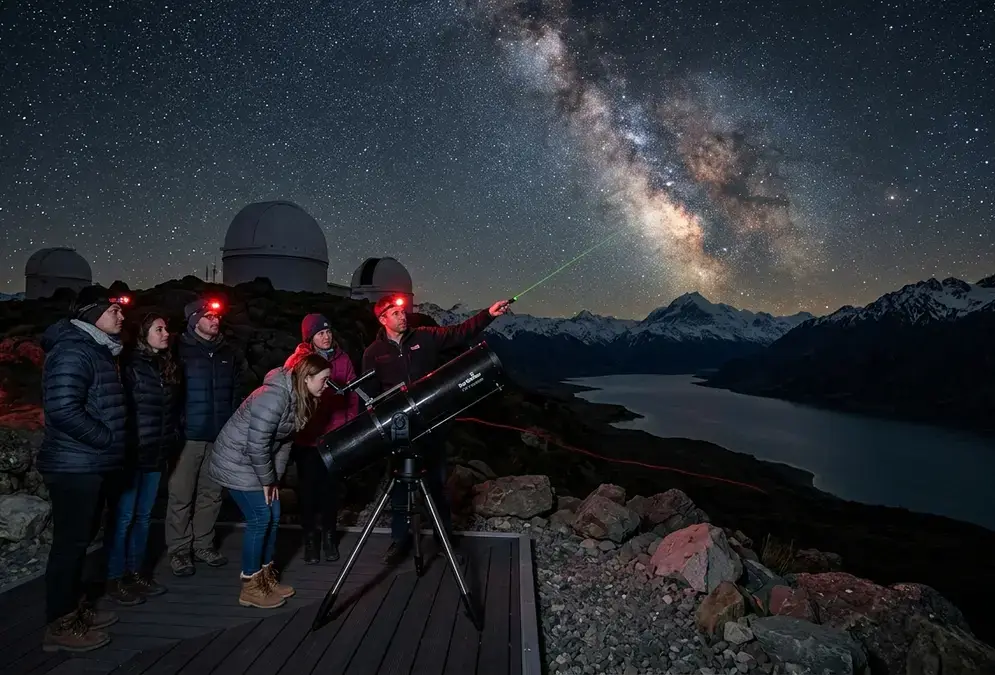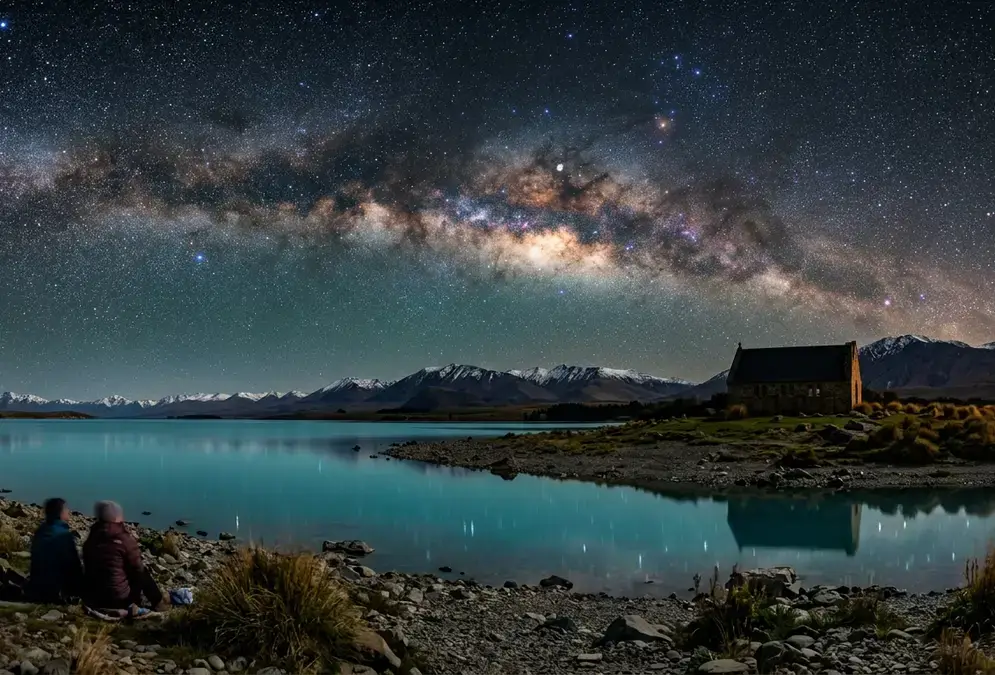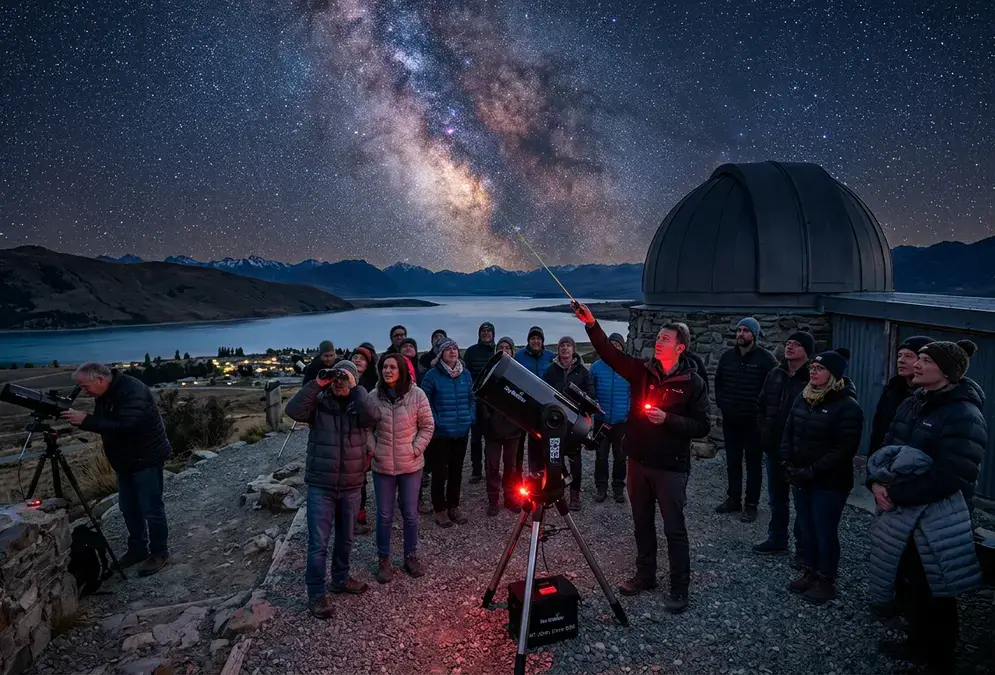
Visitors and a guide looking through a large telescope inside the private dome of Mt John University Observatory above Lake Tekapo at night, New Zealand
Observatory Visit Free

New Zealand's largest research observatory, open after dark for guided stargazing

1 hour 45 minutes
Nightly year-round, weather permitting; departure time shifts with sunset across the seasons, earlier in New Zealand's winter, later in summer. Cloud cover, wind, or rain cancels roughly 40–60% of departures depending on season; Dark Sky Project runs an indoor Alternative Weather Experience when the summit is a no-go.
Dark Sky Project base, 1 Motuariki Lane, Lake Tekapo (Takapō), New Zealand. Check in 20 minutes before departure; transport to and from the Mt John summit is included in the tour.
All activities

Most stargazing tours point a telescope at the sky from a car park. The Summit Experience puts you inside New Zealand's largest professional research observatory, 1,029 metres above Lake Tekapo, looking through the same kind of instrument astronomers use on a working night. Dark Sky Project runs the tour from its base on the Lake Tekapo (Takapō) lakefront, transports you to the Mt John University Observatory summit, and gets you back down in 1 hour 45 minutes. It costs from $219 NZD per adult, and it sits inside the Aoraki Mackenzie International Dark Sky Reserve, one of the first two Gold Tier reserves ever awarded, and still one of only four worldwide.

Inside the dome: what 1h45m on the summit actually covers

The tour starts at ground level with a practical detail most operators skip: everyone gets fitted with an extreme cold weather jacket before the vehicle leaves for the summit, because the temperature at 1,029 m drops well below whatever you felt walking to the base. The drive up is short; the observation itself unfolds in two distinct stages.

  • Naked-eye orientation. A guide uses a handheld laser to trace the southern sky: the Southern Cross, circumpolar and visible every night of the year from this latitude; the Magellanic Clouds, two companion galaxies bright enough to see without any optical aid; and the galactic core, sitting near-overhead rather than skimming the horizon.
  • Telescope viewing. The group moves into the private observatory dome for access to a 16-inch telescope, aimed at whatever the night offers: Saturn's rings, the globular cluster Omega Centauri, or deep-sky targets invisible from anywhere in the Northern Hemisphere.

The fitness requirement is moderate, not strenuous: budget roughly 100 metres of walking on a gravel incline and a few steps navigated in the dark between the vehicle and the dome entrance. There's no hiking involved.

Why Mt John, and not a roadside pull-off

Mt John University Observatory is New Zealand's largest professional research observatory, run by the University of Canterbury, and it sits at the summit above Lake Tekapo because the site rates Bortle Class 2 on the standard dark-sky scale: dark enough that the Milky Way casts a faint shadow on a clear, moonless night. That rating isn't unique to the summit; it's the baseline across the whole Aoraki Mackenzie Dark Sky Reserve, 4,367 km² spanning the Mackenzie Basin. What the summit adds is elevation and a genuine research dome rather than a viewing platform: you're looking through the kind of instrument the observatory's own astronomers use on a working night, not a demonstration model bought for tourists.

That distinction matters if you've done a stargazing tour elsewhere and found the telescope secondary to the sales pitch. Here, the guide's job is explanation, not spectacle: what dark adaptation is and why the 20 minutes it takes is worth protecting, why the Southern Cross never sets from this latitude, why Omega Centauri resolves into individual points of light through a 16-inch mirror instead of staying a fuzzy smudge.

Age limit, pricing, and the family pass most visitors miss

The tour admits children aged 10 and up only; younger children are not admitted, for safety reasons tied to the summit walk and the dark conditions inside the dome. Budget for the following:

  • Adult: from $219 NZD
  • Child (10+): from $169 NZD
  • Family Pass (2 adults + 2 children aged 10 and up): from $353 NZD
  • Extra child: $95 NZD

Pricing is confirmed through 30 September 2026 — check the current rate at booking, since operators revise seasonally. Cancellation is free up to 24 hours before departure.

The number to plan around: cloud cancels up to 60% of these tours

Weather, not booking difficulty, is the real risk to this tour. Cloud cover, wind, or rain cancels somewhere between 40 and 60% of Summit Experience departures depending on season, and Dark Sky Project runs an Alternative Weather Experience indoors when the summit is a no-go, so a clouded-out night isn't a wasted evening. Still, if the point of your trip is looking through that 16-inch telescope, don't stake it on a single booking. Build at least one extra night into your Lake Tekapo stay, and check the best time for stargazing at Aoraki Mackenzie before you lock in dates: New Zealand's winter, June through August, runs the longest, driest nights of the year, the opposite of what a Northern Hemisphere itinerary trains you to expect.

Booking, getting to the base, and what to bring

Check in 20 minutes before departure at Dark Sky Project's base on the Lake Tekapo lakefront; the tour, including transport, covers the drive to and from the summit, so you don't need your own car for this part of the evening. Book directly through Dark Sky Project, or through GetYourGuide, Viator, Klook, or Headout if you'd rather manage it alongside other trip bookings.

The jacket provided covers your torso, not everything else. Bring gloves, a warm hat, and closed shoes with grip for the gravel section; a red-light headlamp is worth packing too, since it lets you read a program or find a dropped glove without wrecking the group's night vision, which the white beam of a phone torch destroys in seconds.

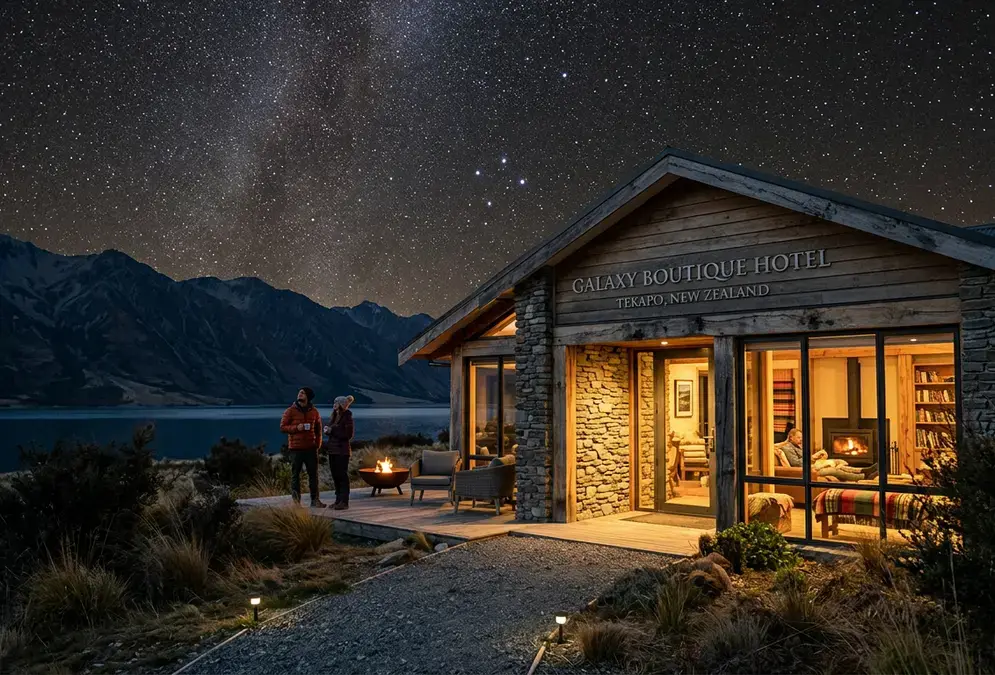
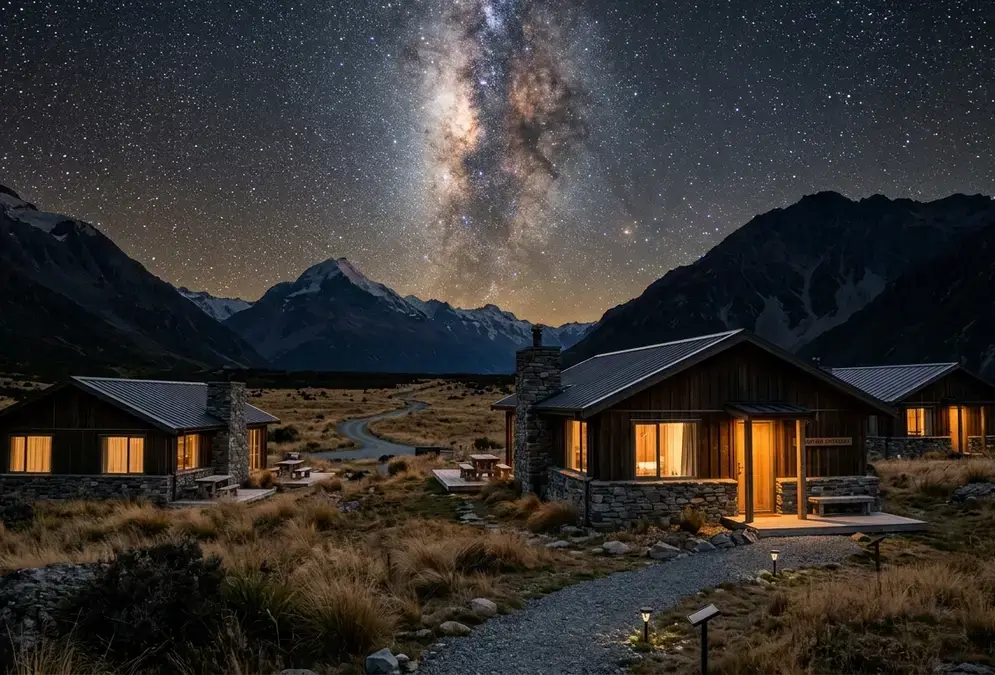
Stay close enough to walk to the base: Galaxy Boutique Hotel, 500 metres from the Tekapo shoreline, puts a skylight directly above the bed in its Deluxe Lake View rooms, so the night doesn't have to end the moment the tour bus drops you back at the village.
Highlights

  • Naked-eye orientation to the southern sky with handheld laser-pointer guidance
  • Telescope viewing inside a private observatory dome, using a 16-inch telescope
  • Transport to and from the 1,029 m summit included, with an extreme cold weather jacket provided
  • Set inside the Aoraki Mackenzie International Dark Sky Reserve, one of the first two Gold Tier reserves ever awarded, still one of only four worldwide
  • Guided by staff working inside New Zealand's largest professional research observatory
  • Indoor Alternative Weather Experience if cloud or wind rules out the summit

Included

  • Transport from the Dark Sky Project base to the Mt John Observatory summit and back
  • Extreme cold weather jacket for the summit
  • Guided naked-eye stargazing session with handheld laser pointer
  • Telescope viewing session
  • Access to a 16-inch telescope inside the private observatory dome

Not included

  • Transport to the Dark Sky Project base in Lake Tekapo — you need to get yourself there before check-in
  • Food and drinks
  • Camera or tripod equipment; check dome space constraints with your guide if you plan to bring one

Practical information

Languages

English

Accessibility

Not wheelchair accessible: reaching the dome from the transport drop-off involves roughly 100 m of walking on a gravel incline and navigating steps in the dark. Contact Dark Sky Project directly to discuss accessibility needs before booking.

Good to know before booking

  • Children must be 10 or older; younger children are not admitted, even with the Family Pass
  • Moderate fitness required: roughly 100 m of walking on a gravel incline, plus steps, in the dark
  • Book online in advance, especially over New Zealand's summer school holidays (December–February) and around new moon
  • Free cancellation up to 24 hours before departure; weather cancellations trigger the indoor Alternative Weather Experience rather than an automatic refund

Prices & Booking

Bookable online

From $219 NZD per adult ($169 NZD for children aged 10 and up; younger children are not admitted). Family Pass (2 adults + 2 children aged 10+) from $353 NZD, extra child $95 NZD. Pricing confirmed through 30 September 2026 — confirm current rate at booking. Free cancellation up to 24 hours before departure.

Nightly year-round, weather permitting; departure time shifts with sunset across the seasons, earlier in New Zealand's winter, later in summer. Cloud cover, wind, or rain cancels roughly 40–60% of departures depending on season; Dark Sky Project runs an indoor Alternative Weather Experience when the summit is a no-go.

Tags

mt john observatory lake tekapo aoraki mackenzie new zealand south island stargazing dark sky guided tour night tour telescope gold tier dark sky project

Frequently asked questions

What is the Dark Sky Project Summit Experience at Mt John Observatory?

It's a 1-hour-45-minute guided stargazing tour that transports you from Lake Tekapo up to the 1,029-metre summit of Mt John University Observatory, New Zealand's largest professional research observatory. The tour combines a naked-eye orientation to the southern sky with a telescope viewing session inside a private observatory dome, using a 16-inch telescope.

How much does the Mt John Observatory night tour cost?

From $219 NZD per adult and $169 NZD for children aged 10 and up. A Family Pass (2 adults + 2 children aged 10 and up) runs from $353 NZD, with each extra child costing $95 NZD. Pricing is confirmed through 30 September 2026 — check the current rate at booking.

What's the minimum age for the Mt John Observatory tour?

10 years old. Younger children are not admitted, including under the Family Pass, because of the summit walk and the dark conditions inside the observatory dome.

What happens if it's cloudy on the night of my tour?

Dark Sky Project runs an indoor Alternative Weather Experience when cloud, wind, or rain rules out the summit. Cloud cover cancels roughly 40 to 60% of departures depending on season, so a clouded-out night still gets you a program, just not the telescope view from the dome.

What should I wear on the Summit Experience tour?

Dark Sky Project provides an extreme cold weather jacket for everyone, but bring your own gloves, a warm hat, and closed shoes with grip for the gravel section near the dome. A red-light headlamp is useful for reading a program or finding a dropped item without ruining the group's night vision.

How do I book the Mt John Observatory night tour?

Book directly through Dark Sky Project's website, or through GetYourGuide, Viator, Klook, or Headout if you'd rather manage it alongside other trip bookings. Free cancellation applies up to 24 hours before departure.

Is the Mt John Observatory tour physically demanding?

No, but it isn't fully accessible either. Expect roughly 100 metres of walking on a gravel incline and some steps navigated in the dark between the vehicle and the dome entrance. There's no hiking involved, but anyone with significant mobility limitations should contact Dark Sky Project before booking.

What will I actually see through the telescope at Mt John Observatory?

Typical targets include Saturn's rings, the globular cluster Omega Centauri, and deep-sky objects that never rise above the horizon in the Northern Hemisphere. The naked-eye portion of the tour also covers the Southern Cross, which is circumpolar here, and the Magellanic Clouds, two companion galaxies visible without any optical aid.

Further reading

Sources