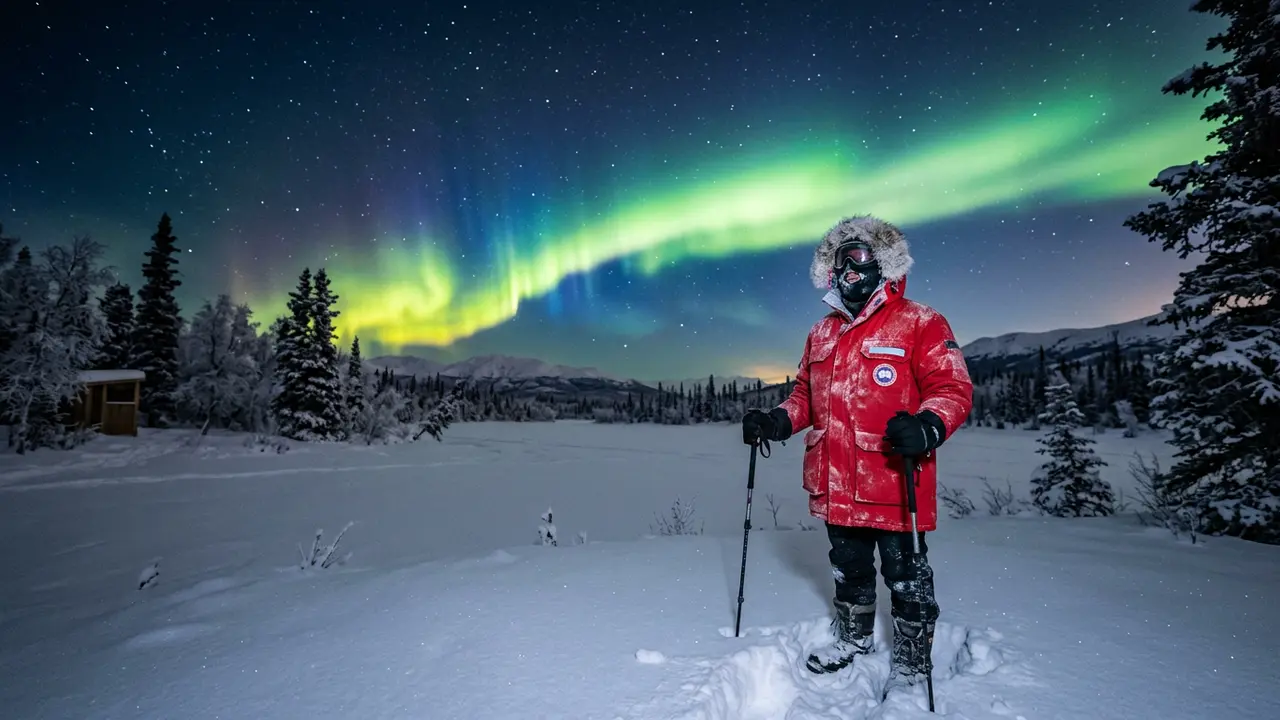

Standing still is a different cold
Most cold-weather packing advice assumes you're moving. Skiers, hikers, and snowshoers generate body heat. Their problem is managing sweat as much as managing cold. Aurora hunting in Fairbanks is the opposite problem.
You find a clearing, set up your camera, and wait. For 2 to 5 hours you stand largely motionless, staring at the sky. Your body produces almost no metabolic heat in that posture. Everything depends on the clothing.
Fairbanks earns its reputation. January and February daytime highs run between −5°F and −15°F; nights drop to −20°F or −30°F; the coldest spells push well below −40°F. At −25°F, frostbite on exposed skin develops in under 10 minutes; at −40°F, that window shrinks to under 5 minutes[1]. Aurora sessions typically run 2 to 4 hours.
A parka rated for a city winter and insulated gloves will not carry you through a Fairbanks northern lights session at these temperatures. The clothing system here looks more like what mountaineers wear on high-altitude summit approaches: every layer doing a specific job, no single point of failure.
Under 5 minutes
The three-layer system for extreme cold
Base layer is where most people compromise. The single rule: nothing cotton. Cotton absorbs moisture and holds it against skin, accelerating heat loss. At −40°F standing still for hours, that moisture does not dry. It drains warmth continuously.
Between merino wool and synthetic polyester, merino is the stronger choice for extended aurora exposure. The fiber's natural crimp creates air pockets that retain warmth even when damp, and merino can absorb up to 30% of its weight in moisture while still feeling dry against skin. Synthetic polyester moves moisture faster but loses insulating value once saturated. For a 90-minute ski run you would not notice the difference. For a 4-hour aurora session, you will.
Choose midweight merino for the base layer, not lightweight. Lightweight merino is not enough on its own at these temperatures.
| Attribute | Merino wool | Synthetic polyester |
|---|---|---|
| Warmth when damp | Retains insulation | Loses insulating value quickly |
| Moisture capacity | Absorbs up to 30% of its weight | Wicks via capillary action |
| Best use case | Extended aurora sessions (3–6 h) | Active sports, short exertion |
| Cost | Higher | Lower |
Mid layers require two, not one. The first is a 200- to 300-weight fleece, worn after any initial exertion has cooled. The second is an insulated puffy jacket — down fill at 650+ fill power minimum or synthetic insulation if you expect any moisture exposure. Down collapses when wet and loses its insulation entirely. Synthetic holds some warmth damp but weighs more.
The outer layer is your final defense: windproof, waterproof, and rated for temperatures colder than what you expect. Parka ratings assume light walking-pace activity. Standing motionless generates far less heat, so a parka rated −20°F effectively performs like a −5°F coat when you're stationary. For true Fairbanks aurora conditions, look for an expedition-rated parka with a −40°F comfort rating minimum, a sealed draft collar, and a full hood.
Extremities: where aurora hunters fail
Fingers, toes, ears, and face are where Fairbanks aurora hunters fail most often. They're farthest from the heart, have limited thermal mass, and go numb well before pain signals register.
Mittens, not gloves, at −40°F. Mittens keep all fingers together in one insulated pocket, sharing body heat. Gloves separate each finger into its own compartment exposed to cold on four sides. Frostbite research confirms that mittens substantially outperform gloves at extreme temperatures[2]. The tradeoff is dexterity: you'll need to briefly remove one mitten for camera work. Plan for this rather than trying to operate equipment with mittens on. Your mittens need a −40°F temperature rating or lower.
Featured · Destination
Fairbanks Northern Lights
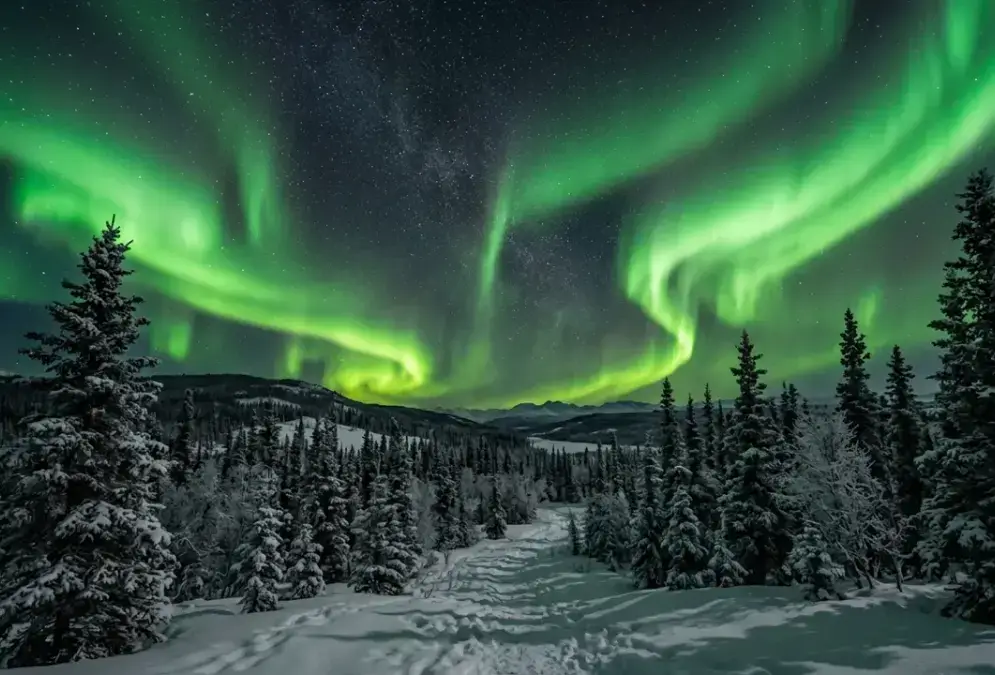
Fairbanks sits directly under the auroral oval at 64.8°N. Aurora season runs Aug 21–Apr 21, peaking Feb–Mar, with roughly 90% odds if you stay 3+ nights.
Boots are the second most common failure point. Feet rest on the coldest surface available and generate almost no warmth when you're standing still. Minimum boot rating: −40°F; ideally −50°F if you're visiting in January or February. A two-sock system helps:
- A thin moisture-wicking liner sock (merino or synthetic, never cotton) sits against the skin and manages sweat
- A heavy insulated wool outer sock over the liner holds warmth even slightly damp
For your head: a fleece-lined trapper hat with fully covering earflaps, paired with a full-face balaclava that covers everything except your eyes and a small mouth opening. This is what Fairbanks aurora guides actually wear in the coldest conditions. A thin knit ski hat leaves your ears and lower face exposed; at −40°F that is not a minor oversight.
If you are still finalizing your trip window, see the best time to see the northern lights in Fairbanks for a month-by-month breakdown of temperatures and aurora activity.
Hand warmers and foot warmers at extreme cold
Chemical hand warmers work through an exothermic reaction activated on contact with air. They reach approximately 130°F and stay active for up to 10 hours per packet. Keep them in pockets or tucked between mittens and hands, never pressed directly against bare skin.
The reason that placement matters: at −40°F, fingers losing circulation may already be numb before the session ends. Frostbitten skin cannot feel a burn. Burns from hand warmers placed against numb fingers go unnoticed until you're back indoors, and dealing with a burn on top of frostbite only complicates your recovery.
Electric hand warmers maintain a steadier temperature and last several hours per charge. The practical problem at extreme cold is battery drain. Lithium batteries lose capacity as temperatures fall, so an electric warmer rated at 6 hours may deliver 3 at −40°F. Carry backup chemical warmers regardless of what you use as your primary.
Recommended tours
Tours are selected for quality, not commission. I earn a small fee if you book — at no extra cost to you.


Heated insoles solve a problem hand warmers cannot: there is nowhere to hold something in a boot. Rechargeable insoles run off battery packs carried in an inner pocket and deliver consistent warmth to the sole. Test them before your aurora session, because battery performance at −40°F differs substantially from room-temperature testing.
Many Fairbanks aurora tour operators include chemical hand warmers in guided packages. Check when booking rather than buying a bulk supply only to find they're already included.
Renting cold-weather gear in Fairbanks
Fairbanks has a practical rental infrastructure built around visitors who arrive without extreme-cold clothing. An expedition parka weighs several kilograms and occupies most of a large suitcase; shipping or checking it internationally rarely makes sense for a one-week trip.
Alaska Element specializes in extreme-cold clothing rental for aurora viewing: expedition parkas, heavy mittens, insulated hats, and balaclavas. Their packages are calibrated for the standing-still aurora exposure scenario rather than general winter tourism. Booking in advance is worthwhile during January and February, when demand from tour groups can deplete stock quickly.
Many established Fairbanks aurora tour operators maintain their own rental gear or have partnerships with local outfitters. When booking a Fairbanks aurora viewing tour, ask explicitly whether the package includes clothing. A tour that bundles cold-weather gear and hand warmers into the price simplifies preparation considerably.
Read next · Tour
Fairbanks Aurora Viewing Tours
Fairbanks aurora tours from $235. At 64.8°N under the auroral oval, the northern lights appear 240+ nights a year. Compare operators and guarantee policies.
Footwear rental makes the strongest case for international visitors. Expedition boots rated to −50°F are large, heavy, and impractical to transport across multiple flights. Renting a pair locally and pairing them with your own wool socks is typically cheaper and simpler.
What to leave home
Cotton in any form is dangerous at −40°F. The fiber absorbs moisture and holds it against skin. Sweat from the walk to your viewing spot saturates a cotton base layer, and that moisture sits against your body for the next three to five hours, steadily drawing heat away. This is how people develop hypothermia in below-freezing temperatures while wearing what feels like warm clothing.
Leave these at home:
Read next · Article
Stargazing Gear for Beginners: Binoculars to Telescopes
New to stargazing gear? This guide breaks down binoculars, telescopes, and smart telescopes, so you know what to buy first and what to skip for right now.
- Cotton socks or sock blends with more than 10% cotton
- Cotton underwear or cotton-blend long underwear
- Denim in any form
- Casual "winter jackets" rated for conditions above −20°F
- Cotton terry or cotton-blend fleece pullovers
The last item catches experienced cold-weather travelers who rely on clothing from milder winters. A well-made down jacket rated for 0°F handles a Chicago January but fails when you're standing motionless at −40°F. Parka ratings assume walking pace. Stationary exposure needs a garment rated 20 to 30 degrees colder than the air temperature you expect.
Synthetic mid layers fail more subtly. Polyester base layers wick moisture efficiently at first but stop wicking once saturated. A synthetic base layer soaked during your setup walk provides almost no protection for the aurora session that follows. Merino wool for the skin-contact layer avoids this: it retains insulating value when damp and stays functional for the full duration.