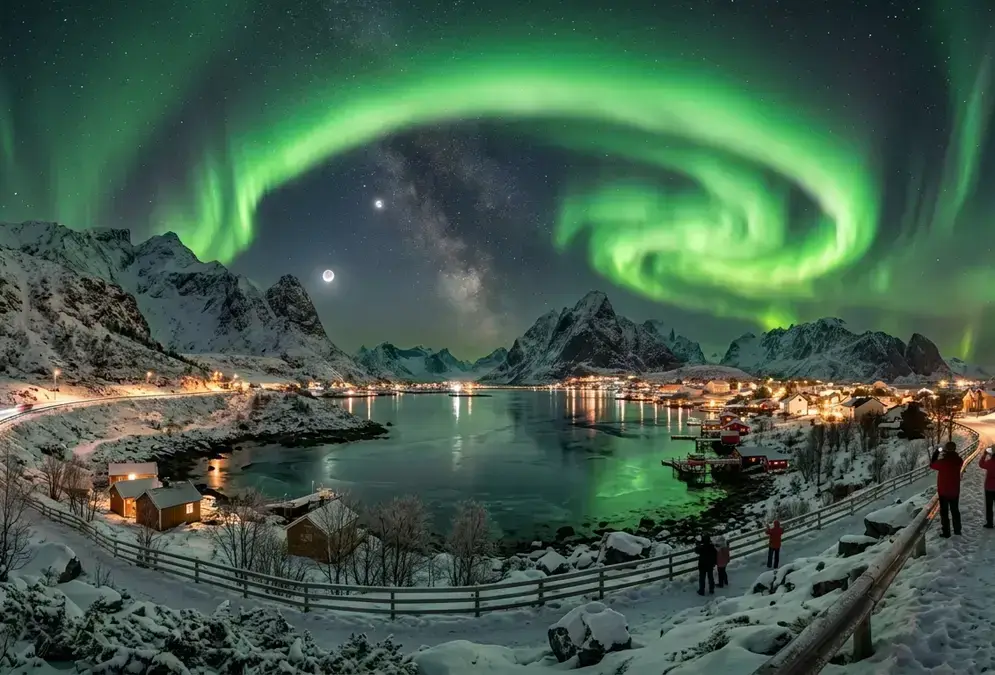

How many nights actually changes your odds
The figures below come from trip-duration modeling based on historical clear-night data for Tromsø's aurora season. They are travel-industry estimates rather than meteorological guarantees, but they give a working framework for planning[1].
One night puts your cumulative probability around 30–40%, and two nights raises it to 50–60%. That is still close to a coin flip on a single night, and many first-timers lose it. One unlucky cloud layer rules out the whole trip.
Featured · Destination
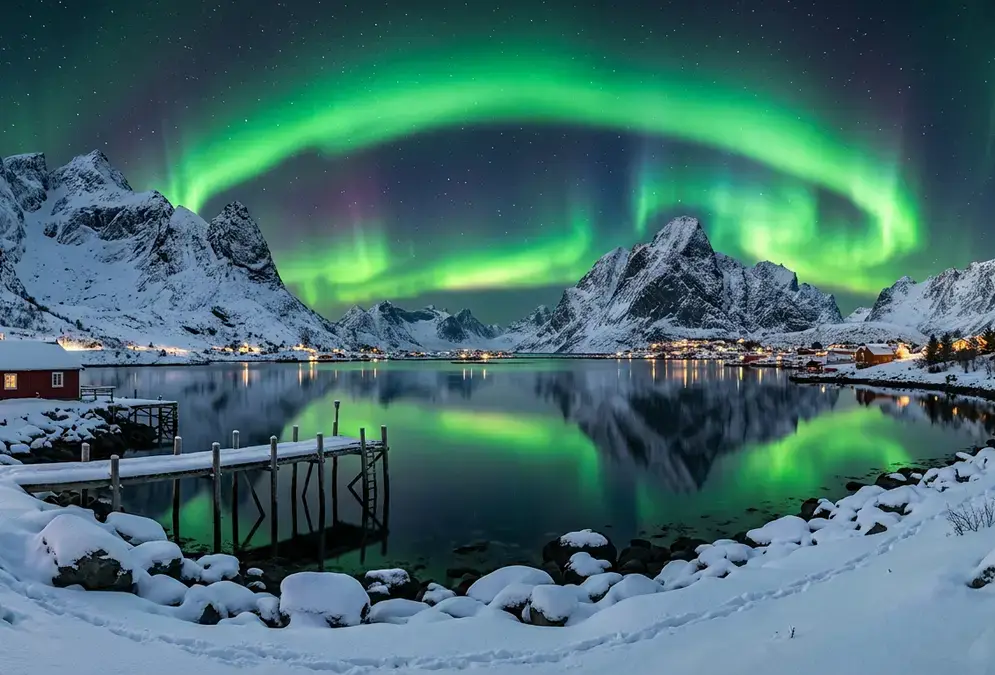
Northern Lights in Tromsø
At 69.6°N inside the auroral oval, Tromsø sees aurora at Kp 2. Peak season November–February. Best viewing spots, tour advice, and aurora forecast strategy.
Three nights pushes the figure to 60–70%. Most tour operators treat this as the minimum for a dedicated aurora trip. Three chances to catch a clear, active night is meaningfully different from two.
Five nights is where the math starts working in your favor at 75–85%. It also gives you enough room to combine aurora hunting with Tromsø's other winter activities without feeling like every hour away from the sky is a mistake. Most people who return to Tromsø do five nights or more.
Seven or more nights reaches 90–95%, and at that point you are building in genuine flexibility rather than chasing probability. Three bad nights in a row become manageable instead of catastrophic.
The basics of aurora forecasting are covered in how to see the northern lights: the Kp index, the auroral oval, and why forecasts can be accurate and useless at the same time.
Cloud cover: the variable that outweighs everything else
The Kp index gets most of the attention in aurora planning, but for Tromsø specifically, cloud cover is the bigger problem. On any given night during the viewing season, a Kp 4 storm can be fully visible fifty kilometers away while you see nothing but gray overhead. The aurora does not care about the forecast if the sky is closed.
October averages the most favorable cloud conditions of the season, with roughly 32% of daylight hours being clear[2]. That still leaves the majority of any given day under cloud; even in Tromsø's better months, clear nights are the exception.
December and January are the cloudiest months of the viewing window. Overcast sky is the norm, and clear gaps are short and unpredictable. Planning a trip purely for the aurora in this window is a high-variance bet, though the long dark nights create their own appeal.
5.3 hrs/day
March peaks at around 75% cloud cover with roughly 5.3 clear hours per day[3], making it the cloudiest month of the season by that measure. Hunters who accept the risk often come away with some of the season's most dramatic displays, because geomagnetic activity is still strong and storm windows are long.
The practical lesson: check the five-day cloud forecast every time you check the aurora forecast. Locals who run aurora tours routinely drive 30 to 60 kilometers east into the fjord valleys to chase clear-sky gaps — mobility matters more than the right hotel window.
Kp activity, solar maximum, and what Tromsø's magnetic latitude means
Tromsø sits at 67.4° magnetic latitude[4], placing it directly inside the auroral oval — the ring where geomagnetic particles funnel down along Earth's field lines most consistently. That same latitude is why Norwegian scientists first mapped the aurora from Tromsø in the early 20th century. At this latitude, the aurora becomes visible when the Kp index reaches 1+. Kp 3 and above typically produces the kind of display that a basic phone camera catches and that the naked eye can track across the sky.
This matters for trip planning because the Kp index moves fast. A Kp 4 storm that peaks at midnight can drop to Kp 1 by 2 a.m. The most active phase of a geomagnetic storm often lasts only a few hours. Being outside between roughly 10 p.m. and 2 a.m. local time is when it counts, not just having a clear sky earlier in the evening.
The current solar maximum phase means the Sun is producing more frequent coronal mass ejections than during quieter periods of the solar cycle. In practical terms, Tromsø sees considerably more geomagnetically active nights per season right now than it did five years ago. Cloud cover filters most of them, but the geomagnetic side of the equation is unusually favorable.
Moon phase adds a third variable. A bright full moon washes out a faint aurora the same way it washes out the Milky Way. Planning your trip around a new-moon window gives you a significantly darker baseline: the difference between a faint shimmer only the camera catches and a display your eyes can follow. Check a moon-phase calendar before you book, and shift by two or three days toward new moon if your schedule allows.
One thing the forecasts cannot tell you in advance is the interplanetary magnetic field (Bz) direction at the moment a solar wind stream arrives. A southward Bz triggers the full display; a northward Bz means a weaker show than the Kp number suggested. This is the randomness you cannot plan around. It is also why more nights always outperforms smarter forecasting.
For where to position yourself once you are in Tromsø, this spot-by-spot Tromsø breakdown covers the specific sites, from the Tromsdalstinden valley to the islands west of the city, where local guides set up when conditions look favorable.
Month by month: which windows actually favor you
Aurora season in Tromsø runs September through late March. Within that window, the months are not interchangeable.
September and early October offer a combination that later months lose: cloud cover is at its seasonal best, Kp activity is building toward the solar maximum, and evenings go genuinely dark by late September. The Russell–McPherron effect also tilts geomagnetic storm frequency slightly upward around the September equinox, making this one of the more active windows despite sitting outside midwinter.
| Month | Cloud cover | Kp activity | Recommendation |
|---|---|---|---|
| September–October | Clearest of season | Rising (equinox boost) | Good; nights shorter than midwinter |
| November–January | Peak cloudy period | High | Long nights, high cloud risk |
| February | Improving from Jan low | High | Best overall balance |
| March | Cloudiest month | High | High variance, strong storms possible |
November through January covers the period when Tromsø is Arctic-dark for most of the day. This sounds ideal for aurora hunting, but January is typically the lowest-probability month for actually seeing the lights — not because geomagnetic activity drops, but because clear nights become rare. The viewing window is long; the cloud cover is dense.
February is the month most repeat visitors recommend. Cloud cover starts improving from the January low, geomagnetic activity stays high, and dark nights remain. The blue-hour twilight at this latitude lasts for hours each day, making the surrounding fjord landscape photogenic in its own right.
Late March offers a trade-off: improved light and slightly better conditions for other activities, but more cloud cover than February. Experienced hunters who have made the trip more than once tend to aim for late February, where cloud recovery and Kp activity align most favorably.
What to do when the sky clouds out
Three consecutive cloudy nights on a five-night trip is a genuine possibility, not an edge case. The visitors who handle it best planned alternative activities from the start.
Dog sledding is worth booking for a half-day. The fjord valleys east and southeast of Tromsø have established operations running morning and afternoon departures through the winter. Moving through Arctic birch forest on a sled behind a working team of huskies is a different category of experience from standard tourism, and it runs regardless of cloud cover.
Whale watching runs from November through January when orca and humpback whales follow herring shoals into the Tromsø fjords[6]. This is one of the few places in Europe where you can watch humpbacks from a small boat in winter. If your trip includes December, book this before arrival.
Recommended tours
Tours are selected for quality, not commission. I earn a small fee if you book — at no extra cost to you.


The Fjellheisen cable car makes the four-minute run to the Storsteinen summit above the city[5]. On clear days it gives a full panorama of the fjord and surrounding peaks. On cloudy nights, going up can sometimes place you above the coastal cloud layer, which is not a reliable aurora workaround but worth attempting when conditions are improving higher up.
The Arctic Cathedral (Ishavskatedralen), twenty minutes on foot from the city center across the Tromsø bridge, runs concerts through the winter season and takes about an hour to visit.
Read next · Lodge
Æra Panorama Glass Lodge
Glass-ceiling cabins 30 min northeast of Tromsø: Æra lets you watch the northern lights from bed. On-site sauna, restaurant, and rental car with direct booking.
A glass-ceiling lodge changes the calculus on marginal nights, the evenings when conditions are unclear rather than definitively poor. From a warm room with an unobstructed sky view, you can monitor conditions without a 2 a.m. alarm and step outside the moment clouds break.
Building your trip: timing, structure, and what to book first
Once you have settled on five nights as the target, the practical questions come down to timing and booking order.
Book accommodation and guided tours early. February is Tromsø's peak-demand aurora month, and reputable glass lodges and guided tours fill two to four months ahead for popular dates. Arriving without reservations and planning to fill in from a local tour desk is how most first-timers end up with the suboptimal option.
The cost math runs in the same direction as the probability math. Return flights from major European hubs to Tromsø Airport are a significant fixed cost, and every night you add to the trip reduces the effective per-day rate while simultaneously improving your aurora odds. A two-night trip amortizes that travel cost over very few days. A seven-night trip spreads it far enough that the per-day figure stops feeling punishing — and you leave with a much higher chance of having actually seen the aurora.
Guided tours are worth booking for one or two nights of a five-night trip, not every night. An experienced local guide positions you in genuinely dark sites outside the city, reacts in real time to cloud pockets across the fjord valleys, and handles the transport. Going out solo on uncertain nights without local knowledge is how most first-timers spend two hours in a lit car park. The guaranteed-sighting aurora tour Tromsø runs to dark-sky sites east of the fjord and adds extra nights at no charge if clouds or poor Kp prevent a sighting on the booked date. That policy only helps if your schedule is flexible — another argument for booking at least five nights rather than three.
Check aurora forecasts at 24-hour and 48-hour intervals rather than a week out. Longer-range forecasts confirm that conditions are broadly favorable, but specific storm timing only becomes visible roughly 15 to 30 minutes before a peak. The only planning tool that reliably improves your odds is more nights in the right location.
For a longer, more cautious version of this math, an 8-night, split-stay itinerary built around the same probability logic, see the Tromsø aurora trip I've planned three times.