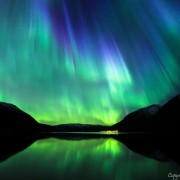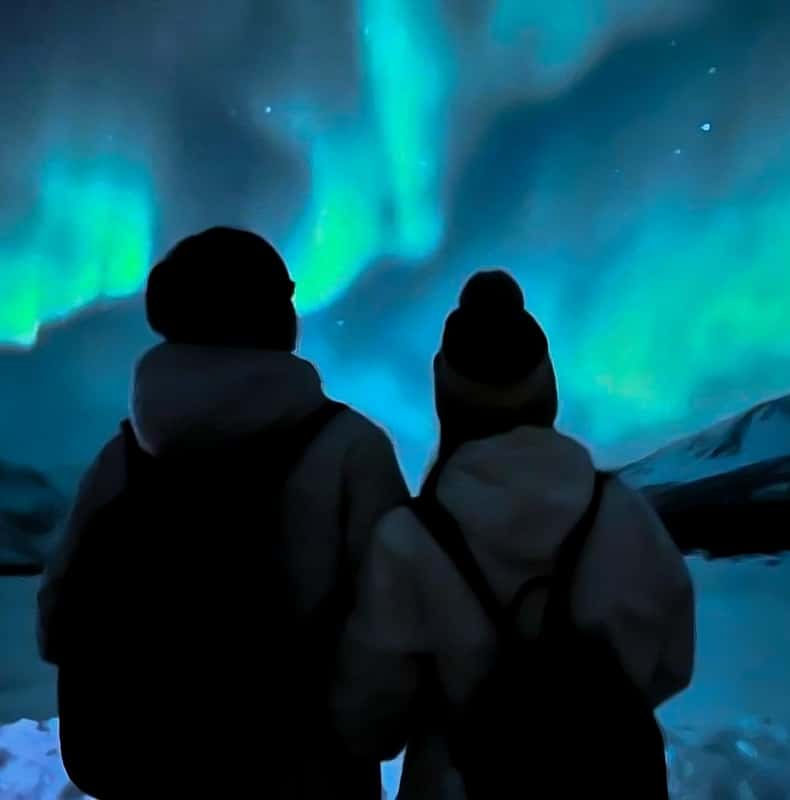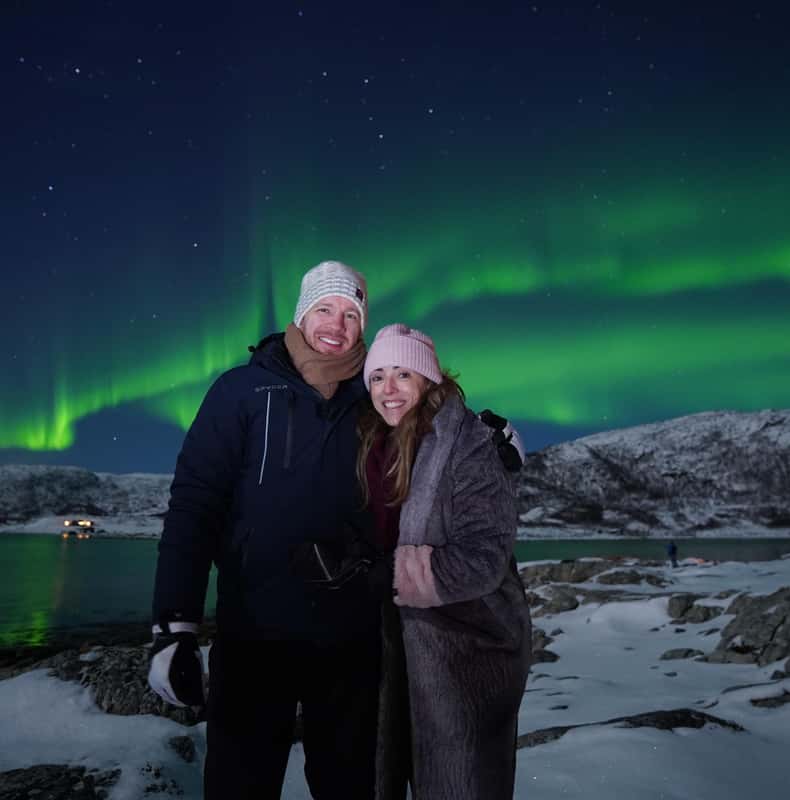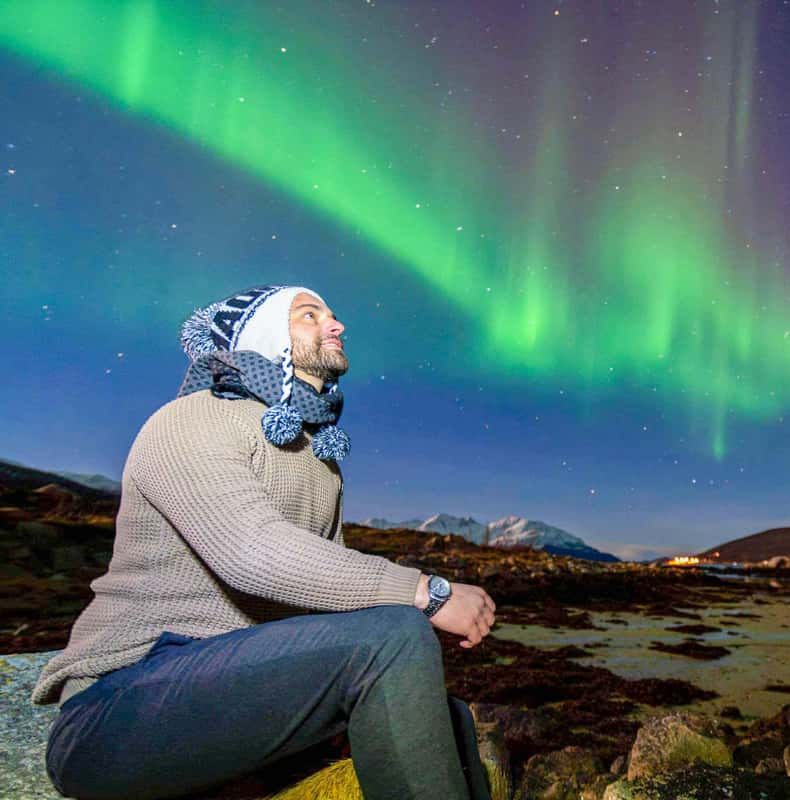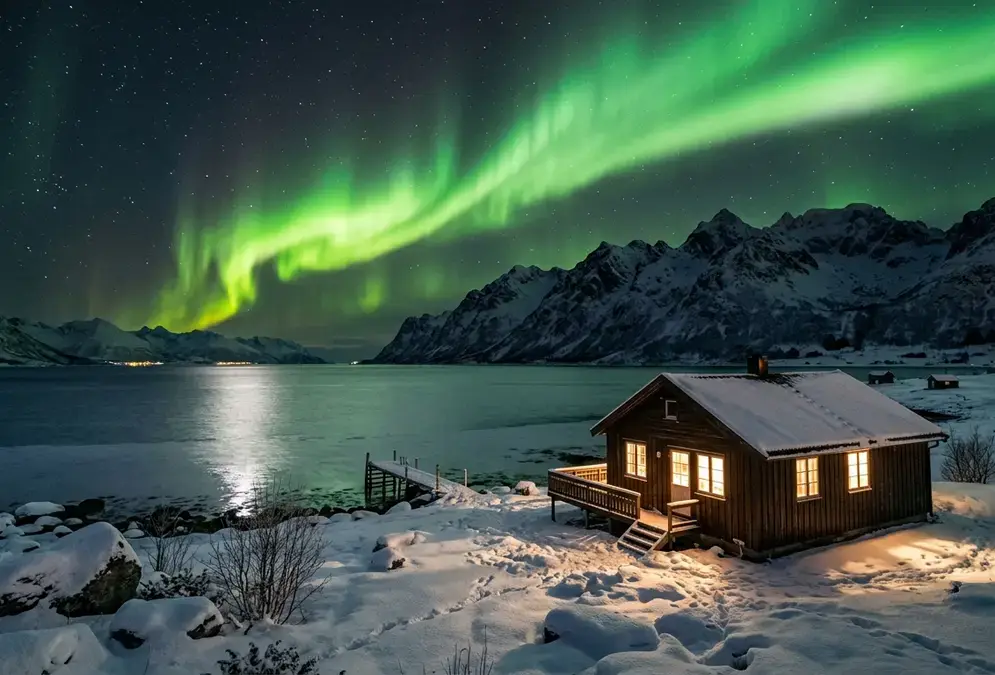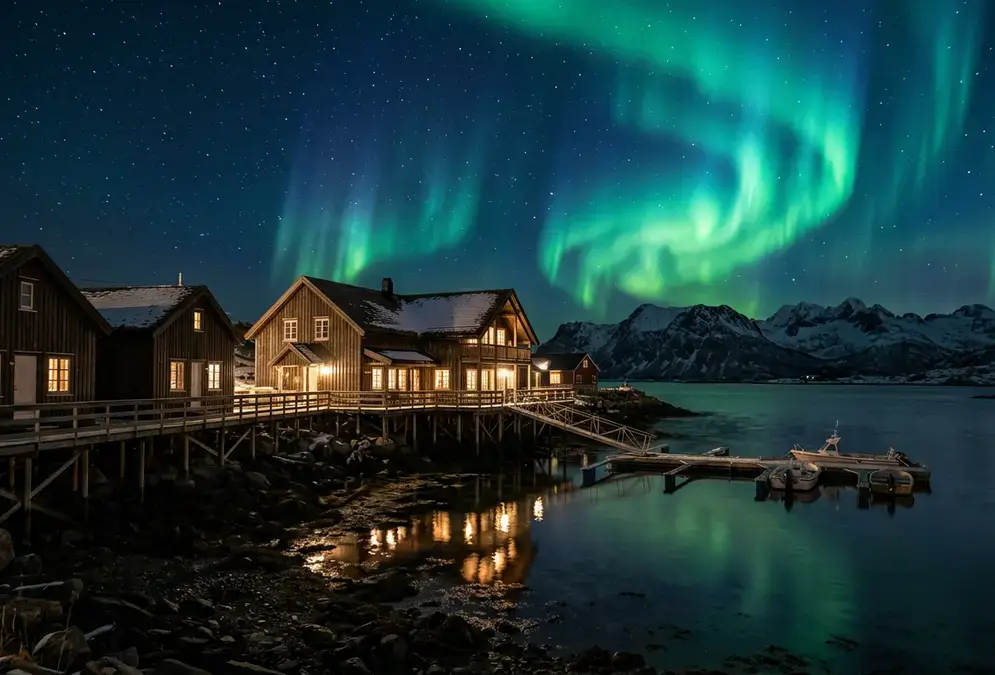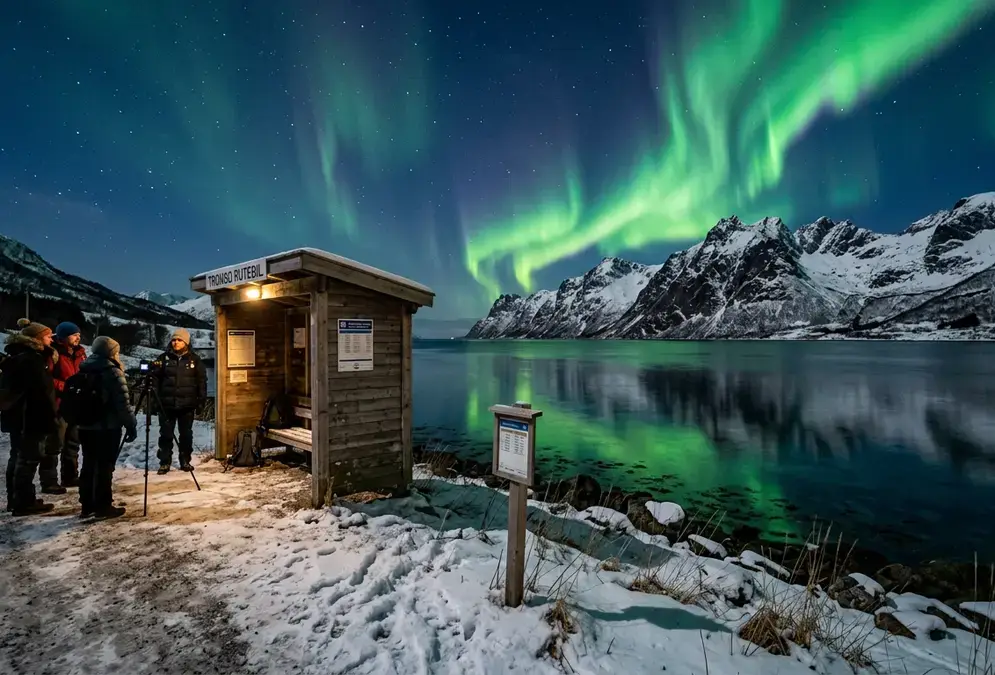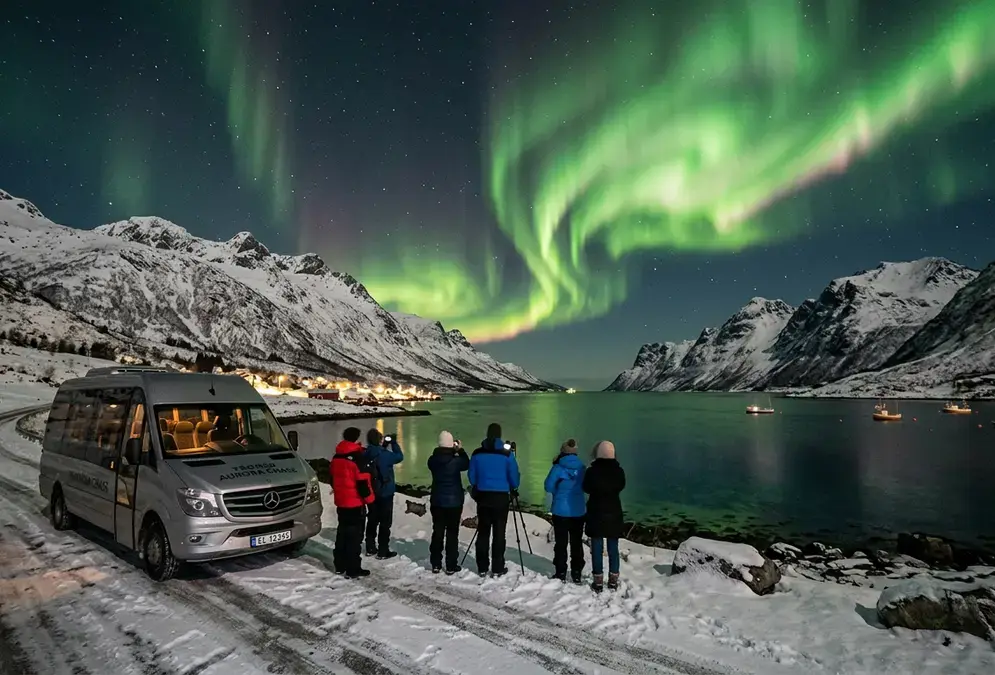
Green aurora borealis over a snow-covered fjord near Tromsø, Norway, photographed from a small minibus group stopped on a winter road at night
Northern Lights

Five or six hours chasing clear sky above the Arctic Circle

5–6 hours
Nightly departures November–March. Departures typically 18:00–20:00 from central Tromsø; return by 23:00–02:00. Timing adjusts against real-time aurora forecast and cloud cover data.
Central Tromsø city center — confirm exact meeting point with operator after booking; some operators offer hotel pickup within central Tromsø
All activities

Tromsø sits at 69.6°N inside the aurora oval — the belt of latitude where Earth's magnetic field funnels incoming solar particles most reliably into visible light. That geography puts Tromsø among a handful of cities where a moderate Kp-3 event produces aurora overhead rather than a distant glow on the northern horizon. What geography cannot do: move you out from under the cloud systems that frequently roll in off the Arctic Ocean. That's the job of a chase tour.

How the cloud chase works

The standard northern lights chase runs 5–6 hours in a heated minibus of 4 to 16 passengers. Your guide tracks live satellite cloud imagery and the real-time Kp index (how active the solar wind is, where cloud cover is thinning), then routes the vehicle toward open sky. Directions vary by night: north toward the Lyngen Alps, south toward Sørreisa, east into Finnmarka, wherever the data shows a gap. The vehicle can cover 100–200 km. A fixed viewing platform on the edge of Tromsø has no answer for a solid overcast; this format does.

No operator on a standard five-hour chase offers a sighting guarantee, and you should be skeptical of any who do. Geomagnetic activity and weather are independent variables that no guide can predict more than a few hours out. What you're paying for is expertise in reading both simultaneously and a vehicle fast enough to respond when conditions shift. Most tours include professional photography during stops — guides carry fast wide-angle lenses suited to cold and motion; your phone camera handles neither well at −15°C.

When to go and how to prepare

Season is November through March, with December and January delivering the longest nights — up to 20 hours of darkness near Tromsø — but also the most weather instability. February is the month experienced guides consistently prefer: coastal weather is more stable than midwinter, nights remain very long at 14–16 hours, and solar activity tends to increase ahead of the spring equinox. Hot drinks and light snacks are standard inclusions; thermal suits are usually on offer and worth accepting. Plan two or more consecutive nights in the city — a second evening gives you a weather fallback without the cost of a guaranteed-rebooking format.
Highlights

  • Real-time Kp index and cloud cover tracking — guides route the minibus 100–200 km to find open sky
  • Small groups of 4–16 passengers; minibus flexibility outperforms coach formats for cloud chasing
  • Professional aurora photography included at stops — guides carry cold-rated lenses and tripods
  • Tromsø at 69.6°N: a Kp-3 event produces overhead aurora, not a horizon glow
  • Hot drinks, light snacks, and thermal suits included

Included

  • Heated minibus transport
  • Professional guide with aurora expertise and real-time weather monitoring
  • Hot drinks and light snacks
  • Thermal suits (provided by most operators)
  • Professional photography during aurora stops

Not included

  • Hotel pickup (city center meeting point standard; some operators offer central Tromsø pickup)
  • Meals beyond hot drinks and snacks
  • Personal photography equipment

Practical information

Languages

English, Norwegian

Group size

4–16 passengers per minibus (some operators run larger coach groups)

Good to know before booking

  • Dress in wool or synthetic thermal base layers and a fleece mid-layer under any provided thermal suit — temperatures outside the vehicle reach −10°C to −20°C
  • Plan two or more consecutive nights in Tromsø to allow a second attempt if cloud cover blocks the first evening
  • Book in advance for December–January peak; February tours have more availability but fill quickly on good-forecast nights
  • Check aurora forecast apps (My Aurora Forecast, Space Weather Live) on the afternoon of your tour

Prices & Booking

From €120 approx.

From NOK 1,300 per person (approx. €120–180 depending on operator and inclusions)

Nightly departures November–March. Departures typically 18:00–20:00 from central Tromsø; return by 23:00–02:00. Timing adjusts against real-time aurora forecast and cloud cover data.

An editorial guide to this experience. Book directly with the operator when you plan your trip.

Tags

aurora northern lights tromso norway guided tour aurora chasing minibus tour small group winter arctic

Frequently asked questions

What if we don't see the aurora on the chase tour?

Standard chase tours carry no sighting guarantee and no automatic rebooking. If cloud cover blocks the sky or solar activity falls below visible levels, the tour runs its course and you return without a refund or a free second night. That's the honest trade-off: you're paying for a guide's expertise and a mobile vehicle, not for an aurora no operator can produce. If you want a weather fallback, book a guaranteed-sighting tour — they include a free return the following night and cost around 200–300 NOK more per person. If budget is the factor and you have only one evening in Tromsø, the standard tour offers the best probability at the lower price.

When is the best time for a northern lights chase from Tromsø?

February is the month most experienced guides recommend: coastal cloud cover drops compared to December–January, darkness still runs 14–16 hours, and geomagnetic activity tends to increase as the solar cycle advances toward the spring equinox in March. The full season is November through March. December and January are darkest but most overcast. September and October work near the equinox but polar darkness is still building, which limits your window.

What should I wear on a Tromsø northern lights tour?

More than you expect. Temperatures outside the minibus reach −10°C to −20°C in midwinter, and you'll stand still at outdoor stops. Thermal suits are usually provided, but they go over your own layers — arrive in wool or synthetic thermal base layers, a fleece mid-layer, and thick wool socks. Bring hand warmers for long outdoor stops. Avoid white lights from your phone: they destroy dark adaptation in seconds and make faint aurora displays harder to spot.

How far from Tromsø do northern lights chase tours travel?

Tours can cover 100–200 km in a single evening, routing toward wherever satellite cloud maps show open sky. Common directions include north toward the Lyngen Alps, south toward Sørreisa and Bardufoss, and east toward Finnmarka. There's no fixed destination — the guide tracks cloud imagery and the Kp index through the night and adjusts the route accordingly. That mobility is the main reason to choose a minibus chase over a fixed-location experience near the city.

Further reading

Sources