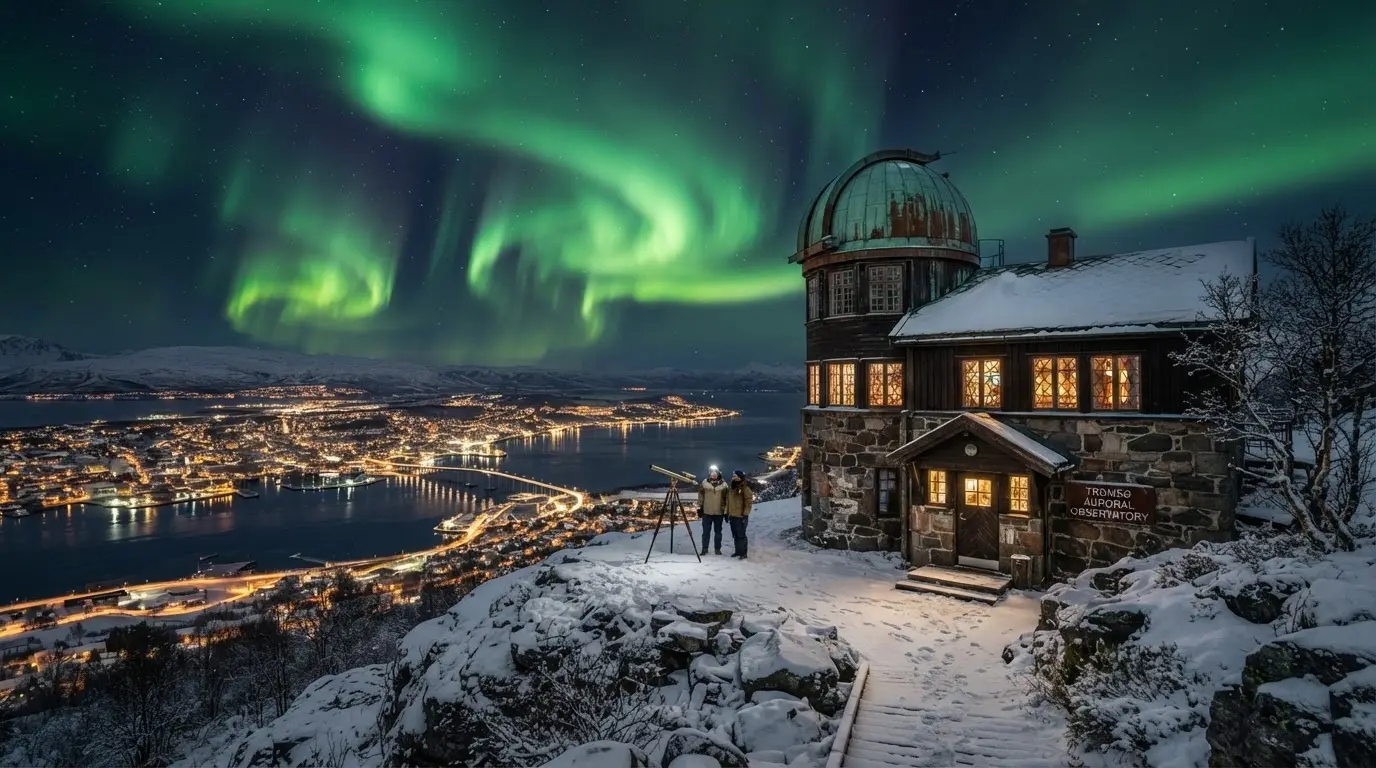

A magnetized ball in a vacuum chamber: Birkeland's expeditions and the terrella
Kristian Birkeland didn't start with Tromsø. He started with a magnetized sphere in a vacuum chamber, and years of miserable travel to prove what it meant.
Beginning in 1898, the Norwegian physicist organized a series of geomagnetic expeditions to remote sites across the far north[1] — outposts in northern Norway, Iceland, Spitsbergen, and Novaya Zemlya, chosen because their magnetometers could register disturbances tied to auroral activity that mid-latitude stations further south simply couldn't detect. The fieldwork meant months at isolated stations through polar winters, reading dials by lamplight, and the data was slow to interpret. But it gave Birkeland something a desk scientist in Oslo couldn't get: direct measurements of the magnetic storms that accompanied the aurora borealis overhead.
Back in his laboratory, Birkeland built the experiment he's now remembered for: the terrella, a glass vacuum chamber holding a small magnetized sphere standing in for Earth, bombarded with electron beams to see whether he could reproduce the aurora's glowing rings in miniature[2]. He could. The beams curved toward the sphere's poles and lit up in patterns that matched what his expedition data showed happening at the real poles, and Birkeland argued from this that the aurora was caused by charged particles from the sun, funneled down toward the ground by Earth's own magnetic field.
The physics establishment largely rejected the idea during his lifetime. Birkeland died in 1917, decades before satellites could confirm the solar wind he had proposed — it turned out to be essentially correct[3]. Vindication came too late for Birkeland himself, but the Arctic expedition network he had built, and the observing tradition it started, is the reason a mountain above Alta became Norway's first purpose-built aurora station rather than a footnote in a physics textbook.
Why a mountain above Alta became Norway's first aurora observatory
Haldde, a peak above Alta in Norwegian Finnmark, was the site Birkeland's successors picked to turn expedition data into continuous observation. By the autumn of 1912, a purpose-built magnetic-meteorological observatory was ready and operating at the summit[4] — Norway's first dedicated aurora research station, staffed through winters that made the daily climb to the instruments its own kind of fieldwork.
The observatory's logic was straightforward: Haldde sat close enough to the auroral zone that its magnetometers and photographic plates captured activity too far north for instruments in Oslo, and far enough from any town's lights or stray electrical interference to keep the readings clean. For over a decade, staff there logged magnetic disturbances and photographed auroral displays through the polar night, building exactly the kind of long, continuous dataset that a single expedition season never could.
Featured · Destination
Northern Lights in Tromsø
At 69.6°N inside the auroral oval, Tromsø sees aurora at Kp 2. Peak season November–February. Best viewing spots, tour advice, and aurora forecast strategy.
It didn't last. Haldde's remoteness, the same quality that made it scientifically useful, made it brutally expensive to keep supplied and staffed, and in 1926 the observatory closed down due to economic difficulties[5]. Norway had proven a mountaintop aurora station worked. It hadn't proven it could afford to run one indefinitely, and that funding problem, not the science, is what eventually moved the whole enterprise to Tromsø itself.
From Haldde to Tromsø: Parliament funds a permanent institute
The fix, once Norway's Parliament acted, was to stop relying on a single remote peak and build a proper institution in a city that could support one year-round. On 15 June 1917, the Storting agreed to establish a geophysical institute in Tromsø that would absorb the magnetic-meteorological work already done at Haldde[6] — a deliberate shift from expedition science to permanent infrastructure, with Tromsø's harbor and rail links solving the supply problem that had strangled the mountain station.
The move took another year to complete on the ground. Staff scientists Ole Andreas Krogness and Olaf Devik left Haldde in midsummer 1918 and moved into the new institute building in Tromsø that July[7], a structure staff nicknamed Geofysen, a name that stuck through every reorganization the institute went through afterward. For anyone weighing whether Tromsø's aurora credentials hold up against every other claimant to the title, this is the paper trail behind them: a parliamentary act, a named building, and a continuous instrument run that never again had to shut down for a winter supply crisis.
Geofysen wasn't yet the Auroral Observatory that would make Tromsø's scientific reputation. That came a decade later, once the institute had the staff and funding to specialize.
Leiv Harang and the discovery that made Tromsø matter
In 1928, the Tromsø institute formally organized its aurora work as its own section of the Norwegian Institute of Cosmical Physics, known by its Norwegian initials NIKF[8]. The new section had a name, the Tromsø Geophysical Observatory, dedicated to the study of aurora borealis phenomena, and from its founding, a director: Leiv Harang, who became the observatory's first manager[9].
Harang was 26 when he took the post. Born on 19 April 1902, he would spend the next quarter-century in Tromsø turning the observatory's instrument readings into the first systematic physics of the aurora's electrical behavior[10] — not the visual curtains tourists watch for, but the electric currents flowing high overhead that actually drive them, measured through a network of magnetometers spread across Arctic Norway.
Recommended tours
Tours are selected for quality, not commission. I earn a small fee if you book — at no extra cost to you.



That work produced Tromsø's genuine claim to a place in aurora science. In 1946, Harang identified a boundary within the ionosphere's electric current system where the current's direction reverses, a phenomenon later named the Harang Discontinuity in his honor[11]. It's still the term physicists use today for that reversal zone in the auroral electrojet, the band of current that circles the polar sky and drives much of the aurora's structure, and it came directly out of two decades of instrument runs at the observatory Harang had directed since he was in his twenties.
Harang left Tromsø in 1952 to take a professorship at the University of Oslo[12], by which point the observatory he had built had already produced the discovery that carries his name.
1946
Legacy: from NIKF to today, and what Tromsø did not discover
The institute Harang left behind kept evolving without him. In 1972, NIKF merged into the University of Tromsø[13], folding a semi-independent research institute into a full university department and setting up the aurora and space-physics research that continues there today, long after Geofysen's original building stopped being the only instrument on the mountain.
It's worth being precise here about what Tromsø's institute actually discovered, because two achievements get conflated. The Harang Discontinuity is a Tromsø discovery, made by a Tromsø-based physicist from Tromsø instrument data. The auroral oval, the ring-shaped zone around the magnetic pole where aurora activity concentrates and a concept every modern aurora forecast map still uses, was not. It was proposed independently in the 1960s by geophysicists working from satellite and ground-station data, with no Tromsø connection. Crediting Tromsø or Harang with the auroral oval is a common mix-up, but it collapses two separate findings, a decade and a discipline apart, into one.
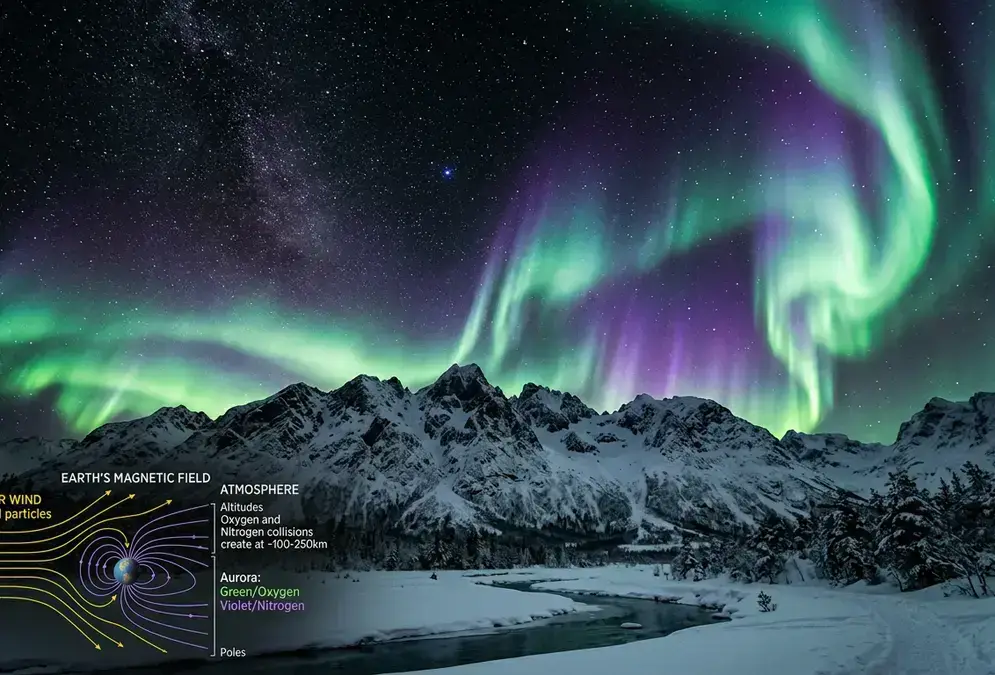
Featured · Article
What Causes the Northern Lights? The Science Explained
Solar wind collides with Earth's magnetic field, funneling charged particles toward the poles, where they excite oxygen and nitrogen into glowing color.
None of that diminishes what actually happened here. A mountain observatory that couldn't afford to stay open became a university institute that's still measuring the same electrojet Harang mapped eighty years ago, feeding the same kind of aurora and geomagnetic forecasting that airlines, GPS operators, and aurora-chasing travelers now check before heading out. For a trip built around that same sky, how many days to budget in Tromsø, whether a guided tour is worth booking, and how Tromsø compares to Abisko are the practical questions this history doesn't answer. Neither does it explain why locals don't dread the two-month polar night that same sky sits behind — that's a separate, more recent piece of Tromsø research. But the science behind those forecasts is still quietly built on the instrument runs this institute started.