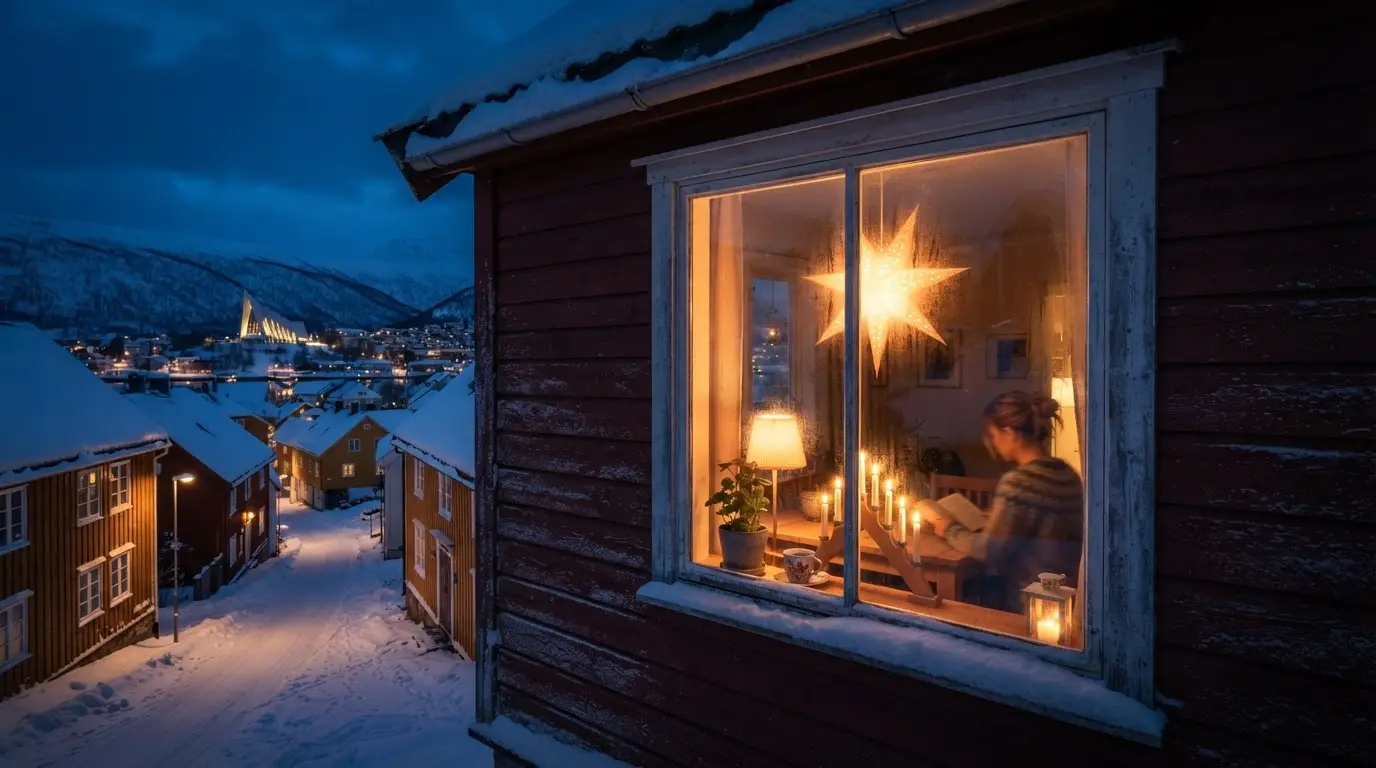

The two-month night that shouldn't work
Tromsø's polar night runs from around mid-November to mid-January, and even at midday the sky gets nothing brighter than civil twilight: two to five hours of it, with the sun tracking just beneath the horizon rather than over it[6].
By the numbers, this should be miserable. Seasonal affective disorder (SAD) affects an estimated 6% of the U.S. population, and another 14% get a milder version researchers call the "winter blues"[7].
Move that math three time zones north and add two sunless months, and the odds should get worse, not better. On the Norwegian archipelago of Svalbard, where the polar night runs a full two and a half months, residents carry headlamps around the clock and, once outside town limits, flare guns for polar-bear safety[8].
This is the contradiction Kari Leibowitz went to answer. In August 2014, the Stanford-trained social psychologist moved to Tromsø, a genuine small city of roughly 70,000 people rather than a remote research outpost[1], as a Fulbright Scholar specifically to find out why locals don't unravel the way that darkness predicts[2].
The gap between the statistics and the lived experience is exactly what her research measured: not whether Tromsø residents secretly suffer in silence, but whether how they think about winter changes how winter actually feels.
How do you measure a 'wintertime mindset'?
There was no existing instrument for this. Leibowitz's Fulbright placement ran a full ten months, from August to May, based at the University of Tromsø, where she partnered with UiT psychologist Joar Vittersø, whose own research covered happiness and quality of life[9].
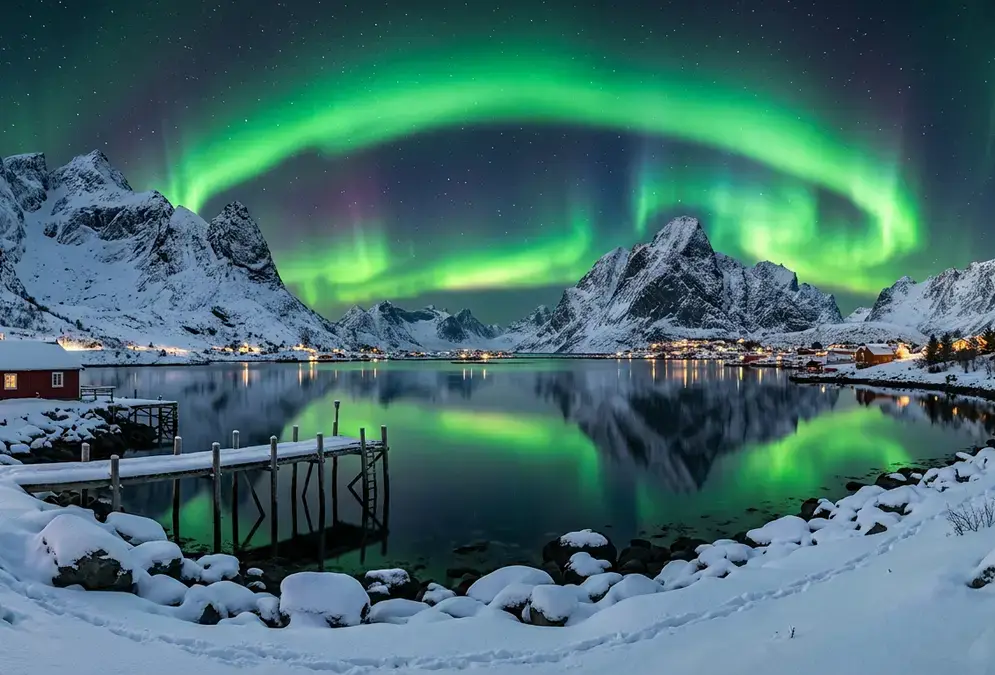
Featured · Destination
Northern Lights in Tromsø
At 69.6°N inside the auroral oval, Tromsø sees aurora at Kp 2. Peak season November–February. Best viewing spots, tour advice, and aurora forecast strategy.
Because no questionnaire existed for how a person interprets winter as a season, Leibowitz and Vittersø built one from scratch, drawing on conversations with Norwegian and international residents of Tromsø for its themes. The resulting Wintertime Mindset Scale asks ten questions: six framed positively (winter as beautiful, cozy, or full of activities available only that time of year) and four framed negatively, such as feeling more tired or not wanting to do anything[10].
That gap mattered. Without a way to measure how someone interprets a season, researchers could track depression, but not the belief system sitting upstream of it.
To test the scale, the team mailed survey invitations to 1,500 randomly chosen addresses in January 2015: 500 each in Oslo, Troms county (home to Tromsø), and the Arctic archipelago of Svalbard[11]. 238 people responded, split across all three regions[5].
The results were published as a peer-reviewed paper in the International Journal of Wellbeing, carrying a citable DOI[12], the kind of detail that separates peer-reviewed psychology from a magazine trend piece.
What the numbers actually showed
Here's the headline result. Svalbard residents scored highest on the Wintertime Mindset Scale, averaging 4.01 out of 5, well above Troms county's 3.58 and Oslo's 3.34[4].
That's the opposite of what you'd predict if darkness alone drove misery. Svalbard has the longest, darkest polar night of the three regions, and its residents reported the most positive attitude toward winter, not the least.
A positive wintertime mindset correlated with every wellbeing measure the researchers tested: life satisfaction, positive emotions, psychological flourishing, and personal growth[3].
For a Tromsø local, that finding backs up something the culture already assumed: winter is worth preparing for, not just surviving. For a visitor arriving for a week, it's a reminder that the "locals don't feel it" line isn't magic. It's practiced, and it's measurable.
Koselig, big light off, and the tools mindset lives inside
Mindset isn't just an attitude Norwegians will themselves into. It's practiced. Leibowitz describes Tromsø residents preparing for the polar night with deliberate koselig: candles, soft lighting, warm drinks, gathering with people they love, rather than merely enduring the dark[15].
The University of Tromsø's student center even runs a light café, where students sit in front of sun lamps between classes[16]. But Leibowitz says the bigger cultural lever isn't the lamps. It's anticipating the season's specific activities rather than just compensating for lost daylight[16].
Staying physically active carries equal weight. Norwegians have a saying for it: "there's no such thing as bad weather, only bad clothing", the belief that being outside through winter, correctly dressed, is part of a happy life[17]. For visitors weighing what that actually means, how to dress for an Arctic winter and a proper winter packing list turn that saying into a gear list.
Leibowitz has since turned the research into practice for a wider audience. Her 2024 book How to Winter describes 'big light off': turning off overhead lighting at home in favor of lamps and candles, a habit she says is already common throughout Scandinavia[18].
Building your own wintertime mindset
- Prepare with koselig: candles, soft light, warm drinks, time with loved ones
- Turn off overhead lights ("big light off") in favor of lamps and candles
- Dress for the weather instead of waiting for it to improve
- Plan season-only activities in advance, rather than just enduring the dark
- Notice the confirmation bias: expecting misery makes you find it
Does this work if you don't live in the Arctic?
Leibowitz's broader argument is that dreading a season in advance can become a self-fulfilling confirmation bias (the tendency to notice information that confirms what you already expected)[19]. Assume winter will be miserable, and every gray afternoon feels like proof; assume it has its own compensations, and you notice those instead.
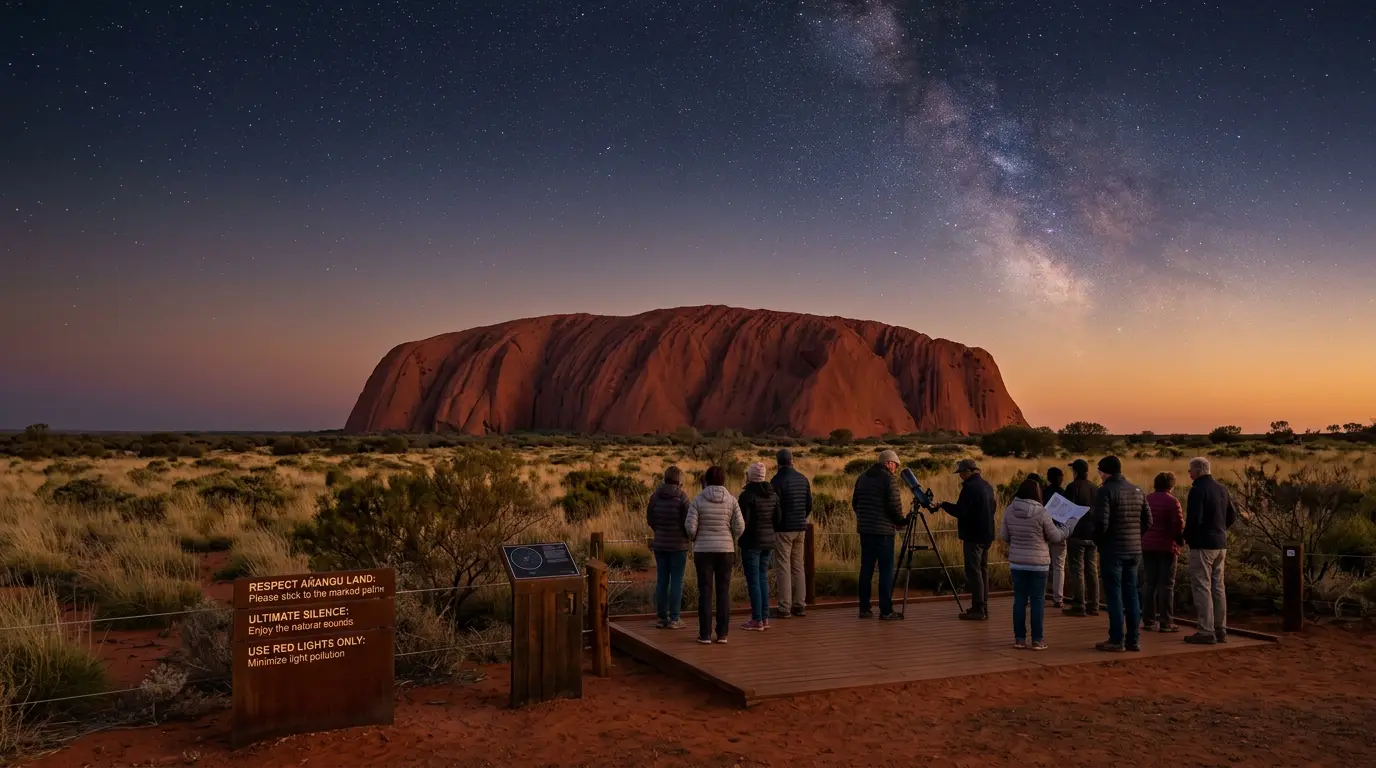
Featured · Article
Uluru Cultural Significance and Visitor Etiquette
Uluru is Anangu land under joint management. Here's why the 2019 climb closure is settled policy, what you can't photograph, and real visitor etiquette.
None of this is unique to weather. It echoes Stanford psychologist Alia Crum's research on stress mindsets: people who frame stress as enhancing rather than purely debilitating cope and perform measurably better[20]. Winter, in this framing, is just one more circumstance where the story you tell yourself about it changes what it does to you.
That doesn't make Tromsø's darkness disappear, and it doesn't replace treatment for a clinical mood disorder. It does mean the mindset research travels well beyond one Arctic city, worth knowing whether you're weighing a week built around Tromsø's aurora science and history, figuring out what to do beyond the northern lights, or just getting through a grey February at home.
I haven't stood under a Tromsø aurora yet. I've costed an eight-night trip there three times, timed to this solar cycle's peak, and still haven't booked it. The mindset research is the part I trust regardless of whether I ever go.