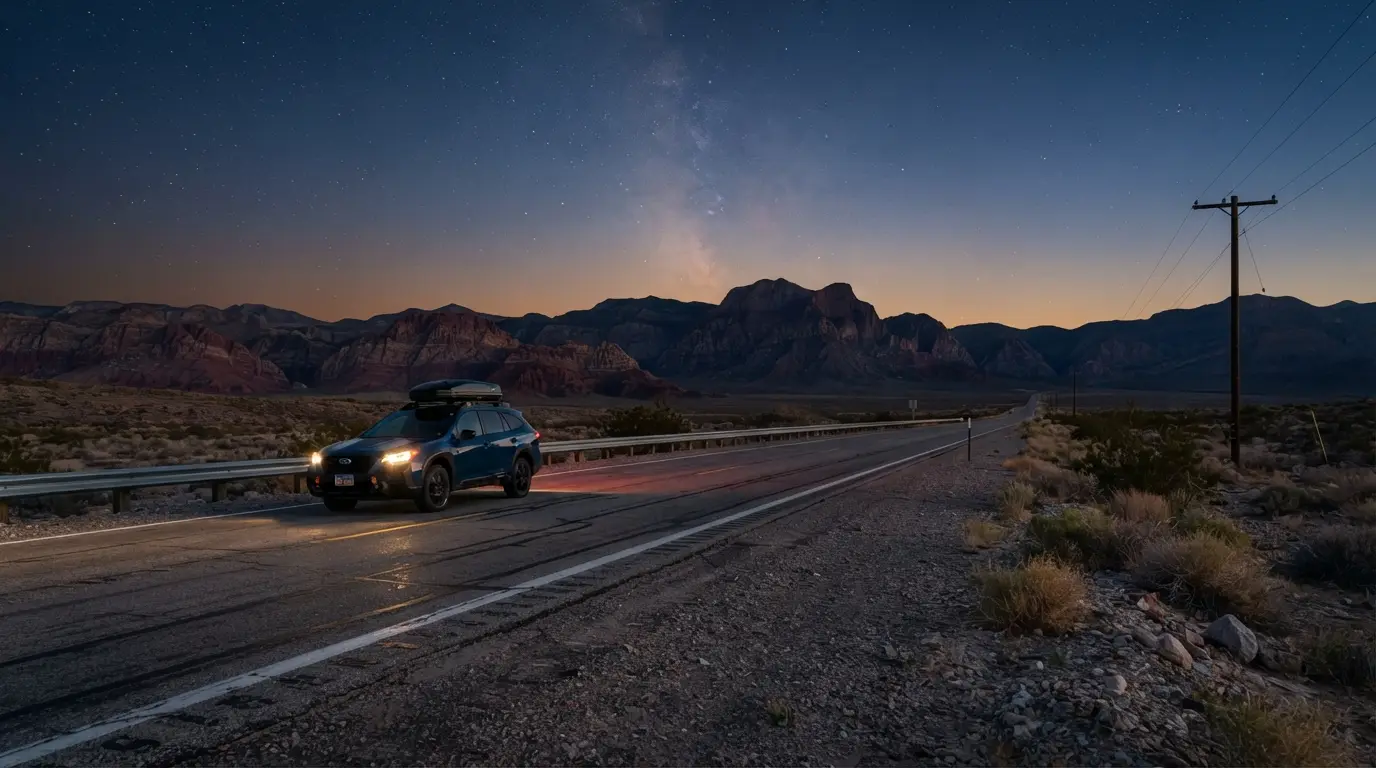

Why Las Vegas is the right hub for this loop
This trip is an out-and-back from Las Vegas with a long middle, not a tidy circle. Death Valley sits about two hours west of the Strip[3], Joshua Tree about three and a half hours east on the Mojave Preserve route[32], and the two parks stand about 265 miles apart by road[1]. That gap, not the distance from the city, is what shapes the itinerary. Las Vegas earns the hub role twice over: it is the cheap-flight gateway for both parks and the rental-car market where a desert-ready sedan is a normal option, not a special request. Add the legs and the round trip comes to roughly 570 to 630 miles depending on the return route; that total is my arithmetic from the per-leg numbers below, not a figure anyone publishes as a single number.
Why Death Valley first? Because its season is the strict one. Death Valley's comfortable window ends when most of its campgrounds close in April[18], while Joshua Tree's main season runs October through April[22], longer at both ends. Do Death Valley first and you front-load the park most likely to age you out of the trip if the calendar slips. Reverse the order and the risk is ending the loop in a park whose season already shut.
One alternative shape deserves a mention before the legs start: fly into Las Vegas and out of Palm Springs or Palm Desert, skipping the return drive. The flights are limited enough that most people do not bother[34], but it is the cleanest way to cut the trip's last long day if the dates line up. Getting to Death Valley from Las Vegas owns the first leg's mechanics, from fuel stops to cell-signal dead zones, so this itinerary sticks to the sequence, the drive times, and the nights.
Leg 1: Las Vegas to Death Valley — the easy first night
The first leg is the trip's on-ramp: about 120 miles, a touch over two hours on NV-160 through Pahrump onto CA-190[3], all of it paved. Leave after breakfast and you are checking in at Furnace Creek with a full afternoon of daylight left, which is the whole point of starting here. The approach guide owns the leg's mechanics, from fuel to cell signal, so the dark-sky version of this day has exactly one job: arrive with enough light to see your night spot before the sky goes black.
Featured · Destination
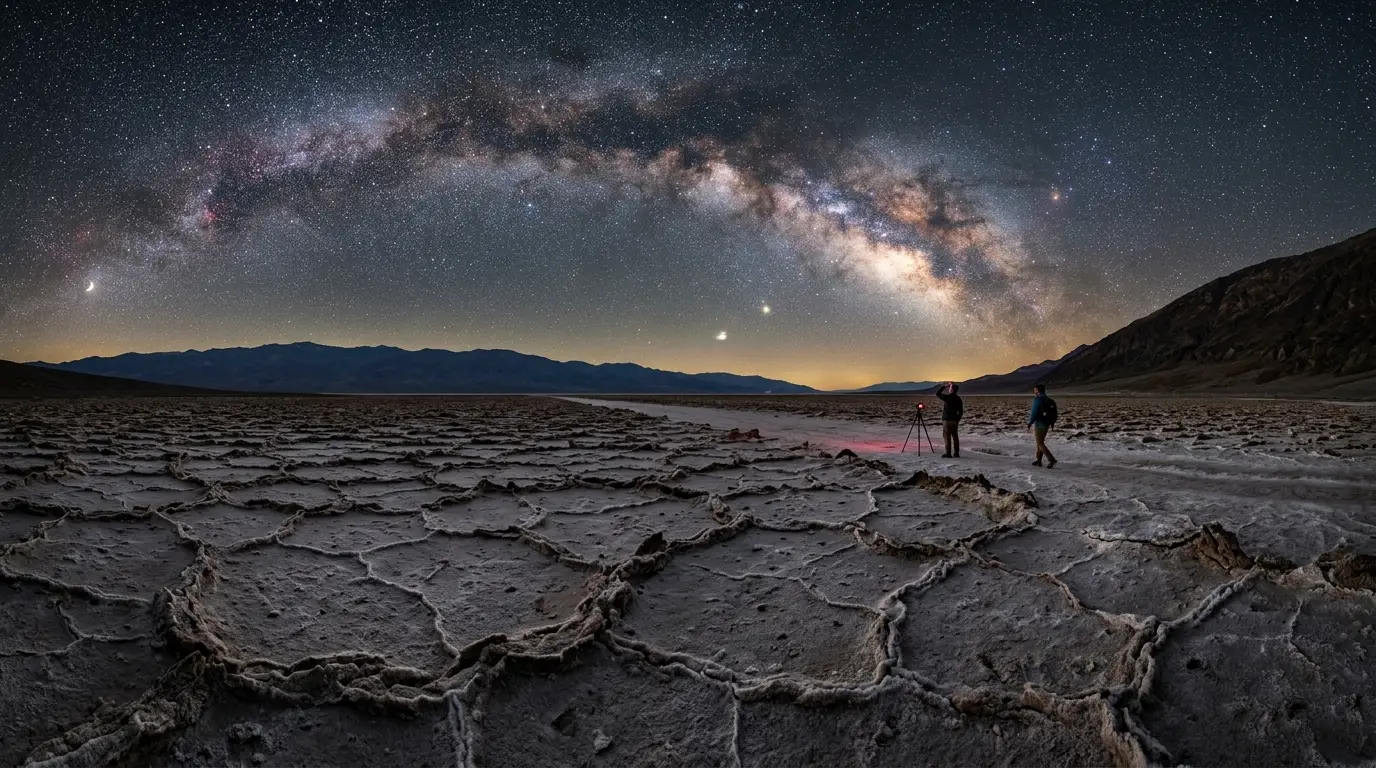
Death Valley
Death Valley's Gold-tier dark sky sits at the lowest point in North America. Here's when to visit, where to stay, and how to handle the extreme summer heat.
Where to sleep on night one
You have two in-park bases and the choice is real. Furnace Creek sits closer to most of the sights and costs more; Stovepipe Wells is the budget side, out near the dunes[28]. The two resorts are The Inn at Death Valley and The Ranch at Death Valley[29], the Inn the splurge and the Ranch the family-style option, both under one management. Campers get the sharper trade: Furnace Creek Campground is the park's only reservable site, bookable six months ahead between October and April[30], while Stovepipe Wells Campground runs first-come, first-served, November through May[31]. In season, that reservable site is the difference between a guaranteed spot and a 4pm game of musical chairs. Both campgrounds sit within a short drive of the main night-sky pull-offs, so pick the bed, then pick the sky.
Where to point your chair after dark
Death Valley's night-sky list is short and every entry is reachable on pavement. The rangers' top suggestions are Mesquite Flat Sand Dunes, Harmony Borax Works, Badwater Basin, and Ubehebe Crater[10]; night photographers drift to Zabriskie Point, Mesquite Flat, and Harmony Borax Works[11]. For one night in the park, pick a single spot: Mesquite Flat if you want dunes in the frame, Zabriskie if you want the badlands ridgelines, and be in position before astronomical twilight ends. Hopping between viewpoints costs you the dark adaptation that makes the first hour worthwhile, and one good spot beats three rushed ones. The best Death Valley stargazing spots article goes spot by spot, including which ones tolerate a telescope tripod.
Leg 2: Death Valley to Joshua Tree — the long middle drive
This is the leg that decides your pacing, so it earns the most planning attention. Death Valley to Joshua Tree runs about 265 miles[1] and 4.5 to 5.5 hours[7], the longest stretch of the loop, along a corridor with more character than the maps suggest: CA-190 east to Death Valley Junction, CA-127 south to Baker, Interstate 15 to Barstow, then CA-247 south onto the CA-62 side of the park[5].
| Pacing option | Drive time | What it costs |
|---|---|---|
| Split in Barstow | About 3.5 h, then about 2 h | One extra overnight in a functional town |
| One long moving day | 4.5 to 5.5 h straight through | An evening in Joshua Tree lost to road fatigue |
The Barstow split
The standard way to survive the leg is to break it in Barstow, the natural halfway town: Death Valley to Barstow runs about three and a half hours[6], and from Barstow, Joshua Tree is a two-hour drive[8]. The itinerary source this site draws on calls the full leg about five and a half hours and credits the Barstow night with keeping the trip sane[7]. Barstow's job is functional: it turns one long moving day into two half-days with a shower in between, so treat it as a sleep-and-leave stop, not a destination. Skip it if your desert-driving tolerance is high; keep it if you want to meet Joshua Tree's sky fresh instead of road-tired.
Which Joshua Tree entrance to use
Coming from the Barstow side you arrive at the north end of the park, which settles the entrance question before you get there. The West Entrance sits five miles south of Highway 62 at Joshua Tree Village[24]; the North Entrance at Twentynine Palms is the one with the shorter queues, since the west gate backs up with cars from the coast while the north gate rarely has anyone waiting[25]. If you are basing in Twentynine Palms, the north entrance also puts you closest to the park's designated stargazing pull-offs. The south entrance at Cottonwood only makes sense on the Palm Springs side of the loop, so ignore it on this itinerary. Getting to Joshua Tree breaks down every entrance if you are still weighing where to sleep.
Where the corridor gets empty
The empty miles sit between Baker and Barstow, where the Mojave opens up and the fuel-and-signal discipline from the first leg starts paying for itself. Top up in Baker, top up again in Barstow, and treat the stretch between them as a no-services zone; the same fuel and cell-service numbers that govern the drive in apply to this corridor, so the first leg's habits carry straight over.
How many nights each park earns
Night allocation beats day counting on a dark-sky trip, and this one has a floor worth stating plainly: at least one full day in Death Valley and at least one and a half days in Joshua Tree[9]. Translated into sleeps, the minimum is one night per park, spent at the best-odds spot each park offers. That floor holds only inside the new-moon window, with zero weather margin, and one night in each park means the spot is chosen before you leave Vegas, not scouted after dinner. One night per park is also the honest booking: two nights in one park and none in the other only makes sense once you have already chosen a favorite.
The reservable campground is the plan
Furnace Creek Campground is Death Valley's only reservable campground, bookable six months ahead from October to April. The rest of the park runs first-come, first-served: in season, showing up expecting a site is how trips end with a night in Barstow.
One night per park, spent right
In Death Valley, one night means Mesquite Flat Sand Dunes or Zabriskie Point[10][11]: the dunes for the classic wide frame, Zabriskie for the ridgelines. In Joshua Tree, the park designates four stargazing areas: the parking lots of Quail Springs, Hidden Valley, Cap Rock, and Ryan Mountain[12]. The darkest skies sit further out, at Cottonwood Campground[13] and along Pinto Basin Road[14], which costs you a longer drive from the Twentynine Palms base. Dark adaptation takes 20 to 30 minutes[16], so the one-night plan is to arrive early, park once, and stay put: every headlamp flip and car door resets the clock. The best Joshua Tree stargazing spots article maps those pull-offs properly; pacing-wise, the Hidden Valley–Ryan cluster is the right home for a Twentynine Palms night.
The 4-night compact
The tightest workable shape is four nights: one in Death Valley, two in Joshua Tree, with the middle leg either split across a Barstow night, which makes it five, or driven straight. Four nights only works when the moon cooperates and you accept zero weather margin: a cloudy night in either park and you have spent the trip driving between two overcast skies. It is the shape for a long weekend with a plan B, not the shape for the trip of a lifetime.
The 5-night and 7-night shapes
Five nights is the shape most people should actually book: two in Death Valley, two in Joshua Tree, with the spare night going to Barstow or into either park. The extra Death Valley night is the one I would add first: the park is the Gold Tier half of this pair and Joshua Tree Silver[37], and a second night at Mesquite Flat or Zabriskie is where that certification gap shows up in practice. The Death Valley vs Joshua Tree stargazing comparison makes the tier argument properly; the pacing lesson here is one extra Death Valley night when you can manage it. At seven nights, the reference itinerary this site draws on runs Vegas, Stovepipe Wells, Barstow, two nights in Twentynine Palms, and back to Vegas, opening its Death Valley leg at Stovepipe Wells[36]. That is the five-night shape with a bookend Vegas night on each side.
Seasonality and the new-moon window
Both parks have separate seasons and one shared sweet spot. Death Valley's comfortable window runs November through March, with highs at or below 90°F; Joshua Tree's runs September through May[2], and spring and fall are the overlap where both parks sit at their best[23]. A mid-November run of this exact loop delivered highs in the low 70s[20], a concrete data point for how good the shoulder can be.
The calendar trap
The trap is that the loop's best months fall at the edge of Death Valley's window, not inside it. Most Death Valley campgrounds close in April[18], which is the loop's real deadline: plan the trip before summer or the Death Valley half stops having places to sleep. Summer is not a version of this trip, it is a different trip: Death Valley's highs reach 110 to 130°F[19] in June through August, and Joshua Tree, merely very hot by comparison, still makes a two-park loop a dawn-and-dusk operation. This is a desert shoulder season loop, October to November or March to April, and the campground calendars enforce it. Death Valley also stacks the deck seasonally: ranger astronomy programs run through the winter[26] and an annual spring Dark Sky Festival lands on the calendar[27], either one a natural date to build the loop around.
The new-moon rule
Moon phase outranks every other calendar factor. The National Park Service is blunt: bright moonlight reduces the number of stars you will see, so check the phase and the rise and set times before you book[15], and a full moon overpowers the stars outright[21]. The new-moon window picks the dates; the parks pick themselves. Pair the calendar with a sky-forecast check in the week before you go, since an app like Astrospheric is the only honest way to know whether the cloud cover will cooperate. If the only clear weekend in your month lands near full, this loop is the wrong use of it.
What the galactic core changes
One more factor splits the calendar in a way most guides skip. The bright galactic core arching over the Joshua trees is a summer-evening view: between November and February the core does not rise at night[17]. So the loop's two goals pull in opposite directions: the comfortable-season trip, November through March, trades away the core, and the core-chasing trip lands in summer, when Death Valley is a danger rather than a destination. October is the compromise month: Joshua Tree's main season is open[22] and the core still clears the horizon in the evening, but Death Valley's 90°F ceiling does not kick in until November, so early October in the park can run hot. Decide which sky you are chasing before you pick the month.
The return leg and loop variations
The loop closes with the second-shortest leg: about 3.5 hours from Joshua Tree back to the Las Vegas airport[4]. Two routes do the job. The I-15 direct run is the dull one, pure interstate. The scenic one cuts through the Mojave National Preserve, as fast as the interstate routes because it goes direct to the park[33], and gives you a legitimate reason to stop at Roy's Motel in Amboy, the Route 66-era roadside holdout that still works as a break point on the way back[35]. Pick the scenic route on a clear afternoon, the interstate on a tight schedule.
Reverse the order and the loop still works: Joshua Tree first, then Death Valley, then back to Vegas. Ending in Death Valley shortens the final drive to the airport, and the reverse shape is the one to pick if your flight lands late or your first nights fall near a full moon. The cost is front-loading the park with the longer season and saving the strict one for last, with the risk that Death Valley's window has shut by the time you arrive. If you do start with Joshua Tree, the direct Las Vegas approach is the Mojave Preserve route, 185 miles in about 3 hours 20 minutes[32].
Featured · Article
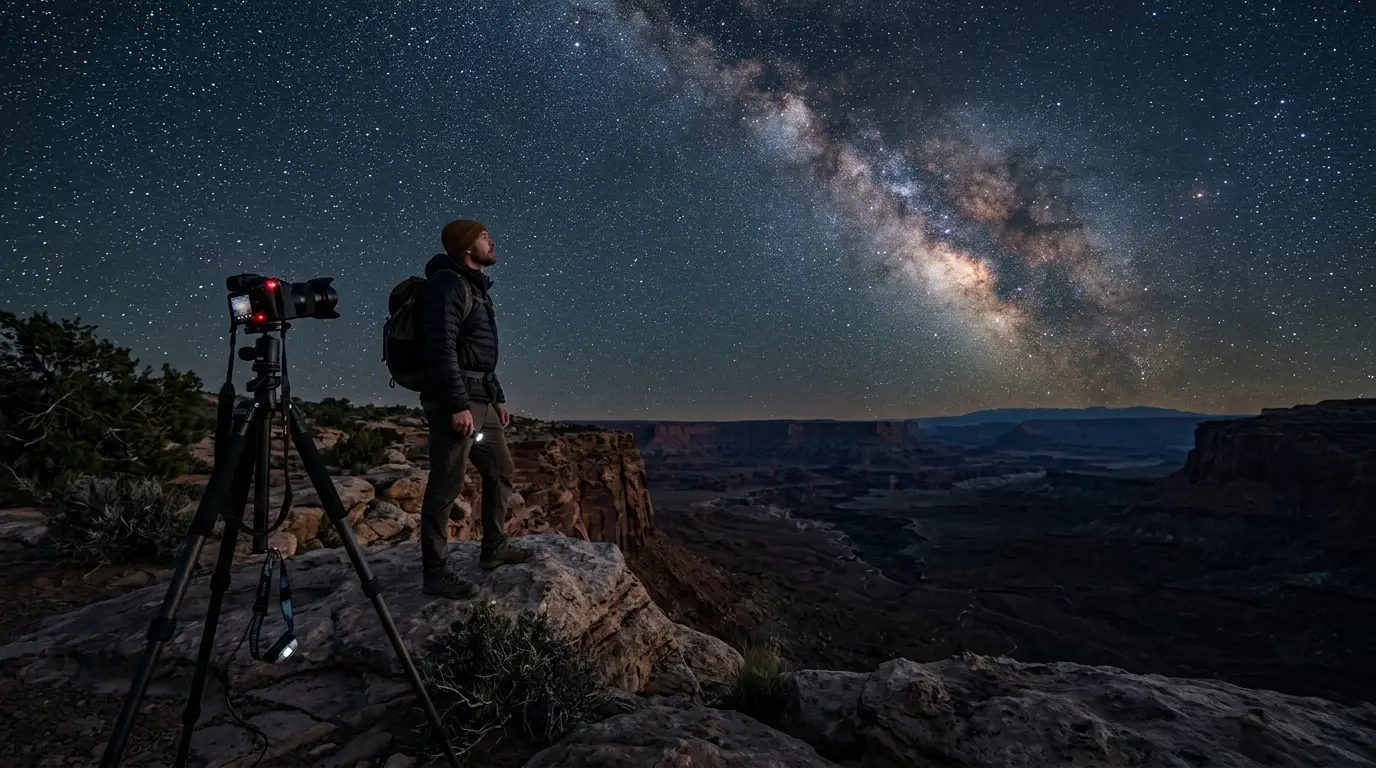
What Is Astrotourism? The Complete Beginner's Guide
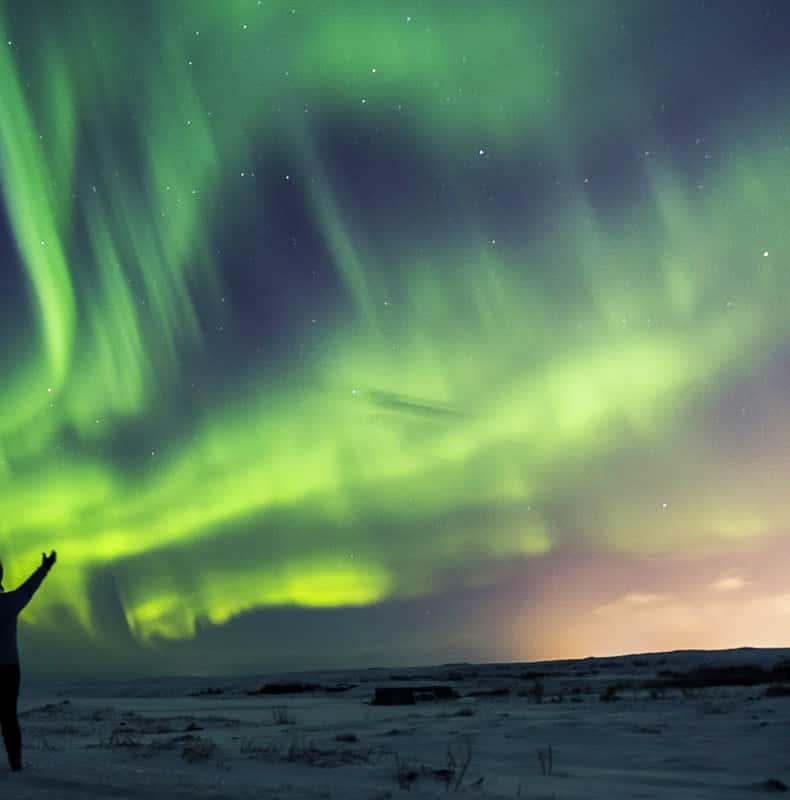
Astrotourism means travel built around dark skies: meteor showers, auroras, the Milky Way. What it means, where to go, and how to plan your first trip.
Recommended tours
Tours are selected for quality, not commission. I earn a small fee if you book — at no extra cost to you.
One note on the final morning: the loop's last day often ends with time to spare before a Vegas flight, and the near-city add-ons, Red Rock Canyon and the Seven Magic Mountains, sit close enough to the airport road to count as a wind-down stop. Or treat them as a reason to come back: the loop is repeatable, and the second run is when you stop driving and start choosing.