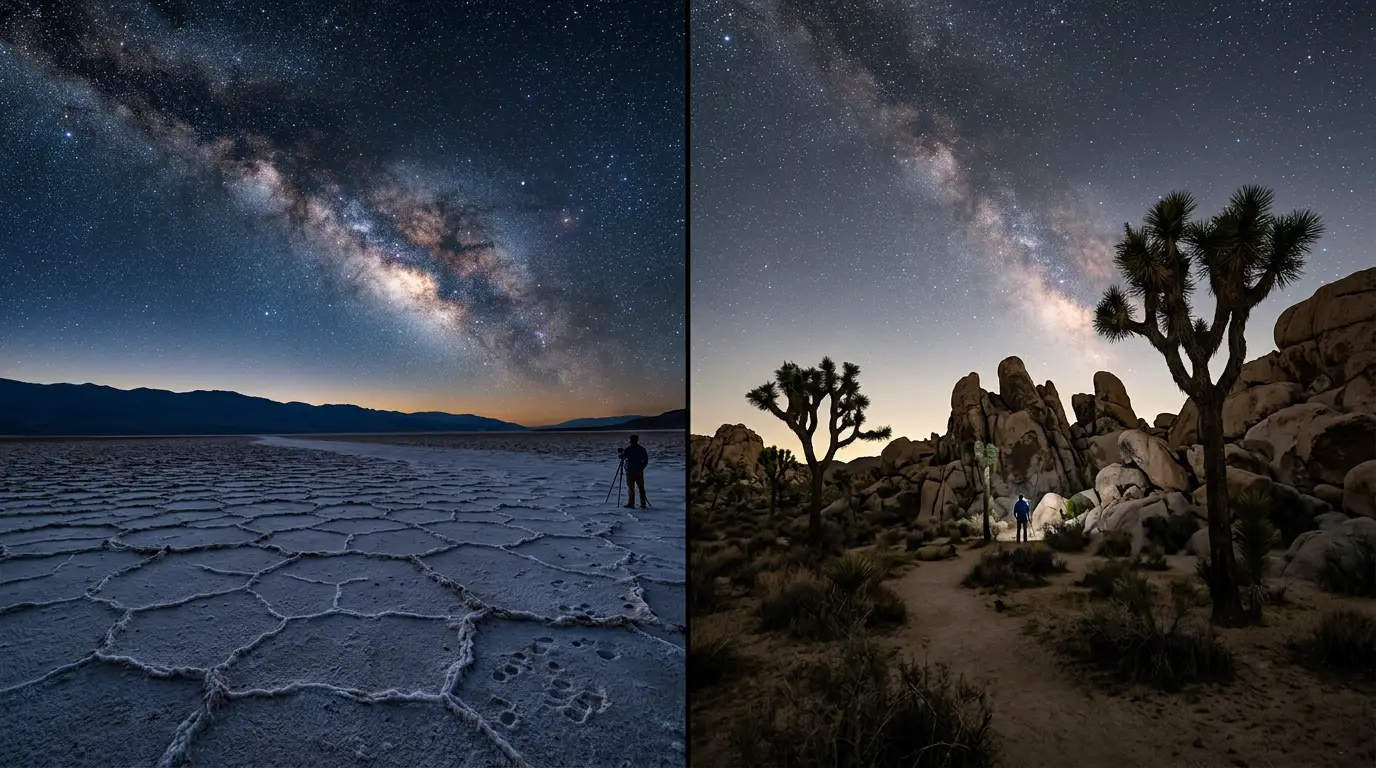
Two Certified Dark Sky Parks, Two Very Different Trips
Death Valley and Joshua Tree share a rare distinction: both hold International Dark Sky Park certification from DarkSky International, a status very few places on Earth ever earn. Death Valley claimed the organization's highest Gold Tier rating[1] in 2013[2]. Joshua Tree followed four years later, in 2017, certified at the Silver Tier level[3], one step below the top rating Death Valley already held.
The tier difference isn't a technicality. Gold Tier demands the strictest measured sky-quality data and the least ambient light pollution of any category DarkSky International awards. Silver Tier still requires real work, including lighting agreements with nearby towns, but tolerates more glow bleeding in from outside the park boundary. That single distinction explains almost everything else in this comparison: how dark each sky actually gets, how far you have to drive to reach it, and how much comfort you're trading away for that darkness.
| Death Valley | Joshua Tree | |
|---|---|---|
| Certification | Gold Tier, DarkSky International (2013) | Silver Tier, DarkSky International (2017) |
| Darkest recorded sky | Bortle class 1 in the northwestern interior | No published Bortle rating; documented light pollution |
| Elevation range | -282 ft to 11,049 ft | High desert; no single published range |
| Distance from Los Angeles | About 4.8 to 5 hours | About 140 miles, 2 to 2.5 hours |
| Best suited for | A dedicated, heat-aware desert trip | A weekend trip with a rental car |
Death Valley's Case: Gold Tier, Bortle 1, and a Landscape That Fights Back
Every superlative attached to Death Valley points the same direction: darker, lower, hotter, more extreme. The park's northwestern interior reaches Bortle class 1, astronomy's darkest classification, described as 'excellent dark sky'[4]. There's nowhere further to go on that scale; Bortle 1 is the ceiling, not a benchmark Death Valley is approaching.
That darkness isn't an accident of remoteness alone. Death Valley's extreme aridity produces exceptional atmospheric transparency, and its vast desert basins provide unobstructed horizon views in every direction[5]. The same dryness that makes the park brutally hot by day is what rewards anyone who stays through the night.
Then there's the elevation. Death Valley spans from 282 feet below sea level at Badwater Basin to 11,049 feet at Telescope Peak[6], a vertical range packed inside a single park boundary that most travelers underestimate until they've actually driven it. Few certified dark-sky parks anywhere ask a visitor to cross that much vertical ground between one overlook and the next.
11,331 feet
The Heat That Comes With the Darkness
None of this comes free. Reaching Death Valley takes real commitment on its own: about two hours from Las Vegas[7], or roughly 4.8 to 5 hours from Los Angeles[8]. Once you're there, the same dryness responsible for the sky is also responsible for the hottest air temperature ever reliably measured on Earth: 134°F, recorded at Furnace Creek on July 10, 1913[9]. Daytime summer highs routinely clear 120°F in the shade.
The honest advice here is to treat the heat as a planning constraint, not a footnote. Carry more water than feels necessary, avoid exertion during peak daytime hours, and check your vehicle before driving into a park where services thin out fast between towns. The Death Valley stargazing hub covers the full safety picture, and the best stargazing spots in Death Valley guide breaks down exactly where inside that vast certified boundary to point a camera.
Joshua Tree's Case: A Real Weekend Trip, With an Advocacy Story
Joshua Tree's whole argument rests on something Death Valley can't match: it sits close enough to Los Angeles and Palm Springs for an actual weekend trip, not a multi-day desert expedition, and it's the reason Joshua Tree shows up on so many first-timer stargazing lists that Death Valley simply doesn't.
That convenience has a cost. Joshua Tree sits close enough to surrounding development that light pollution reaches into the park[10], and the impact isn't even across the boundary: the western half nearest Palm Springs and Palm Desert carries a visible light dome, while the eastern wilderness stays noticeably darker.
What makes Joshua Tree worth telling on its own terms, rather than as Death Valley's lesser cousin, is what the certification actually took to earn. Getting designated required more than measuring the sky that was already there; it meant partnering with the towns of Twentynine Palms, Yucca Valley, and the wider Morongo Basin to reduce lighting impacts coming from outside the park boundary entirely[11]. The Morongo Basin Conservation Association also helped bring about a Light Trespass ordinance for San Bernardino County, which took effect January 6, 2022[12].
Why the Advocacy Story Matters
Unlike a purely protected wilderness, Joshua Tree's dark-sky rating depends on relationships holding outside its own boundary. Growth in Yucca Valley, Twentynine Palms, and the wider Coachella Valley puts ongoing pressure on those lighting agreements, which makes Joshua Tree less a finished certification than a maintained one. Anyone curious how the Silver Tier process actually works, and what keeps it in place, should look into how that certification came together.
Sky Quality Head-to-Head: Bortle 1 vs Light Domes
Strip away the advocacy story and the trip logistics, and the sky-quality gap between these two parks is the whole comparison in miniature. Death Valley's northwestern interior holds the darkest rating the Bortle scale offers, achieved because there's functionally nothing nearby bright enough to interfere with it. Joshua Tree has no equivalent official rating; NPS instead documents specific interference reaching in from three separate metro areas, a textbook light dome effect, worst at the park's popular western overlooks and considerably lighter once you're deep in the eastern wilderness or at Cottonwood Campground.
That's the real difference in plain terms. Death Valley's darkness holds steady across almost the entire certified area, so where exactly you stand inside the park matters less. Joshua Tree's darkness is directional and locational: the gap between a mediocre night and a genuinely dark one comes down to picking the right pullout and driving past the crowd at the popular overlooks. Neither approach is wrong, but they demand different things from a visitor. Death Valley rewards showing up prepared for heat and distance; Joshua Tree rewards knowing which corner of the park to actually park in.
Featured · Destination
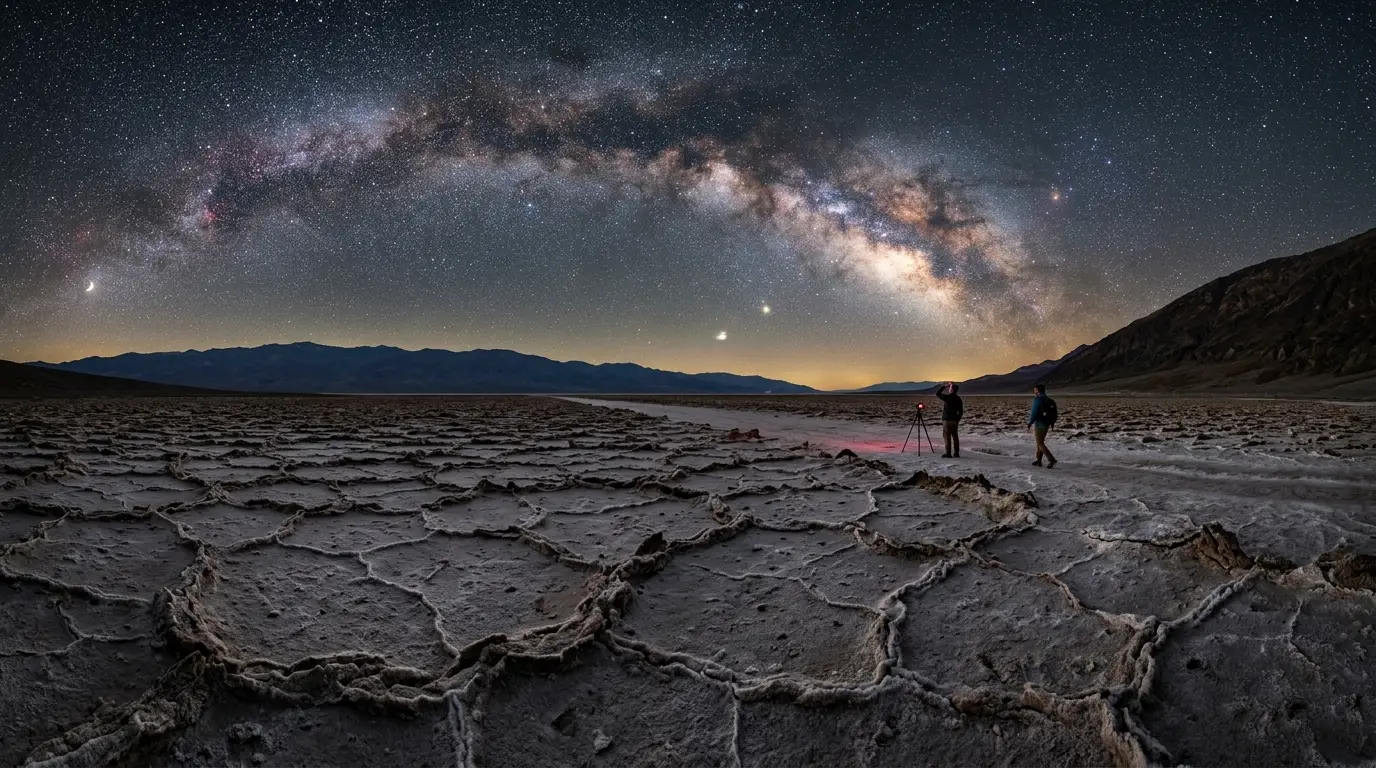
Death Valley
Death Valley's Gold-tier dark sky sits at the lowest point in North America. Here's when to visit, where to stay, and how to handle the extreme summer heat.
Getting There: The Trip Logistics That Actually Decide This
The two trips barely resemble each other once you get past "drive to a desert park." Joshua Tree: fly into Los Angeles or Palm Springs, rent a car, and budget one to two nights. Death Valley: fly into Las Vegas for the shorter drive, or Los Angeles for the longer one, and budget at least two to three nights to make the distance worth it.
A few things worth sorting out before either trip, doubly so for Death Valley:
- Gas up before entering either park; fuel stops are sparse once you're inside, especially in Death Valley
- Cell service is unreliable to nonexistent in both parks after dark
- Death Valley's summer daytime heat is a genuine safety issue, not a comfort one; plan stargazing for the hours right after sunset and avoid exertion at midday
- Check the new-moon window before locking in dates at either park, and build in a buffer night in case cloud cover rolls in
Recommended tours
Tours are selected for quality, not commission. I earn a small fee if you book — at no extra cost to you.
The getting to Death Valley guide covers the exact routes from Las Vegas and Los Angeles, what to check before you lose cell service, and what kind of vehicle actually holds up out there. For a trip that runs both parks as back-to-back legs rather than choosing between them, whether to keep both desert legs in September is worth working out before you book the flights.
The Verdict: Which Park Fits Your Trip
Pick Death Valley if the trip is really about chasing the darkest possible sky and you can handle the heat, the distance, and the extra planning that comes with both. Gold Tier and Bortle 1 aren't marketing language here; they're the measured result of how remote and dry this place actually is. Pick Joshua Tree if the trip needs to fit inside a weekend from Los Angeles or Palm Springs, and a real, if imperfect, dark sky is worth more to you than the absolute darkest one available in California.
A few situations make the choice easier than picking blind:
- A dedicated desert expedition built around the darkest sky available in the Lower 48: Death Valley
- A weekend trip with a rental car and minimal planning overhead: Joshua Tree
- A trip planned around extreme heat safety and genuine remoteness: Death Valley
- Interest in the ongoing light-pollution advocacy story behind a park's certification: Joshua Tree
Featured · Article
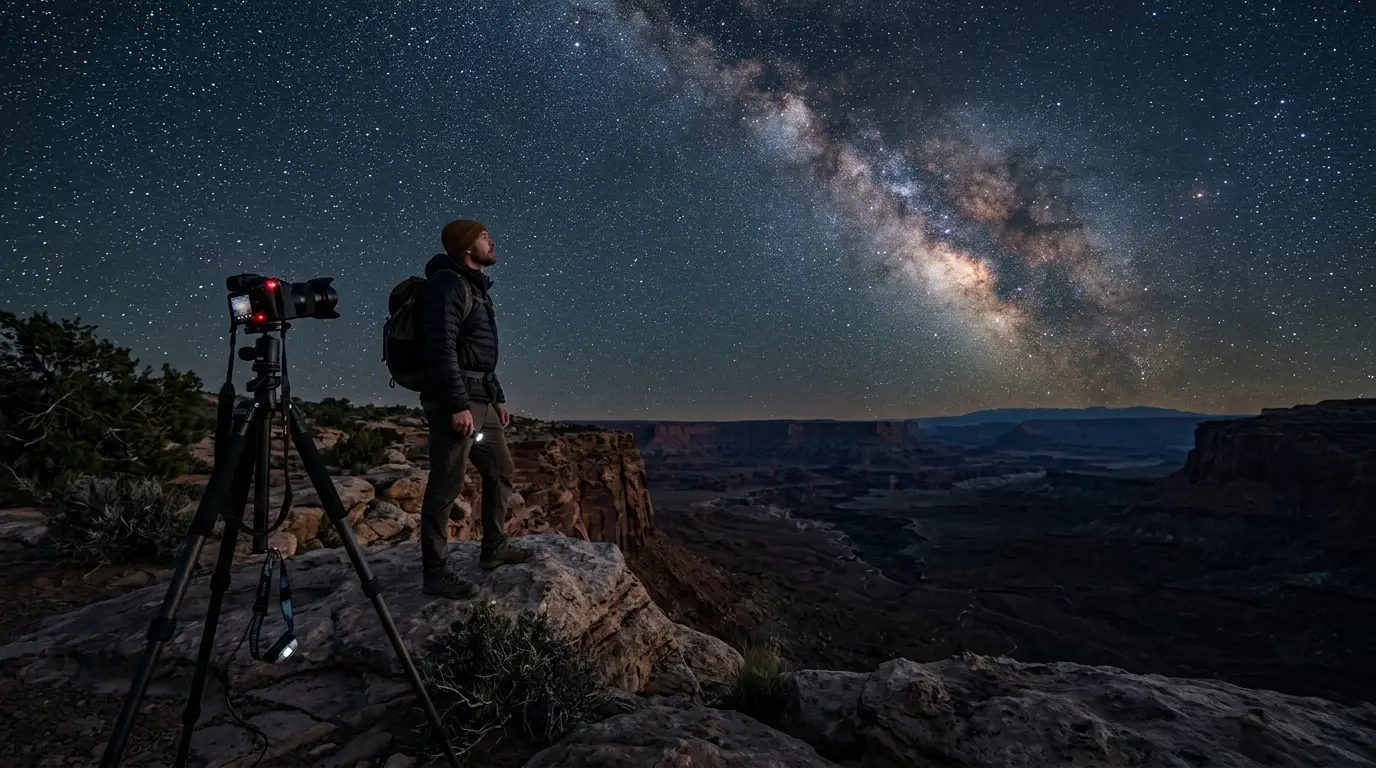
What Is Astrotourism? The Complete Beginner's Guide
Astrotourism means travel built around dark skies: meteor showers, auroras, the Milky Way. What it means, where to go, and how to plan your first trip.
Neither park is secretly the better choice once the marketing gets stripped away. It comes down to how much distance, heat, and planning you're willing to trade for a slightly darker sky. The is Joshua Tree worth it for stargazing piece digs into that trade-off in more depth if Joshua Tree is the park your trip is actually leaning toward, and if it is, the best lodges for Joshua Tree stargazing ranks where to stay for the weekend.