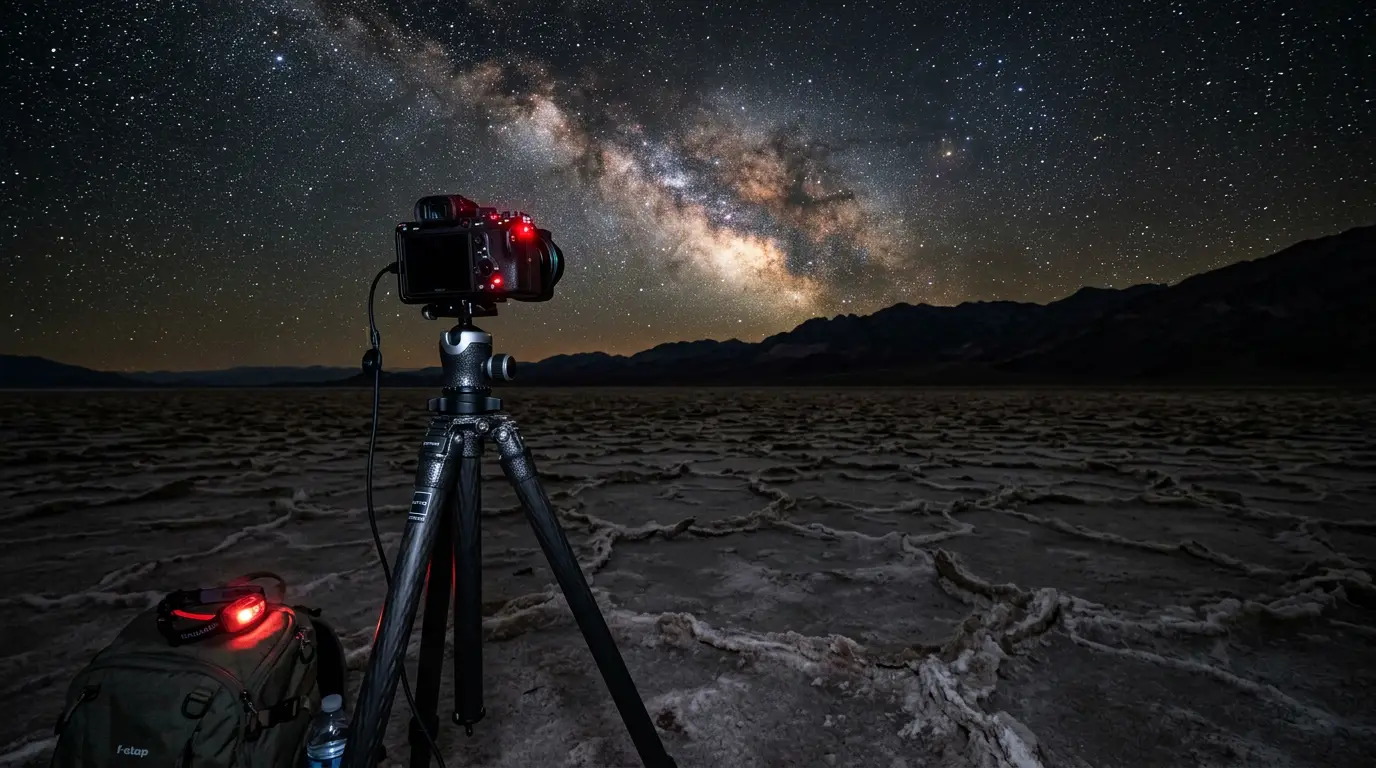
Why Death Valley Needs Dedicated Camera Gear
Point a phone at the Milky Way over Badwater Basin and the sensor mostly gives up: a faint gray smear where the galaxy's core should be. A dedicated camera does the one thing a phone can't: hold a long exposure open at a wide aperture long enough to pull real structure out of a band of light the naked eye sees only as a soft haze. If a phone really is the only camera in the bag, my guide to Death Valley stargazing photos with your phone covers what Astrophotography mode can and can't do here, and stargazing gear for beginners covers the same question for any dark-sky trip; everything below assumes a mirrorless or DSLR body.
Death Valley earns the extra gear. It holds Gold Tier certification from DarkSky International, the top rating the organization awards, and it also holds a much less flattering record: the highest reliably recorded air temperature on Earth, 134°F in July 1913[1]. One of the darkest skies in North America sits directly on top of one of its most hostile climates, and that combination is the entire reason this gear list looks different from a cold, high-elevation park.
What follows covers camera body and lens choice built for both the Milky Way and Death Valley's dust, the manual settings that separate a sharp shot from noise, how Badwater Basin and the Mesquite Flat dunes change a composition, and the heat, dust, and condensation care a cold-weather guide simply doesn't need to mention. For the wider trip-planning picture beyond gear, stargazing in Death Valley covers seasonal timing, ranger programs, and where to stay.
Camera and Lens: Aperture, Focal Length, and Weather Sealing
Aperture is worth spending real money on before anything else. An aperture of f/2.8, or the widest your lens allows, is the standard setting for Milky Way photography[2], since a wider opening pulls in more light without pushing ISO, and the noise that comes with it, any higher than necessary. A kit lens capped at f/4 or f/5.6 will still record the Milky Way here on a clear, moonless night, just with more visible grain in the shadow detail of a salt-flat foreground.
Focal length decides how much sky, and how much foreground, lands in the frame. Roughly 14mm to 24mm on a full-frame body is the standard wide-angle range for Milky Way landscape shots[3], and it happens to match, independently, the working kit photographers actually pack for Death Valley: fast prime lenses in that same range rather than a slower zoom[4]. A prime buys the widest aperture available at a given focal length; a zoom covering the same range almost always costs a stop or two of light to get there.
The desert adds a requirement a mountain park doesn't. Fine salt and windblown sand get into everything at Badwater and the dunes, and weather-sealed lenses are worth the premium if regular desert shooting is the plan rather than a single trip[5]. A cheaper, unsealed lens will still work for one night out; it just won't stay clean for a second.
14mm-24mm
Foreground Composition: Badwater Basin and the Mesquite Flat Dunes
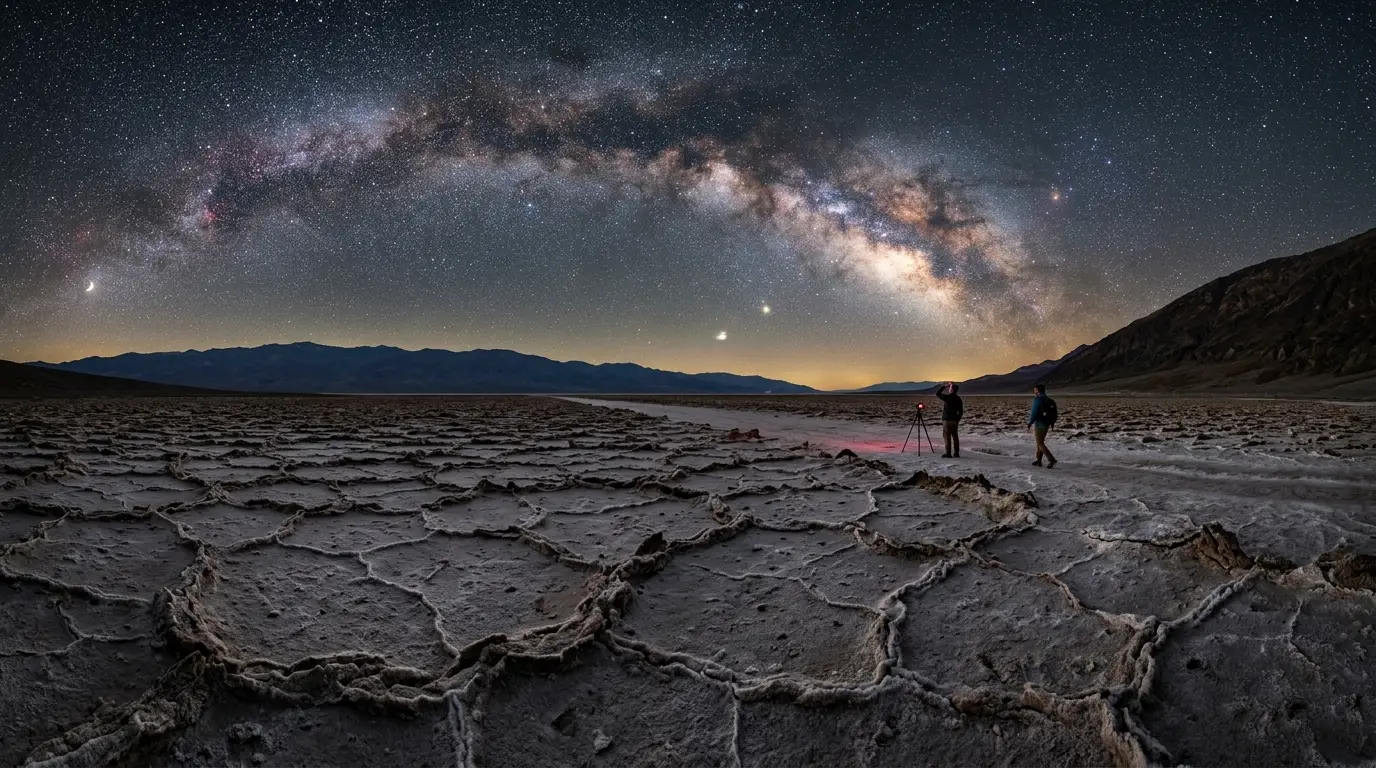
A galaxy core over a featureless dark rectangle is a night-sky photo anyone can take from a parking lot. Death Valley hands photographers two foregrounds that actually earn a frame. where to actually set up in the park covers distances, access, and which of the park's named spots suits a given night; this section is about what to do with a camera once you're standing at one of them.
Badwater Basin's salt pan does something a rock formation or a tree line can't. After rain leaves even a thin, still skin of water across the crust, the flat pan can turn genuinely reflective, doubling the Milky Way in the frame under the right light and moisture conditions. It won't happen on every visit; the pan needs that thin, still layer of water or dampness to reflect cleanly. On a night it does, the effect is unlike anything the dunes or a rim overlook can offer.
Mesquite Flat Sand Dunes, near Stovepipe Wells, trade that reflective flatness for texture: rippled sand that holds shadow and shape under even a sliver of moonlight, a foreground with real relief instead of a flat line. Get low, at or near sand level, and a single dune ridge can carry the whole bottom third of a frame without needing anything else in it.
Featured · Destination
Death Valley
Death Valley's Gold-tier dark sky sits at the lowest point in North America. Here's when to visit, where to stay, and how to handle the extreme summer heat.
A tripod matters as much as the lens choice at either spot. Sand doesn't hold a leg the way solid ground does, so twist each leg down until it's genuinely seated rather than just resting on the surface, and skip extending the center column if there's any wind at all. Both the salt pan and the open dune field catch a breeze with nothing around to block it. Material matters less than making sure the thing is actually locked down; test the setup in the real wind at the spot before committing to a long exposure sequence.
Manual Settings for the Milky Way Core
Start with ISO 3200 to 6400, the typical range for Milky Way photography[6], and adjust from there depending on how wide your aperture runs and how long your shutter is already open. A brighter aperture buys room to bring ISO down; a narrower one pushes toward the top of that range, and toward more visible noise in the final file, before the desert's own heat adds any grain of its own.
Shutter speed has a hard ceiling before stars stop looking like points of light and start streaking. The 500 Rule, 500 divided by your lens's focal length, gives the maximum exposure time before that trailing becomes visible[7]. A 14mm lens tops out around 35 seconds; a 24mm lens buys roughly 20 before the same blur creeps in.
Two habits matter as much as any number on the dial. Shoot RAW, not JPEG, so the shadow detail in a salt-flat or dune foreground survives editing once you're home; a compressed file throws that data away before you ever open it. And switch to manual focus locked at true infinity before the first frame. Autofocus hunts uselessly in near-total darkness, and heat shimmer rising off a still-warm salt pan can throw off contrast-based autofocus even worse than the dark alone.
| Focal length | 500 Rule max exposure | Typical ISO |
|---|---|---|
| 14mm | ~35 seconds | 3200-6400 |
| 20mm | ~25 seconds | 3200-6400 |
| 24mm | ~20 seconds | 3200-6400 |
Timing and Battery Care: When the Heat Works Against You
Camera care in Death Valley starts with when you shoot, not what's in the bag. Summer nights offer little relief from the day's heat, hot enough that both the photographer and the gear are working against the clock rather than the dark. Spring and fall nights run cooler and are the more forgiving windows for a long session, though even then the valley floor rarely gets what most people would call cold.
Elevation changes the math more than season does. Even in summer, Death Valley's valley floor holds onto its heat after dark, with days reaching up to 130°F and nights only cooling into the 90s[8], while a night up at Racetrack Playa or Dante's View, both well above the valley floor, runs noticeably cooler and drains a lithium-ion battery faster. Carry two or three spares regardless of where you're shooting and keep them warm against your body rather than in an outer bag pocket, the same habit any cold-weather astrophotography guide recommends, since a battery already stressed by the day's heat has less margin left once a cooler night at elevation starts pulling the other direction.
Featured · Article
Stargazing Gear for Beginners: Binoculars to Telescopes
New to stargazing gear? This guide breaks down binoculars, telescopes, and smart telescopes, so you know what to buy first and what to skip for right now.
None of this is a reason to skip a summer night entirely. It's a reason to shoot right after sunset, once the day's heat has stopped climbing and before the ground has fully released it, and to treat the gear the same way you'd treat yourself: less time in direct exposure, more breaks, and a plan that doesn't depend on everything running for hours straight. Best time to stargaze in Death Valley breaks down exactly which months and moon phases suit a longer session versus a quick one.
Dust, Condensation, and the Night-Shoot Checklist
Sand and salt don't wait for wind to show up. Fine salt and sand settle on front elements even on calm nights at Badwater and the dunes, so check and wipe the front element between exposure sequences rather than assuming a still night means a clean lens[9]. Never change lenses out on the valley floor if there's any breeze at all; the particulates that get inside a body during a lens swap are the ones that end up on the sensor for good.
Recommended tours
Tours are selected for quality, not commission. I earn a small fee if you book — at no extra cost to you.
Condensation is the quieter risk, and it shows up indoors, not out. Moving a camera straight between an air-conditioned vehicle and the hot air outside, or the reverse after a cold night shoot, causes condensation on the lens, sensor, and internals[10]. Seal the camera in its bag before making that jump either direction, and give it roughly thirty minutes to acclimate before opening the bag again.
A short kit prevents most of the rest before it starts:
- Keep gear sealed in its bag until the moment of use, and clear dust with a rocket blower rather than compressed air
- Mount a lens hood and a UV or clear filter as a sacrificial barrier over the actual glass
- Carry a microfiber cloth for the front element and check it between every few frames at Badwater or the dunes
- Pack two or three spare batteries, kept warm against your body on any higher-elevation stop like Dante's View or Racetrack Playa
Staying at Stovepipe Wells Village puts a warm room within a short drive of the Mesquite Flat dunes, exactly the kind of window where a sealed bag and a little patience save a sensor. For a guided version of all of this, the Death Valley astrophotography workshop walks photographers through camera settings and composition at Racetrack Playa over a full weekend, with someone who's already made the mistakes described above. For composing around the sailing stones' trails specifically, see shooting the sailing stones at Racetrack Playa after dark.