Why the Sailing Stones of Racetrack Playa Actually Move
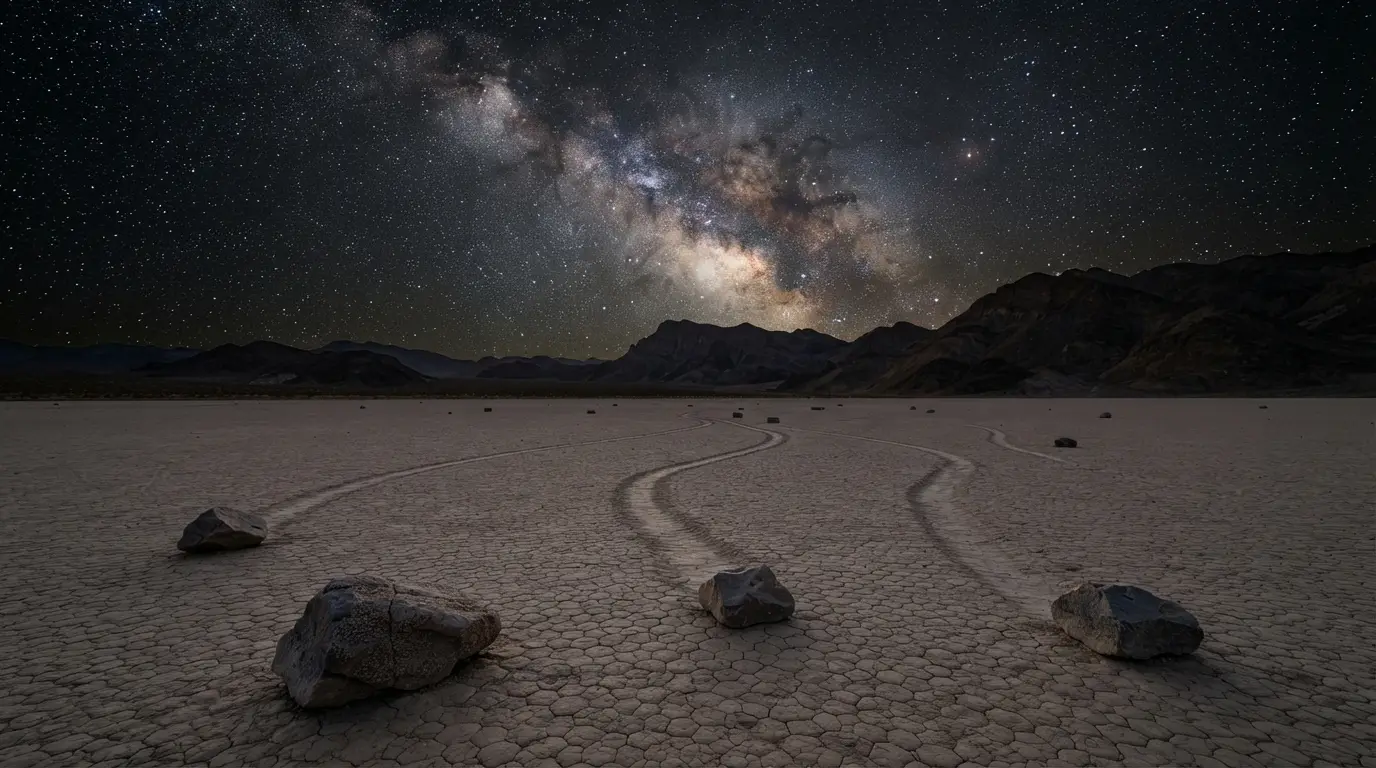
The mystery is older than most explanations proposed for it. Stones scattered across the playa's dry lakebed drag out trails stretching for dozens of meters, some curving, some doubling back on themselves, and for decades the leading theories ran from dust devils to magnetic fields to practical jokers with ropes. The truth turned out less exotic: the movement had been the subject of speculation for almost a century, because nobody had actually watched a stone move[4].
That changed after planetary scientist Ralph Lorenz teamed up with paleobiologist Richard Norris and his cousin James Norris, who fitted fifteen rocks with GPS trackers and installed a weather station on the playa in winter 2011[2]. Two years later, in December 2013, a rare combination of rain, freeze, and light wind finally gave the waiting equipment a direct recording of the phenomenon.
~100 yrs
The mechanism the data confirmed is thin-ice sailing, not wind alone scraping bare rock across dry mud. Light rainfall had covered the playa with a shallow layer of water that froze overnight into a thin ice sheet; as the sun rose, that sheet cracked into loose, floating panels, and a light wind under 5 meters per second pushed the ice-and-rock rafts across the slick surface beneath[5]. The rocks weren't sliding on mud — they were riding rafts of ice, dragged by wind stress transmitted through the floating sheet[6].
Once moving, a stone could cover real ground. Field data recorded speeds up to roughly 15 feet per minute during active events[3], fast enough to watch happen in real time, if you happened to be standing there at 3 a.m. in December with a weather station running. Nobody had been, until December 2013.
Getting to Racetrack Playa: The Drive from Furnace Creek
The drive from Ubehebe Crater to the stones runs in four stages:
- Ubehebe Crater: where Racetrack Valley Road begins[7]
- Teakettle Junction, 20 miles in: the first checkpoint[7]
- Grandstand parking area, at the 26-mile mark: the north end of the Racetrack itself[7]
- The stones, 2 miles farther south, then a half-mile walk toward the southeast corner of the playa for the best views of the rocks and their trails[9]
Skip the summer drive
Death Valley summer days can reach 130°F, with nights staying near 90°F[12]. That heat turns a mechanical problem on an empty road into a medical one, so plan this trip for fall through spring instead.
Budget the whole day for getting there and back. Drive time from Furnace Creek is at least 3.5 hours each way, and there's no cell coverage anywhere along the route[10]. If something goes wrong out here, it goes wrong alone.
Camping vs. Day Trip: Planning Your Own Racetrack Visit
The permit and vehicle questions are settled elsewhere: no permit exists for Racetrack Playa, and a high-clearance 4x4 is the vehicle you want for the drive, both covered in the Death Valley stargazing FAQ, alongside where to go for stargazing in Death Valley National Park if the Racetrack itself isn't in your plans this trip. What that FAQ doesn't answer is what you actually do once you're standing on the playa after dark, and that comes down to one choice: day trip or camp.
A day trip means timing your arrival for the hour around sunset, shooting for an hour or two once the sky goes properly dark, and then driving back out the way you came, tired, on a road that doesn't get safer at night. It's the lower-risk option, and it still delivers the point of the trip: a look at the stones and their trails under a sky with essentially no artificial light to compete with.
Featured · Destination
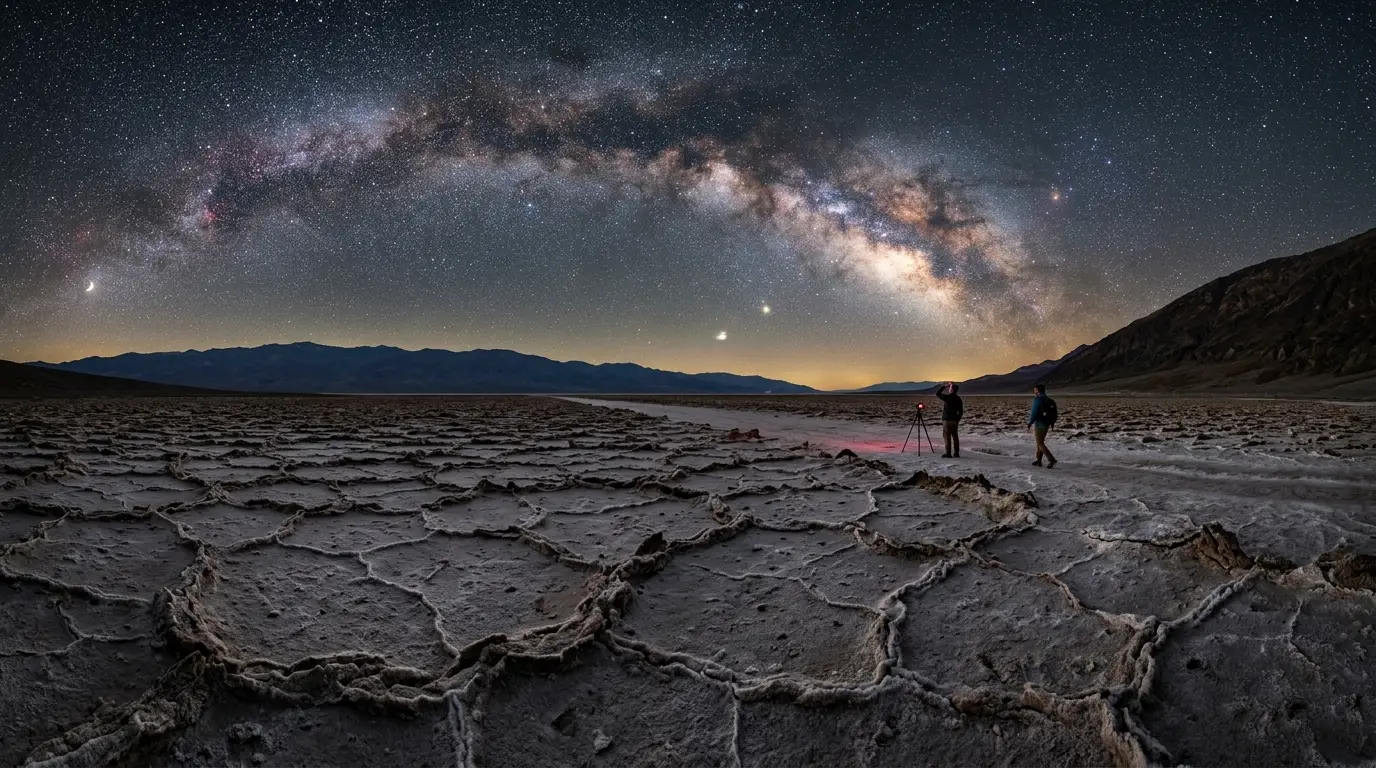
Death Valley
Death Valley's Gold-tier dark sky sits at the lowest point in North America. Here's when to visit, where to stay, and how to handle the extreme summer heat.
Camping turns that same trip into an overnight. A primitive, no-facilities site (sources refer to it as Homestake or Homestead Flat, so check current signage with a ranger before you commit) is the nearest camping option to the playa, about 3.1 miles (5 km) away[13]; camping elsewhere is restricted to designated dispersed backcountry sites, not the playa. No water, no bins, pack out everything you bring in. The payoff is a full night under the sky instead of a couple of stolen hours, plus a second look at the stones in different light the next morning.
Whichever you pick, the road punishes stock tires: sharp washboard gravel shreds them fast. Carry a full-size spare if you have one, and a second if there's room. A flat 30 miles from the nearest help is a logistics problem, not an inconvenience.
Playa Etiquette: Why You Never Walk the Trails
Racetrack Playa is a functioning geological record, and the ground itself is the fragile part. Driving anywhere off the established road, including onto the playa surface, is prohibited[14], because the crust that holds the trails intact can't take a tire and won't recover if it does.
Recommended tours
Tours are selected for quality, not commission. I earn a small fee if you book — at no extra cost to you.
The same rule extends to the stones themselves and the trails they've cut. Don't touch a stone, don't nudge it back into its own groove for a better photo, and don't walk the trail line even when it looks like solid ground. The mineral crust records footprints the same way it records the tracks it was formed to show, and there's no undoing a boot print once it sets.
Never step on wet mud
After rain, the playa turns to mud, and a footprint pressed into it can scar the surface. Approach the stones on foot only when the ground is dry, and stay off entirely if it isn't[15].
None of this is really a restriction so much as the whole reason to come. A playa that visitors had trampled for decades wouldn't have any trails left to study, let alone photograph. Treat the ground the way the researchers who finally solved this mystery had to: watch, don't touch.
Photographing the Sailing Stones Under the Milky Way
Racetrack Playa's isolation puts it inside a park that holds DarkSky International's Gold Tier certification, the highest rating the organization awards[16]. Death Valley was only the third U.S. national park to earn an International Dark Sky Park designation[17]. That matters more here than at a typical overlook, because the composition photographers actually want depends on genuinely dark sky at the edges of the frame, not just overhead.
The trails themselves are the reason to shoot here rather than anywhere else in the park. They radiate out from their stones in every direction, so there's a trail pointed at wherever you need it: sunrise, sunset, moonrise, moonset, or the Milky Way core[18]. Pick a rock whose trail runs toward the section of sky you're shooting and it becomes a leading line, pulling the eye from foreground rock to the galaxy overhead.
Getting that shot usually means arriving well before dark to scout the composition in daylight, since the trails are far easier to read while you can still see the whole playa. Most photographers who've shot it well end up blending or compositing multiple exposures, one for the foreground rock and trail, one for the sky, rather than relying on a single frame to hold both[19]. Bring a headlamp with a red-light mode for the walk back and a sturdy tripod for the low-light foreground exposure. For camera body and lens choices beyond this one shot, see Death Valley astrophotography gear.
Is Racetrack Playa Worth the Detour?
For most visitors to Death Valley, the answer is no, not because the sky is any less dark, but because the round trip costs most of a day or a full overnight for a payoff you can't rush and can't guarantee if no rock has moved during your visit. See the best stargazing spots in Death Valley for options that don't demand a rough road and a spare tire.
For a smaller group, stargazers already committed to seeing Death Valley properly, photographers chasing a shot nobody else has, or travelers who want the story of standing where a century-old mystery finally got solved, it's worth the drive. The stones don't move often, and most visitors won't see one in motion. What they will see is the trail it left, under a sky dark enough to make that trail feel like the point rather than a curiosity. Check the Death Valley stargazing forecast before committing to the rough road out here; a cloudy or moonlit night undercuts the whole trip in a way a flat tire alone doesn't.
Featured · Article
What Is Light Pollution? Definition, Types, and Solutions
Light pollution is artificial light brightening the night sky, affecting 80% of the world. Learn the 4 types, wildlife and health effects, and how to fix it.