Why Death Valley's Sky Timing Actually Matters

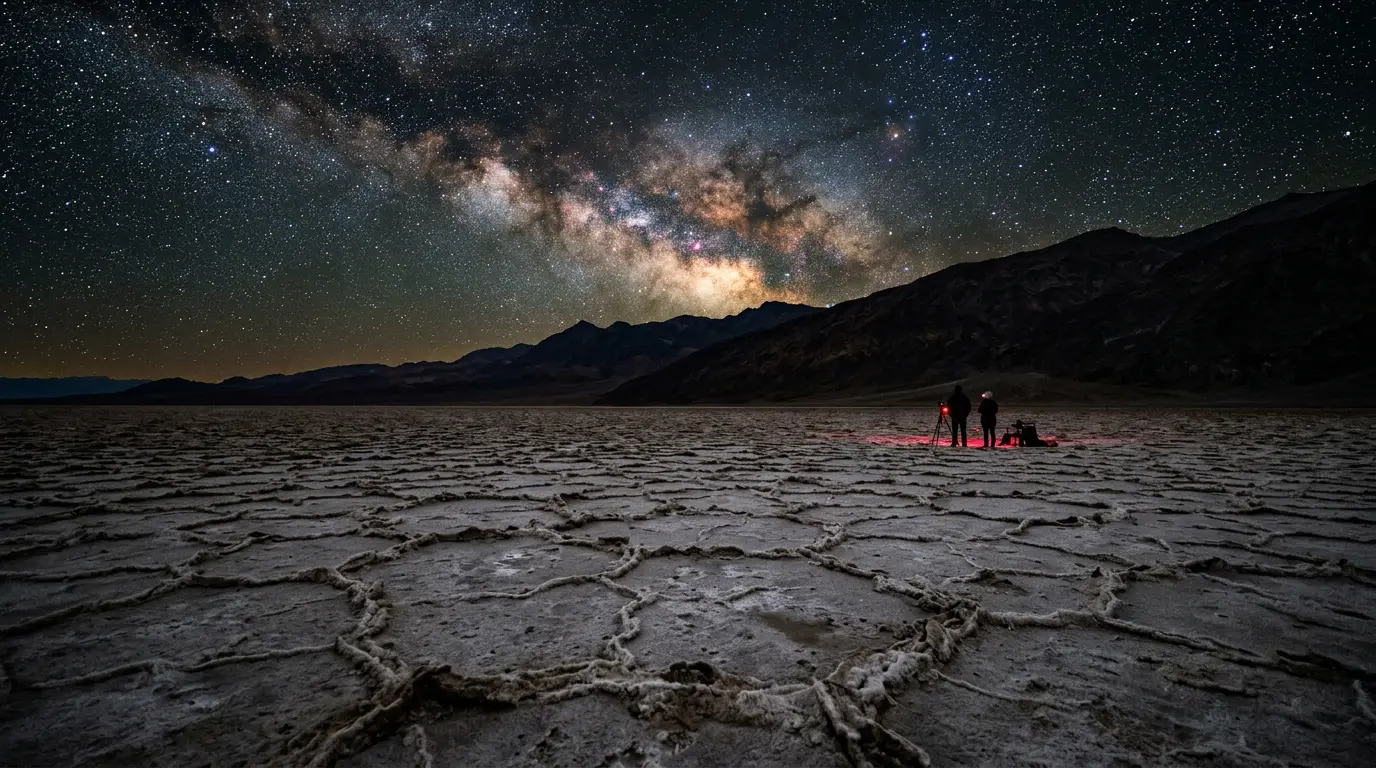
Death Valley holds Gold Tier designation from DarkSky International and the National Park Service, the top rating the certification offers[1]. That's not a marketing label. It's a measured claim about how dark the sky gets here on a clear, moonless night, dark enough that the full arch of the Milky Way shows up overhead without a telescope, binoculars, or any other gear.
What makes timing genuinely tricky is the desert's split personality. The same valley known for some of the country's most extreme summer heat also delivers some of the calmest, coolest desert nights for most of the rest of the year. The stargazing calendar and the comfort calendar line up for one long stretch, October through April, then pull apart for the remaining months.

None of that makes Death Valley a half-year park. The right night here depends on what's driving the trip:

  • Comfort and easy planning
  • The sharpest Milky Way core geometry
  • A specific meteor shower
  • A workaround for summer's daytime heat
Each has its own window, covered section by section below.

October to April: The Season Everyone Books

If comfort matters more than perfect Milky Way geometry, book somewhere in October through April, though "mild" swings more than the season's reputation suggests. Daytime highs run from the low 90s°F at the October and April edges down to the mid-60s°F in December and January, and nights follow the same curve: the 50s°F in fall and spring, dropping to the high 30s and low 40s°F at the coldest point of winter[2]. December and January call for real cold-weather layers, not just a light jacket, but nowhere near cold enough to cut a night on the valley floor short.
This is also the one stretch where Death Valley's temperature and its darkness point the same direction. New moon periods inside these cooler months line up with the calmest weather of the year[3], so checking a lunar calendar before booking dates does double duty here: dark skies and comfortable nights, together. Our guide on when to stargaze covers how to read that lunar calendar against a season, worth a look before you lock in dates.
SeasonTypical night tempsBest forTrade-off
Oct-AprHighs low-90s°F (Oct/Apr) to mid-60s°F (Dec/Jan); nights 50s down to high-30s/low-40s°FComfortable, easy planningBusiest season, book lodges early
Mar-early MayManageable, warming fastMilky Way core positionNarrower window, plan around new moon
Summer (Jun-Aug)Cools to the 90s after a 130°F dayMeteor showers, empty parkGenuine heat risk before dark
It's also, unsurprisingly, the park's busiest season. Furnace Creek and Stovepipe Wells fill with day-trippers chasing the same mild weather, so the real payoff comes after dark, once the crowds thin and the valley empties out toward the horizon.

March to Early May: The Milky Way's Sweet Spot
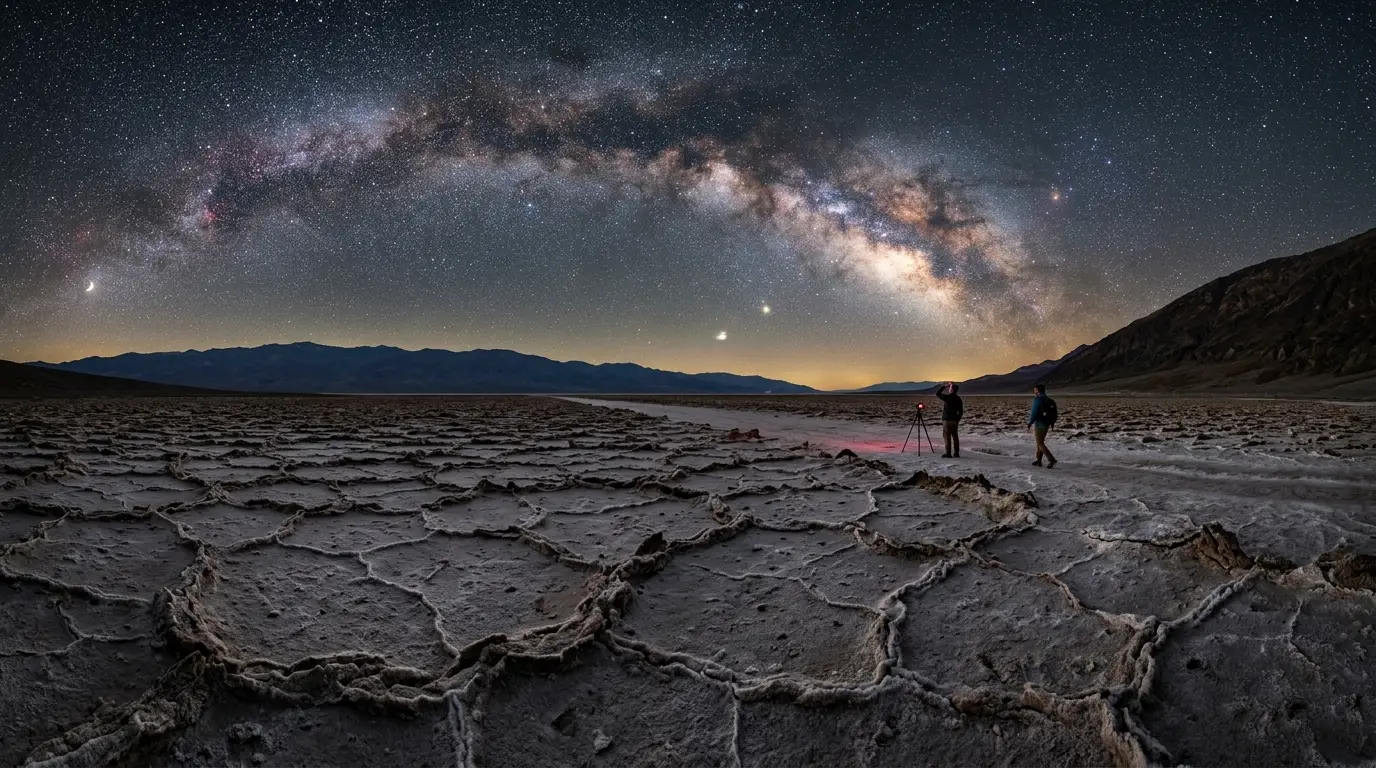
For the sharpest look at the Milky Way's galactic core, narrow the window further: March through early May is the stretch astronomy guides and astrophotographers both point to, driven by geometry more than weather. As Earth moves through this part of its orbit, the core climbs higher and stays visible longer after dark, and temperatures are still manageable rather than the punishing heat that arrives by June[4].
The trade-off is a shorter runway. Miss this window and you're either back in the cooler, more crowded October-through-April stretch with a lower core position, or into summer's heat-management calculus. A handful of clear, new-moon nights inside six weeks is a tighter target than the broader cool season, so this is the trip worth booking around a specific date rather than a loose range.

Featured · Destination

Abisko Stargazing

Abisko's rain-shadow microclimate keeps skies clear when nearby Arctic spots cloud over. Aurora season, the Sky Station, ICEHOTEL, and getting there by train.

None of this requires special gear to notice. A wide-angle phone camera on a tripod, or just patient eyes after 20 minutes of dark adaptation, is enough to see the core's dust lanes stand out against the rest of the band once the moon is down. Our Death Valley Stargazing hub tracks current sky-quality notes and the park's best pullouts for this exact window.

Summer Nights: The Paradox of Death Valley Heat

Summer in Death Valley earns its reputation. Daytime temperatures can reach 130°F, and even after sunset the air can stay near 90°F[6]. And yet, once the sun is down, the same nights that make daytime hiking dangerous turn into some of the year's most pleasant stargazing conditions: temperatures drop fast after dark, the park empties out, and the sky stays every bit as dark as it does in cooler months[5].
That paradox is real, but it doesn't cancel out the risk that comes before dark. Anyone visiting in June, July, or August needs to treat the drive in, the wait for sunset, and the walk back to the car as seriously as the stargazing itself. The National Park Service is direct about what that means in practice.
Milky Way visible above Death Valley's Badwater Basin on a warm summer night, illustrating why nighttime stargazing stays pleasant despite Death Valley's extreme daytime heat

Milky Way visible above Death Valley's Badwater Basin on a warm summer night, illustrating why nighttime stargazing stays pleasant despite Death Valley's extreme daytime heat

How Much Water to Bring

The National Park Service recommends at least one gallon of water per person per day as a baseline[7]. Many experienced summer visitors carry double that or more once daytime highs climb into the 120s, treating the NPS figure as a floor rather than a fixed target. Water stations exist at three points inside the park[9]:

  • Furnace Creek
  • Stovepipe Wells
  • Panamint Springs
They're not evenly spaced across the park's back roads, so the safe assumption is to carry everything you'll need before you leave pavement, not to plan on refilling along the way.

Recognizing Heat Exhaustion

Know the symptoms before you need them: nausea, vomiting, fatigue, headaches, cramps, and pale, cool, clammy skin[8]. Any of these after time outside in summer heat is a signal to get to shade, water, and air conditioning immediately, not to push through for one more photo.

Prepping Your Vehicle for the Drive

Treat the vehicle itself as part of the safety plan. The National Park Service specifically advises carrying proper tire-changing equipment, since tow companies can be hours away from remote park roads[15]. It's also worth topping off the tank, checking coolant, and carrying extra water separate from what you're drinking, in case a breakdown puts you on the shoulder of a back road rather than at a visitor center. None of Death Valley's triple-digit temperatures forgive an overheated radiator or a flat tire without a spare.

Meteor Showers Worth Timing Your Trip Around

Two showers are worth building a Death Valley trip around, and their calendars land in opposite seasons.
The Geminids peak December 13-14 with a zenith hourly rate near 150 meteors, the strongest annual shower[10], and 2026 favors this peak specifically: a waxing crescent moon sets by mid-evening, leaving the rest of the night dark for meteor watching[11]. That timing lands the Geminids squarely inside the park's cool, comfortable season, so a December trip can combine the shower with the mild temperatures already covered above.
The Perseids peak August 12-13, with rates often reaching 100 meteors an hour[12], and 2026 conditions favor this peak too: the moon is new on August 12, giving a fully dark sky for the entire peak night[13]. That puts the Perseids squarely inside summer's heat-management window, so anyone chasing this shower needs to layer the meteor-watching plan on top of the same water, timing, and vehicle prep covered above, not treat it as a separate trip with separate rules.
Timeline
  1. Aug 12-13

    Perseid peak

    New moon in 2026 gives a fully dark sky for the shower's peak night, with rates often reaching 100 meteors an hour.

  2. Dec 13-14

    Geminid peak

    The year's strongest shower, with a waxing crescent moon setting by mid-evening in 2026, leaving the rest of the night dark.

Either shower rewards patience over gear: no telescope helps with a meteor shower, only a dark-adapted eye, a reclining chair, and roughly 20 minutes away from any screen or headlamp before the rate starts to feel real.

Ranger Programs and Putting a Trip Together
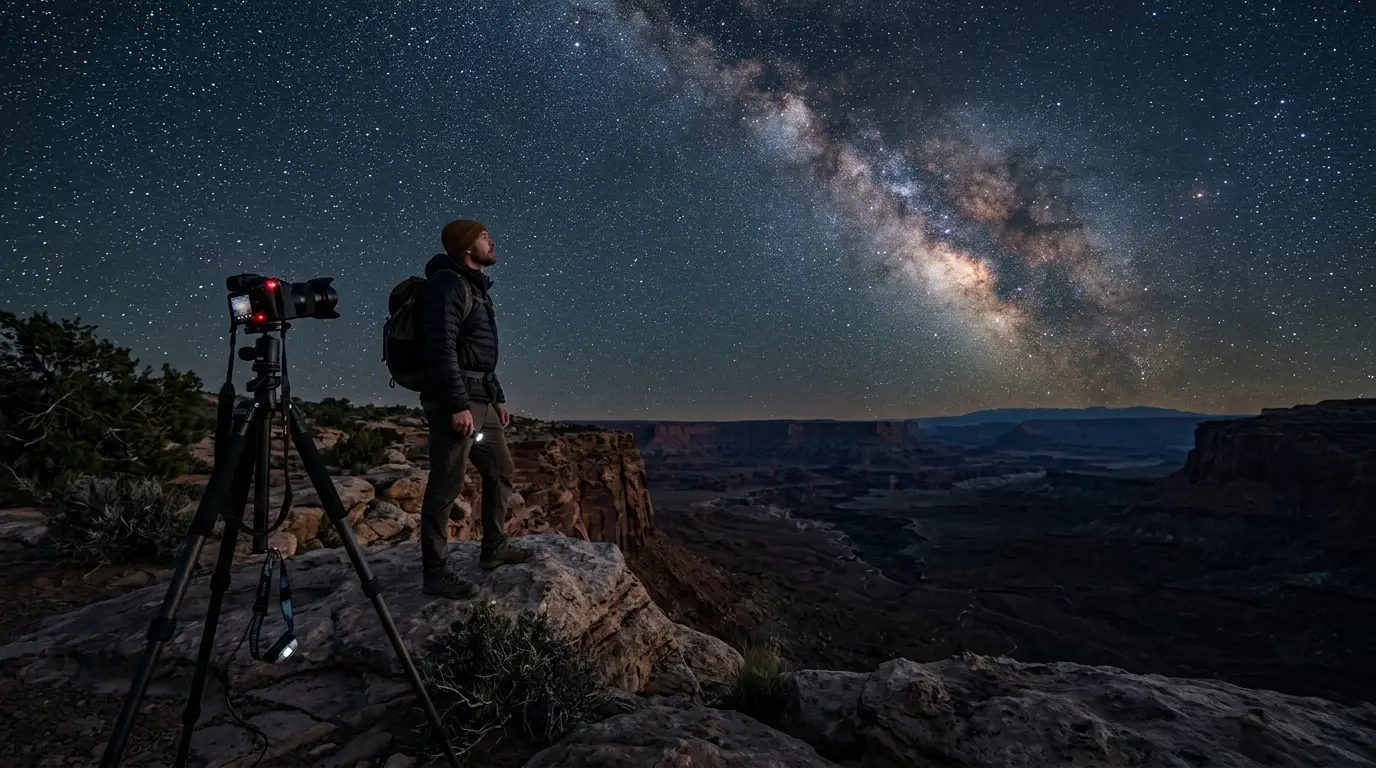
Death Valley runs Night Sky Talks each season from mid-November through mid-April, with programs held daily from December through March[14], a free, guided way to learn the sky before finding a dark pullout on your own. Schedules are posted at nps.gov/deva roughly a week ahead and can shift with staffing or weather, so check dates close to your trip rather than locking a night in months out.
Whatever season you land on, moon phase decides more than the calendar does. A cloudless night three days after full moon can wash out the same core a new-moon night the week before showed off in full detail, and working through that mechanic in more depth than fits here is what the Death Valley Stargazing Forecast is built for.
For where to stay, The Inn at Death Valley puts you inside the park with an easy walk to dark ground after the restaurant closes, while Best Lodges for Death Valley Stargazing rounds up the full range of options, from that historic property down to budget-friendly bases outside the park boundary. Book the season first. Lock the exact night once you're within a few weeks of it, and treat the heat plan as non-negotiable if summer is the trade-off you're making.

Featured · Article

What Is Light Pollution? Definition, Types, and Solutions

Light pollution is artificial light brightening the night sky, affecting 80% of the world. Learn the 4 types, wildlife and health effects, and how to fix it.