What the Naked Eye Actually Sees in Death Valley
The honest answer to what the Milky Way looks like in Death Valley is that the real thing is quieter than the photographs, and better in a way photos can't reproduce. On a clear, moonless night the band runs overhead as pale, gray light with real structure, brightest toward the galactic center, and the park's interior is so dark that it measures Bortle 1, the darkest class on the scale, where the Milky Way casts a visible shadow[1]. That shadow is your first clue that you're looking at something physically solid rather than a trick of the light, and no edited photo prepares you for it.
Give your eyes time and the band sharpens into detail. On a moonless night the galactic center is visible with enough detail to make out the dust lanes, the dark rifts where interstellar clouds block the starlight behind them[5]. What you will not see is color: the eyes don't resolve color in the dark, so the Milky Way appears as pale, milky patches rather than a colorful object[4]. Most people have never had the chance to learn this firsthand, because most people can't see the Milky Way from where they live and may never see it in their lifetime[6]. The gap between that gray band and the photographs is the whole reason this article exists: it's the difference between arriving ready for the real thing and arriving disappointed by it.
Seen from a pullout at two in the morning, the band is not subtle so much as quiet: it holds your attention without any of the fireworks the photos imply. Death Valley is where that changes for most first-timers, because the park holds Gold Tier certification, the highest rating DarkSky International awards[7], and understanding what that rating measures is worth a read before you go: Death Valley's dark-sky certification explains what the badge actually requires. The sky is almost never the problem here; the surprise is what your own eyes do with it.
Why the Eye Sees Gray: Night Vision Is Colorblind
The gray band isn't a trick Death Valley plays on you; it's how human night vision works everywhere, including the darkest skies on Earth. In very dark environments, rod cells dominate what you see, a mode called scotopic vision, and colors become barely perceptible, leaving a nearly black-and-white, desaturated view of everything, the Milky Way included[8]. The rods that do this work trade color for sensitivity, so a scene that contains every color of the spectrum reports to your brain as shades of gray. The eye runs the same process indoors: step from a bright room into a dark one and the first minute is nearly blind, then the room slowly resolves. A night sky is that process stretched out over half an hour.
Dark adaptation is the one lever you actually control. Full adaptation takes around 30 minutes, and every flash of white light (a phone screen, a headlamp, a car door opening) resets part of that clock[2]. The National Park Service's own advice for Death Valley nights is to cover flashlights with red cellophane, because red light has the least impact on adjusting your eyes[9]. Red is the one color you can use freely out there, and it's the difference between a band that stays faint and one where the dust lanes snap into view.
Featured · Destination
Death Valley
Death Valley's Gold-tier dark sky sits at the lowest point in North America. Here's when to visit, where to stay, and how to handle the extreme summer heat.
The first twenty minutes are the hardest, when the band seems faint and the sky looks almost empty. Around the half-hour mark the structure clicks into place, and the difference is dramatic enough that you'll notice it yourself without anyone pointing it out. Nothing about the sky changed in those thirty minutes; your eyes did.
Why the Camera Sees More: Light That Accumulates
The camera's version of the same night comes from a different instrument with a different rule. The eye has no shutter speed: it captures and processes light in a fixed timeframe, and staring longer at the same patch of sky reveals nothing new[10]. A camera sensor is the opposite. Leave the shutter open and it keeps adding photons to the same frame, so faint structure accumulates into visible detail over seconds and minutes. The eye integrates light in fractions of a second; the sensor integrates it for as long as you let it.
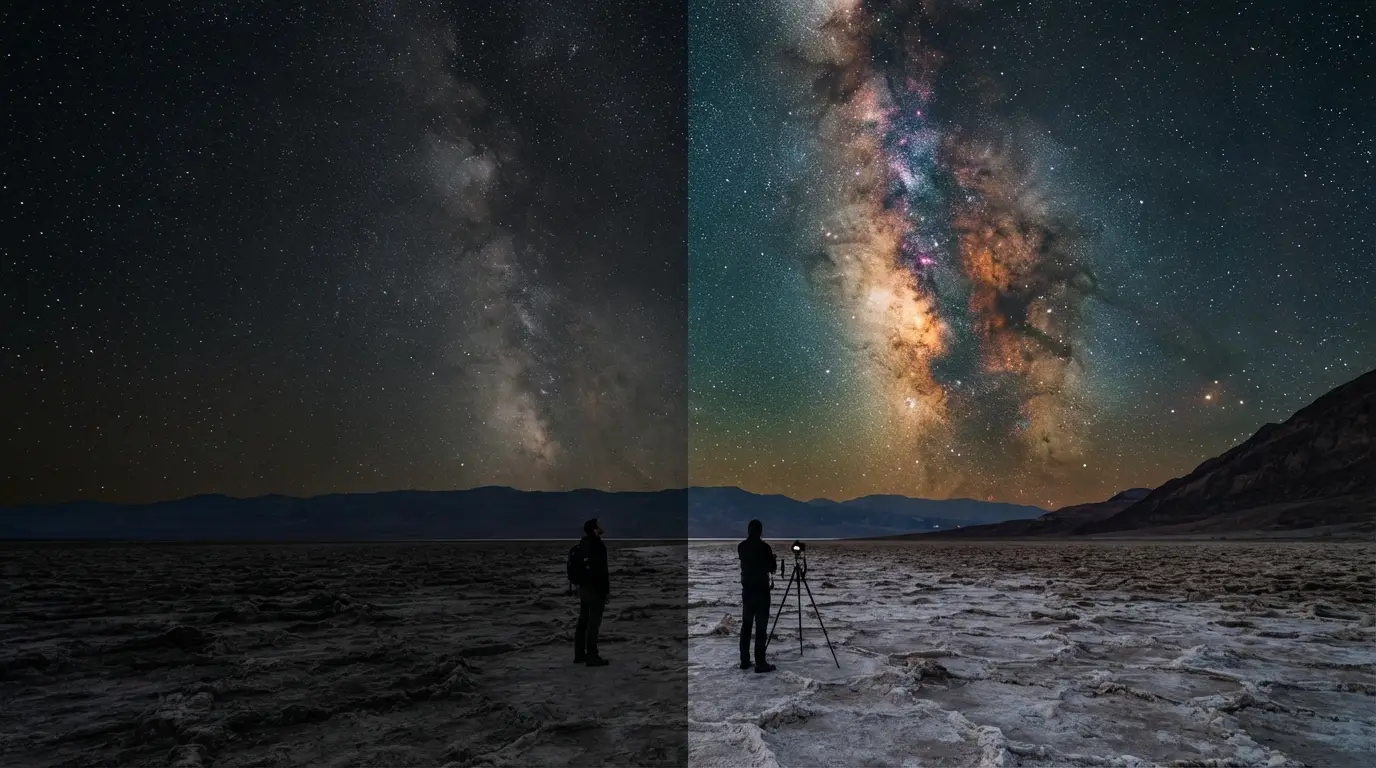
The cleanest demonstration is the pair of exposures this article opened with: a simulated naked-eye view at 3.2 seconds, ISO 800[3], set against a single 10-second exposure from the same dark sky. Same sky, same lens; the only difference is the extra light the sensor was allowed to collect. One frame is what your eyes report; the other is what's physically up there. Two identical cameras pointed at the same sky will produce nearly identical frames; the instrument is doing the work, not the brand. Photographers push further still by combining multiple frames, which is where the last of the fine detail in the most dramatic images comes from.
Color works the same way. The Milky Way's integrated light really is a very pure white, around 4,840 Kelvin[11]; the sensor records that white, and the pipeline that turns a capture into a picture amplifies what's already there. The saturated hues in finished photos are real light, stretched, not color the camera invented. What the camera adds is time, and time is the one thing your eyes don't get. That whiteness is why the gray band isn't a failure of the scene: the light reaching your eye really is white, and your eye is what filters it.
4,840 K
If you want to capture that accumulated view yourself, Death Valley astrophotography gear covers the camera-side setup, and Death Valley smartphone stargazing photos covers the phone's Astrophotography mode, which works on the same light-accumulation principle. Both are technique pieces; this one only explains why the results look the way they do.
Unedited vs. Edited: Where the Colors in Photos Come From
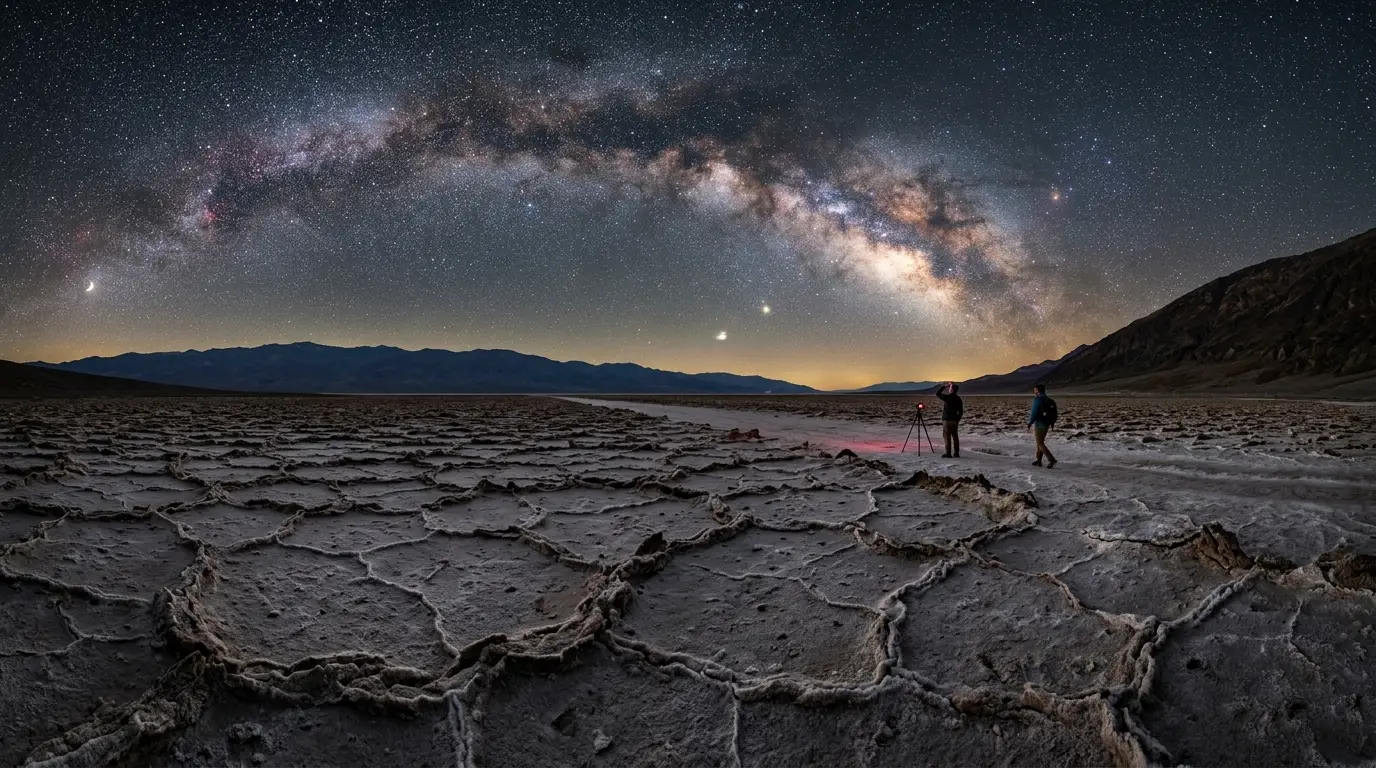
Here's the part that causes the most disappointment, so it's worth being blunt. A single 10-second exposure, unedited apart from a white-balance correction, already shows the Milky Way as the eye cannot see it[12]. That's how much more the sensor gathers. But the photographs that made you book the trip were almost certainly not single unedited frames; the vibrant reds, blues, and golds in popular Milky Way images come from specialized imaging techniques and post-processing, not from what the eye would see[13].
Recommended tours
Tours are selected for quality, not commission. I earn a small fee if you book — at no extra cost to you.


The finished picture is a composite: several exposures stacked into one frame, the faint signal stretched hard. It's a legitimate record of light the sensor collected, an amplification of real emission rather than false color, but it is not what anyone sees standing under the sky. Neither version is fake. The unedited frame sits closer to the eye's truth; the processed image is a different record of the same light. What's fake is the unspoken promise that they'll match.
Don't judge the night by the LCD screen
Camera playback and phone previews show the unedited capture: dimmer and grayer than the finished photos you've seen, so the sky looks like it's underdelivering when it isn't. Judge the night with your own dark-adapted eyes, and save judgment on the photos until you've seen them edited on a real screen.
Hold onto that distinction and the gray band stops reading as a failure. The naked-eye view is the experience; the camera view is the documentation. They answer different questions, what it is like to stand there versus what is physically up there, and a first trip goes better when you plan for the first one. Expect the photo version and you'll leave wondering what the fuss was about; expect the gray band and you'll get the one view no screen can reproduce.
Your First Night: Expect the Gray, Plan Around It
The planning is simple once you stop expecting the photo version. Death Valley's Milky Way season runs late February through early June and again September through November[14]; inside that window the moon decides everything, and a new-moon night is the difference between visible dust lanes and a washed-out band. The best time to stargaze in Death Valley maps the seasons, the moon phases, and the summer heat trade-off in full. The moon is decisive enough that a clear night near full moon can be a worse bet than an overcast new-moon night: clouds pass, and moonlight doesn't.
Two habits matter more than any gear. Give your eyes the full 30 minutes of darkness they need before judging the sky[2], and keep every light red, since a phone in night mode still reads as a flashlight to a dark-adapted eye. Where you stand matters less than the discipline of not flashing white light at your own eyes or your neighbor's; the best stargazing spots in Death Valley covers the named pullouts, and the Death Valley stargazing hub tracks current conditions, ranger programs, and where to stay.
Featured · Article
What Is Light Pollution? Definition, Types, and Solutions
Light pollution is artificial light brightening the night sky, affecting 80% of the world. Learn the 4 types, wildlife and health effects, and how to fix it.
Go in knowing the payoff: the gray band over a Death Valley sky is the same galaxy the photos show, minus the amplification. That isn't the consolation prize; it's the point. The camera keeps the record; your eyes get the experience, and after one night under it you'll understand why photographers work so hard to reproduce a gray band. Plan to split the night: fifteen minutes of shooting for the record, the rest of it for your eyes.