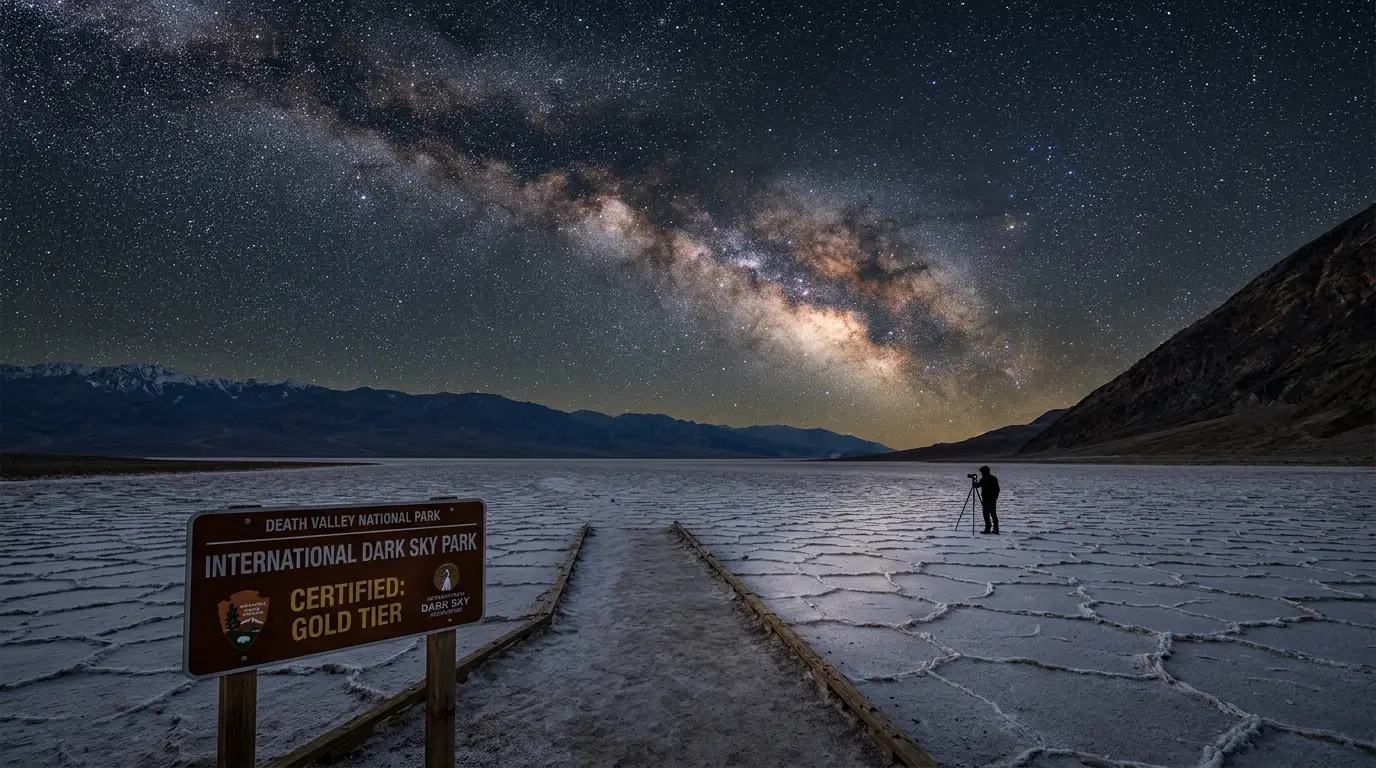

What International Dark Sky Park Certification Actually Means
A Dark Sky Park designation isn't a park's own marketing line. DarkSky International, the nonprofit formerly known as the International Dark Sky Association, certifies parks jointly with whichever agency manages the land. Death Valley's certification was announced jointly with the National Park Service on February 20, 2013.[1] That date matters more than it looks: plenty of casual write-ups treat desert isolation as the whole story, but the sky itself had to clear a formal review process on a specific day before any tourism copy could start using the phrase. That whole certification apparatus began with a single Arizona city: Flagstaff became the world's first International Dark Sky Community in 2001, a designation that directly produced the Dark Sky Places program certifying parks like Death Valley today.[10][11]
Certification inside the Dark Sky Park category isn't a single pass-or-fail badge, either. DarkSky International grades certified parks into tiers based on measured darkness, and Death Valley didn't just qualify, it received the top rating available: Gold Tier.[3] That's the same rating held by only a handful of U.S. national parks, and it's worth being precise about what Gold Tier does and doesn't measure, because two different superlatives get tangled together in most write-ups about this park, and they deserve to be kept separate.
Feb 20, 2013
How Death Valley Became One of the World's Largest Dark Sky Parks
Start with the number that's cleanly verified: at 3.4 million acres, Death Valley's certified area[2] is commonly cited as the largest International Dark Sky Park anywhere on the planet, not ranked only against other U.S. national parks, against every Dark Sky Park DarkSky International has ever certified. That's a straightforward acreage figure with a widely repeated ranking attached to it, and it's widely cited as the largest designated area any park has carried into this program.
A second, narrower superlative gets mixed in with that one, and it's worth pulling apart. Inside the U.S. National Park System specifically, Gold Tier is rare: Death Valley joined only Big Bend National Park and Natural Bridges National Monument as the sole units of the entire National Park System holding Gold Tier certification at the time.[4] That's a fact about how few NPS units clear the Gold Tier bar, not a claim that Death Valley is the largest Gold Tier park within the Park System specifically. No source ranks the three by size against each other, so treat that comparison as unconfirmed rather than repeat it as settled fact. For the ground-level version of what this scale means for a visit, stargazing in Death Valley covers where inside the park to go and when.
| National Park System unit | What sets it apart |
|---|---|
| Death Valley National Park | Widely cited as the world's largest International Dark Sky Park, at 3.4 million acres |
| Big Bend National Park | One of only three NPS units holding Gold Tier certification |
| Natural Bridges National Monument | One of only three NPS units holding Gold Tier certification |
The Real Reason the Sky Is So Dark: Extreme Aridity, Not Elevation
Here's where a lot of casual write-ups get the mechanism backward. Death Valley's floor sits 282 feet below sea level, the lowest point in North America.[5] Low elevation, on its own, typically works against sky clarity, more atmosphere sits overhead, not less. If elevation explained Death Valley's reputation, this would be one of the weaker places in the American West to look up, not one of the strongest.
The actual mechanism is aridity, and it isn't subtle. Death Valley averages just 2.36 inches of precipitation a year, the driest spot in North America[6], because the valley sits in the rain shadow of four major mountain ranges. Moisture-laden Pacific air loses most of its water crossing each range in turn, and by the time what's left reaches the valley floor there's almost nothing left to lose.[7] On clear nights here, relative humidity can drop under 5%, and that dry air produces atmospheric transparency that rivals or exceeds high-altitude mountain sites, despite the valley floor sitting nowhere near high altitude.[8]
That's the honest version of the claim: extreme dryness compensates for, and in practice outweighs, the disadvantage of sitting below sea level. The lowest point in North America and one of its darkest skies are both true and both genuinely interesting, but one doesn't cause the other. If anything, Death Valley is dark despite its elevation, not because of it.
Featured · Destination
Death Valley
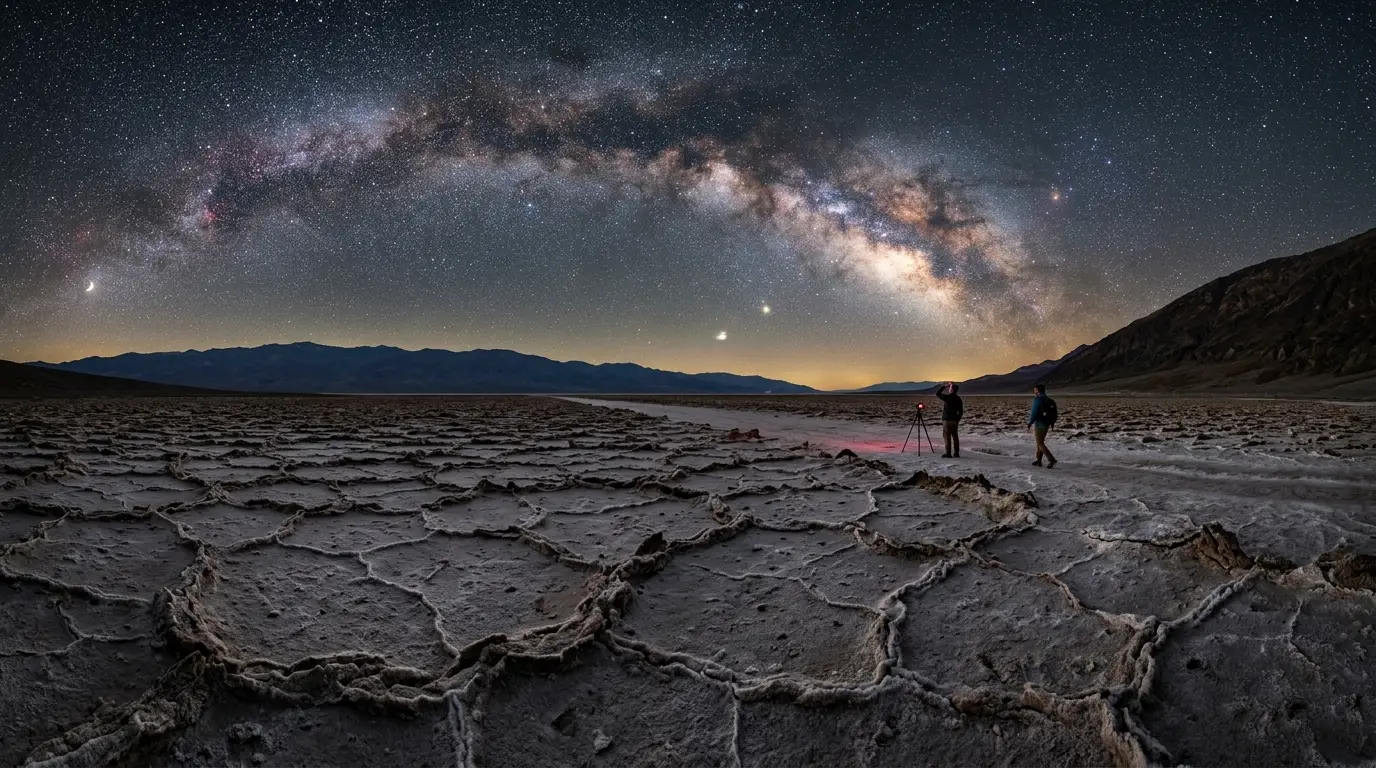
Death Valley's Gold-tier dark sky sits at the lowest point in North America. Here's when to visit, where to stay, and how to handle the extreme summer heat.
Just How Dark It Gets: Bortle Class 1 Skies
Numbers make the case concrete, at least the ones that hold up under scrutiny. Measured sky darkness here runs close to the natural limit of how dark Earth's night sky gets at all, atmosphere and all. On the Bortle scale, a nine-point scale astronomers use to rate sky darkness from inner-city glow down to true wilderness dark, Death Valley is rated Class 1, the scale's own floor.[9] Very few places anywhere carry that rating.
None of it matters if clouds roll in every other week, and this is the part worth being honest about: the park sees clear skies most of the year, but a precise, sourced figure for how many nights that amounts to isn't confirmed on a primary source, so it isn't repeated here as a specific number. That's still the quieter, less quotable reason a Gold Tier rating here tends to translate into a trip that actually works, rather than a rating that looks good on paper and rarely delivers a usable night in practice.
Gold, Silver, and Bronze: What Death Valley's Tier Actually Rates
Gold Tier isn't the only rating DarkSky International hands out inside its Dark Sky Park category. Certified parks fall into three tiers, Gold, Silver, and Bronze, based on measured darkness, with Gold reserved for the darkest skies clearing the program's highest bar. Precise numeric cutoffs separating the three tiers vary across secondary write-ups and weren't confirmed on a single directly fetchable DarkSky International page for this piece, so treat any specific threshold quoted elsewhere as a secondary estimate rather than a confirmed primary figure.
Recommended tours
Tours are selected for quality, not commission. I earn a small fee if you book — at no extra cost to you.
That's also a different question from what kind of place is certified in the first place. DarkSky International's separate designation categories describe land type and management model, not sky quality:
- Park — a certified site with visitor infrastructure, typically a single park or monument
- Reserve — a large protected core ringed by a buffer zone with enforced lighting rules
- Sanctuary — the most remote and pristine certified skies in the program
- Community — a town or city that has rewritten its own outdoor lighting rules
Death Valley is a Dark Sky Park that reached Gold Tier; a Reserve or a Sanctuary elsewhere on this site is a different designation entirely, usually covering far more land under a different governance model. The best dark sky parks in the world guide compares all of DarkSky International's categories and tiers across a dozen certified destinations worldwide, worth reading in full rather than repeated here.
What Gold Tier Certification Means for Planning Your Trip
None of this is trivia for its own sake. A Gold Tier rating over one of the world's largest certified dark-sky areas is the reason a clear night at Badwater Basin looks different from a clear night almost anywhere else within driving distance, and it's worth carrying that into how a trip gets planned.
Practically, the certification doesn't promise any single night will be cloudless, and it doesn't guarantee a specific visitor sees the Milky Way's core casting a shadow the way the driest, darkest nights here can produce. What it does confirm is that the park's measured darkness clears a bar very few certified places anywhere reach, over an area large enough that finding a dark pull-out rarely takes much effort. Where inside the park to go, and when the ranger-led Star Party and Dark Sky Festival run, is covered in full in the stargazing in Death Valley destination guide.
Featured · Article
What Is Astrotourism? The Complete Beginner's Guide
Astrotourism means travel built around dark skies: meteor showers, auroras, the Milky Way. What it means, where to go, and how to plan your first trip.
That's the practical shape of what Gold Tier buys a visitor here: not a guarantee for any single night, but real confidence that a desert floor below sea level, dry as it is, keeps delivering measurably dark skies year after year. For where to base a trip around it, see the best lodges for Death Valley stargazing. To see how Death Valley's Gold Tier skies stack up against another certified park, read the Great Basin National Park stargazing comparison.