Merzouga Has No Dark-Sky Certification: Here's What It Has Instead
Start with what's missing. Merzouga carries none of the usual signals:
- No IDA Dark Sky Park designation
- No DarkSky International listing
- No UNESCO dark-sky reserve boundary anywhere near Erg Chebbi
Compare that to the handful of destinations that do hold one of those badges, cataloged in my guide to the best dark sky parks in the world, and Merzouga is conspicuously absent.
That absence isn't a red flag. Nobody has run the formal light-pollution survey that certification requires, so there's no paperwork to point to for Merzouga specifically. What it does have instead is something more basic and, once you understand the physics, just as convincing: it sits a genuinely long way from anywhere bright enough to wash out a night sky.
This piece walks through that case in order: first the underlying science of how light pollution actually fades with distance, then the specific geography that puts Merzouga on the right side of that math, and finally what an honest reader should do with the darkness claims circulating online, including one number worth ignoring entirely.
Nobody has run the formal light-pollution survey that certification requires, so there's no paperwork to point to for Merzouga specifically.
The Basic Science: How Distance From Light Sources Creates Real Darkness
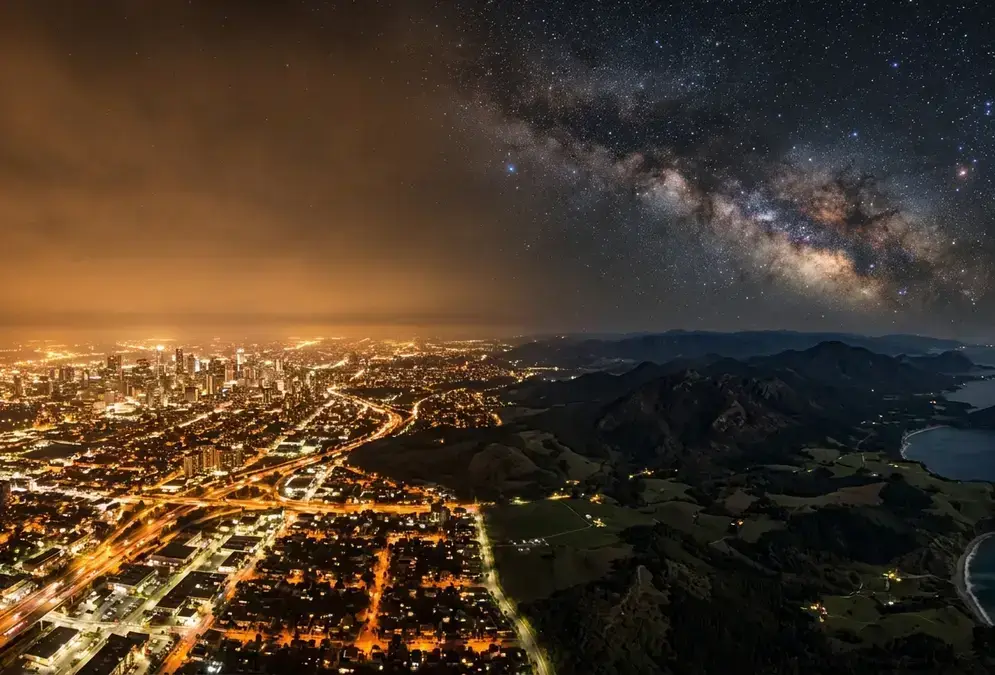
Light pollution isn't a mysterious quality some places have and others don't. It's physics: artificial light scatters off dust and moisture in the lower atmosphere and reflects back down as a diffuse glow, called skyglow, that sits over every city like a dome. The bigger the city, the taller and wider that dome, and the farther it reaches before fading into true darkness.
NASA's own guidance for finding a good stargazing spot is refreshingly direct about how far that fade actually takes: "The amount of skyglow from light pollution diminishes as you venture farther outward from a population center. So heading outward from town, at least 20 to 30 miles from the city limits, is key."[1] That's the baseline distance for escaping a single mid-sized city's glow, not a desert-scale claim, and it's worth holding onto as a yardstick for what comes next.
The same physics scales up with population and out with distance: a bigger city needs a proportionally bigger buffer, and there's no shortcut around that relationship, no matter how clear the forecast looks. A light-pollution map (tools like lightpollutionmap.info plot this in real time) is the honest way to check any specific claim about a specific place, rather than trusting whatever darkness rating a tour operator's marketing page happens to quote.
20-30 miles
Why Merzouga Really Is Remote
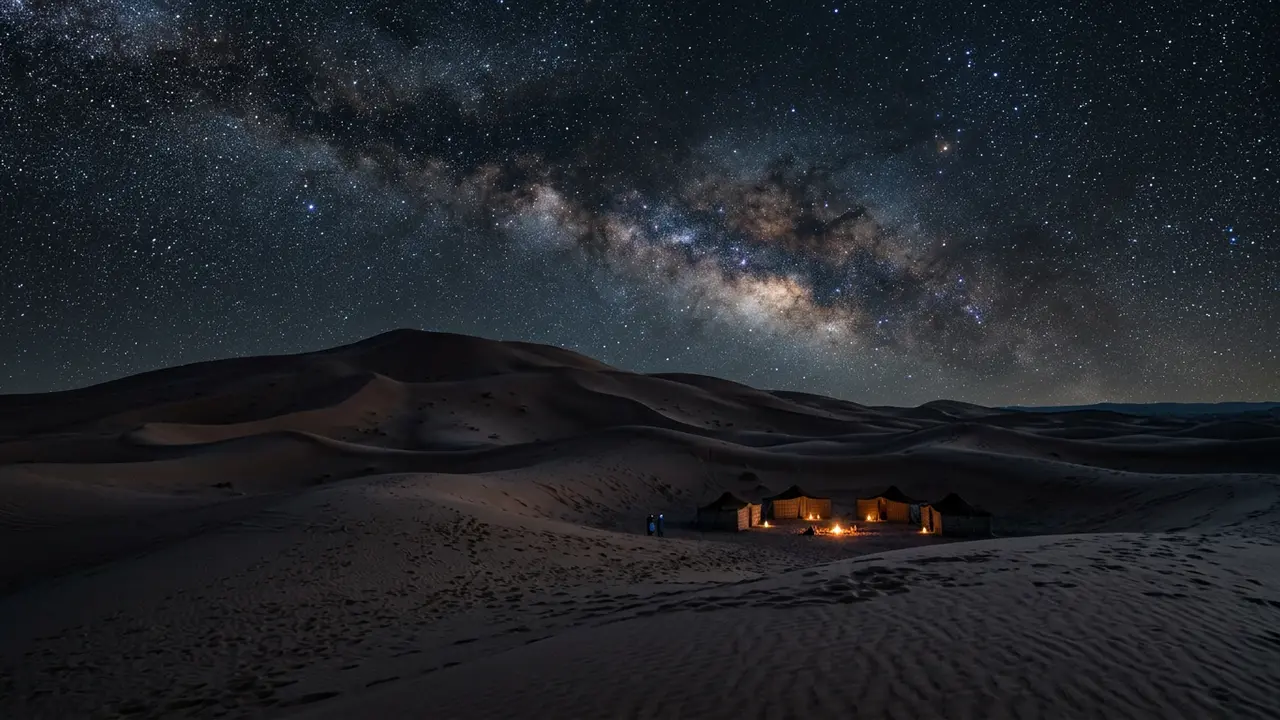
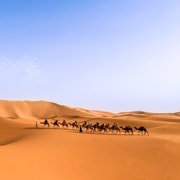
Run that yardstick against Merzouga's actual location and the numbers stop being abstract. Stargazing in Merzouga means camping at the edge of Erg Chebbi, in Morocco's far southeastern corner, 560 km from Marrakech[2] and roughly 380 km from Fes, the country's two nearest cities large enough to cast a meaningful light dome of their own. In miles, that's roughly 350 and 236, both many multiples past NASA's 20-to-30-mile minimum for escaping a single city's glow.
Distance from the big cities is only half the case. Merzouga itself isn't a city, and that matters more than it sounds: it's a small settlement that exists primarily as the gateway to the dunes, with:
- No medina
- No ancient monuments
- No souks[3]
Featured · Destination
Merzouga Stargazing
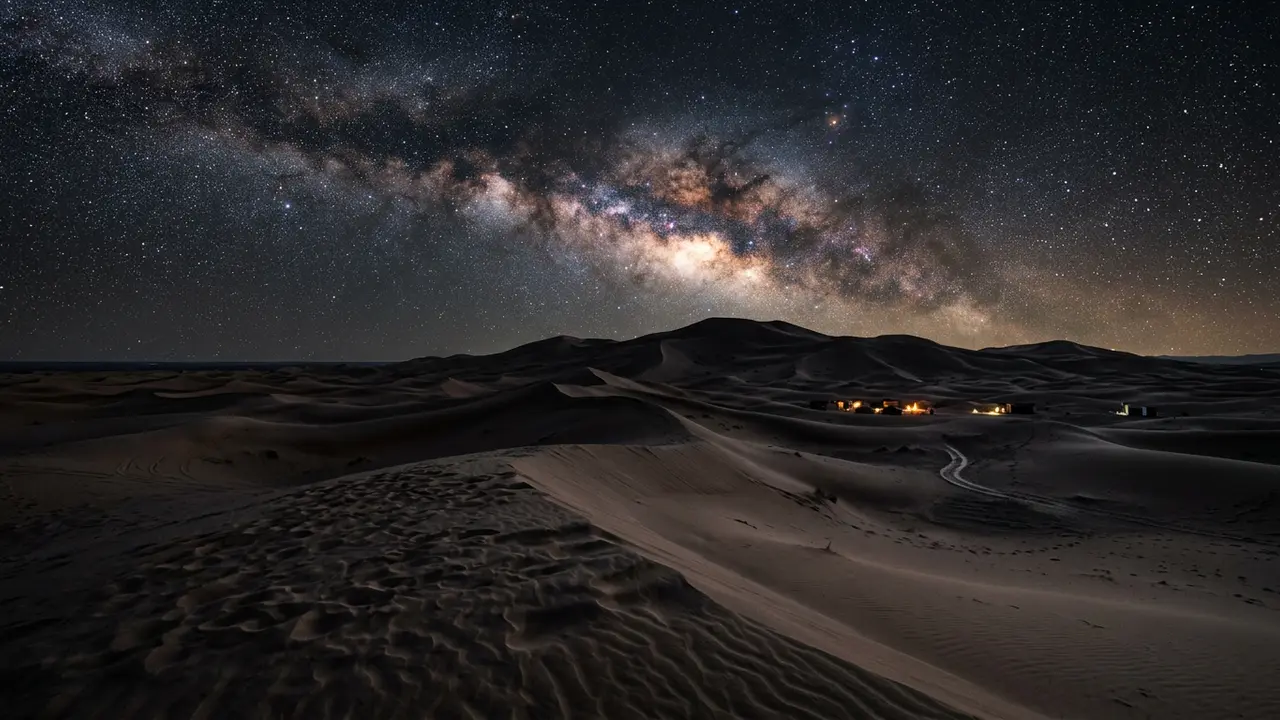
Erg Chebbi's dunes rise 150m above Morocco's Sahara, hours from city light. Stargaze from Berber-led desert camps: when to go, where to stay, how to get there.
There's no local urban core generating its own light dome to fight through, the way you'd have to at a stargazing spot that's remote from a big city but still sits inside a smaller regional town.
Put both facts together and the picture is straightforward: no nearby major city, and no local town-sized light source either. That's not a certified rating. It's two independently checkable geographic facts that happen to add up to a very dark sky.
What a Missing Bortle Rating Actually Means
Search for Merzouga's stargazing quality and you'll run into a specific number fast: Bortle Class 1-2, repeated across several travel-tips pages as if it were measured fact. It isn't. No public light-pollution survey, DarkSky International listing, or cited instrument reading backs that figure anywhere it appears; it traces back to marketing copy repeating itself, not a primary source.
The Bortle scale itself is a real, useful tool: a nine-point rating astronomers use to describe how much a location's sky glows, from Class 1 (the darkest skies left on Earth) to Class 9 (inner-city). My ranked roundup of certified dark-sky parks covers how certified sites get and publish that rating. Merzouga has never gone through that process, so there's no audited number to cite, however many blogs claim otherwise.
Recommended tours
Tours are selected for quality, not commission. I earn a small fee if you book — at no extra cost to you.
That doesn't make Merzouga's sky less dark. It makes the specific claim about how dark, expressed as a precise number, something you shouldn't trust secondhand. The more honest approach: pull up a current light-pollution map yourself before you book, and treat any Bortle figure you see quoted for Merzouga specifically as shorthand for it's genuinely dark here, not as data.
How Remoteness-Based Darkness Compares to Certified Parks
There are really two paths to a night sky dark enough to show the Milky Way's core with the naked eye. One is the certified route: a park or reserve submits to a formal survey, earns an IDA or UNESCO designation, and publishes an audited rating that a badge and a citation back up. The other is what Merzouga has: a location so far from any significant artificial light source that the darkness holds up on its own, without anyone needing to formally measure it.
Neither path is inherently better at producing a dark sky. What the certified route buys you is verification, a number you can cite and compare across destinations with confidence. What remoteness buys you is exactly what the geography in the last two sections laid out: distance from the nearest cities, and no local town generating its own glow.
Featured · Article
What Is Light Pollution? Definition, Types, and Solutions
Light pollution is artificial light brightening the night sky, affecting 80% of the world. Learn the 4 types, wildlife and health effects, and how to fix it.
If you're weighing Merzouga specifically against a certified desert-camp destination, Merzouga vs Wadi Rum stargazing covers that comparison in full, including Wadi Rum's UNESCO status against Merzouga's remoteness-only case. The short version for this piece: both can put on a genuinely dark sky. Only one of them can prove it with paperwork.
Planning Around What Merzouga's Sky Actually Offers
None of this changes what you should actually do to see the sky at its best. It just tells you which claims to trust while you plan.
Moon phase does more to determine what you'll actually see on a given night than any darkness rating, certified or not: a few nights around new moon will outperform a full-moon night at any location, Merzouga included. The best time to stargaze in Merzouga guide breaks down how season and moon phase interact across the year, and best stargazing spots in Merzouga covers exactly where on the dune field to set up once you've picked your dates.
| What you get | Certified dark-sky park | Merzouga |
|---|---|---|
| Official designation | IDA or UNESCO badge | None |
| How darkness is verified | Audited on-site survey | No public survey, check a light-pollution map yourself |
| Basis of the darkness claim | Instrument-measured rating | Distance from cities plus no local light source |
What you shouldn't do is pick a camp because its marketing page cites a specific Bortle number. Pick one because it gets you onto the dune crest, away from any camp lighting, on a night close to new moon. That's the version of dark sky this piece can actually stand behind.