Why the Merzouga packing list starts with the thermometer

Erg Chebbi doesn't just get hot. It gets hot and then genuinely cold, in the same 24 hours, and the gap between the two is the first thing any packing list here has to account for. Summer daytime temperatures in the region run roughly 40-48°C, dropping to about 20-28°C once the sun is down[1]. Winter runs the same pattern at a gentler scale: daytime highs around 18-22°C, with nights falling to 2-8°C, close enough to freezing that a thin blanket won't cut it[2].
What ties both seasons together is the swing itself. A roughly 30°C drop between day and night is common in the Moroccan desert[3], and that number matters more than either extreme on its own. A summer trip that packs only for 45°C afternoons will still shiver at the dune camp once dinner's over. A winter trip that packs only for a mild 20°C day will underestimate just how fast that heat disappears after sunset.
Build the list around the swing, not the season's headline temperature, and the rest of the packing decisions below fall into place. Layer for both ends of the day, since the number on the forecast app at 2pm tells you almost nothing about what you'll need standing on cooling sand at 9pm. If you haven't picked a month yet, best time to stargaze in Merzouga breaks down how that swing shifts season to season.

~30°C

The common day-to-night temperature swing in the Moroccan desert. Pack for the drop, not just the daytime high or the nighttime low on its own.

Layering for the swing: what actually keeps you warm after a hot day

The single most useful item on this list isn't glamorous: a warm fleece or a light down jacket, since desert nights here can drop below 5-10°C even outside the coldest months[4]. A packable insulated layer does more work than any other single piece of gear, because it's the difference between standing at the dune crest for a full hour of stargazing and heading back to the fire after fifteen minutes.

Build the system in three parts rather than relying on one warm item grabbed on the way out the door:

  • A breathable base layer that also handles daytime heat, loose and light-colored
  • A fleece or light down mid-layer for once the sun drops
  • A windproof outer shell, since even a mild breeze cuts harder once the ground stops radiating the day's warmth
A packable insulated layer does more work than any other single piece of gear, because it's the difference between standing at the dune crest for a full hour of stargazing and heading back to the fire after fifteen minutes.
Add a warm hat and gloves for winter sessions, especially if you're handling camera dials or a phone screen at a telescope for any length of time. A scarf or head wrap does double duty here too, warmth around the neck on the walk back to camp, and a barrier against blowing sand if the wind picks up. Pack the fleece even for a summer trip. A 30°C swing doesn't disappear just because the daytime number was higher to start with.

Sand that gets everywhere: protecting gear from Erg Chebbi's fine dust

Erg Chebbi's dunes are classic wind-driven Sahara sand, finer and more powder-like than the coarser, rockier terrain sand found at other desert camps. That fineness is exactly what makes it a problem for anything electronic: it behaves less like beach sand and more like a fine grinding dust, working into zipper teeth, lens mounts, and phone charging ports far more readily than a coarser grain would.
Treat gear-sealing as non-negotiable, not optional, out here. Ziploc bags or small dry bags are worth carrying specifically to protect electronics from sand[5], and a phone or camera that spends the day loose in a daypack pocket is a phone or camera that's collecting dust the whole time, not just during a windy moment. A neck gaiter or scarf pulled up over the mouth and nose earns its place on any windy day or dune crossing[6], and it does the same job for a camera as it does for you: fewer particles in the air around your gear in the first place.

A few habits protect the equipment itself, beyond just sealing it away:

  • Cover the camera whenever possible with a heat-deflecting cover, since desert heat, not moisture, is the bigger risk to sensitive electronics here[7]
  • Avoid changing lenses in open wind; step behind a vehicle, tent flap, or your own body first
  • Clean gear with a blower or brush at the end of the day, away from the dusty site itself, rather than reaching for compressed air, which can push fine particles deeper into a lens or body instead of out
  • Keep a microfiber cloth dry and dedicated to sand, not shared with sunscreen or lens-cleaning fluid, which turns fine sand into a mild abrasive paste on contact

The camel can't carry your suitcase: packing for the multi-day tour

Most visitors reach stargazing in Merzouga as part of a two- or three-day loop out of Marrakech or Fez, not a direct drive to the dunes, and that changes the packing shape entirely. Hard-shell suitcases and full luggage generally stay behind in the tour vehicle or at a hotel in Merzouga village. What actually goes into the dune camp on a camel or 4x4 is a small overnight bag, since camels can't carry a wheeled case and most camps aren't built to store one either.
A soft duffel or backpack packs and travels better than hard-shell luggage on these desert-tour vehicles in the first place[8], so it's worth using one for the whole trip rather than switching bags partway through. Inside that, a smaller daypack in the 10-20 litre range covers what you actually need for the excursion itself, water, camera, and the layers described above[9], leaving the rest of your gear in the main bag back at the vehicle.

Featured · Destination

Merzouga Stargazing

Erg Chebbi's dunes rise 150m above Morocco's Sahara, hours from city light. Stargaze from Berber-led desert camps: when to go, where to stay, how to get there.

What belongs in the small overnight bag headed into the dunes:

  • One change of clothes and the sleep layer you'll actually wear that night
  • The full cold-weather layering system from the section above
  • Camera and phone, sealed against sand as covered above
  • A headlamp, portable charger, and any daily medication
  • Toiletries pared down to travel-size, not the full kit
Leave the rest, chargers for gear you won't use that night, spare shoes, anything bulky, in the main bag. A camel trek into Erg Chebbi rewards a light overnight bag far more than it rewards a full suitcase you never needed at the dune camp anyway.

Footwear, red light, and the small gear that makes the difference

Loose sand doesn't reward sandals or flip-flops, and a dune crest at night is not the place to discover that your shoes aren't up to it. Closed-toe shoes with a sole that sheds sand easily, rather than trapping it, cover both the camel trek and the walk from camp to wherever you settle in to look up.
A headlamp with a red-light mode matters here as much as it does at any other dark-sky destination, since eyes take 20 to 30 minutes to fully adapt to the dark and one burst of white light undoes that adjustment instantly, for you and for anyone else standing nearby. Pack spare batteries rather than counting on a single charge to last a full night session plus the walk back to the tent.
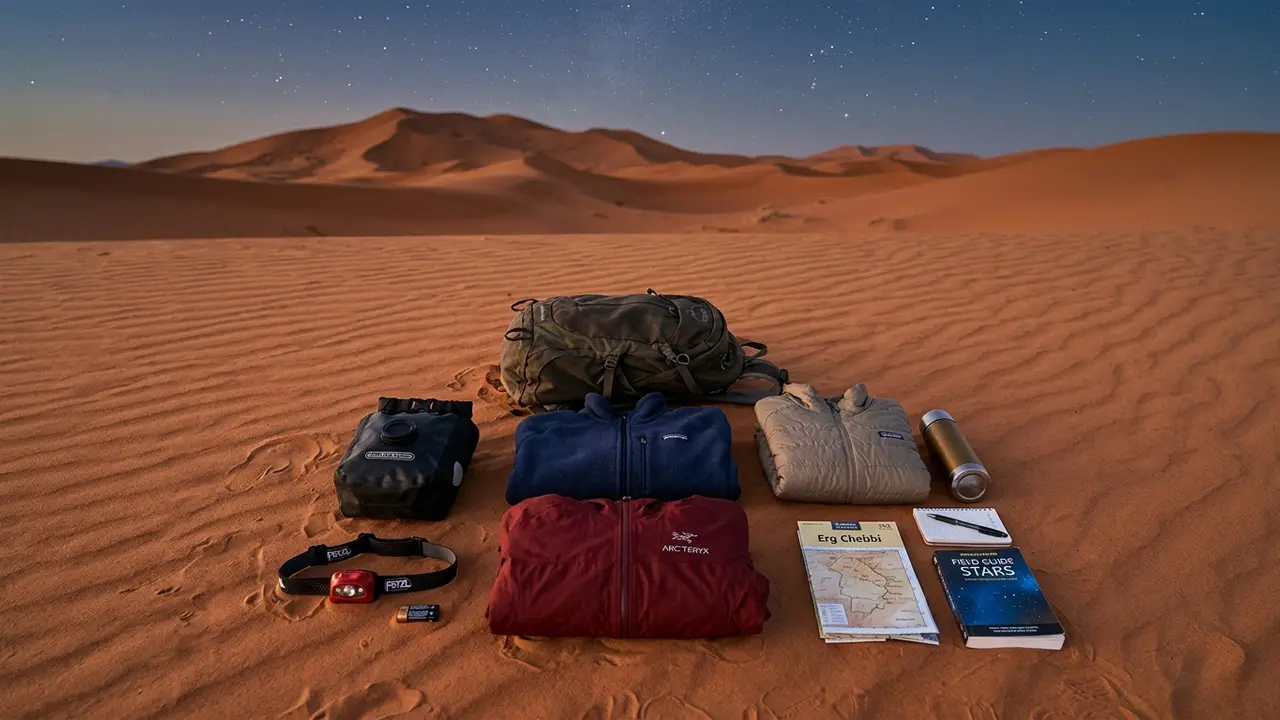
Flat-lay of Merzouga stargazing packing list gear on Sahara sand: fleece layer, windproof shell, dry bag for a camera, red-light headlamp, and a small soft daypack with Erg Chebbi's dunes in the background

Flat-lay of Merzouga stargazing packing list gear on Sahara sand: fleece layer, windproof shell, dry bag for a camera, red-light headlamp, and a small soft daypack with Erg Chebbi's dunes in the background

A short list of small items that matter more than their size suggests:

  • A red-light headlamp or torch, tested before you leave home
  • Spare batteries, carried in an inner pocket rather than a cold outer bag
  • Lip balm and a heavier moisturizer than usual; dry desert air pulls moisture out fast, day and night alike
  • Sunscreen and sunglasses for the daytime half of the same trip
  • A basic first-aid kit, useful after a day of walking on soft, uneven sand

Featured · Article

What Is Light Pollution? Definition, Types, and Solutions

Light pollution is artificial light brightening the night sky, affecting 80% of the world. Learn the 4 types, wildlife and health effects, and how to fix it.

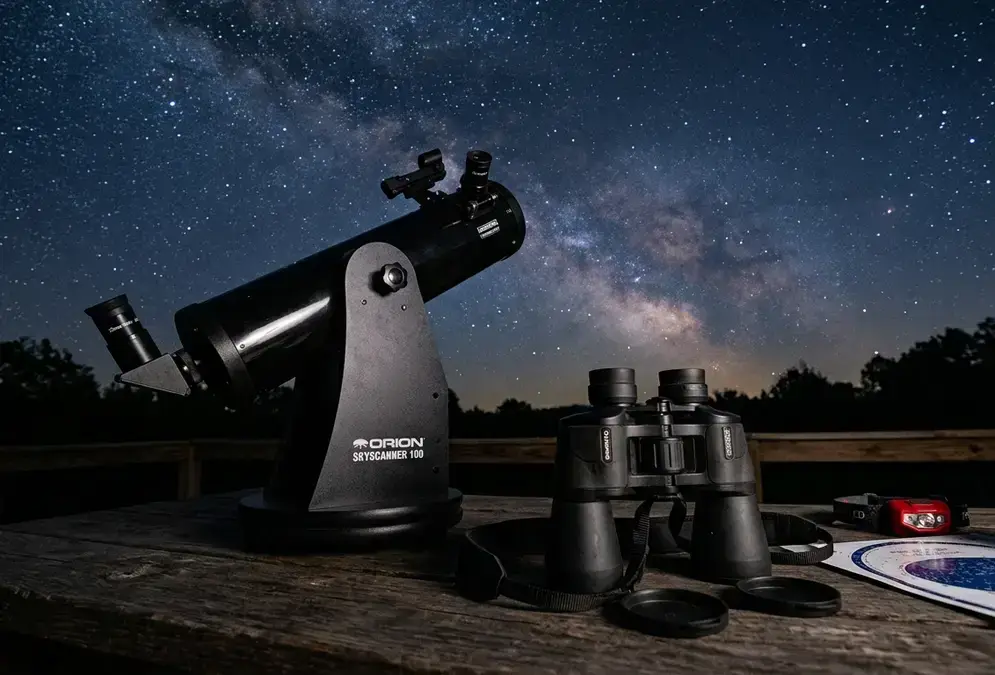
Pack the small stuff together in one dedicated pouch rather than scattered across a daypack. Digging through several pockets by feel, in the dark, while the rest of the group is already looking up, is exactly the kind of friction a little organization avoids. Camps that build a guided telescope session into the night, like Desert Astro Camp, are worth checking beforehand so you know whether to pack your own optics or rely on theirs.

The Merzouga desert stargazing packing checklist

Pull all of the above into one list and a Merzouga stargazing packing list looks like this:
  • Breathable base layer, fleece or light down mid-layer, windproof outer shell
  • Warm hat and gloves for winter sessions
  • A scarf or head wrap for warmth and sand protection
  • Ziploc bags or small dry bags for a phone and camera
  • A heat-deflecting camera cover and a blower or brush for cleaning, no compressed air
  • A soft duffel or backpack for the main trip, plus a 10-20 litre daypack for excursions
  • A small overnight bag packed separately for any camel trek or dune camp night
  • Closed-toe shoes with a sole that sheds sand
  • A red-light headlamp with spare batteries
  • Lip balm, heavier moisturizer, sunscreen, and a basic first-aid kit
The underlying logic doesn't change from one season to the next, even though the exact mix does. Pack for the swing between day and night, seal anything electronic against Erg Chebbi's fine sand, and keep your overnight bag light enough for a camel to carry. Get those three things right, and the packing list stops being a chore and starts being the reason you're comfortable enough, at 9pm on a dune crest, to actually enjoy the sky you came for. Our stargazing gear guide covers general kit in more depth if you're building a stargazing bag from scratch, and if you're bringing a dedicated camera rather than just a phone, Merzouga astrophotography gear narrows this same sand-and-heat problem down to the camera-specific subset: filters, dry bags, and battery care.