Death Valley's Extreme Heat Is a Thermal Extreme, Not Ordinary Desert Summer

Death Valley holds the hottest air temperature ever reliably recorded on Earth: 134°F (57°C) at Furnace Creek on July 10, 1913[1]. That's not a historical footnote you can file away as ancient weather trivia; ordinary summer days here still climb dangerously high for weeks on end, hot enough that the valley floor works like a bowl with no drain for the heat.
This isn't the kind of heat where a headache and some shade fix things. Heat exhaustion and heat stroke share early symptoms, heavy sweating, nausea, weakness, but heat stroke adds something scarier: genuine changes in behavior, confusion, or disorientation[2]. That distinction matters because it's the line between a bad afternoon and a medical emergency, and it's the reason this packing list opens with safety rather than gear.

134°F

The hottest air temperature ever reliably recorded on Earth, measured at Furnace Creek on July 10, 1913. Death Valley's summer days still routinely climb dangerously high for weeks at a time.
Everything that follows, the water math, the vehicle checklist, the layering system, exists to manage one fact: Death Valley's day and night sit at two extremes, July's average high alone reaches 116°F (41°C)[10], and a stargazing trip means being outside for both. This guide assumes a trip to Death Valley Stargazing is already on the calendar, so what follows is what actually goes in the bag and the trunk.

Water Strategy: One Gallon Is the Floor, Not the Target

The National Park Service is blunt about it: drink plenty of water, at least one gallon a day, to avoid dehydration[3]. Treat that gallon as a floor, not a target. Add physical exertion, a hike out to an overlook, a longer stint standing at a tripod, and the number climbs fast, especially once the ground is still radiating the day's heat back at you well after sunset.

Refill points inside the park are scarce. Water is reliably available at only three places:

  • Furnace Creek
  • Stovepipe Wells
  • Panamint Springs
Top off at any of them whenever you pass through, rather than waiting until a bottle runs dry.
Don't wait for thirst to tell you it's time to drink water; by the time you feel thirsty, you're already dehydrated.

Vehicle Prep: Get the Car Ready Before You Drive In

Heat changes how a vehicle behaves, and Death Valley is not a forgiving place to find that out mid-drive. Extreme heat is hard on a car's tires, and checking tire pressure before you enter the park is standard advice for any summer desert drive[4].

Run through this before you enter the park, not after the dashboard lights up:

  • Check tire pressure first thing in the morning, when tires are cold, and keep it at the manufacturer's recommended PSI
  • Check coolant levels and confirm the antifreeze-to-water mixture is correct
  • Fill the tank completely; services between towns are sparse and distances are long
  • Pack extra water for the radiator, not just for yourself
  • If the temperature gauge climbs, switch off the air conditioning and idle gently rather than pushing through
Featured · Destination

Abisko Stargazing

Abisko's rain-shadow microclimate keeps skies clear when nearby Arctic spots cloud over. Aurora season, the Sky Station, ICEHOTEL, and getting there by train.

None of this is exotic advice. It's the difference between a delayed afternoon and a breakdown on an exposed road with no shade and no cell service.

Timing Your Trip: Cooler Months, New Moon, and the 30-Minute Wait for Your Eyes to Adjust

For the best Milky Way visibility, aim for June through early August[5], though that's also the hottest stretch of the year. If comfort matters as much as visibility, March through early April is the balance point: nights have cooled from summer's worst extremes while the Milky Way core is still visible after midnight, the same stretch covered in full in our guide to the best time to stargaze in Death Valley. Pair either window with a new moon phase for the darkest skies; moonlight washes out the faintest stars regardless of season.
Once you're at an overlook, budget real time before you start looking for detail. It takes about 30 minutes for your eyes to fully adjust to the night sky and pick up the faintest stars[6]. Set up your gear, get comfortable, and resist the urge to check a phone screen; every glance at a bright display resets that adjustment clock.
If a summer trip is unavoidable, the schedule flips: sightsee early, retreat indoors through the worst of the afternoon, and don't head back out until the sun's been down long enough for the ground to stop radiating heat like a stovetop.

Gear for the Heat-to-Cold Swing: Layering, Batteries, and the Full Packing List

Summer nights here provide only minimal relief: overnight lows typically dip into the 85°F to 95°F range even at the coolest hour before dawn[7]. That's warm enough that heavy insulation is pointless, but the drop from a scorching afternoon still feels like a real temperature change after dark, enough that a light layer earns its space in the bag. Stick to moisture-wicking synthetics rather than cotton; cotton holds sweat against your skin instead of moving it away, which matters even when the air itself isn't cold.
Electronics have their own heat limit. Lithium-ion batteries struggle and can overheat in extreme desert conditions, which covers your phone, your camera, your portable power bank, and any tripod-mounted tracker. Charge everything in the cool early morning rather than leaving gear baking in a hot car all afternoon, and carry a spare battery or two rather than counting on one to last a full night session. A red-light headlamp protects your night vision once your eyes have made that 30-minute adjustment, and a real tripod earns its keep for anything longer than a handheld phone shot.
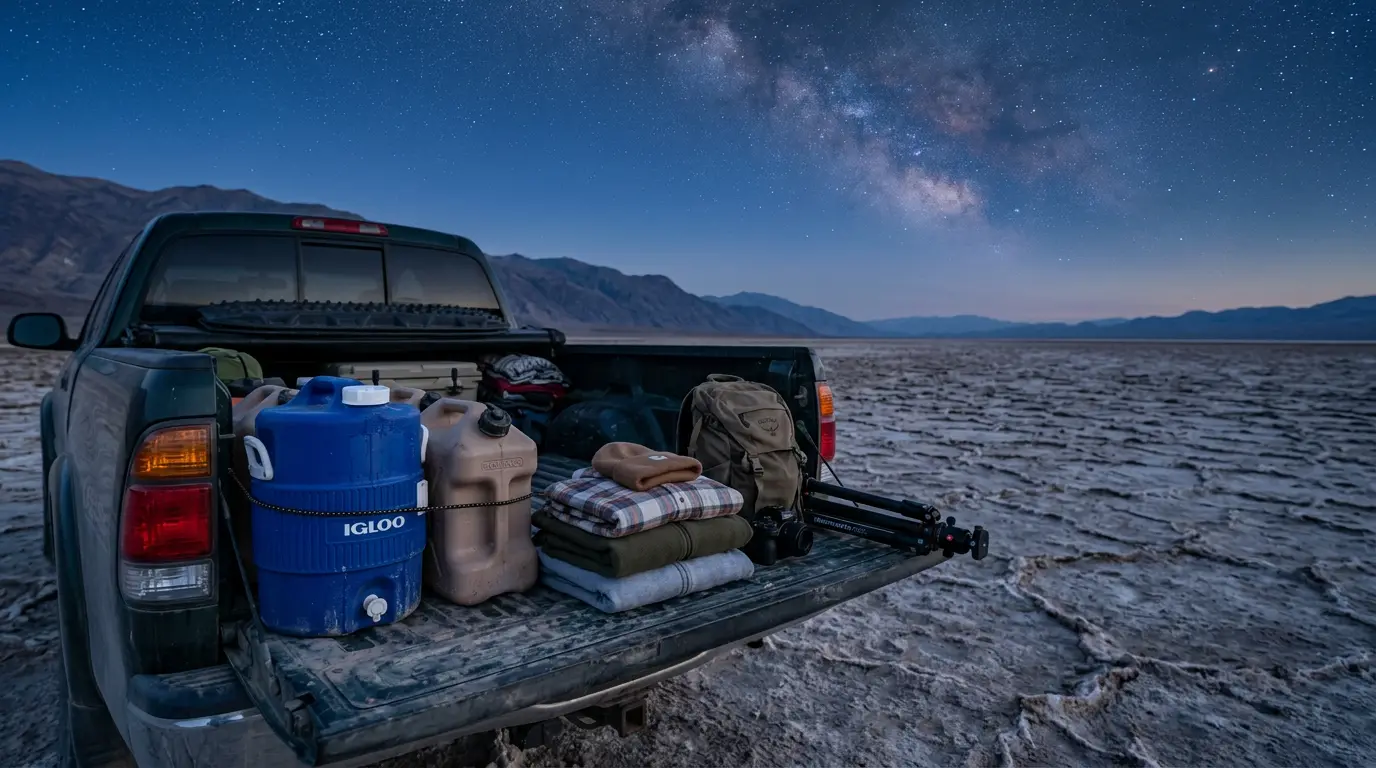
A packed daypack, water jugs, layered clothing, and vehicle tools laid out before a Death Valley stargazing trip in extreme summer heat

A packed daypack, water jugs, layered clothing, and vehicle tools laid out before a Death Valley stargazing trip in extreme summer heat

Here's what actually earns space in the bag and the trunk for a Death Valley stargazing trip:

Featured · Article

What Is Light Pollution? Definition, Types, and Solutions

Light pollution is artificial light brightening the night sky, affecting 80% of the world. Learn the 4 types, wildlife and health effects, and how to fix it.

Daytime heat protection:

  • Sunscreen, SPF 50 or higher
  • Wide-brim hat and UV-blocking sunglasses
  • Lightweight, long-sleeve UPF shirt

Evening and night layers:

  • Moisture-wicking base layer, synthetic rather than cotton
  • Light fleece or wind layer for after dark
  • Sturdy, supportive footwear for standing at an overlook

Water and hydration:

  • Two to three gallons per person for a multi-day trip
  • A hydration backpack for anything involving a walk
  • Electrolyte packets, not just plain water

Vehicle kit:

  • Extra coolant and radiator water
  • A verified spare tire, jack, and lug wrench
  • A full tank before you enter the park

Stargazing gear:

  • Red-light headlamp
  • Tripod
  • Pre-charged batteries and a backup power bank

Emergency and comfort:

  • First aid kit
  • Offline maps; cell service is unreliable through most of the park
  • A blanket and chemical hand warmers for a long night session, even in a warm desert

The Payoff: Gold-Tier Skies After the Prep
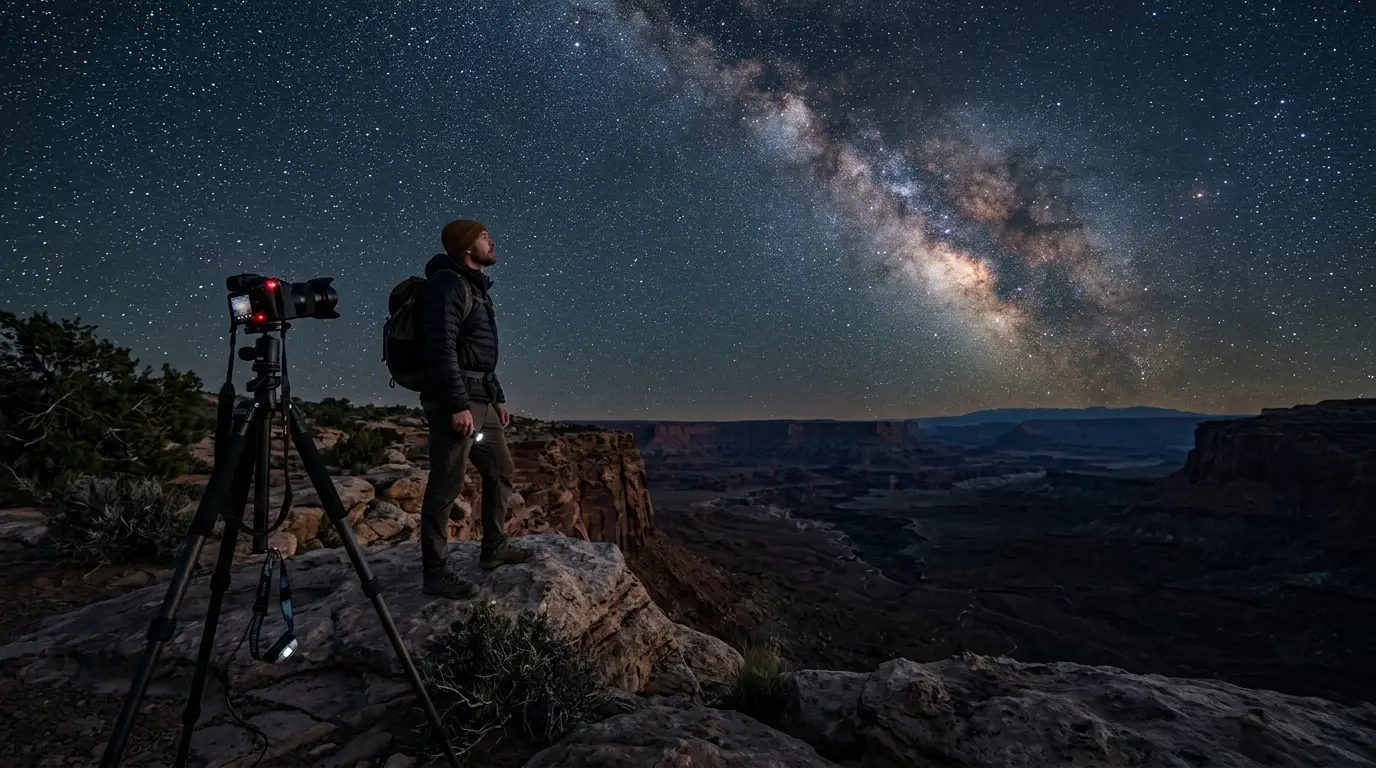
Elevation helps if you can use it: temperature drops roughly 3 to 5°F for every thousand vertical feet you gain[8], so a pull-out toward Panamint or Wildrose runs measurably cooler after dark than the valley floor at Badwater. It won't turn a hot night into a cold one, but it's a real, free advantage if a higher overlook is already on your route.
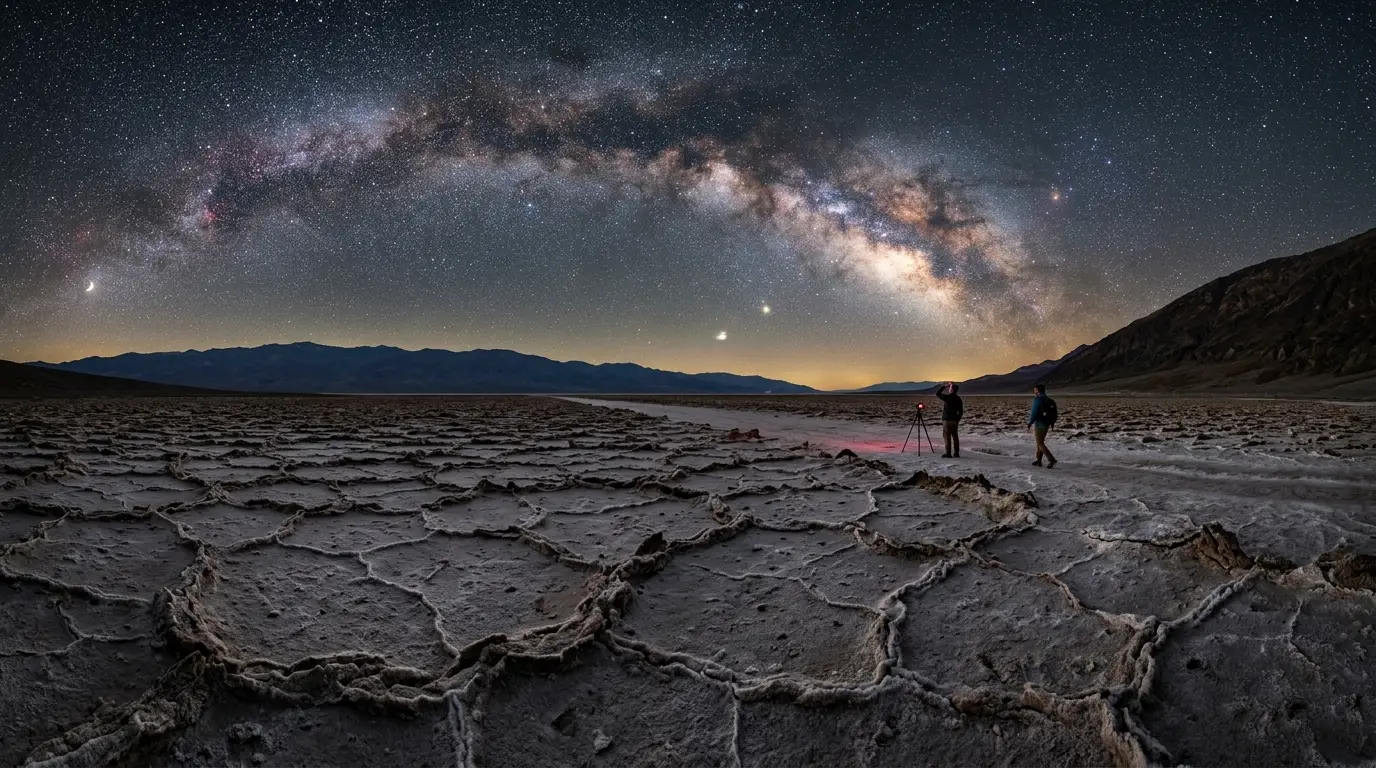
All of this exists for a real reason. Death Valley holds Gold Tier status, the highest classification from the International Dark-Sky Association[9], and the park stays open around the clock with no closing time for a night under that sky. Badwater Basin's salt flats, the Mesquite Flat dunes, and Zabriskie Point's overlook each offer a different foreground for the same dark, wide-open sky.
For a base close to the dark, the Inn at Death Valley puts a spring-fed pool and a stargazers deck a short walk from the overlooks covered here. Pack for the heat first. The sky takes care of the rest.