
Death Valley Is More Than a Night-Sky Park
Death Valley holds Gold Tier certification from DarkSky International, the largest designated dark-sky area on the planet, and stargazing in Death Valley covers what that rating means after dark. What that focus tends to obscure is how much the park delivers before sunset: a salt flat that sits below sea level, a hillside painted by volcanic minerals, and an overlook that puts the park's lowest and highest points in one sightline.
Four stops make the strongest daytime case: Badwater Basin, Artist's Palette, Dante's View, and a scatter of shorter walks (Golden Canyon, Devil's Golf Course, Natural Bridge) that fill in the gaps between them. Racetrack Playa, home to the park's famous sailing stones, is worth knowing about too, though reaching it is its own undertaking, covered in more detail later in this guide.
None of this replaces the night. It's the other half of a trip that's otherwise a single evening at an overlook stretched thin across a long drive to get there.
Badwater Basin: Walking Onto the Lowest Salt Flat in North America
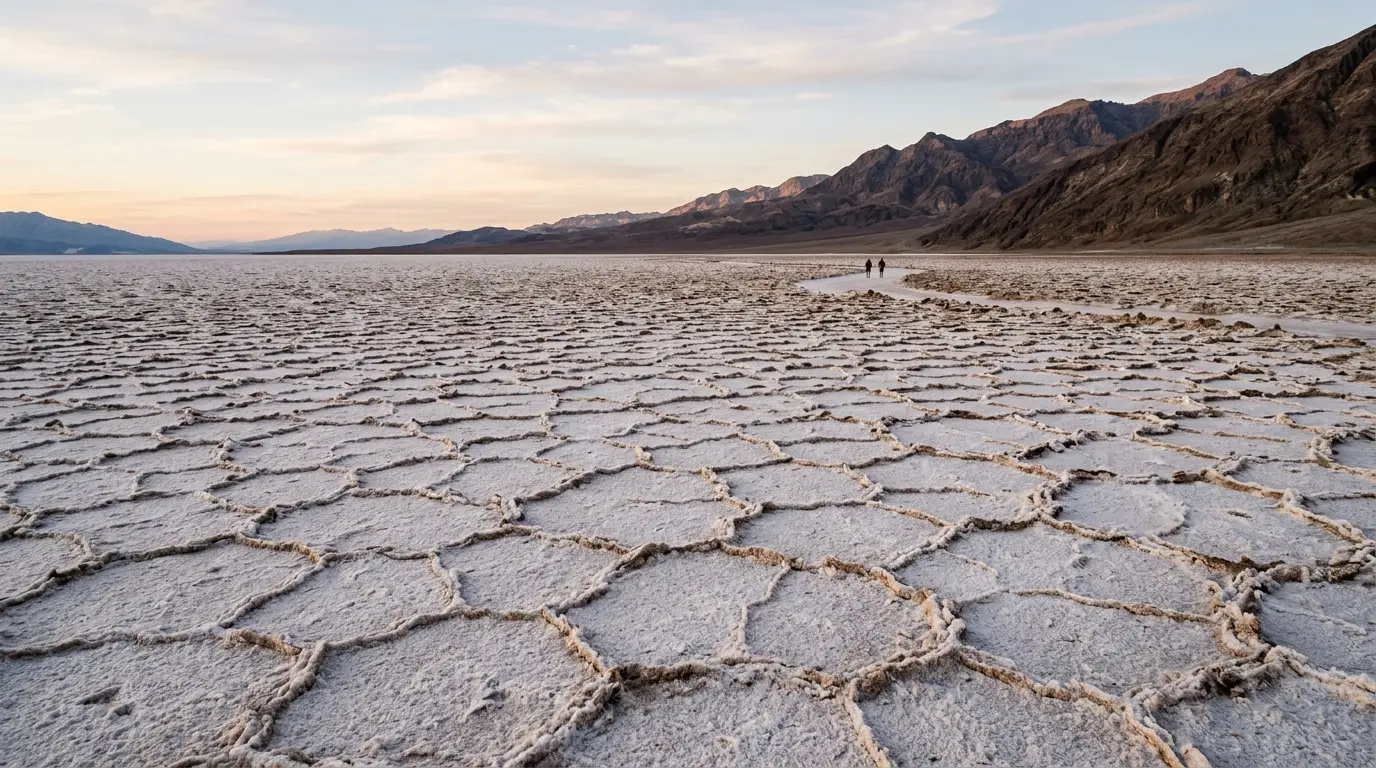
Badwater Basin sits 282 feet below sea level, the lowest point in North America[1], and the basin floor itself is the reason to come: a paved lot gives way almost immediately to a boardwalk, then to open salt, hexagonal crystal patterns stretching out until the mountains ringing the valley pinch the horizon on every side. The valley's 200-square-mile salt flats are among the largest protected environments of their kind in the world[2], built up over more than 10,000 years of mineral accumulation, sodium chloride, calcite, gypsum, borax, with nowhere for the water that once carried it here to drain out.
Access is about as easy as Death Valley gets: paved road right up to the parking area, then a flat walk onto the flats with no scrambling and no elevation gain. That ease is also the trap. Midday heat here is not gentler than anywhere else in the park just because the walking is flat, and the white salt underfoot reflects sun back up at you on top of what's already coming down. Visit early morning or within an hour of sunset, when the light also does the best job picking out the crystal texture underfoot, and treat the middle of the day as a driving-and-air-conditioning window rather than a hiking one.
Midday heat here is not gentler than anywhere else in the park just because the walking is flat, and the white salt underfoot reflects sun back up at you on top of what's already coming down.
Artist's Palette and the Colors of Artist Drive
Fifteen minutes north of Badwater, the Artist Drive scenic loop climbs into the Black Mountains and past Artist's Palette, a hillside where the rock changes color block by block: reds, pinks, yellows, greens, and a startling patch of purple. The colors come from the volcanic deposits underneath, rich in compounds like iron oxides and chlorite, which together produce the rainbow effect[3], each mineral reacting differently with the same desert air over the same span of geologic time. The formation underneath, cemented gravel, old playa deposits, and volcanic debris, dates to one of the most explosive periods in the park's volcanic history, and the colors are essentially a record of what that eruption left behind.
Artist Drive is one-way, a nine-mile loop that only runs in one direction, and light matters here more than at almost any other stop on this list. Midday sun flattens the colors into a wash of pale rock; afternoon light, lower and angled, is what turns the hillside into the postcard version of itself. Budget twenty minutes for the drive alone, longer if you stop at the marked pullout to walk closer to the palette itself, and time the visit for two or three hours before sunset rather than treating it as a midday add-on.
Featured · Destination
Death Valley
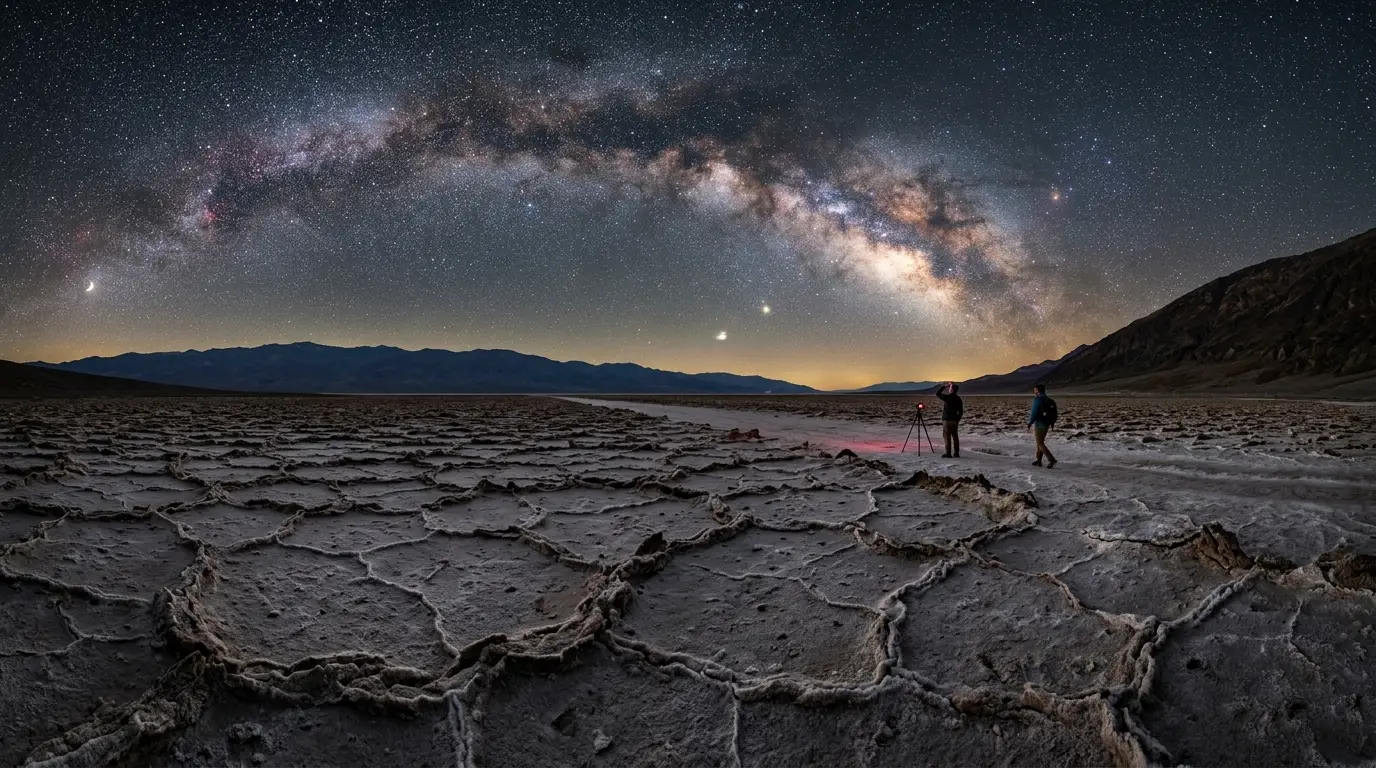
Death Valley's Gold-tier dark sky sits at the lowest point in North America. Here's when to visit, where to stay, and how to handle the extreme summer heat.
Dante's View: The Park's Full Vertical Range in One Sightline
Climb to 5,476 feet at Dante's View[4] and the park shows you both of its extremes at once: Badwater Basin, 282 feet below sea level, directly beneath the overlook, and Telescope Peak, 11,043 feet[5], on the opposite skyline, an 11,331-foot difference across the same view. It's the kind of view that makes the valley floor's scale legible in a way it isn't from down among the salt flats or the colored hills, where the mountains ringing the basin hide how enormous the drop actually is.
The drive up is paved the whole way, no washboard road or high-clearance requirement here, and the elevation itself does something the valley floor can't: it's noticeably cooler. Expect temperatures to drop several degrees for every thousand feet gained, which puts Dante's View well below whatever the thermometer reads at Furnace Creek. On a summer afternoon when Badwater is unsafe for anything beyond a short walk, Dante's View is often the one stop on this list still comfortable enough for an unhurried visit.
11,331 feet
Golden Canyon, Devil's Golf Course, and the Detour to Racetrack Playa
Fill the gaps between the big three stops with three shorter walks. Golden Canyon, about 12 miles from Furnace Creek, is a short slot-canyon walk through badlands geology, an easy introduction to the eroded formations that make up so much of the park's daytime scenery. Devil's Golf Course, about 15 miles out, is a stretch of jagged salt formations sharp enough that the terrain gave the spot its name; the interpretive walk there is short, but the ground itself, spiky, uneven, genuinely alien, is worth the stop on its own. Natural Bridge, the farthest of the three at about 40 miles from Furnace Creek, is a two-mile round-trip hike through a canyon to a rock arch, longer than the other two and shaded enough to make a reasonable midday option when the exposed stops above aren't.
Recommended tours
Tours are selected for quality, not commission. I earn a small fee if you book — at no extra cost to you.
- Golden Canyon: about 12 miles from Furnace Creek, short badlands walk
- Devil's Golf Course: about 15 miles from Furnace Creek, short interpretive walk on jagged salt
- Natural Bridge: about 40 miles from Furnace Creek, 2-mile round trip, partly shaded
Racetrack Playa, the dry lakebed famous for its sailing stones, rocks that leave long, visible trails across the bare playa, deserves a mention here even though it isn't a stop to add onto the same day as the others. The drive is at least 3.5 hours each way from Furnace Creek[6], on a rough washboard road that genuinely requires a 4x4 with high clearance[7], and rental cars are a bad bet for it; flat tires out there are common enough that park staff actively discourage the attempt in anything else. The stones move when thin ice sheets form on winter nights and break into panels the next morning, light winds pushing the ice, and the rocks frozen inside it, across the mud below[8]; the last suspected movement was in 2006[9], which tells you how rare and how slow this particular kind of magic actually is. For the full case on whether that detour is worth making, including camping-vs-day-trip logistics and shooting the stones under the Milky Way, see Racetrack Playa stargazing: the sailing stones at night. Best stargazing spots in Death Valley covers what that same drive is like after dark, if the detour is part of a longer trip.
Read next · Article
Best Stargazing Spots in Death Valley: 4 Places to Know
Four named spots handle Death Valley's Gold Tier sky differently: Badwater's horizon, Zabriskie's overlook, Mesquite Flat's dunes, Ubehebe's isolation.
Beating the Heat: Water, Timing, and What to Do If It Goes Wrong
Everything above assumes you've taken the heat seriously, and in Death Valley that's not optional advice. Summertime temperatures can reach 130°F (54°C)[10], hot enough that the valley floor stops being a place to linger and starts being a place to move through quickly, between air conditioning and shade. The National Park Service's baseline recommendation is blunt: drink at least one gallon of water per person per day to avoid dehydration[11], more if you're doing anything strenuous, and don't wait until you're thirsty to start.
Build the day around the heat rather than treating it as an afterthought. Visit Badwater Basin and Artist's Palette in the early morning or the last two hours before sunset, save the exposed midday hours for driving between stops with the air conditioning running, and treat Dante's View, several degrees cooler at 5,476 feet[4], as the obvious choice if you need to be outdoors when the sun is highest. Stay within sight of your vehicle once the heat sets in, and know the difference between the two stages of heat illness: heat exhaustion brings nausea, fatigue, headache, cramps, and cold, clammy skin; heat stroke adds confusion and disorientation on top of that and is a genuine medical emergency. If either shows up, stop moving, get out of direct sun, and drink water gradually rather than all at once.
Featured · Article
What Is Astrotourism? The Complete Beginner's Guide
Astrotourism means travel built around dark skies: meteor showers, auroras, the Milky Way. What it means, where to go, and how to plan your first trip.
November through March is the easiest season to do all of this without the constant heat math, mild enough for a full day of sightseeing without the strict morning-and-evening schedule summer demands. Base out of The Inn at Death Valley, and pair a day among these daytime stops with a night back at the overlooks once the heat has actually broken. For exactly which months line up daytime sightseeing with the darkest, coolest nights, see the best time to stargaze at Death Valley.