Big Bend Runs Hot by Day and Cold by Night, Sometimes Very Cold
Start with the number that should shape every packing decision for Big Bend National Park: the desert floor is usually well above 100 degrees Fahrenheit by late morning[1], and that holds true for most of the day across May through August, the park's hottest stretch of the year[2]. This isn't dry heat you shrug off with a hat. It's the kind that turns an unplanned midday walk into a real medical risk, and it sets the baseline for everything else on this list.
Elevation buys some relief, but less than most hikers assume. The Chisos Mountains run 10 to 15 degrees cooler than the desert floor[3], which matters if your stargazing spot sits up in Chisos Basin rather than down along the Rio Grande. At Rio Grande Village, the park's lowest elevation, summer highs reach 107°F in June and winter lows drop to 29°F in December, based on the park's published monthly weather averages. Up at Chisos Basin, the highest developed area, highs top out near 88°F and lows bottom out around 37°F by the same measure. Same park, same week of the calendar, close to a twenty-degree spread depending on where you're standing.
Even within a single summer night, the swing is real. One packing guide for the park puts it plainly: even in the summer, the desert nights are known for getting a little cold[4]. That's the whole packing problem in one sentence: dress for a furnace at 2 p.m. and a genuinely cool evening by 2 a.m., in the same 24 hours, possibly at the same campsite.
| Location | Summer high | Winter low |
|---|---|---|
| Rio Grande Village (lowest elevation) | 107°F (June) | 29°F (December) |
| Chisos Basin (highest elevation) | 88°F | 37°F |
Water: The One Supply You Cannot Improvise in the Desert
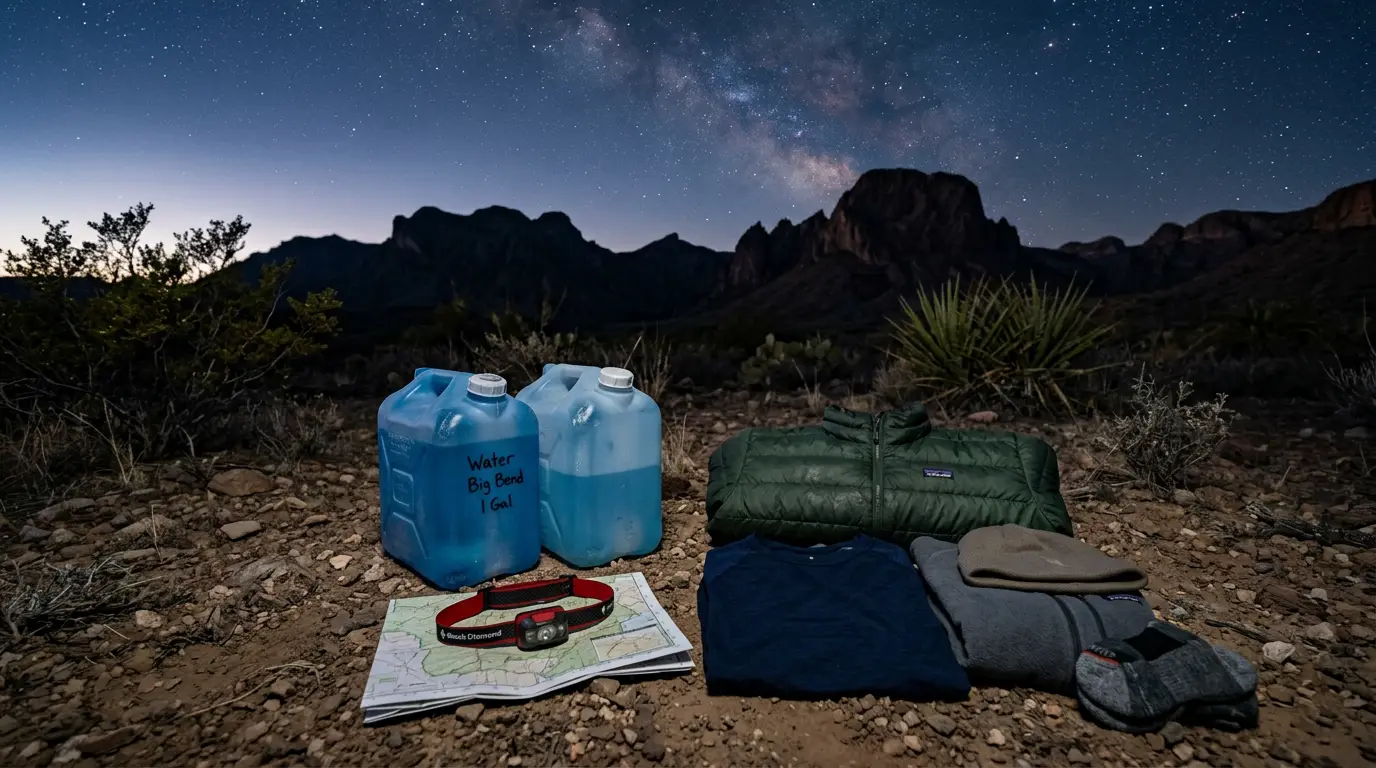
Everything else on this list is negotiable. Water isn't. The National Park Service tells visitors to carry a minimum of one gallon of water per person per day in the summer[5], and that's a baseline for sitting in camp, not a hiking allowance. Anything more active pushes the number up fast: a half-day hike calls for at least 2 quarts (2 liters) per person[6] on top of what you're already drinking to get through the heat.
Don't count on the desert to top you off. NPS is direct about it: never stake your life on a water source that might not be present[7]. Boot Spring, the most commonly cited water source in the Chisos Mountains, is usually dry[8], not an occasional inconvenience but the default state. Desert water here is precious, ephemeral, and unpredictable[9], which is the park's own language, not a guidebook exaggeration.
Treat every gallon you carry in as the only water you'll have all day, because that's usually the truth. A spring marked on a map is not the same thing as water in your bottle.
A spring marked on a map is not the same thing as water in your bottle.
Fuel and Supplies: Two Gas Stations Inside a Very Large Park
Inside Big Bend's boundary, gasoline is available at only two spots: Panther Junction and Rio Grande Village[10]. Outside the park, Study Butte and Stillwell's Ranch fill the gap, but neither is a quick detour once you're deep inside, especially after the drive covered in Getting to Big Bend.
Diesel drivers have even less room for error: it's available at Panther Junction alone inside the park[11], with Study Butte as the nearest outside option. Fill up before committing to the last stretch of road toward a stargazing spot, not after the gauge starts worrying you. There's no roadside service waiting to rescue a car that runs dry a long way from the nearest pump.
Featured · Destination
Big Bend National Park
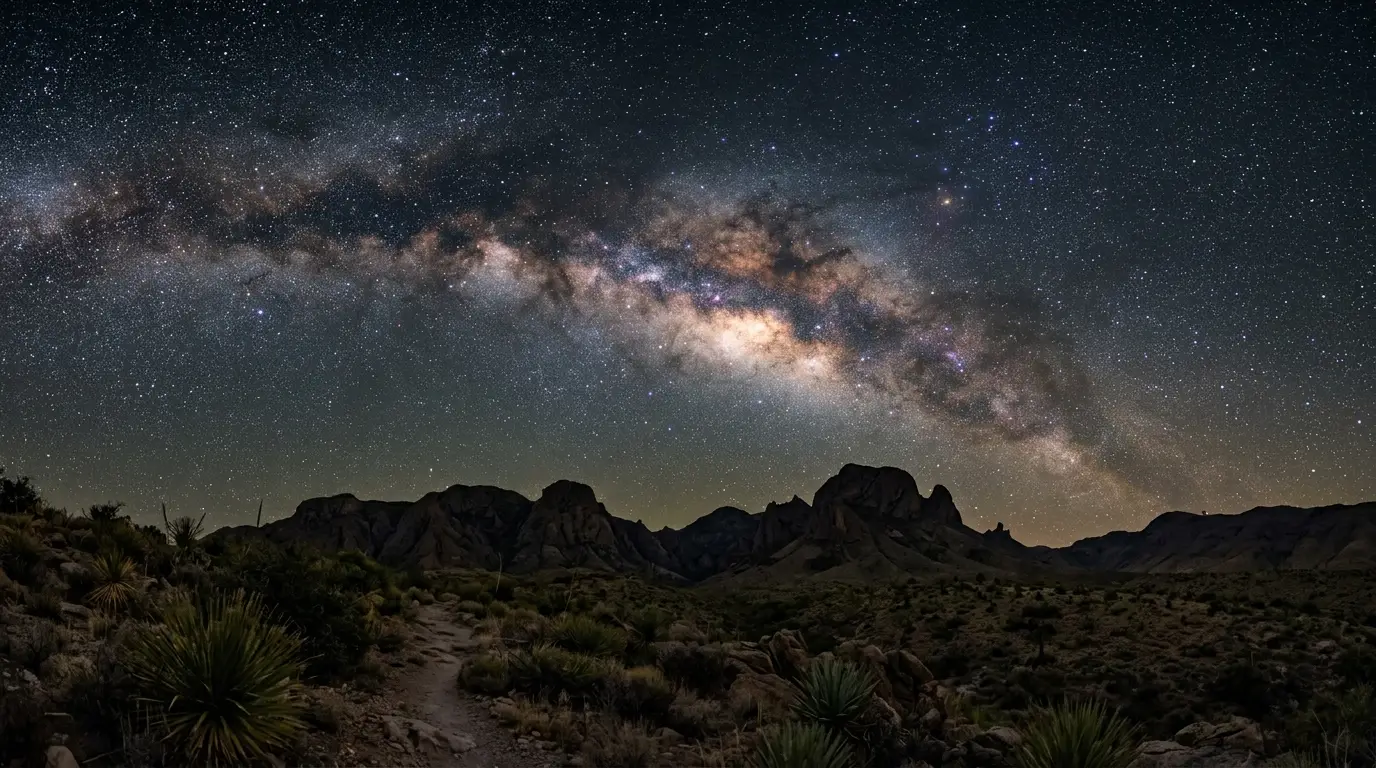
Big Bend National Park is Bortle Class 1, the darkest rating the Bortle scale has. What that dark sky rating means on the ground, and the best months to go.
No Cell Service Means Your Gear Does the Job a Phone Usually Does
Cell service is very spotty throughout the entire Big Bend area[12], with the only reasonably reliable pockets sitting around Chisos Basin and near Panther Junction. Step outside those two spots, and a phone becomes a camera and a flashlight, nothing more. That changes what belongs in the bag: offline maps, a paper map as backup, and ideally a satellite messenger for anyone driving or hiking to a stargazing spot after dark.
Standard backcountry practice covers the gap a phone usually fills. Skip cross-country travel without real route-finding experience, and always tell someone outside the park where you're headed and when you plan to be back[13]. Write down your route and your expected return time, and leave it with someone before you head out for the night.
Two more backcountry habits earn a spot in the packing mindset, even for a one-night stargazing trip. Give camp real distance from any dry wash or streambed, since desert flash floods can arrive with little or no warning, and plan to cook on a camp stove rather than an open fire, since ground and wood fires are banned everywhere in the park, with no seasonal or area exception. Pick a site with that flood buffer in mind before you settle in for the night.
The Full Packing List: Heat Gear, Cold Gear, and Backcountry Basics
Here's what actually earns space in the pack and the trunk for a Big Bend stargazing trip, organized around the swing between a 100°F afternoon and a properly cold desert night.
Daytime heat protection:
- Wide-brim hat and UV-blocking sunglasses
- SPF 30 or higher sunscreen, reapplied through the day
- Lightweight, long-sleeve UPF shirt
- Electrolyte packets alongside plain water
Night cold layers:
- Insulated jacket for a winter trip, when Chisos Basin lows can sit near 37°F
- Warm hat and gloves for shoulder-season nights
- Moisture-wicking base layer rather than cotton
- Sturdy closed-toe shoes for standing at an overlook after dark
Water and hydration:
- One gallon per person per day, minimum, in summer
- An extra 2 quarts per person for any half-day hike
- A hydration backpack for anything involving walking
- Never count on a marked spring as a real water source
Recommended tours
Tours are selected for quality, not commission. I earn a small fee if you book — at no extra cost to you.
Fuel and vehicle:
- A full tank before entering the park; only Panther Junction and Rio Grande Village sell gas inside
- Diesel drivers should top off before arriving; only Panther Junction sells it inside the park
- A verified spare tire, jack, and lug wrench
- Extra engine coolant for a long, hot drive
Navigation and backcountry safety:
- Offline maps downloaded before you lose signal
- A paper map as backup
- A satellite messenger for night drives or hikes to a remote overlook
- A written route and return time left with someone outside the park
Stargazing and camp gear:
- Red-light headlamp to protect night vision
- Tripod for anything beyond a handheld phone shot
- Pre-charged batteries and a backup power bank
- A camp stove instead of firewood; ground and wood fires are banned park-wide
Match Your Gear to the Season Before You Go
Timing changes what's actually useful on this list. The Milky Way core shows best from spring through fall, which is also when daytime heat is at its worst, so anyone traveling June through August should treat the daytime heat protection section above as mandatory, not optional. Winter trades a visible Milky Way core for cold, clear nights and the coldest numbers on this list, Rio Grande Village's December lows near 29°F and Chisos Basin's near 37°F, which make the night cold layers worth a second look before a winter visit.
If the water and fuel math above feels like a lot for a first trip, it's worth weighing a night at Chisos Mountains Lodge instead of backcountry camping. It doesn't remove the heat or the drive, but it takes water rationing and campfire rules off the table for at least one night. Once you're inside the park, the best stargazing spots in Big Bend covers exactly where to point this gear once the sun goes down.
Featured · Article
What Is Astrotourism? The Complete Beginner's Guide
Astrotourism means travel built around dark skies: meteor showers, auroras, the Milky Way. What it means, where to go, and how to plan your first trip.