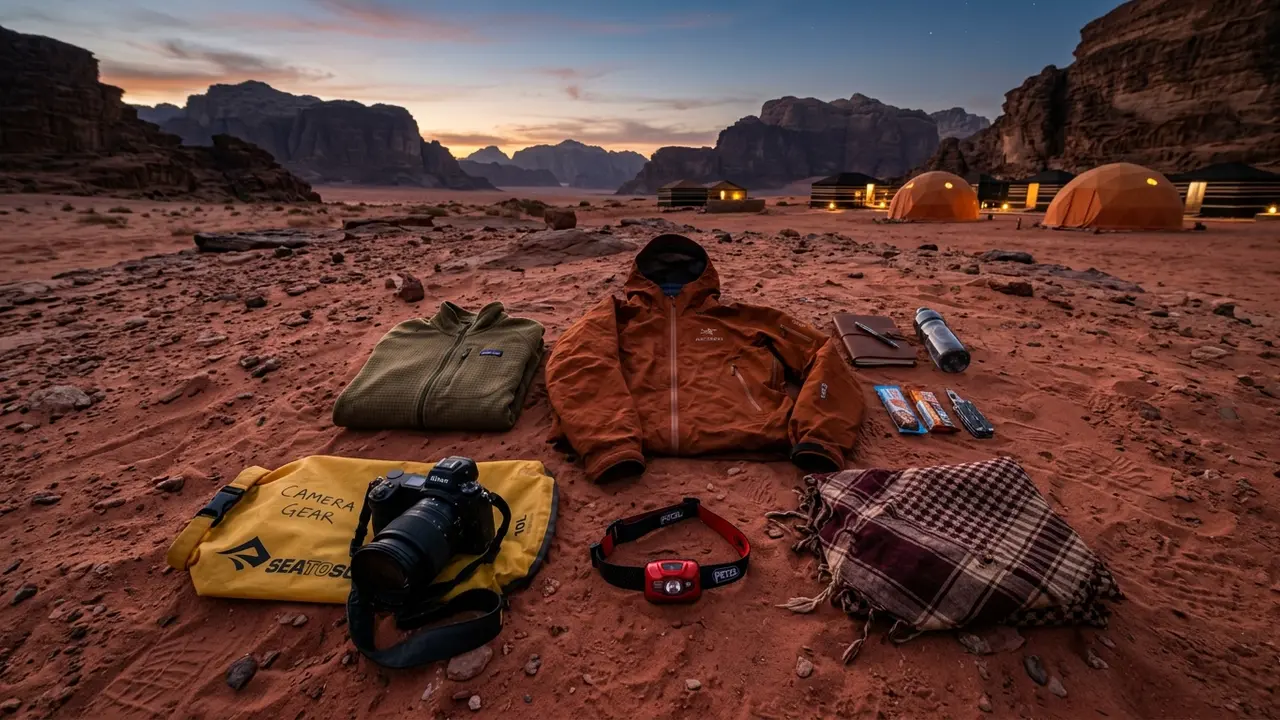

Why a Wadi Rum packing list starts with the thermometer
Wadi Rum doesn't do mild. Summer daytime temperatures average in the mid-30s°C (mid-90s°F), with peaks that climb well over 40°C (104°F), the kind of heat that makes the sandstone cliffs of the Valley of the Moon shimmer by early afternoon, deep inside the Wadi Rum Protected Area. The heat radiates up off red sand as much as it comes down from the sky, and by midday even the shaded side of a rock face offers only marginal relief. Once the sun drops, that heat doesn't linger. Nighttime temperatures run roughly 10°C cooler than the daytime average[1], and the fall happens fast, not gradually.
Winter flips the extremes without softening the swing. Daytime temperatures average 10-15°C, and on the coldest nights of the year, the temperature can drop below zero[2]. What ties both seasons together is the mechanism, not the numbers: the fast temperature drop at sunset and rise after sunrise is caused by the dry desert air[3], which holds almost no moisture to trap the day's heat overnight.
Build the packing list around the swing itself, not the season's headline number. A midsummer afternoon at 40°C tells you nothing about what you'll need standing outside a dome tent at 9pm, and a mild winter day in the mid-teens hides just how sharp the drop feels once the desert stops radiating warmth. Guides and camp staff plan the day around this same swing, scheduling jeep tours for the cooler morning and evening hours and saving the hottest stretch of afternoon for resting back at camp. If you haven't settled on a month yet, best time to stargaze in Wadi Rum breaks down how that swing shifts across the year.
~10°C cooler
Layering for the swing, not just the extremes
The single line every source on Wadi Rum agrees on: pack a sweater or jacket for the evening, even if the day was blazing. Camps here confirm it directly, since evenings in winter do need a sweater or jacket despite what the afternoon felt like[4]. That advice holds through summer too, when the daytime high is nowhere near the whole story once the fire's lit and the group settles in for the night sky. Light-colored, loose clothing does double duty here, since it reflects the daytime sun and layers easily once a fleece goes on top after dark.
Build the layering system in three pieces rather than one warm item grabbed at the last minute:
- A breathable, loose base layer that also handles the daytime heat
- A fleece or light insulated mid-layer for once the sun drops
- A windproof outer shell, since even a light breeze cuts harder once the sand stops radiating the day's warmth
The single line every source on Wadi Rum agrees on: pack a sweater or jacket for the evening, even if the day was blazing.
Head protection and sunscreen matter just as much on the other end of the clock. Camps specifically recommend covering your head and using plenty of sunscreen[5] for the hours spent out among the cliffs, before the layering conversation even starts. Pack for both jobs, not one.
What a Bedouin camp already packs for you, and what it doesn't
This is where Wadi Rum differs from a self-sufficient desert trek. Most overnight stays happen in a Bedouin camp, and camps here supply the core of what you'll sleep on: mattresses, blankets, and pillows come with the tent[6], and drinking water is provided too, so guests don't need to carry their own supply[7]. In cold weather, most camps also add comforters specifically to keep guests warm through the night[8].
That coverage changes what belongs in your bag. There's no real need to bring your own sleeping bag, since the bedding is already there, though some travelers still prefer to bring one for their own comfort or warmth preference[9]. What camps consistently do not supply is a towel, so pack one, since guests are asked directly to bring their own[10].
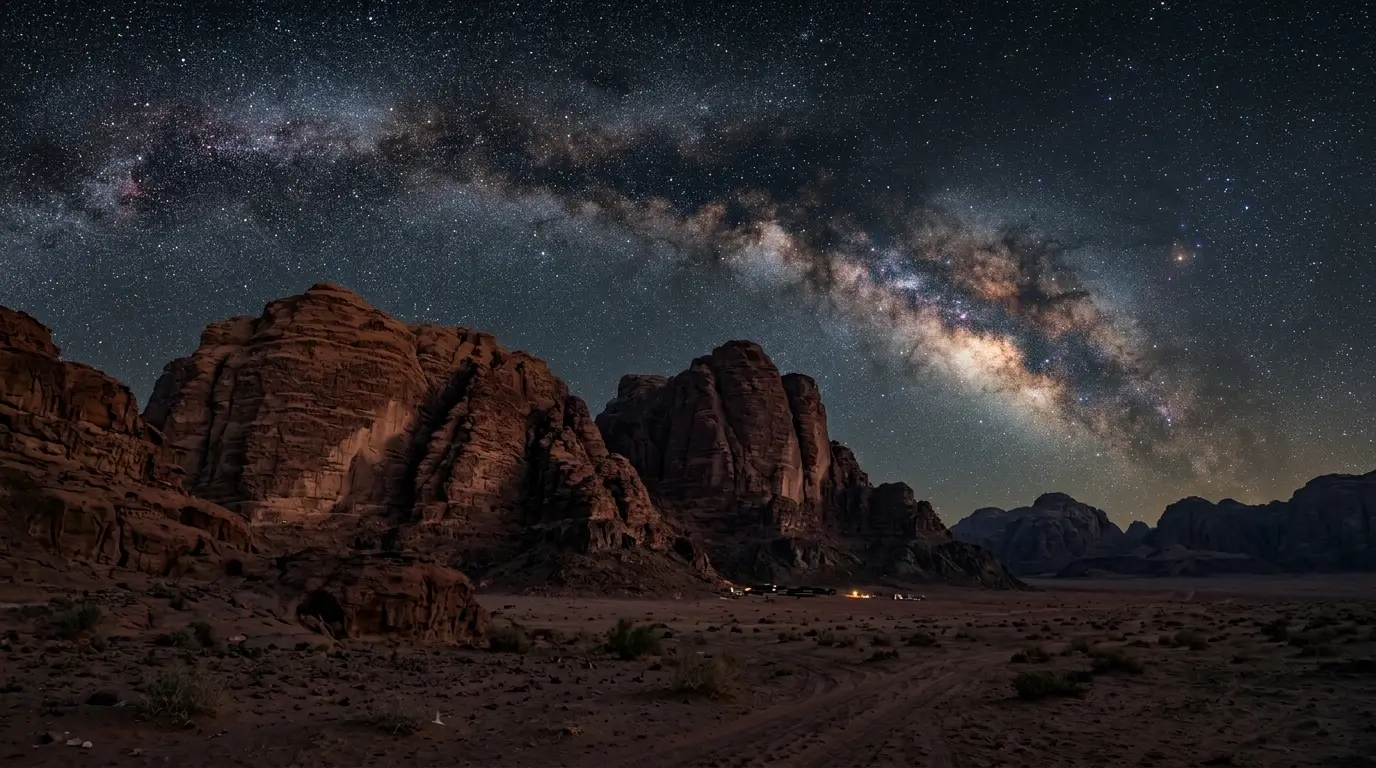
Featured · Destination
Wadi Rum
See the Wadi Rum night sky from a Zalabieh Bedouin camp in Jordan's UNESCO desert: bare tents to glass domes, Bortle 2-3 skies, and year-round stargazing.
Sleeping arrangements vary by camp type. Some Wadi Rum camps put guests in insulated dome tent camps with real beds and heating, closer to glamping than traditional desert camping in Jordan. Others keep to the older style: an open-sided Bedouin tent, or a bed rolled out under the sky on a clear night, with the camp's blankets doing the work a four-walled room would otherwise do. None of that changes because a camp calls itself "luxury" or "basic"; the core sleeping kit tends to stay consistent across the valley, and it's the extras, heating, en-suite bathrooms, the dinner spread, that vary. Check what a specific camp offers before you go. the Martian Dome bubble tents and Wadi Rum Night Luxury Camp fall at different points on that spectrum, and knowing which one you booked changes exactly zero of your clothing layers but everything about whether you need your own pillow.
Khamsin winds and the daytime sun: the other packing problem
Heat and cold aren't the only extremes Wadi Rum packing has to plan around. Summer months can bring khamsin, a dry, hot, sandy wind that blows in from the Arabian Peninsula[11], turning a clear afternoon into a haze of blown sand within the hour. It isn't a daily event, but it's common enough across the hottest months that a scarf or buff pulled up over the nose and mouth earns a spot in the daypack, not left behind in the main bag. Local drivers and guides read khamsin conditions the way sailors read weather, watching the horizon for a dust haze before deciding whether to push on to a farther viewpoint or stay closer to camp.
Cameras and phones deserve the same caution as skin does, even without a documented Wadi Rum-specific sandstorm study to point to. Sealing electronics in a dry bag or a simple ziplock when they're not actively in use, avoiding lens changes in open wind, and giving gear a wipe-down at the end of the day are standard desert-photography habits anywhere sand blows, and there's no reason Wadi Rum's fine red sand would be an exception. For a full camera and lens setup built for these conditions, see Wadi Rum astrophotography gear. Treat that as ordinary prudence rather than a locally-measured hazard. Nobody has published how many days a summer sees khamsin or how long a given storm lasts, so the honest packing advice stays qualitative: expect it, protect for it, and don't panic if a whole trip passes without seeing one.
Dust and heat sit on top of each other in Wadi Rum, not instead of each other. A camera cover that blocks sun works just as well against blown sand, so there's no need for two separate solutions when packing for both problems at once.
The daypack, the shoes, and the small stuff for the dunes
Most of a Wadi Rum day happens away from camp, out on a jeep tour or hike through the sandstone canyons, so the daypack matters as much as the overnight bag. A daypack built for daytime touring should hold a camera, water, a head covering, snacks, and a light sweater for changing conditions, the same short list local guides recommend for anyone heading out past the camp gate. Jeep tours typically run a few hours at a stretch, long enough that a forgotten water bottle or headlamp becomes a real problem rather than a minor inconvenience.
Footwear matters more than it looks like it should. Loose red sand doesn't reward sandals, and a rocky wadi floor punishes anything without real tread. Closed-toe shoes with a sole that sheds sand, rather than trapping it, cover both a daytime hike and the walk from a dome tent to wherever the group settles in to look up after dark.
A short list of small items earns its place for reasons that have nothing to do with temperature or sand:
- A red-light headlamp, since eyes take 20 to 30 minutes to fully adapt to the dark, and one burst of white light undoes that adjustment instantly
- Spare batteries, packed in an inner pocket rather than a cold outer one
- Lip balm and a heavier moisturizer than usual, since dry desert air pulls moisture out of skin day and night alike
- A basic first-aid kit, useful after a day of walking on uneven sand and rock
- A portable charger, since camps rarely offer reliable power at every tent
Featured · Article
Uluru Cultural Significance and Visitor Etiquette
Uluru is Anangu land under joint management. Here's why the 2019 climb closure is settled policy, what you can't photograph, and real visitor etiquette.
Pack the small stuff together in one pouch rather than scattered across the daypack. Digging through pockets by feel, in the dark, while the rest of the group is already looking up, is exactly the kind of friction a little organization avoids. If stargazing is the whole point of the trip, stargazing in Wadi Rum is worth reading before you finalize the packing list, since the best viewing spots shape what's worth carrying out to the dunes after dinner.
The Wadi Rum desert packing checklist
Pull everything above into one list and a Wadi Rum desert packing list looks like this:
- Breathable base layer, fleece or light insulated mid-layer, windproof outer shell
- Sweater or jacket for winter evenings, packed even for a summer trip
- Scarf or buff for khamsin winds and blowing sand
- Head covering and sunscreen for daytime sun
- A towel, since most camps don't supply one
- A dry bag or ziplock for a phone or camera
- Closed-toe shoes with a sole that sheds sand
- A red-light headlamp with spare batteries
- Lip balm, heavier moisturizer, and a basic first-aid kit
- A portable charger and a daypack for water, camera, and snacks on daytime excursions
What you can leave at home, or in the main bag back at the vehicle: a full sleeping bag (bedding is provided), a hard-shell suitcase (soft duffels travel better on desert transport anyway), and any illusion that this stretch of Jordan behaves like a mild Mediterranean night. Pack for the swing, not the season, protect anything electronic from the wind-blown sand, and let the camp handle the bedding. Get that right and the packing list stops being a chore and starts being the reason you're comfortable enough, at 9pm under a Wadi Rum sky, to actually enjoy the reason you came. For the rest of the trip, how to actually reach the desert and things to do in Wadi Rum beyond stargazing round out the planning.