
Why Wadi Rum Has No Airport of Its Own
Wadi Rum has no airport of its own, and nothing resembling one is likely to appear given the point of the place: a protected desert wilderness where light pollution barely registers. Every visitor arrives by road, whether that road starts at a small domestic terminal an hour away or a bigger international hub several hours further north.
Two airports realistically serve as gateways, and a common add-on route through Petra covers a good share of visitors too:
- Fly into King Hussein International Airport (AQJ) in Aqaba, then a short final drive
- Fly into Queen Alia International Airport (AMM) near Amman, then a longer overland drive south
- Combine the trip with Petra, driving the connecting stretch of highway between the two
Most people planning stargazing in Wadi Rum build the desert leg around one of these three approaches rather than treating it as an isolated day trip. Which one fits depends less on Wadi Rum itself and more on the rest of the Jordan itinerary already forming around it.
The Closest Airport: King Hussein International in Aqaba
King Hussein International Airport (AQJ), on Aqaba's edge by the Red Sea, is the fastest way in. The drive north into the desert covers about 60 km and takes roughly an hour along a paved road. It's a straightforward highway run, no mountain passes or unpaved detours, which makes Aqaba the airport most first-time visitors should aim for if flight schedules allow it.
A private taxi transfer from the airport runs around 20 JOD[1], taking about the same hour-long drive, whether it's arranged through a camp in advance or hailed on arrival. Fewer international carriers fly into Aqaba than into Amman, so this convenience sometimes comes at the cost of a connecting flight through a larger hub.

Featured · Destination
Wadi Rum
See the Wadi Rum night sky from a Zalabieh Bedouin camp in Jordan's UNESCO desert: bare tents to glass domes, Bortle 2-3 skies, and year-round stargazing.
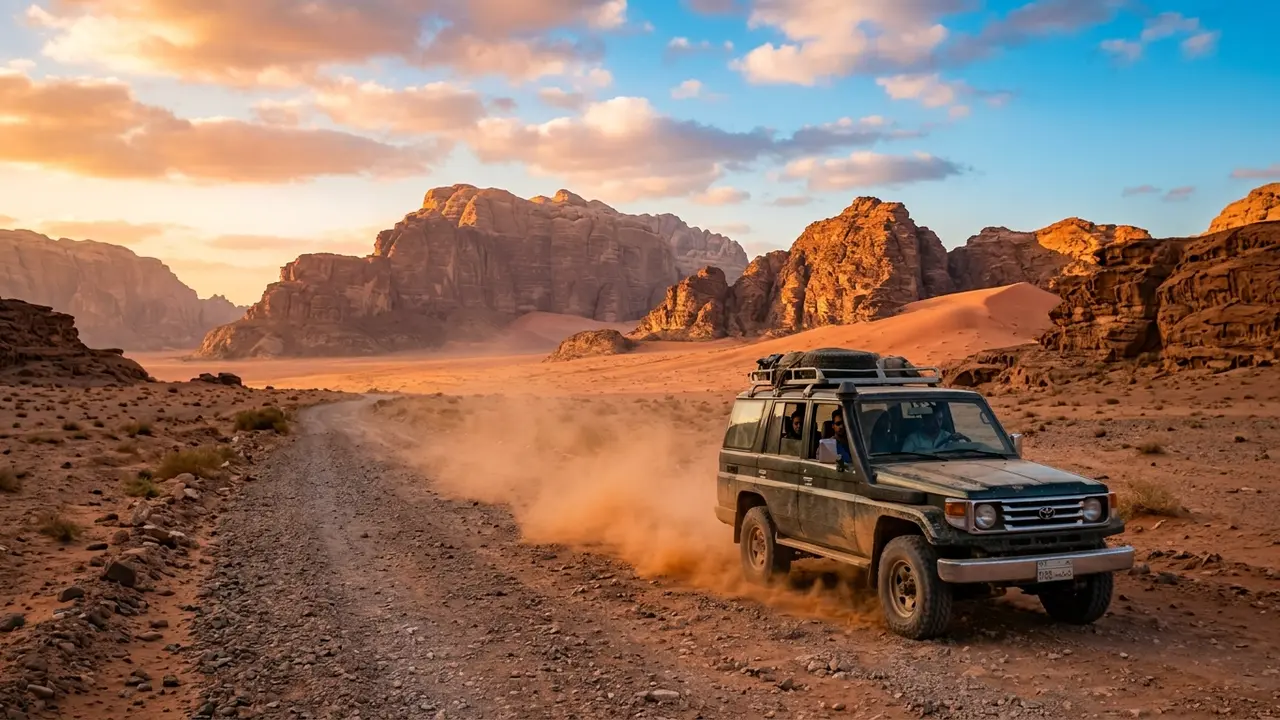
Arriving vehicles reach the Wadi Rum Visitor Centre first, where day-trippers register and pay the protected-area entrance fee. From there, a further stretch of sand-edged road continues to Wadi Rum Village, the last stop before most camps take over with their own 4x4 transfers into the interior.
Coming from Amman via Queen Alia International
Queen Alia International Airport (AMM), Jordan's main international gateway near the capital, sits much further from the desert. Reckon on 280 to 320 km down the Desert Highway (Route 15), a drive of roughly three and a half to four and a half hours depending on Amman traffic and exactly where in the city the trip starts. Sources vary slightly on the precise figure, so treat it as a half-day commitment rather than a quick hop, whatever the exact number turns out to be on the day.
A private transfer booked in advance costs noticeably more than the short Aqaba run, and takes three to four times as long, so the math mostly comes down to which flight schedule suits the rest of the trip. Camps such as the Nomads camp can usually arrange this pickup directly, which is worth asking about before booking transport separately, since quoted fares vary by vehicle and operator.
280-320 km
The Petra-to-Wadi Rum Route
Petra and Wadi Rum sit close enough together that combining both in one trip barely adds a day. The drive covers about 110 km (68 miles) and takes roughly 2 hours, making it the shortest of the three main approaches by a comfortable margin[2].
The route mixes two very different kinds of road, part older and more scenic, part faster and more modern. The Kings Highway section is the more memorable drive, winding past villages and highland scenery that the Desert Highway skips entirely.
It's also considered the route's weak point by many travelers: some stretches of the Kings Highway between Petra and Wadi Rum have a reputation for rough surfaces and patchy cell signal, and drivers sometimes report unplanned detours.
Self-Driving vs. a Private Driver
Renting a car and driving this stretch alone is possible, but the combination of road damage, thin signage, and dead phone reception makes a private driver the safer default for a first visit. A guided jeep safari booked from Petra covers the same ground with someone who already knows which sections to avoid, removing the need to navigate an unfamiliar highway network after a long day of sightseeing at Petra.
Jordan Visa and Entry Requirements
Entering Jordan is more straightforward than the patchwork of regional visa rules might suggest, though the details are worth double-checking before booking anything.
Jordan's official e-visa system runs through the Ministry of Interior's
eservices.moi.gov.jo portal, or the MOI mobile app, and many nationalities can also obtain a visa on arrival at official ports of entry. Third-party visa-guide sites commonly cite a modest single-entry tourist visa fee, though the exact amount is worth confirming directly with Jordan's Ministry of Interior before you travel, since fees are subject to change. Confirm the current amount directly on the MOI portal, or with a Jordanian embassy or consulate, before finalizing a booking.Recommended tours
Tours are selected for quality, not commission. I earn a small fee if you book — at no extra cost to you.



The Jordan Pass is worth knowing about regardless of the exact fee. For stays of four days (three nights) or longer, it bundles a waiver of the standard entry visa fee together with admission to Wadi Rum, Petra, Jerash, and dozens of other sites[3]. Some nationalities may face additional entry requirements regardless, and the minimum-stay condition still has to be met for the waiver to apply, so it's worth reading the fine print rather than assuming it covers every traveler automatically.

Featured · Article
Uluru Cultural Significance and Visitor Etiquette
Uluru is Anangu land under joint management. Here's why the 2019 climb closure is settled policy, what you can't photograph, and real visitor etiquette.
None of this replaces checking current government travel guidance for Jordan before booking flights.
Planning Your Route: What Actually Works
There's no single correct way in, only trade-offs that shift depending on the rest of a Jordan itinerary. Flying into Aqaba wins on speed if the flight schedule cooperates. Flying into Amman wins on international connections, at the cost of a half-day drive. Coming via Petra wins for anyone already planning to see both sites, since the connecting drive is the shortest of the three.
A few practical notes apply no matter which route gets chosen:
- Book a camp transfer in advance rather than assuming a taxi will be waiting, especially around new-moon weekends when demand for Wadi Rum's darkest skies peaks
- Check road conditions on the Kings Highway before attempting a self-drive from Petra, since sections close without much notice
- Confirm with a camp, such as Memories Camp, whether airport pickup is included, since many multi-night stays bundle it in
- Compare pickup policies before booking a transfer; the the ranked list of where to camp ranking covers which camps bundle it in and which don't
- Fill the fuel tank in Aqaba, Amman, or Petra before setting out; options thin out fast once the highway turns into open desert
| Route | Distance | Driving time | Best for |
|---|---|---|---|
| Fly to Aqaba (AQJ) | ~60 km final leg | ~50-60 minutes | Fastest transfer, fewer flight options |
| Fly to Amman (AMM) | ~280-320 km final leg | ~3.5-4.5 hours | More flight choices, longer drive |
| Overland from Petra | ~110 km | ~2 hours | Shortest connecting route, combine both sites |
Timing the drive itself matters too. Arriving a little before sunset means the last stretch into camp happens in daylight, and the sky is already darkening by the time the gear comes out, a detail covered in more depth in the which months give Wadi Rum its clearest skies guide. However the trip gets booked, the last few kilometers are the same for everyone: pavement gives way to sand, the engine goes quiet, and the desert does the rest.