What Wadi Rum's dark sky is actually built on
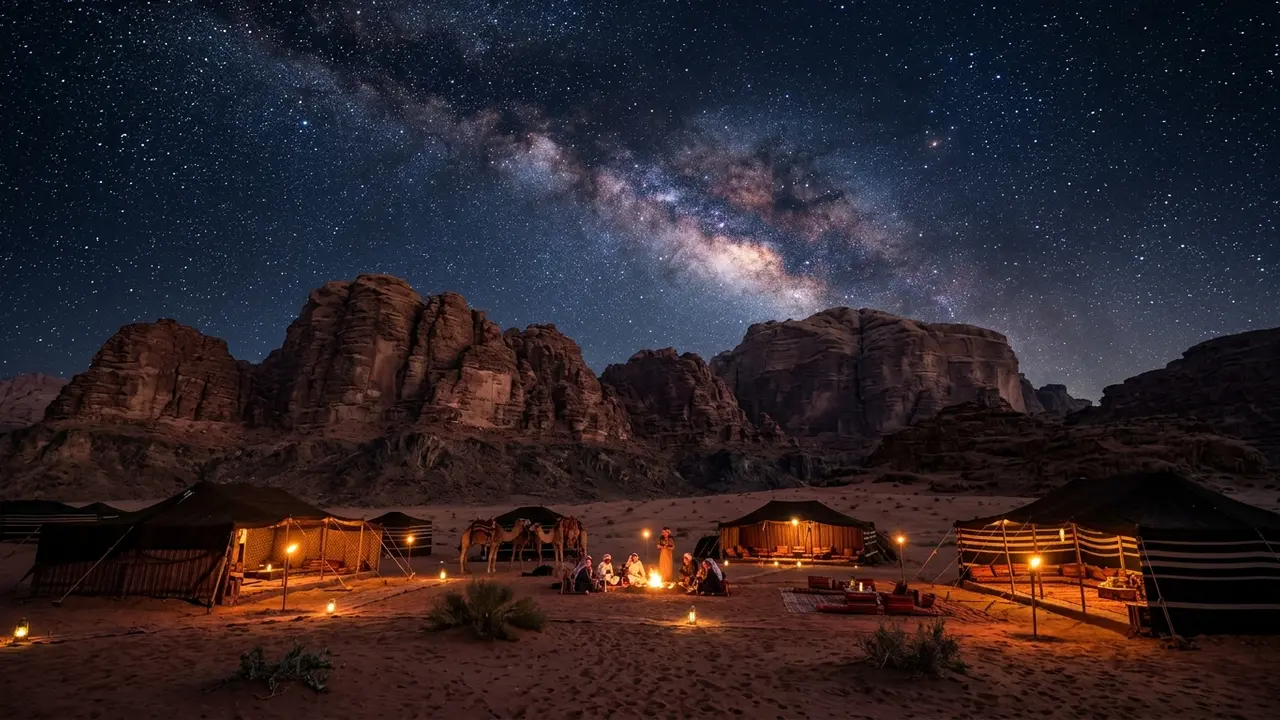
Wadi Rum earns its reputation honestly, just not the way some articles claim. The Wadi Rum Protected Area has held UNESCO World Heritage status since 2011[1], recognized for a desert landscape of towering sandstone and granite massifs rising out of a valley scattered with a handful of small Bedouin desert camps and almost nothing else. Jordan's own tourism board lists Wadi Rum among the kingdom's UNESCO sites too[2], which is the honest, checkable basis for the destination's dark-sky reputation: genuine remoteness and a near-absence of artificial light, not a formal night-sky certification. See the full breakdown of Wadi Rum's UNESCO listing for what the designation does and doesn't cover.
That distinction matters, because it isn't the one most travel content repeats. Search results and some blogs describe Wadi Rum as an official International Dark Sky Reserve or Sanctuary. It isn't, at least according to DarkSky International's own directory of certified places. A Dark Sky Sanctuary carrying the name "Rum" does exist, on the small Isle of Rum off Scotland's west coast, an entirely different desert. No official Bortle scale reading has been published for Wadi Rum either, so calling the sky "exceptionally dark" here is an honest, qualitative description built from geography, not a measured number anyone can point to.
Practically, that means the sky you get in Wadi Rum depends more on where you camp than which month you pick. A camp running string lights and a generator all night washes out faint detail the same way a small town does. A camp that keeps its lighting low, shielded, and pointed downward gives you the sky the desert is actually capable of, whatever the calendar says.
Spring (March-May) and autumn (October-November): the comfortable, crowded window
Spring is when most operators and independent travelers agree Wadi Rum stops fighting you and starts cooperating. Daytime temperatures climb gently across the season, averaging around 20°C in March and rising to roughly 31°C by May, while nights stay cool without turning punishing, generally 8°C to 16°C depending on how far into the season you've gone[3]. That's warm enough to sit outside past midnight in a light jacket, and cool enough that the desert still loses its daytime heat properly after dark, the diurnal temperature swing that helps keep the air still and the sky steady.
Autumn runs the same arc in reverse: temperatures ease down from summer's peak through October and November, landing in roughly the range spring finishes on. Camps fill up in both windows for the same reason, comfortable days lead to comfortable nights, and neither season demands much of a packing list beyond a jacket for after dark.
The trade-off is company. A camp that feels wonderfully isolated in July can have half a dozen other groups' fires visible across the valley in April. If solitude under the stars matters as much as the sky itself, ask your camp directly how full they expect to be on your dates rather than assuming shoulder season automatically means an empty desert.
| Season | Daytime highs | Night temps | Best for |
|---|---|---|---|
| Spring (Mar-May) | 20-31°C (68-88°F) | 8-16°C (46-61°F) | Comfortable days, mild nights |
| Summer (Jun-Aug) | 34-36°C (93-97°F) | 21-23°C (70-73°F) | Clearest-sky reputation, Perseids |
| Winter (Dec-Feb) | 14-17°C (57-63°F) | 3-5°C (37-41°F) | Quiet camps, cold nights |
Summer (June-August): brutal days, cool nights, and the clearest-sky reputation
Summer is where Wadi Rum's desert climate turns into an honest warning. Daytime temperatures average 34°C to 36°C, hot enough that walking any distance across open sand in early afternoon is a bad idea, while nights cool to a genuinely pleasant 21°C to 23°C[4], the kind of evening where a light layer is a bonus rather than a requirement. Wikipedia's climate data for the site backs up just how hot the peak gets: July's mean daily maximum runs about 34.6°C (94.3°F)[5], in line with the operator figures above.
A local Wadi Rum tour operator markets summer specifically as the destination's most reliable stargazing season, arguing the sky stays clear more consistently than in other months. That's a single operator's own claim rather than independently verified weather data, but it tracks with a simple pattern: Jordan's driest stretch of the year runs through summer, and less atmospheric moisture generally means fewer clouds working against you after dark.
Summer also carries the desert's best-known meteor shower. The Perseids run from July 17 through August 24[6], peaking in mid-August, and Wadi Rum camps promote the peak nights specifically as a reason to book a summer stay. For the shower's exact peak date each year and the other ten annual meteor showers worth knowing, see meteor showers guide.
Featured · Destination
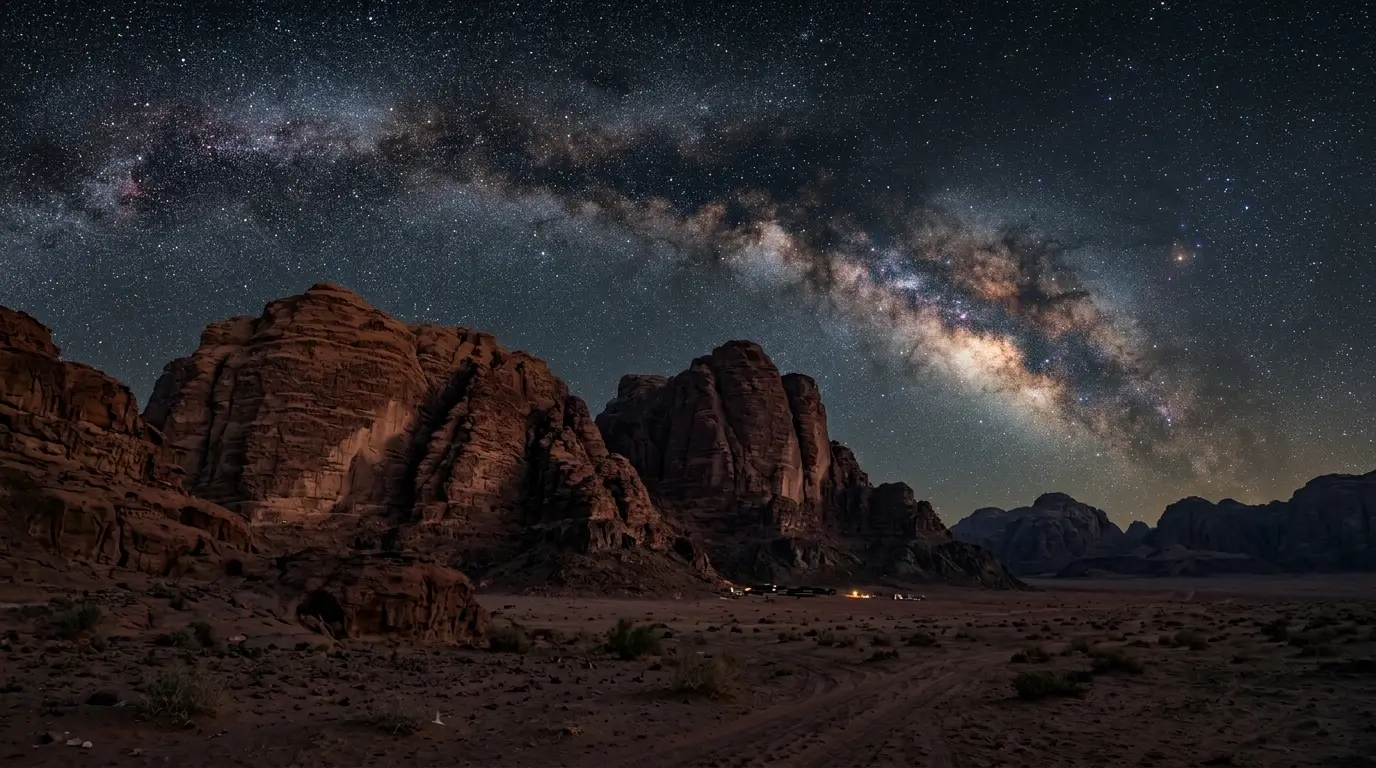
Wadi Rum
See the Wadi Rum night sky from a Zalabieh Bedouin camp in Jordan's UNESCO desert: bare tents to glass domes, Bortle 2-3 skies, and year-round stargazing.
The catch is obvious: you're trading a comfortable afternoon for a better-marketed night. Plan any summer visit around early-morning or after-dark activity, and treat the hours between roughly 11am and 4pm as time to stay in shade, not time to explore the rock formations.
Winter (December-February): cold nights despite mild days
Winter is Wadi Rum's most overlooked season, and also its coldest by a wide margin. Daytime highs settle into a mild 14°C to 17°C, comfortable for a full day of hiking or a jeep tour through the valley's rock formations, but nights are a different story: temperatures commonly drop to 3°C to 5°C[7], cold enough that a desert camp's evening bonfire stops being optional. Pack for winter camping, not a mild-weather trip. A proper down jacket, thermal layers, and a hat matter here as much as sunscreen does in July.
That cold is exactly why winter nights can deliver some of the year's steadiest, most transparent air. Cold air holds less moisture than warm air, and clear winter skies are a direct result of that basic physics, the same reason observatories favor high, cold, dry sites elsewhere in the world. The trade is comfort for clarity: more gear required, but a still, cold sky with none of summer's heat haze near the horizon.
3-5°C
Winter also happens to be the quietest season at most camps. Visitor numbers thin out considerably compared to the spring and autumn peaks, meaning more of the desert's darkness to yourself and less light spill from a neighboring camp's fire pit.
Moon phase decides more than the calendar does
Season decides how comfortable your night will be. The moon decides how much of the sky you'll actually see, and that holds true whichever month you land in. Around a full moon, expect to see relatively few stars; around a new moon, expect the clearest, darkest view Wadi Rum can offer, with the Milky Way's dust lanes and fainter detail rendered as sharply as the desert air allows. That's simply how moonlight and faint starlight interact anywhere on Earth, not a Wadi Rum-specific effect. Either way, give your eyes real time to reach full dark adaptation once astronomical twilight ends, rather than judging the sky the moment you step out of a lit tent.
That single variable outweighs which of the four seasons you picked. A moonless night in the depths of a crowded April can beat a full-moon night in the supposedly ideal, quiet stretch of June. Check the new-moon window before you lock in dates, not after, and build your stargazing nights around the days immediately surrounding it rather than around the month alone. Closer to your travel dates, the Wadi Rum stargazing forecast guide covers the dust-season and cloud-tracking tools that fill in what a moon calendar alone can't predict.
Featured · Article
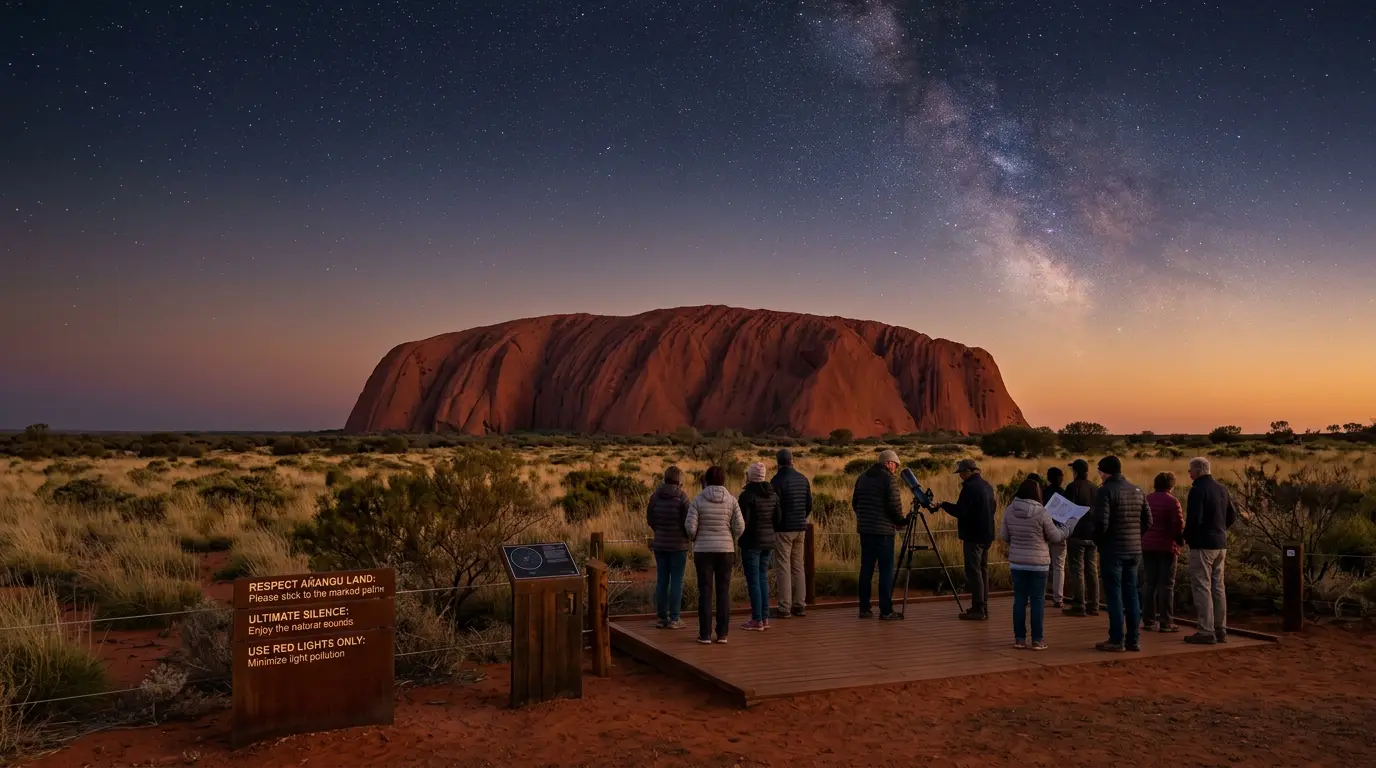
Uluru Cultural Significance and Visitor Etiquette
Uluru is Anangu land under joint management. Here's why the 2019 climb closure is settled policy, what you can't photograph, and real visitor etiquette.
One thing worth hedging honestly: the Milky Way's galactic core, the brightest band low on the southern horizon, follows the general Northern Hemisphere calendar, roughly spring through early autumn, best before dawn early in that stretch and earlier in the evening by late summer. No source ties that timing specifically to Wadi Rum's exact latitude, so treat it as general astronomy guidance rather than a destination-specific promise, and lean on the new-moon calendar instead, since that variable is the one actually confirmed for this location. For the full mechanics behind moon phase and season together, see when to stargaze.
Picking your week: season first, moon second, gear for both
Start with comfort, not the sky, since Wadi Rum's darkness holds up in every season. If mild weather matters most, aim for March through May or October through November, keeping in mind those are also Wadi Rum's busiest months for tourism generally, with April, May, October, and November singled out as the desert's peak, most crowded stretch[8]. If a clear-sky reputation and the Perseids matter more than comfort, summer's brutal days are the trade worth making. If you want the desert closest to empty and don't mind serious cold after dark, winter rewards patience with a quieter camp and steady, transparent air.
Recommended tours
Tours are selected for quality, not commission. I earn a small fee if you book — at no extra cost to you.
Wadi Rum's night sky earns its reputation from geography and a near-empty valley floor, and the rest is just picking the week that suits you. Once a season is picked, check the new-moon date for your travel window and build your stargazing nights around it. A trip that happens to land on full moon isn't wasted; it's simply better suited to naked-eye orientation and planet-watching than to catching the Milky Way's faintest detail.
Wadi Rum's night sky earns its reputation from geography and a near-empty valley floor, and the rest is just picking the week that suits you.
A short checklist before booking:
- Season for comfort: spring and autumn for mild days and nights, summer for heat and the Perseids, winter for cold and quiet
- Moon for clarity: check the new-moon date for your chosen month and centre two or three nights around it
- Camp lighting: ask directly how the camp manages outdoor lights after dark, since a badly lit camp undoes what the desert already gives you for free
- Backup nights: build at least two nights into any dedicated stargazing stay — see how many nights to book for the full trade-offs — since weather and moon rarely cooperate exactly on cue
- Where to set up: once the week is picked, see my guide to Wadi Rum's four best-known stargazing spots — Um Frouth Rock Bridge, Barrah Canyon, Lawrence's House ruins, and the open dunes
None of this needs a certification the destination doesn't actually have. For general etiquette once you're on the ground, from red-light use to camp noise, see dark sky etiquette.