Your phone can shoot Wadi Rum's night sky — here's the honest version

Point a phone at the sky above Wadi Rum and the red sandstone inselbergs do half the work before you've touched a single setting. This protected desert carries no International Dark Sky Reserve plaque and no DarkSky International designation of any kind, a claim some tour operators repeat anyway, seemingly confusing this valley with Isle of Rum in Scotland, an entirely different island that does hold a real Dark Sky Sanctuary. What Wadi Rum has instead is a UNESCO World Heritage listing earned in 2011[1], granted for a landscape UNESCO itself describes as towering red-walled inselbergs of striated sandstone rising directly from flat valleys floored with pink sands[2], plus genuine remoteness and a population density low enough that ambient light barely registers past Rum village. Wadi Rum's UNESCO dark sky status, explained covers what that designation does and doesn't mean for stargazers.
British officer and writer T. E. Lawrence called the valley "vast, echoing and God-like"[3], a line Jordan's own tourism board still uses to describe the scale a camera, phone or otherwise, is up against. That scale is exactly why composition matters here as much as any setting: an inselberg's silhouette or a camp's lantern glow gives a phone's small sensor something to anchor onto besides a featureless dark expanse.
None of what follows requires buying a dedicated camera. It requires understanding what Night Mode is actually doing, keeping the phone still against desert wind and sand, protecting a battery through Wadi Rum's brutal day-to-night temperature swing, and pointing the lens at something more interesting than empty sky. Ready to graduate to a dedicated setup instead? Wadi Rum astrophotography gear covers camera, lens, and tripod choices for the same sky. For the fuller case on why this particular desert is worth the trip at all, see stargazing in Wadi Rum.
vast, echoing and God-like
T. E. Lawrence , British officer and writer, quoted by Jordan's official tourism board

How Night Mode actually captures a star field
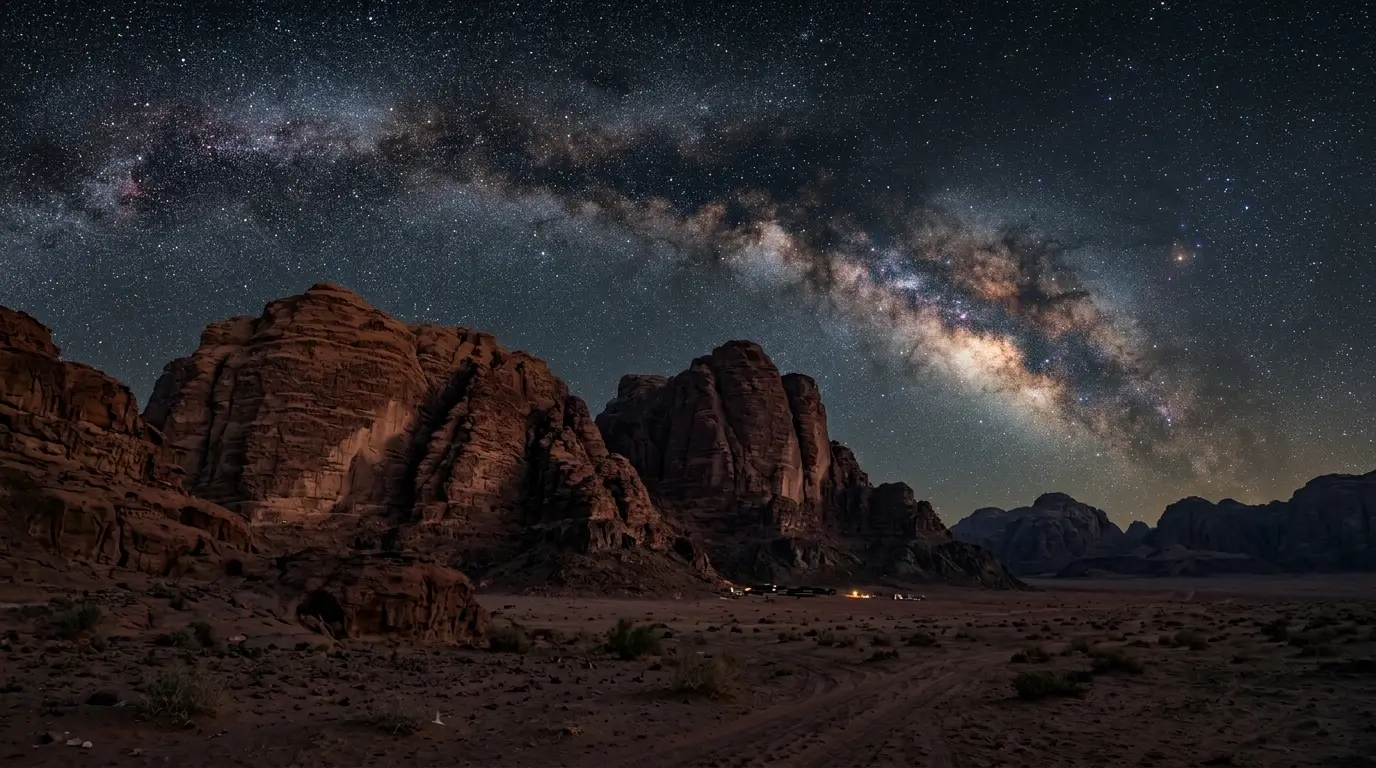
Modern phones don't take one long exposure of the night sky; they take several shorter ones and merge them into a single brighter image, a process usually branded Night Mode or Astrophotography mode depending on the phone. On a sky as dark as Wadi Rum's, away from any camp's lanterns, some phones extend that exposure to several seconds or longer once mounted on something steady, pulling detail out of sandstone silhouettes and the brighter stars that a single quick frame would miss entirely.
None of that stacking matters if the phone moves. Holding the camera still for the duration of even a one-second exposure is critical[4], and a stray shake blurs the same stars Night Mode just spent several frames trying to resolve, turning a crisp sandstone edge into a soft smear.
Wadi Rum adds its own wrinkle here. A phone mounted on open sand catches more wind than one braced against a jeep's roof rack or a camp's stone wall, so where you set up matters almost as much as which mode you're shooting in.

Featured · Destination

Wadi Rum

Wadi Rum is Jordan's UNESCO World Heritage desert, a Mars-like sandstone landscape where Bedouin-led camps put you under near-total darkness at night.

Keeping the phone dead still on sand, rock, and jeep roofs

Inexpensive tripod mountings for smartphones can work wonders in astrophotography[5], and Wadi Rum is a good place to put that advice into practice. A clamp-style mini tripod, the kind of small, portable smartphone tripod sold under names like Joby's GorillaPod[6], collapses into a day bag and works on the elevated rock overlooks many camps use for their evening stargazing stop.

No tripod in the bag doesn't rule out a usable shot. Wadi Rum's sand itself anchors a lightweight tripod's legs in a way hard pavement never would, and a few reliable stand-ins cover most of what a proper mount would do on firmer ground:

  • A rock or low ledge, angled so the phone points where you actually want it
  • A rolled jacket or sand-filled bag, wedged against something solid
  • The jeep's roof rack or bonnet, if the driver's parked at your chosen stop
Without keeping your phone steady during a long exposure shot, the image will be blurred[7], regardless of how clever the improvised support looks.
Test whatever support you're using on the very first frame of the night, before the group moves on to the next stop. A wobble that's obvious in the first thirty seconds is easy to fix; the same wobble buried in a photo you assumed was sharp only shows up once you're back at camp, scrolling through the results.
Test whatever support you're using on the very first frame of the night, before the group moves on to the next stop.

Wadi Rum's brutal day-to-night swing and your phone's battery

Desert air holds onto neither heat nor cold, and that single fact drives everything about how a phone behaves here after dark: the fast fluctuation is caused by the air always being dry, since dry air cannot trap heat nor cold that radiates from the sand[8]. The desert goes from scorching to genuinely cold within an hour of sunset, and warms just as fast after sunrise.
In summer, daytime highs climb well over 40°C[9] before dropping roughly ten degrees to around 20°C once the sun is down, with August alone averaging 34°C across the whole month[10], the hottest of any month here. A phone carried in a jeep or a pocket all day in that heat is often already warm before the night's photography even starts, and Night Mode's longer exposures, plus a star-map app running GPS, add exactly the load a hot battery handles worst.
Winter runs the opposite risk. Daytime highs of 10-15°C can fall to just above or below zero after dark[11], cold enough some nights to trigger a sudden voltage-drop shutdown on a phone left mounted and exposed on a tripod between shots, even with charge still showing on the screen. Keeping the phone in an inner jacket pocket between frames, rather than left on the mount the whole session, buys real minutes of usable battery whichever season you're shooting in.

40°C to 20°C

Wadi Rum's summer days climb well over 40°C, then drop roughly ten degrees to around 20°C within an hour of sunset: a swing dry desert air produces because it can't hold onto heat or cold radiating off the sand.

Composing the shot: sandstone domes, camp lanterns, and jeep-stop overlooks

A phone pointed straight up at a starfield with nothing else in the frame usually reads as a gray smear, however good the settings behind it. Wadi Rum hands you a better foreground for free: a red sandstone inselberg's silhouette cutting a hard edge against the sky does more compositional work than a technically sharper frame of stars alone.
Shooting from camp adds a second option. Hospitality is an essential quality of Bedouin culture[12], and a shared fire is where most camps gather every evening regardless of who's pointing a phone at the sky. The warm glow of a lantern or a dying campfire tucked into one corner of the frame contrasts against the cold blue of a long exposure, and it's the detail that makes a shot recognizably Wadi Rum rather than any dark patch of desert anywhere else. Camps like Sun City Camp run their evening fire pit close enough to the tents that its glow shows up in frame without any extra effort.
Keep the horizon level and resist zooming in. Digital zoom on a phone throws away real resolution for a false sense of getting closer to the sky, and a wide, unzoomed frame with a strong sandstone silhouette beats a cropped attempt at the galactic core almost every time.
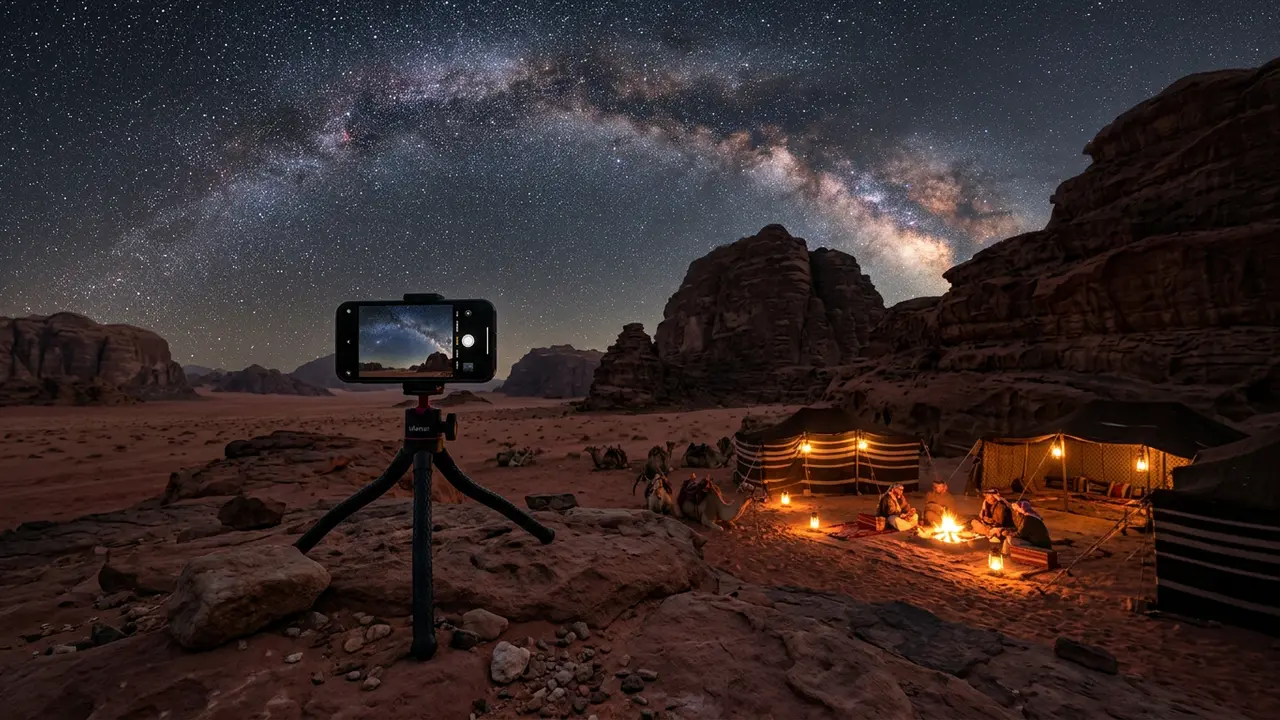
A smartphone braced on a mini tripod capturing wadi rum smartphone stargazing photography of the Milky Way above a red sandstone inselberg silhouette

A smartphone braced on a mini tripod capturing wadi rum smartphone stargazing photography of the Milky Way above a red sandstone inselberg silhouette

Before you head out: signal, timing, and a pre-trip checklist

Wadi Rum's camps and the desert interior beyond Rum village carry limited to no mobile signal in most spots, so any star-map or night-sky app that needs a live data connection should be downloaded and switched to offline mode before you leave the village, not once you're standing under the sky wondering why the app won't load.
Timing still matters more than any setting covered above. Best time to stargaze in Wadi Rum and best stargazing spots in Wadi Rum both go deeper on picking the month and the specific overlook. No phone technique fixes a night with a bright moon washing out the sky, or a viewpoint with another camp's lanterns bleeding into your frame.

A short list covers most of what actually trips people up before a night out:

  • Charge the phone fully before the evening excursion; long exposures and a hot-then-cold desert both drain a battery fast
  • Download offline star-map or planetarium apps before leaving Rum village, where signal disappears
  • Pack a clamp-style mini tripod, or plan to prop the phone against a rock or a rolled jacket
  • Keep the phone in an inner pocket between shots rather than left exposed on the mount the whole session
  • Ask your camp which jeep-stop overlook they use for stargazing photos, and frame around a sandstone silhouette or the camp's own lantern light
Featured · Article

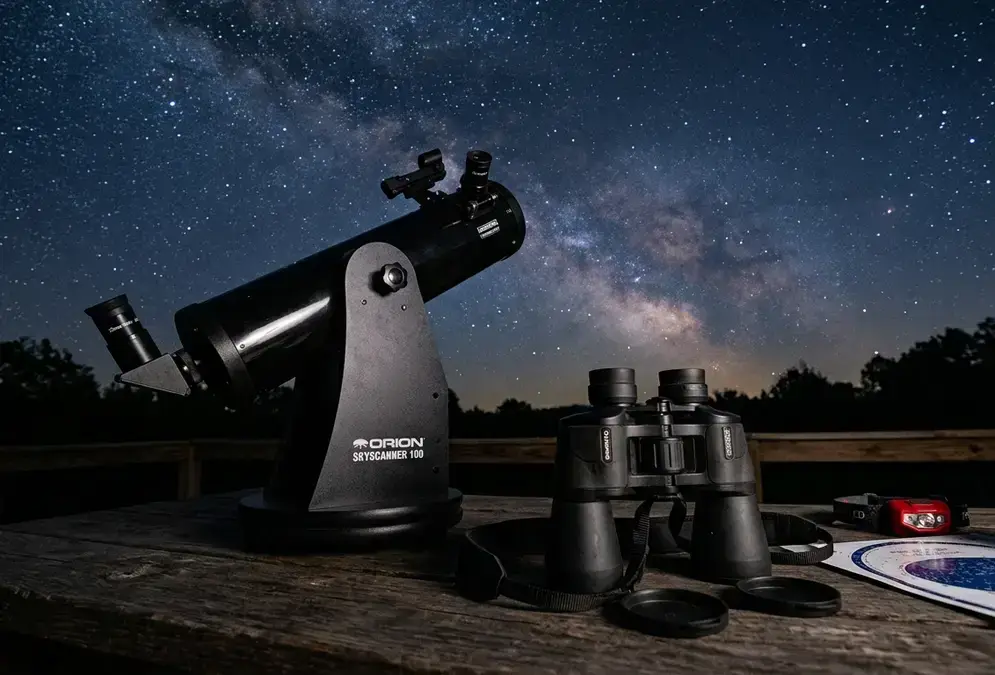
What Is Light Pollution? Definition, Types, and Solutions

Light pollution is artificial light brightening the night sky, affecting 80% of the world. Learn the 4 types, wildlife and health effects, and how to fix it.

None of that requires gear beyond what's already in your bag. It requires knowing what Wadi Rum's sky, and its sand, actually demand from a phone.