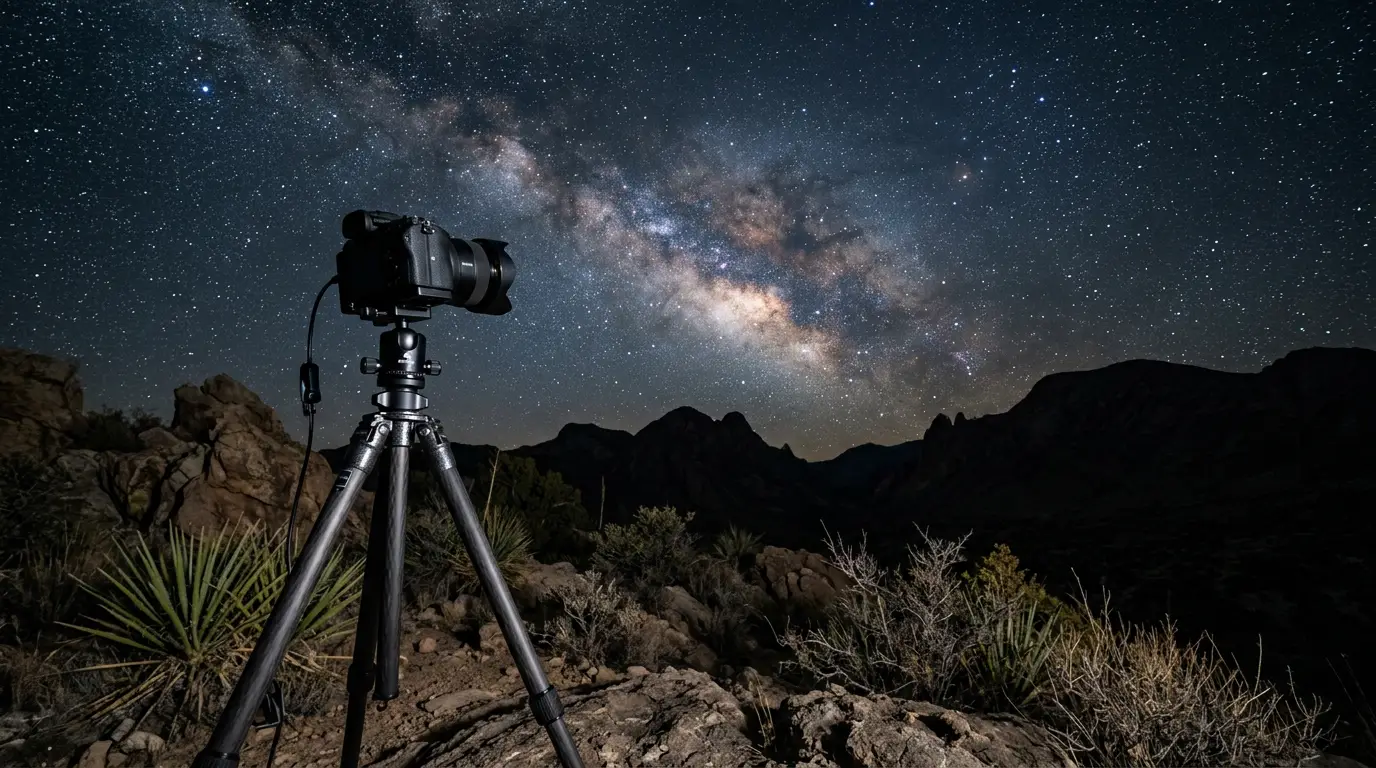
Camera body: full-frame mirrorless for a Bortle Class 1 sky
A full-frame mirrorless camera is the standard recommendation for Milky Way photography, and the reasoning holds as well at Big Bend as anywhere else: a full-frame sensor avoids the crop factor that makes star movement more noticeable during a long exposure[1]. That matters more here than it sounds, since Big Bend National Park is rated Bortle Class 1, the darkest classification the scale has — a rating that border-wall lighting proposals have put at risk — and a sensor that gathers more light per pixel is what turns that dark sky into a usable frame instead of a noisy one.
Crop-sensor bodies still work at Big Bend. The crop factor effectively multiplies a lens's focal length, which shortens the maximum exposure time before stars visibly trail across the frame, the exact problem a full-frame body sidesteps. If a crop-sensor camera is what you already own, the fix is simple: use a wider lens than you would on full frame, and expect to trim a few seconds off your shutter-speed math.
a full-frame sensor avoids the crop factor that makes star movement more noticeable during a long exposure
Manual controls matter more than sensor size once you're actually shooting. Full manual control over aperture, shutter speed, and ISO is non-negotiable for Milky Way work, since autofocus hunts uselessly once the sun is down and there's nothing bright enough nearby for it to lock onto. Focus manually on a bright star or planet before full dark sets in, then leave the focus ring alone, and consider taping it, for the rest of the night.
Lens: wide-angle aperture and the exposure math for a desert Milky Way
Aperture is the number that matters most for a Milky Way frame. Wide-angle lenses at f/2.8 or faster are essential, gathering enough light in a single exposure to render the galactic core without pushing ISO into visibly noisy territory[2]. Anything narrower than f/2.8 forces a choice between a longer shutter, which risks star trails, or a higher ISO, which costs detail.
Focal length decides how long that shutter can stay open before stars start to blur. Using a 14mm lens on a full-frame camera allows roughly a 35-second exposure without visible star movement; switch to a 200mm lens and that window shrinks to just 2.5 seconds[2]. That's not a small difference. A 35-second exposure gathers far more light than a 2.5-second one, which is the entire reason wide-angle glass dominates Milky Way photography over anything resembling a portrait or telephoto lens.
At Big Bend specifically, that wide field of view does double duty, holding both a dramatic foreground and a full arc of the Milky Way core in one frame:
35 sec
- Santa Elena Canyon, for sheer canyon walls as a foreground
- Sotol Vista, for the widest open horizon in the park
- Rio Grande Village, for the river itself as a foreground element
Best stargazing spots in Big Bend breaks down which of the park's six main viewpoints suits which kind of foreground; pick the focal length after picking the spot, not before.
Tripod and accessories: holding still through a long desert exposure
A tripod that can't hold dead still for 20 to 35 seconds undoes every gain from the right camera and lens. Mass and rigidity matter more than any single spec or brand name, whether that's a mid-range carbon-fiber tripod or a heavier professional-grade one. What counts is enough weight and stiffness to stay motionless in open desert wind, which Sotol Vista and Rio Grande Village both get on a clear night.
Two accessories close the gap between a steady tripod and a genuinely sharp frame:
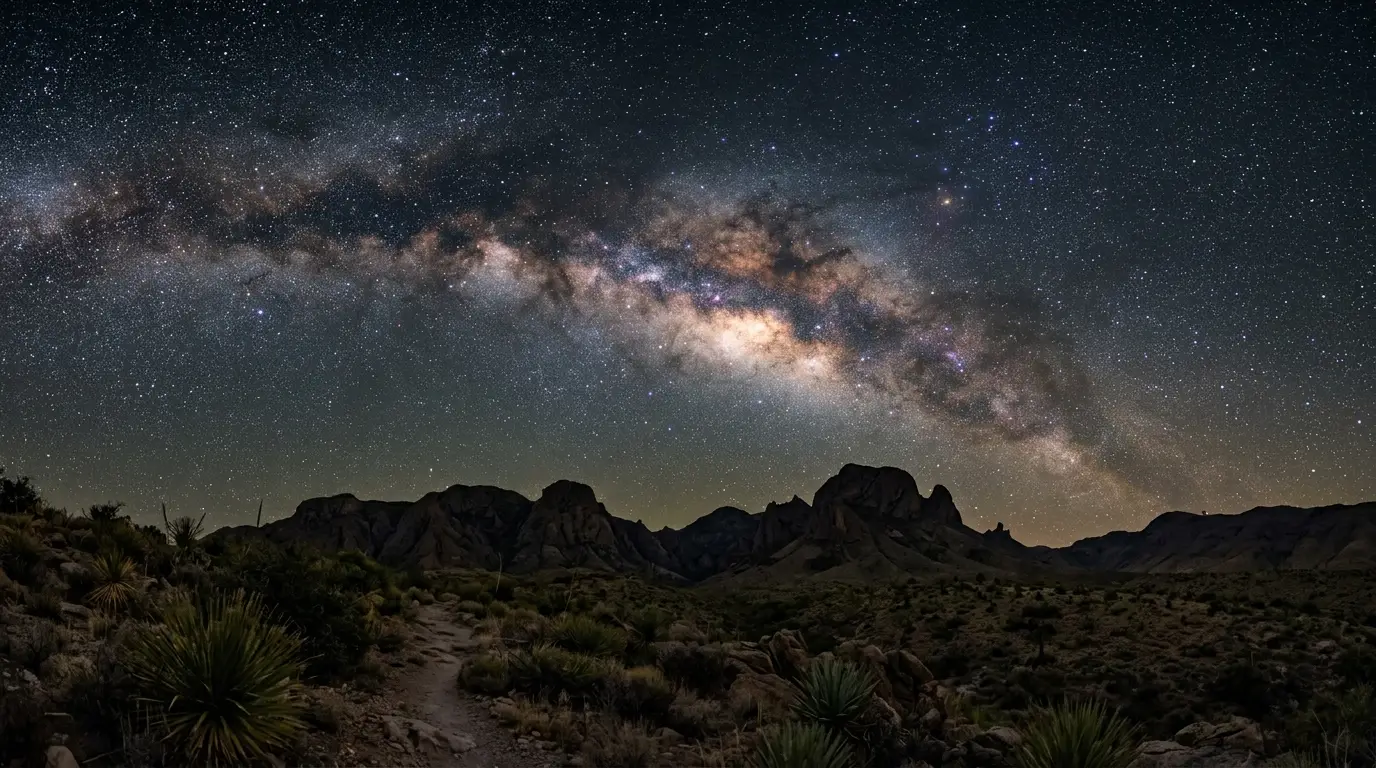
Featured · Destination
Big Bend National Park
Big Bend National Park is Bortle Class 1, the darkest rating the Bortle scale has. What that dark sky rating means on the ground, and the best months to go.
- An intervalometer triggers the shutter without you touching the camera body, removing the small vibration a manual shutter press adds to a long exposure
- A headlamp with a red-light mode preserves the night vision you spent thirty minutes building, unlike a white beam that resets your eyes back to zero[3]
Neither costs much next to a lens or tripod, and both solve a problem no amount of camera-body spending fixes on its own.
Carry more memory cards and one extra battery than feels necessary, too. The nearest camera shop is hours away in any direction, and there's no corner-store fix for a full card or a dead battery once you're out at Sotol Vista after dark.
If you're building a first kit rather than upgrading gear you already own, Stargazing Gear for Beginners covers binoculars and entry-level telescopes step by step; this guide assumes you're pairing a camera you already have with technique specific to Big Bend's desert conditions. If a smartphone is what you're actually carrying tonight, smartphone night sky photography at Big Bend covers night mode and phone-specific technique instead.
Big Bend's climate swing: 106°F desert days to 29°F winter nights
Big Bend's gear problem isn't only optical. Rio Grande Village reaches 106 to 107°F in summer, with winter lows around 29°F, according to NPS's published monthly averages for the park. That's the swing your camera and its batteries have to survive, sometimes within the same 24-hour visit: a scorching afternoon spent driving in from Terlingua or Marathon, logistics covered in Getting to Big Bend, followed by a cold, clear night actually shooting it.
Camera batteries have their own temperature limits to work inside. Lithium-ion cells are generally rated for -20°C to 60°C discharge and 0°C to 45°C charging, a range wide enough to cover most of the year here, but Big Bend's summer days and winter nights both push toward the edges of it rather than sitting safely in the middle[4]. The rest of this guide splits that range in half: what the heat side does to a battery, and what the cold side does.
The same swing threatens the lens itself, not just the battery. Stepping from an air-conditioned rental car into humid post-storm desert air can fog a cold lens element in seconds, the same condensation problem cold-climate photographers guard against, just triggered by air conditioning instead of a heated cabin.
None of this changes the exposure settings you dial in. It changes how you carry and store the equipment between setup and shutter release, which is where most desert astrophotography trips actually lose gear time, not behind the camera.
Battery care in extreme heat: avoiding permanent damage
Heat does something batteries don't fully bounce back from. Lithium-ion cells perform well at elevated temperatures, but prolonged heat exposure reduces their long-term capacity, and many chargers refuse to charge above 50°C (122°F) for exactly that reason[5]. Big Bend's summer daytime temperatures push toward that range on a regular basis, and even a few hours in a hot glovebox or a black camera bag left in direct sun accelerates that wear, not a temporary dip you charge your way back out of.
The fix costs nothing beyond a little planning:
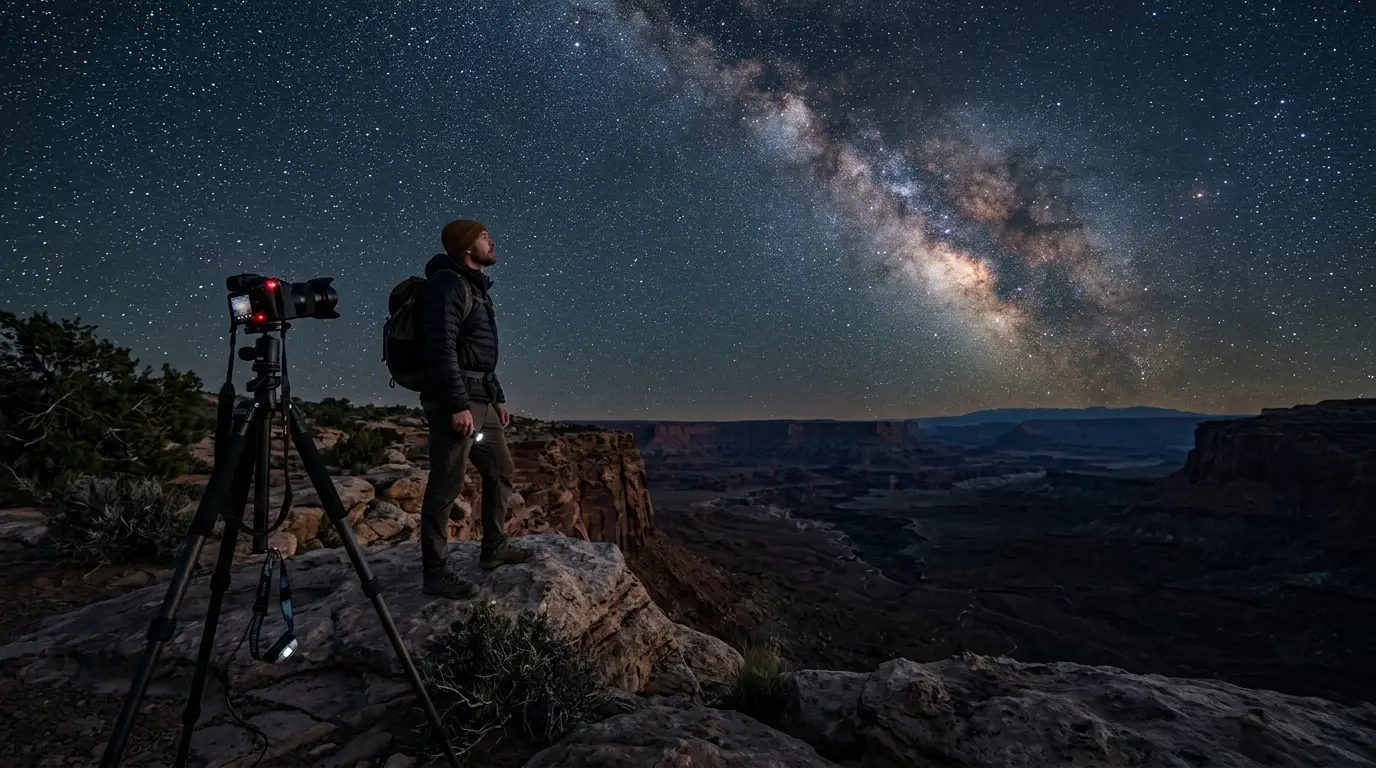
Featured · Article
What Is Astrotourism? The Complete Beginner's Guide
Astrotourism means travel built around dark skies: meteor showers, auroras, the Milky Way. What it means, where to go, and how to plan your first trip.
- Install cameras in shaded or ventilated spots and keep battery packs out of direct sun; heat ages cells fast even on a day that doesn't feel unbearable yet[6]
- Keep spare batteries in a cooler bag or a shaded pack pocket during the day, never the dashboard or a black bag baking in direct sun
- Shoot foreground scouting from shade where the terrain allows it, and save battery-heavy tasks, live view framing, image review, for after the day's heat breaks
None of this is exotic advice. It's the same discipline that protects a phone battery on a hot beach day, just with higher stakes given how far Big Bend sits from the nearest camera shop.
Battery care in the cold: Chisos Basin nights and the 20% capacity hit
Elevation makes the cold side of this swing arrive earlier than you'd expect. Chisos Basin, at roughly 5,400 feet, runs 10 to 15°F cooler[9] than Rio Grande Village at the peak of summer, so a night that's merely cool down by the river can already be genuinely cold up in the Basin, exactly where Big Bend National Park's only in-park lodging and several of its best foreground spots sit.
Cold doesn't damage a lithium-ion battery the way heat does, but it throttles it. Lithium batteries can lose around 20% of their usable capacity at 0°C (32°F), and while that's a real hit to a night's shooting, the battery remains functional and recovers once it warms back up[7]. A 29°F Big Bend winter night already sits below that 32°F mark, so the same mechanism, slowed chemistry rather than damage, is already at work, and possibly more pronounced.
| Location | Elevation | Temperature vs. Rio Grande Village |
|---|---|---|
| Rio Grande Village | Desert floor | Baseline: 106-107°F summer high, ~29°F winter low |
| Chisos Basin | ~5,400 ft | ~10-15°F cooler at summer peak |
The practical fix is the one aurora and winter astrophotographers use everywhere: keep spare batteries against your body, in an inner coat pocket rather than a camera bag, where your own body heat keeps the cell closer to its rated operating range. Swap in a warm spare the moment the active battery's charge indicator drops, and let the depleted one recover in your pocket for the rest of the night. Warm a cold battery back up slowly, with body heat or time inside a warm room, never with a direct heat source like a car heater vent or a campfire; rapid heating can cause a lithium-ion cell to swell, leak, or become a safety hazard[8].
The same slow-warming rule applies to the whole camera body, not just the battery. Bringing a cold camera straight from a night shoot into a warm truck cab or hotel room condenses moisture on and inside the lens; sealing it in a plastic bag for the ride back gives that moisture somewhere harmless to land instead of on the glass.