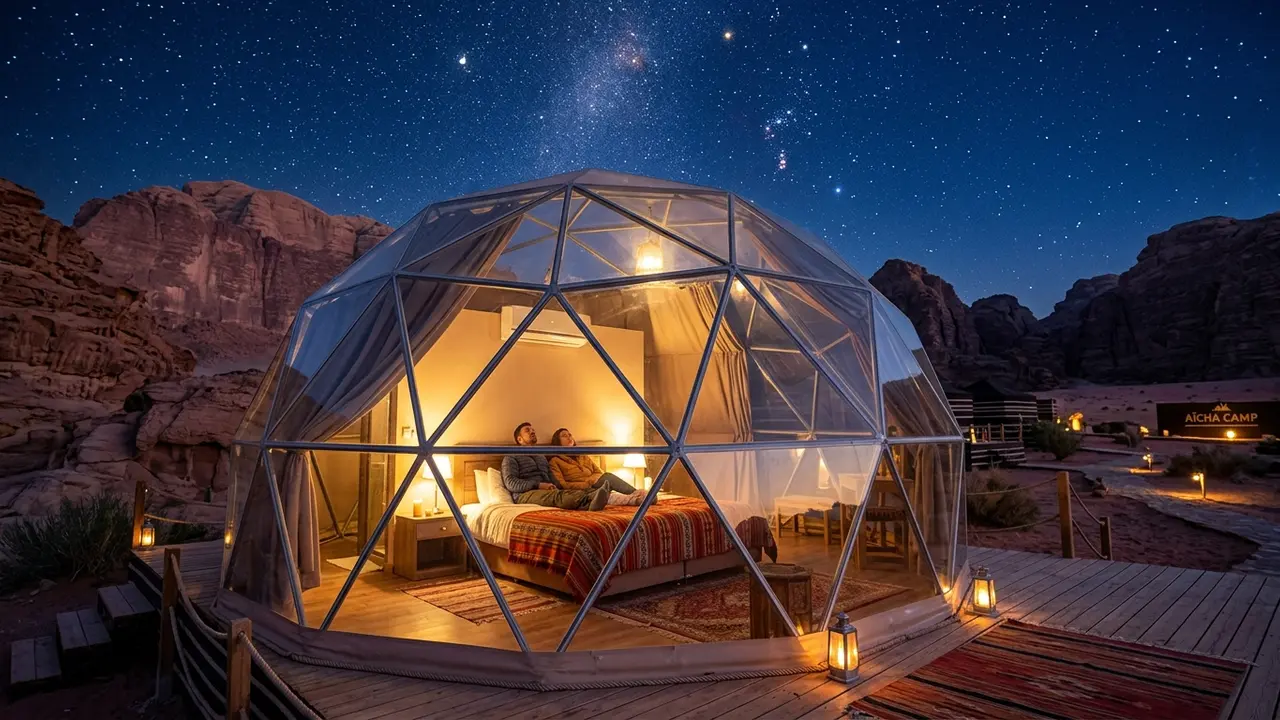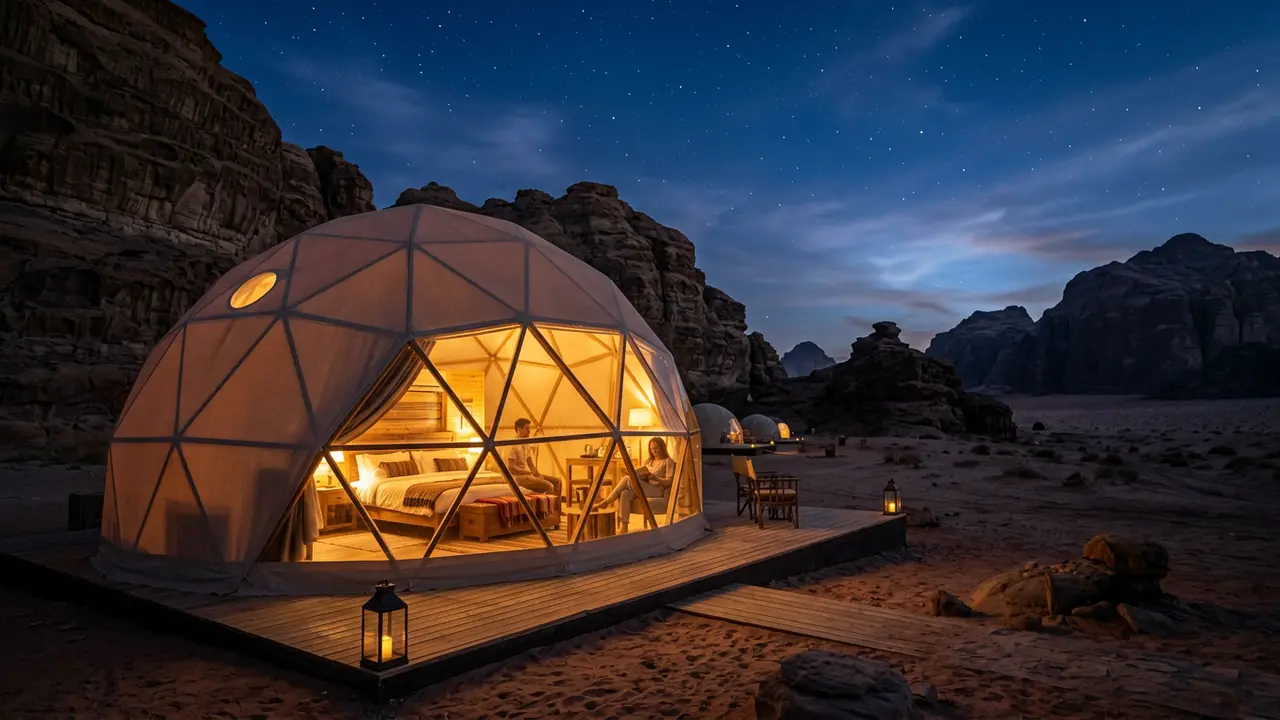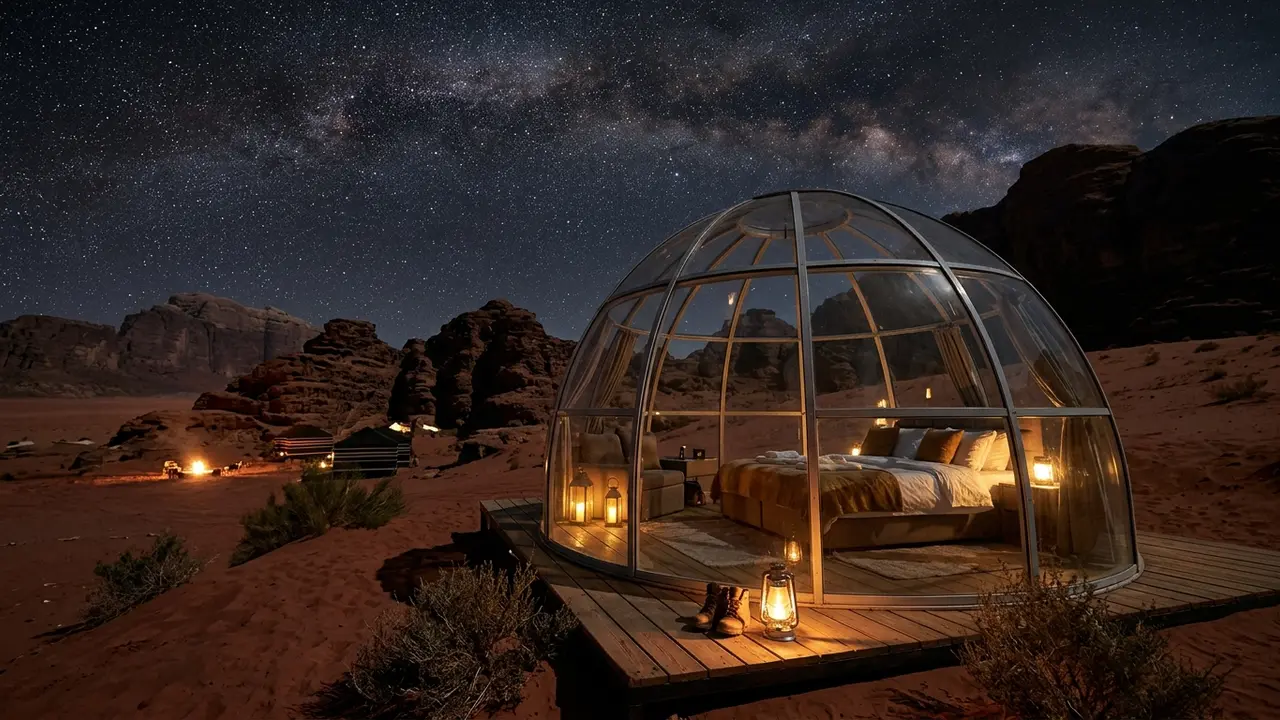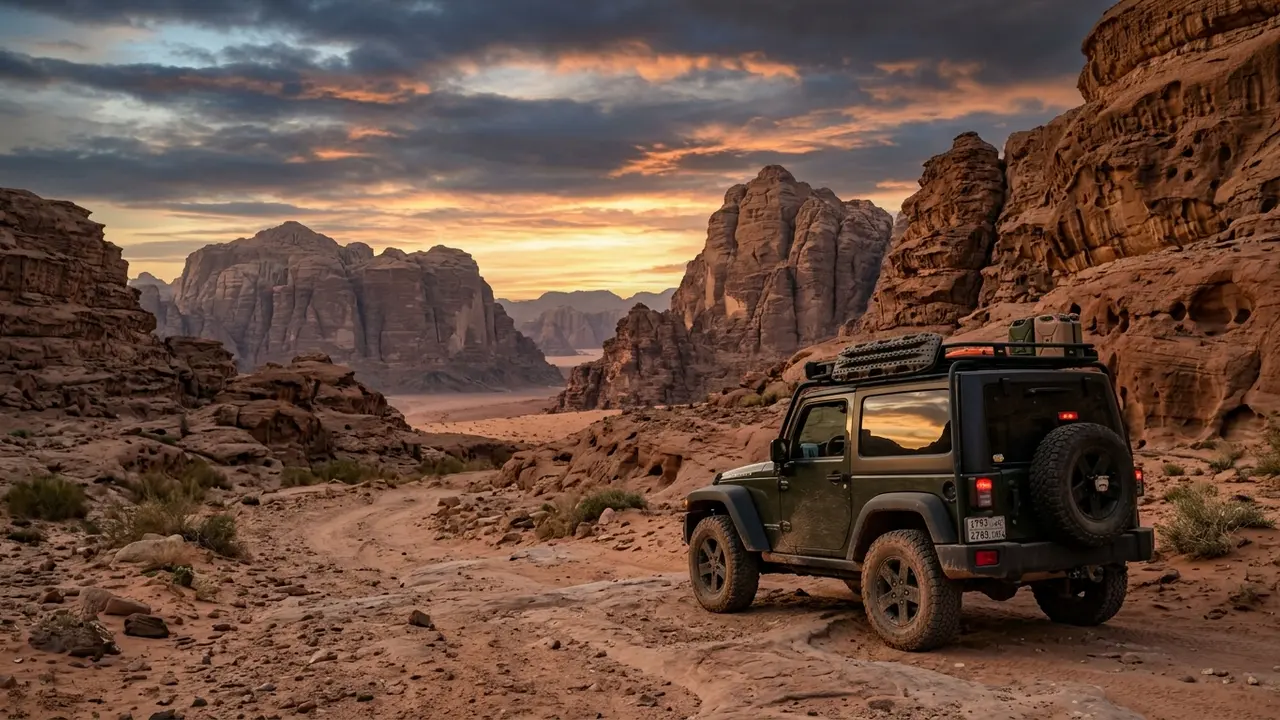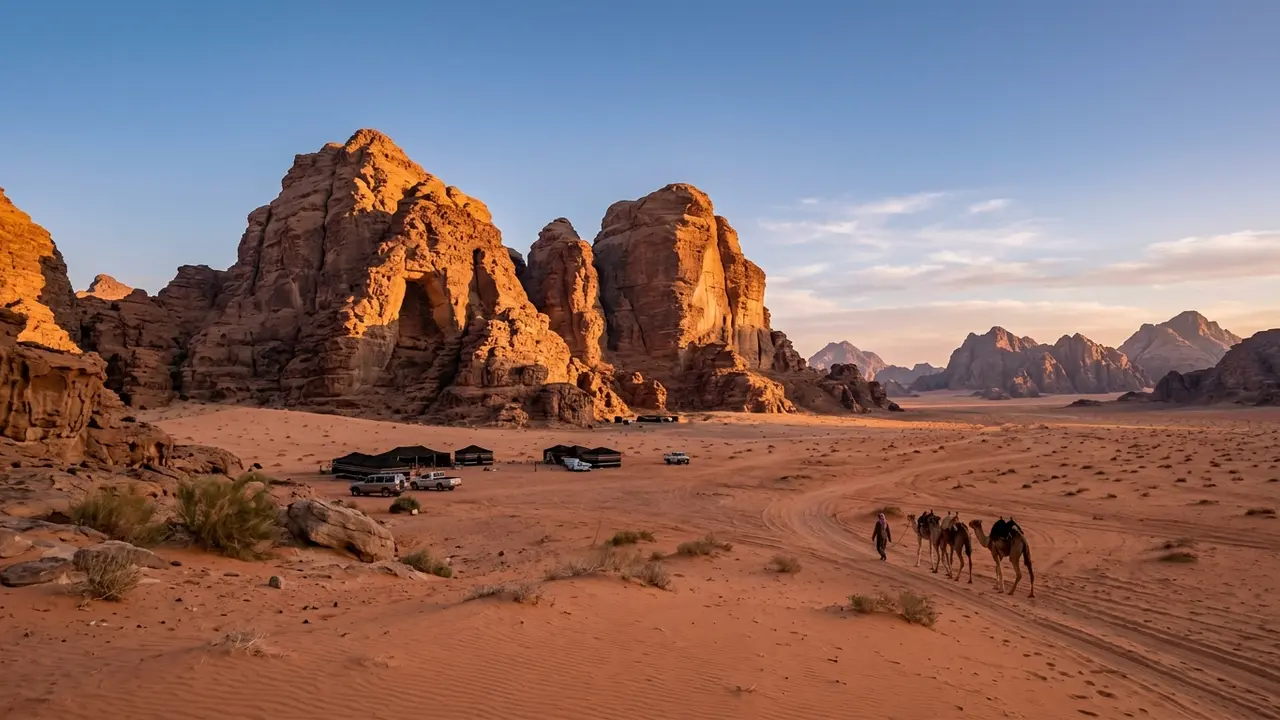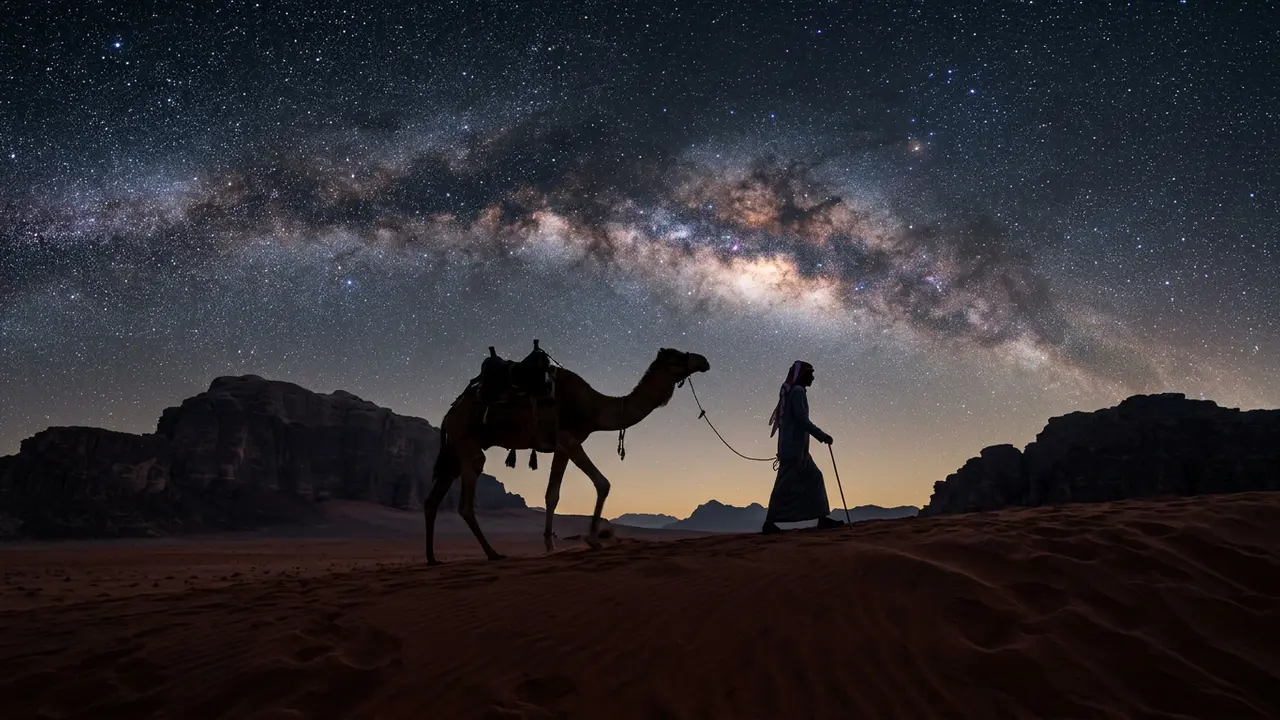
Wadi Rum's desert floor sits well above sea level in southern Jordan, though published elevation figures for the area vary, ringed by sheer sandstone cliffs and sculpted natural arches. Once out of earshot of the village, you are in effective isolation. The sky overhead is exceptionally dark, far removed from any town's light dome, and on a clear moonless night, the Milky Way arches overhead so dense with stars that its dark dust lanes become visible as river-like shadows against the luminous band. The galactic core, the Milky Way's brightest band, follows the general Northern Hemisphere calendar of spring through early autumn, though no source ties its visibility specifically to Wadi Rum's exact latitude. This is not a hotel pool with a small telescope. Wadi Rum Stars Valley specializes in camel-based overnight desert experiences designed around stargazing. The operator provides professional Bedouin guides, all trained in desert navigation and experienced with overnight expeditions. You will sleep under open sky in one of three accommodation options—a natural desert cave, a traditional Bedouin camp, or a luxury ensuite tent—and wake to sunrise over the same dunes.
How the trek works
You begin in Wadi Rum Village, where the operator arranges pickup and briefing. The Bedouin guides are experienced camel herders and desert travelers. Each camel carries one rider, and the guide leads on foot or by camel alongside. You move at a walking pace; no prior camel-riding experience is required, only basic comfort with animals and a moderate fitness level to adjust your balance over several hours.
The pace is slow by design. Morning and late-afternoon treks (before sunset) allow time to observe the landscape—natural arches, sandstone formations, wind-carved rock faces—and the guide shares knowledge of the terrain. The sunset tour, departing 3:30 PM, times your arrival at the overnight camp as the light fades. You watch the sky shift through orange and violet before full darkness, when the Milky Way becomes visible and intensifies over the next few hours as your eyes dark-adapt.
Dinner is prepared over a camp fire, typically a vegetarian stew or meat dish with bread and tea. The operator emphasizes traditional Bedouin hospitality: time around the fire, tea service, and stories. After dinner, a guide may conduct a naked-eye stargazing orientation, pointing out constellations and major deep-sky objects visible from this latitude. Unlike a telescope-led tour, this is observational: your naked eye, the guide's knowledge, and an absence of light pollution.
You sleep in your chosen accommodation (cave, camp, or tent) and wake to a breakfast of bread, honey, eggs, and tea. A morning camel trek back to the village concludes the overnight experience. Day-tour options (30-minute, 1-hour, 2-hour, full-day) are also available for those not overnighting.
Accommodation options
Desert Cave, 25 JD per person (1–2 people) / 20 JD per person (3–6 people)
You sleep inside a natural rock alcove carved into the cliff face, open to the sky. No walls, no roof. The cave offers shelter from wind and the ambient warmth of the rock after sunset. Dinner and breakfast are included. This is the most "under the stars" experience: your sleeping bag or mat sits on the cave floor, and you wake directly to the Milky Way overhead if the night is clear.
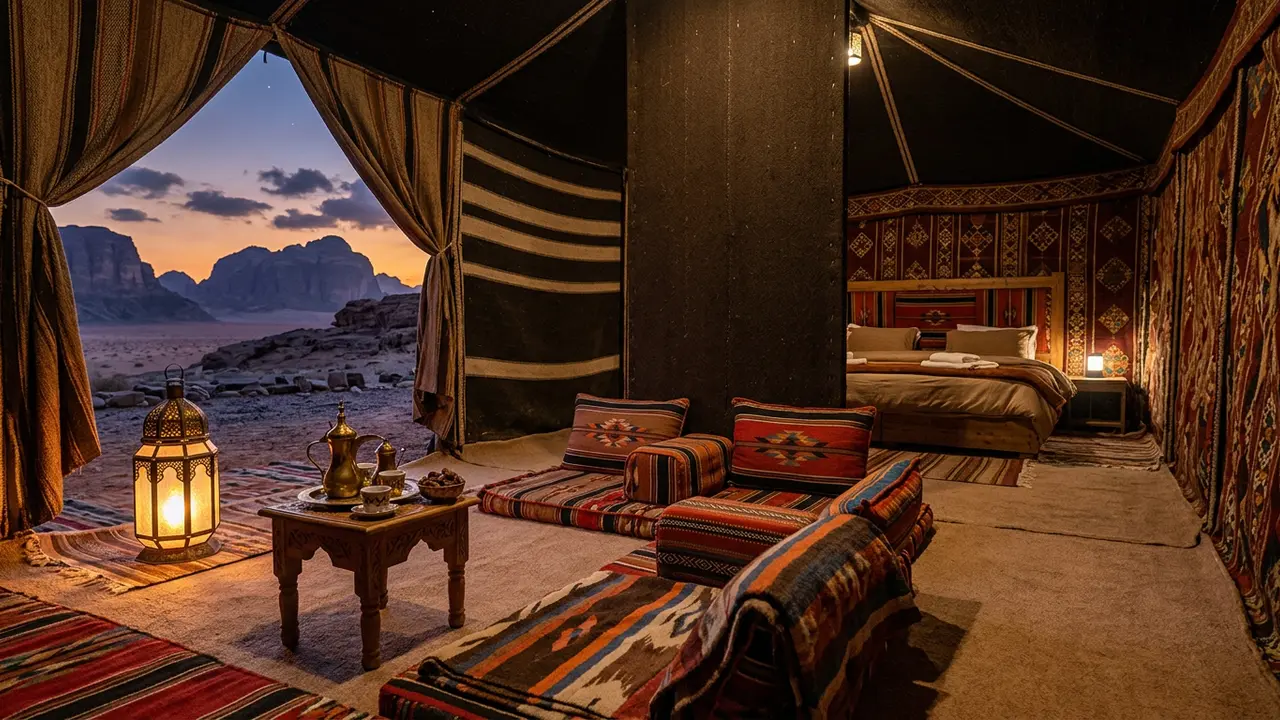
Traditional Bedouin Camp, from around 15 JD per person
A cluster of low tents and rugs around a central fire. This is the most affordable overnight option and is typically quoted as including meals (dinner and breakfast), beverages throughout, and pickup/drop-off within the village—confirm the exact rate and inclusions when you book, as operator pricing shifts. You sleep on a mat or rug inside a simple tent, with the camp's communal fire nearby and the sky visible from your sleeping position. Groups of 3–6 are typical.
Luxury Ensuite Tent, 20 JD per person
A private tent with a canvas floor, a raised sleeping platform, and a small ensuite (portable toilet and washbasin). Dinner and breakfast included, beverages provided. This option offers privacy while maintaining the desert-camp setting and Wadi Rum's night sky.
The stargazing experience
Wadi Rum's isolation and low population density create skies where light pollution is negligible. The nearest town light dome (Aqaba, 70 km west) lies beyond the horizon. From the camp, the limiting magnitude—the faintest stars visible to the naked eye—reaches far beyond what any town or city sky allows on a clear, moonless night. The Milky Way's galactic core is a dense cloud-like band of light, not a faint smudge. The dark dust lanes that split the galaxy become visible as river-like shadows. Constellations stand out with an unfamiliar brightness; minor stars become obvious that are invisible from typical sky conditions.
The Andromeda Galaxy, the farthest object visible to the unaided human eye, hangs overhead in autumn and winter as a faint fuzzy patch. In summer, the Scorpius constellation and the Sagittarius star cloud—the direction of the galactic centre—transit high overhead. Saturn and Jupiter, when above the horizon, shine so brightly they cast shadows.
The guide does not provide a lecture; instead, you are invited to look, ask, and observe at your own pace. Some guests photograph the sky on smartphones or simple cameras. Others lie silent, adjusting to the scale of the universe visible above. The guides know this landscape well and can point to specific stars and trace constellations for anyone who asks.
Practical details
What to bring: The desert is hot by day and cool by night. In summer (May–August), daytime temperatures average in the mid-30s°C, with the hottest stretches climbing toward 40°C, then drop to 15–20°C after dark. In winter (November–February), daytime is mild (15–25°C) and night can drop near freezing. Bring layers: a light shirt and hat for daytime protection, and a jacket or warm layers for night. The operator recommends a sleeping bag rated for the season, though some guests use provided blankets. Sun protection—hat, sunglasses, and sunscreen—is essential; the sand reflects intense midday light.
Personal equipment not included: the operator does not provide sleeping bags, so bring your own or inquire if rentals are available. A headlamp (red-light mode preferred to preserve dark adaptation) is useful for moving around camp after dark.
Fitness requirements: Camel trekking requires moderate fitness and comfort with animals. You must be able to mount and dismount a camel (requires a boost to and from the ground), adjust your balance on a moving animal, and sit upright for 1–8 hours depending on trek length. Anyone with significant joint or back issues should consult the operator before booking. Pregnant women are advised against multi-hour rides.
Best season for stargazing: Wadi Rum's skies stay dark year-round, so timing comes down to comfort rather than the stars themselves. Spring (March–May) and autumn (October–November) offer the mildest nights for sitting out under the sky; summer (June–August) pairs brutal daytime heat with genuinely cool nights; and winter (December–February) is coldest but the low season for visitors, so camps run quieter and less crowded. Whichever season you pick, checking the moon phase before you book matters more than the month does.
Weather cancellations: Camel treks rarely cancel. The main exception is extreme heat in peak summer (August can exceed 45°C) or heavy rain (rare but possible in winter). The operator will reschedule if conditions are unsafe.
Moon phase: Unlike telescope-based tours, moonlight does not significantly degrade naked-eye stargazing. Even a full moon provides enough light to see constellations and the Milky Way, though the sky appears lighter and fewer faint stars are visible. New-moon nights offer the darkest skies.
Languages: The guides speak English and Arabic. Communication is straightforward: camel treks do not require complex instruction, and stargazing guidance is conducted through conversation and pointing.
Booking and contact
Booking is available direct through the operator's website or WhatsApp. No third-party intermediaries required. The operator confirms itinerary, accommodation choice, and logistics at booking. Pickup from Wadi Rum Village is included for overnight packages. If you are arriving from outside the village, arrange your own transport to the village and the operator will collect you from there.
Wadi Rum village has basic lodging, a few restaurants, and a post office, but it is a small settlement. Plan to arrive in the village the day before your trek to rest and arrange any last-minute supplies. The nearest larger town is Aqaba, about 70 km away, which has hotels, restaurants, and a major airport (King Hussein International).