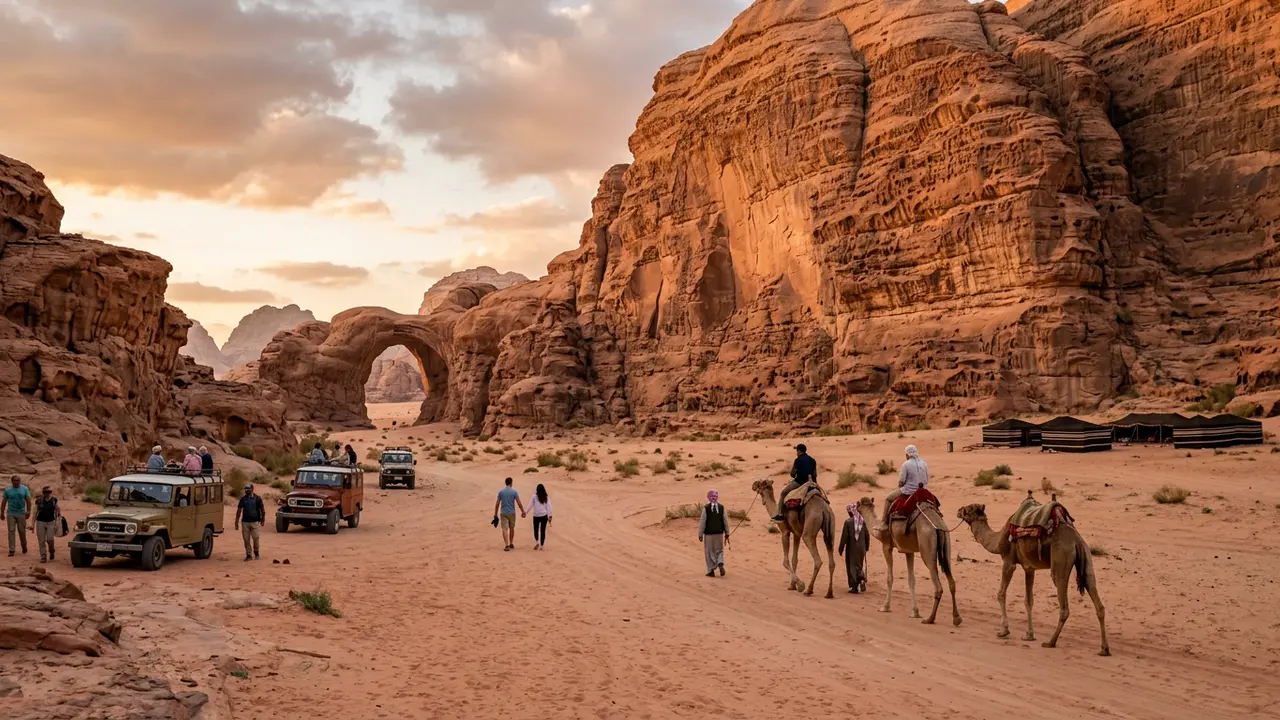

Pairing Wadi Rum with Petra: day trip or two-day split
Petra sits about 68 miles (110 km) from Wadi Rum, a drive of roughly two hours each way, and doing both sites in a single day takes about eight hours round trip once you factor in the drive both ways and real time at the Treasury and the Siq[1]. It's a long day, technically doable, but most travelers who've tried it come back tired rather than satisfied with either site.
A direct JETT bus covers the route once daily, leaving Petra's Visitor Centre at 11:30am and making the crossing in under two hours[2] — useful if you're staying in Petra and want to reach Wadi Rum in time for an afternoon activity and a first night under the stars. Private taxis and hotel transfers run the same road at other hours, for a price, if the bus schedule doesn't fit your plans.
Splitting the visit across two days, a night in Petra followed by a night in Wadi Rum, or the other way round, gives both places the time they're built for instead of treating Petra as a rushed detour on a desert trip. If Petra is the main event and Wadi Rum the add-on, keep the single-day version. If the stargazing is why you booked this trip at all, give Petra its own day and add an extra night at your Wadi Rum desert camp instead.
| Aspect | Single-day pairing | Two-day split |
|---|---|---|
| Total time | About eight hours round trip | One night at each stop |
| Pace | Compressed sightseeing, one long day | A full half-day at both Petra and Wadi Rum |
| Best for | Tight schedules, one rental-car day | First-time visitors and photographers who want unhurried time at both |
Rock climbing Wadi Rum's sandstone massifs
Wadi Rum has established itself as one of the great climbing destinations of the Middle East[3], and its sandstone massifs offer everything from an easy scramble to a full-day, multi-pitch trad route that needs a local guide. None of it requires prior climbing experience to try the easiest grades, which is the part most stargazing travelers don't expect.
Grading follows the same UK and French numerical systems used across the region, with the French scale now more common locally[4]:
- Grade 1 — an easy scramble, no technical climbing involved
- Grade 2 — a more exposed scramble, still within reach of a fit hiker
- Grade 3 — the point where technical rock climbing begins
The marked Wadi Rum Trail tops out at grade 3[5], a level a competent scrambler can manage without prior climbing gear or training, useful to know if you want the exposure without committing to a guided multi-pitch route. Climbing works best in the cooler months, since summer heat on bare sandstone turns even an easy scramble unpleasant fast. Anything harder than grade 3 sits in the massifs beyond the marked Trail[5]. Routes up there typically call for a qualified local guide: Bedouin guides know the lines, and hiring one for a serious route is standard practice, not an upsell.
Booking a guide for harder routes
Camps and tour desks in Wadi Rum village can arrange a guide for anything past grade 3 with a day's notice, and multi-pitch routes typically run a half or full day depending on the line. Confirm gear is included, rope, harness, and helmet, since not every guide supplies climbing shoes. If you already have an overnight camp booked, ask there first; many camps work with the same handful of local guides and can match a route to your experience level without you needing to find an outside operator. Operators such as Wadi Rum Nomads, which runs guided climbing routes alongside its jeep and camel trips, are worth asking directly if your camp doesn't handle it in-house.
Hot-air ballooning at dawn over the desert
A hot-air balloon flight over Wadi Rum is a real, currently bookable activity, run in partnership with Royal Balloon Jordan, and it's the one item on this list that shows the valley's scale from directly above rather than from inside it. Flights last about an hour and drift wherever the wind carries the basket that morning, opening up panoramic views across the sandstone massifs and the valley floor between them[6].
~1 hour · dawn departure
Departure is always early morning, timed to catch the calm wind conditions that don't hold once the desert heats up[7]. That means an early alarm, ahead of the same sunrise you'd otherwise sleep through after a night of stargazing, in exchange for a smooth, predictable flight window instead of a lie-in.
Bring a layer: desert mornings run cold before the sun clears the horizon, and an open balloon basket has no windbreak. Book a day ahead where possible, since flights depend on wind and camps need lead time to confirm a slot with the operator. Pair it with the Wadi Rum Jeep Safari and Stargazing tour later that day rather than squeezing ballooning between two nights under the stars; burning a stargazing night to get up early for a balloon rarely feels worth the trade.
Book through your camp or a named local operator rather than a generic city-agency reseller; Wadi Rum's balloon capacity is limited, and camps that work directly with Royal Balloon Jordan can usually confirm a slot faster than a middleman based outside the valley.
Wadi Rum on screen: Lawrence of Arabia and The Martian
Wadi Rum's red sandstone cliffs have stood in for more than one landscape's worth of story, and film-location visitors make up a steady share of daytime traffic who never plan to climb or fly at all. Lawrence of Arabia (1962) filmed key scenes here, including Prince Feisal's camp and the scene where Lawrence dons Arab robes at a well, at cliffs roughly twenty miles north of the Gulf of Aqaba[8]. The rock is still recognizable against the same red backdrop today, though pinning down exactly which massif hosted which shot isn't something a casual visitor can do without a guide who knows the film's shot list.
More recently, The Martian (2015) used Wadi Rum and the surrounding Aqaba region as the surface of Mars. The valley's rust-colored sand and bare rock did work a studio backdrop couldn't fake, part of why this desert keeps showing up whenever a production needs a landscape that reads as somewhere else entirely.
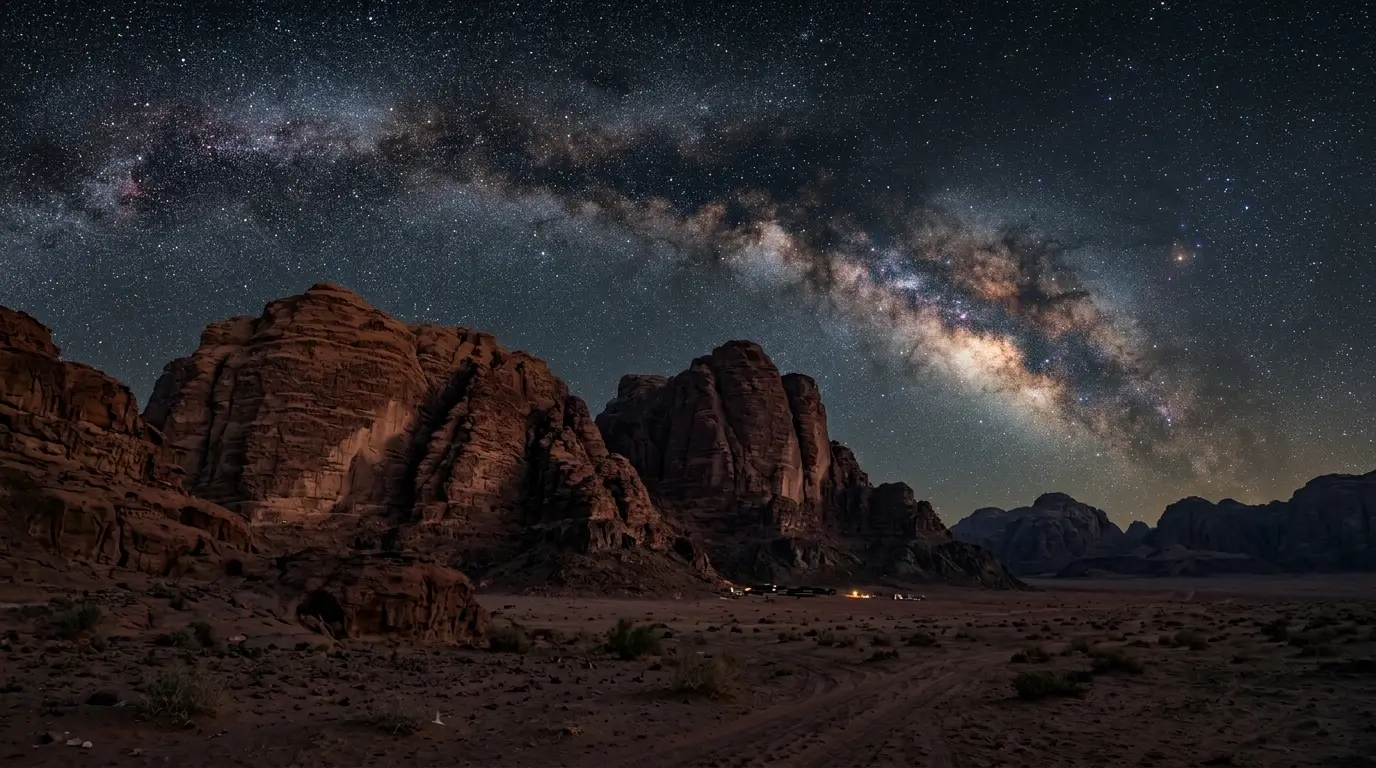
Featured · Destination
Wadi Rum
See the Wadi Rum night sky from a Zalabieh Bedouin camp in Jordan's UNESCO desert: bare tents to glass domes, Bortle 2-3 skies, and year-round stargazing.
The same isolation that made this valley convincing as Mars, no towns and no light glow for miles, is what makes the stargazing worth the trip in the first place. The emptiness a film crew used as a backdrop is the same emptiness that keeps the Milky Way this visible after dark.
Neither film maps cleanly onto one named viewpoint that every tour visits, and claims about an exact filming-location spring or formation vary between operators and guidebooks. Treat a driver's on-the-ground claim about a specific spot with a little skepticism rather than as verified fact; the broader story, that this valley has doubled for Arabia's past and Mars's present, holds up regardless of which cliff face gets pointed out.
Fitting it all around your stargazing nights
None of this competes with a clear night over Wadi Rum's valley floor; it fills the hours until dark is worth stepping outside for. A two-night version covers most of it:
- Night one: arrive at camp, settle in before dusk, first stargazing session after dark
- Day two, morning: climb a grade-1 or grade-2 route while the air is still cool, or take the dawn balloon flight if you booked one the night before
- Day two, afternoon: a jeep tour past the valley's film-location cliffs and rock bridges, back to camp before the second stargazing session
Add a Petra day, either the rushed single-day round trip or a proper overnight stay, if the ruins are part of the plan at all. Petra rewards the extra day; Wadi Rum's climbing and ballooning don't need one, and either can be handled as a single morning add-on if time is tight.
For the stargazing half of the plan, from choosing a clear-sky season to picking a camp with genuinely dark surroundings, see the Wadi Rum stargazing hub, and pair a night with the Wadi Rum Camel Trek Under the Stars or the Rum Magic Nights tour. This piece covers everything else.
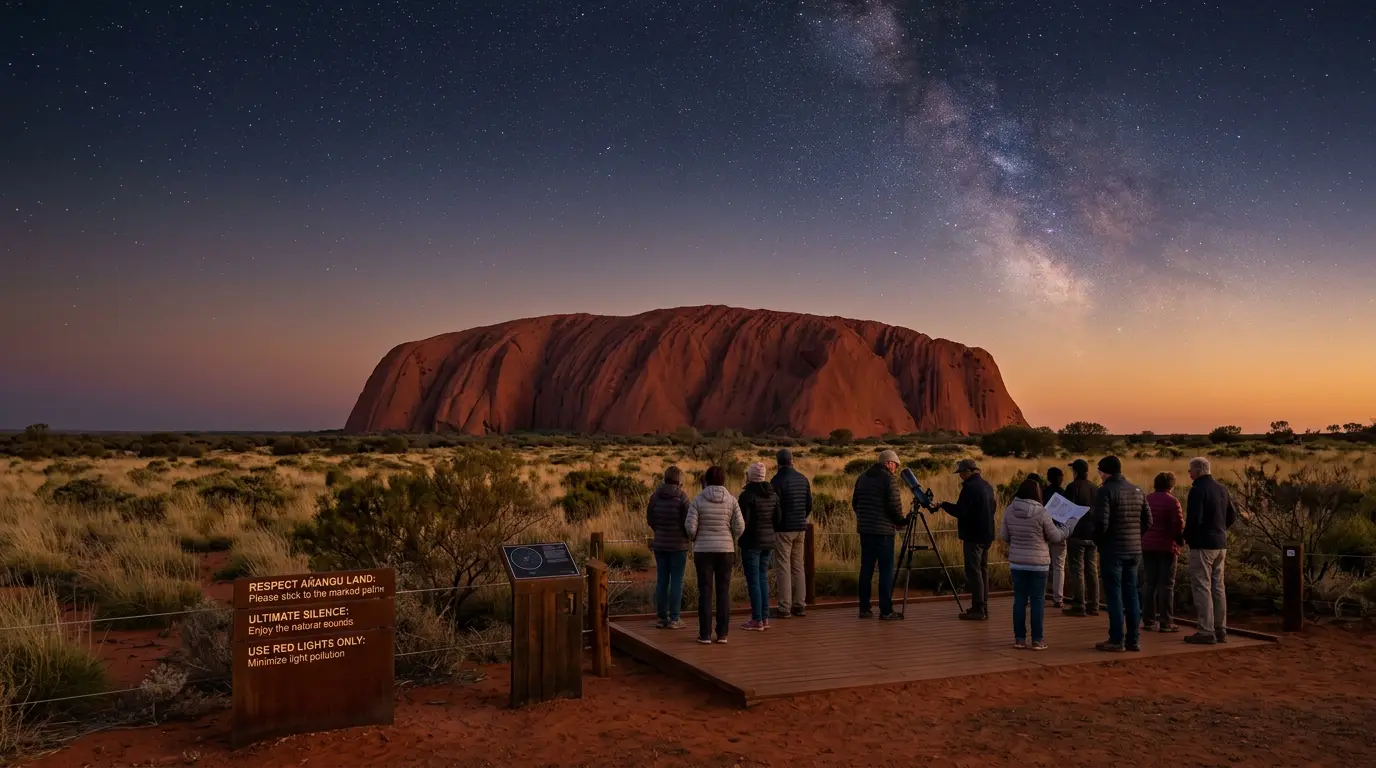
Featured · Article
Uluru Cultural Significance and Visitor Etiquette
Uluru is Anangu land under joint management. Here's why the 2019 climb closure is settled policy, what you can't photograph, and real visitor etiquette.
A three-night version, if you have it
With a third night, spread the two Wadi Rum activities across separate mornings rather than stacking them: ballooning on the first clear morning, climbing on the second once you know the weather is holding, and reserve the third day entirely for Petra rather than treating it as a bolt-on. This pace also leaves room for a weather delay on the balloon flight, since wind can push a launch to the next morning without wrecking the rest of the plan.
What to prioritize if you're short on time
If a full slate isn't realistic, rank the four by how much planning each one takes. Ballooning needs a fixed early-morning slot booked in advance, since it depends on wind, so lock that in first if it's on your list. Climbing a grade-1 or grade-2 route needs no advance booking beyond a guide arranged the day before, and camps are used to organizing one on short notice. Petra is the one that eats a whole day or two, so decide early whether it's a rushed pairing or its own separate stop, since that choice reshapes the rest of the itinerary.
The film-location driving loop costs almost nothing extra: most jeep tours already route past the same cliffs, so ask your driver to point them out rather than booking anything dedicated. Book climbing guides and balloon operators by name, the same way you'd book a desert camp; Wadi Rum's tourism scene runs on word-of-mouth operators more than storefronts, and knowing who's actually taking you up a cliff or into a basket matters as much as the price.