
What Wadi Rum actually is, and isn't, on paper
Search for Wadi Rum and dark-sky travel and you'll find sites calling it a "Dark Sky Reserve" or claiming an official International Dark Sky Association designation. Neither claim checks out. Wadi Rum has no DarkSky International reserve, sanctuary, or park status of any kind. The one real, checkable designation is UNESCO World Heritage, inscribed in 2011 as a mixed natural and cultural site covering 74,000 hectares of southern Jordanian desert near the Saudi Arabian border[1].
That inscription isn't a consolation prize. UNESCO recognized Wadi Rum for both its landscape and its human record: petroglyphs, inscriptions, and archaeological remains testifying to 12,000 years of continuous human occupation, one of the densest concentrations of rock art anywhere in the world[2]. That's a different kind of credential than a Bortle-scale reading, but it's a real one, and it means the valley you're driving into has been carved into and lived in since long before anyone thought to measure its sky.

Featured · Destination

Wadi Rum

Wadi Rum is Jordan's UNESCO World Heritage desert, a Mars-like sandstone landscape where Bedouin-led camps put you under near-total darkness at night.

What the marketing shorthand gets wrong matters for a worth-it calculation. A certified dark-sky reserve comes with a third-party audit of light pollution and a formal commitment to keep it that way. Wadi Rum's darkness is real, but it's the product of raw remoteness, no nearby cities, no light-pollution monitoring body, rather than a certification you can point to. That's not a knock on the sky. It's a reason to set expectations honestly before you book a flight based on a designation that doesn't exist. Wadi Rum's UNESCO dark sky status, explained goes deeper on what that 2011 listing does and doesn't certify. For the full picture of what that darkness looks like on the ground, see Wadi Rum stargazing.

The real cost: flights, visa, and camp price

Getting to Wadi Rum means getting to Jordan first, and for most Western travelers that's the single biggest line item in a worth-it calculation. Flight prices swing hard by season, origin airport, and how far out you book: travelers flying from the UK generally find shorter, cheaper routings into Amman than travelers flying from North America, where round-trip fares routinely run well into four figures. Whatever your starting point, treat any specific fare quoted online as a snapshot, not a promise, and compare live prices across a few search engines before you commit to dates.
On arrival, most Western nationalities, including US, EU, UK, Canadian, and Australian passport holders, can get a Jordan visa on arrival at Queen Alia International Airport or Aqaba. Jordan's standard visa-on-arrival fee applies, a modest cost worth confirming directly with Jordan's official visa authority or JordanPass before you travel, since visa costs and rules shift without much notice. Some travel-agency sites describe a JordanPass fee waiver for stays of three nights or longer; treat that as a lead worth checking directly on JordanPass's own site before you plan around it, not a confirmed rule.

Biggest line item

For most Western travelers, the flight itself, not the camp or the visa, is what makes or breaks Wadi Rum's stargazing trip economics.

Once you're in the desert, the accommodation itself is the cheap part. A traditional Bedouin-style overnight camp stay, dinner and breakfast included, typically runs roughly 50 to 70 JOD per person, though exact rates vary by camp, season, and what's included. That's the part of the trip that actually delivers the stargazing:

  • A shared fire and dinner with a Bedouin family running the camp
  • A short unlit walk from the fire pit to open desert
  • No nearby town bright enough to wash out the Milky Way
The flight is the expense that makes or breaks the trip's value. The camp itself is not.

Is the sky actually dark enough to justify the trip?

Here's the honest answer: yes, if remoteness is what you're after. Wadi Rum sits far from Aqaba and even farther from any settlement large enough to throw meaningful skyglow across the valley. There's no published Bortle-scale reading for the reserve, the same gap that applies to plenty of genuinely dark places without a formal monitoring program, but the geography does the work a certification would otherwise vouch for.
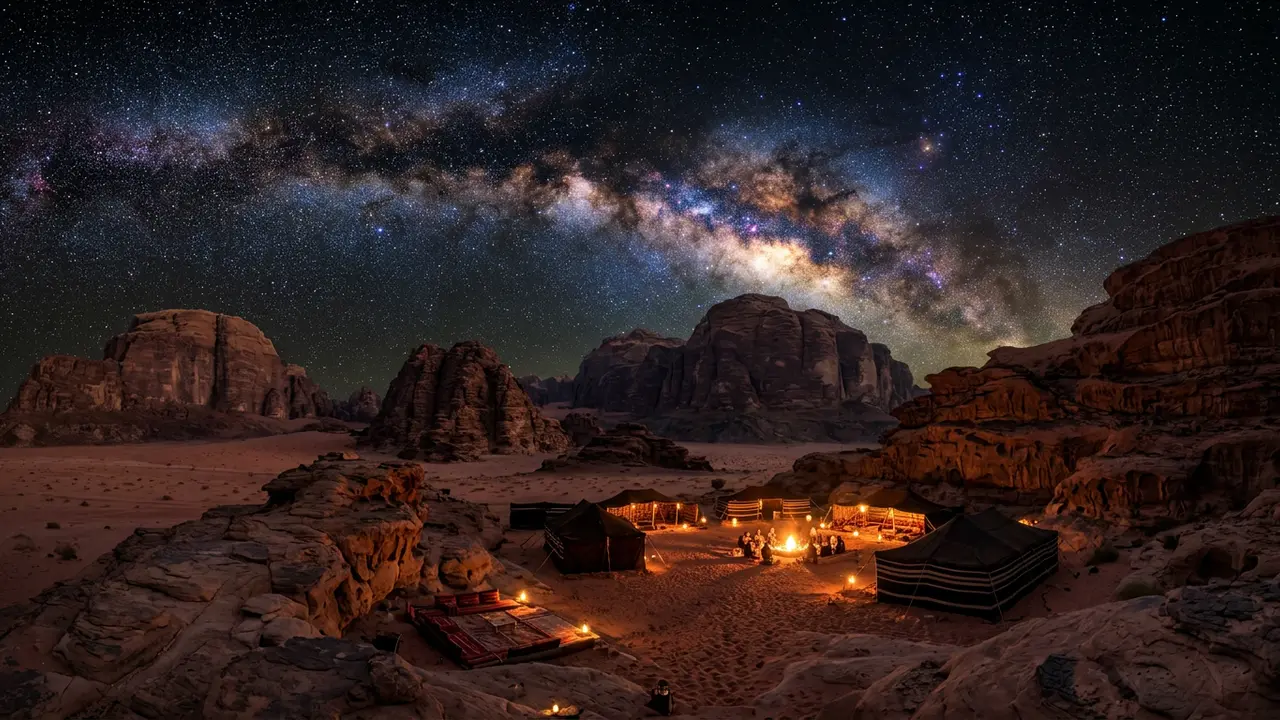
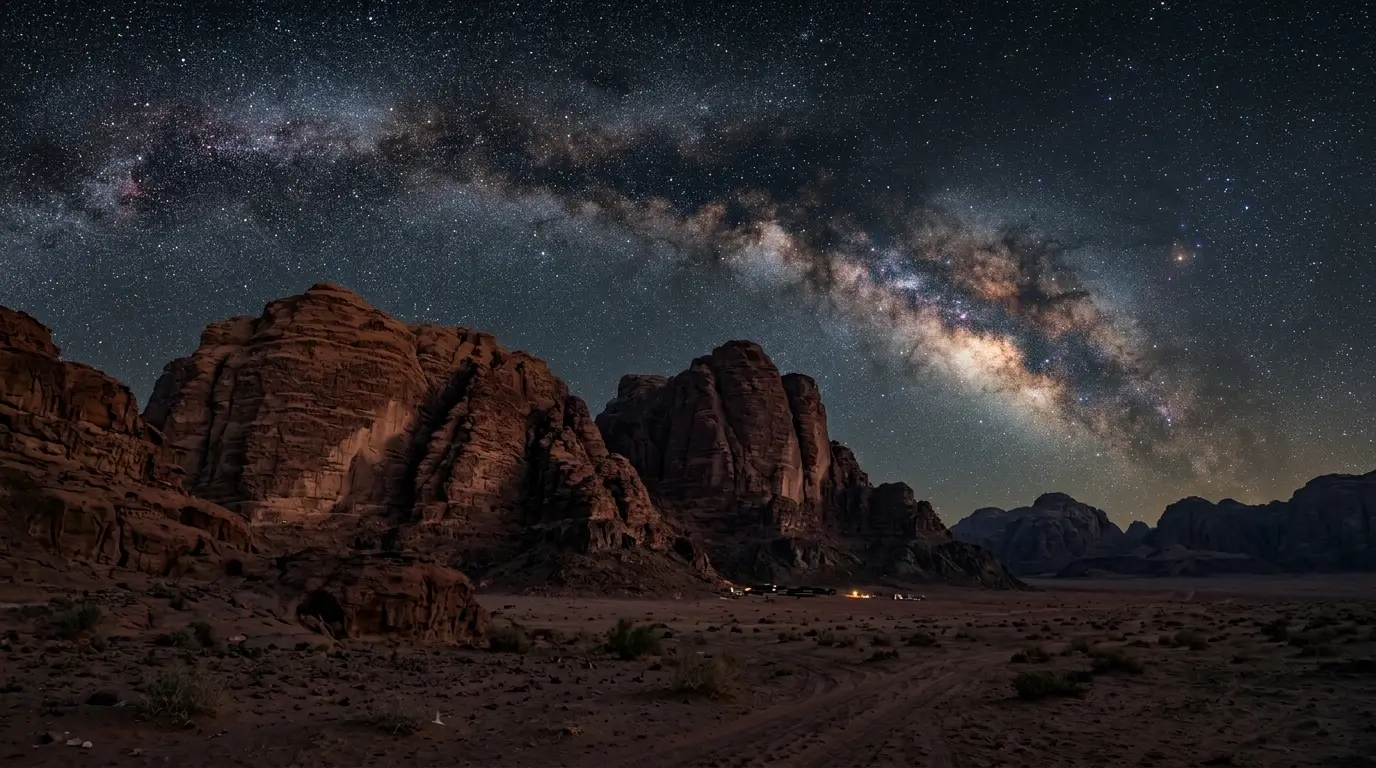
What that means on the ground: climb a dune or a low ridge near camp after dinner, and the sky over the Valley of the Moon fills in fast once the last cooking fire dies down. The Milky Way's core rises directly over sandstone formations that glow rust-red by day and go black by night. There's little to compete with it: no highway glow, no distant city halo, just the shapes of Jebel Rum and Jebel Umm Ishrin cut against the stars. Visitors consistently describe the scale of the place as something photos can't capture[3], and that holds as much for the night sky as it does for the daytime rock formations.
None of that is unique to Wadi Rum. Other deserts get just as dark, some with actual DarkSky certification behind them. What Wadi Rum adds is the Bedouin camp itself: a dinner cooked in a zarb (an underground oven), a guided jeep safari past the valley's rock formations, music and conversation that runs past midnight, and hosts who grew up navigating this exact desert rather than a tour operator's script. That's the part a closer, cheaper, certified dark-sky park can't replicate, because it isn't about the sky alone. For a night-by-night breakdown of when the sky is actually darkest, see best time to stargaze in Wadi Rum, and for exactly where to set up once you're there, best stargazing spots in Wadi Rum.
The Milky Way's core rises directly over sandstone formations that glow rust-red by day and go black by night.
Photorealistic Milky Way over red sandstone formations in Wadi Rum, Jordan, above a lit Bedouin desert camp at night

Photorealistic Milky Way over red sandstone formations in Wadi Rum, Jordan, above a lit Bedouin desert camp at night

Pairing with Petra: how many days does this actually take

Almost nobody visits Wadi Rum in isolation, and that's worth building into the cost-benefit math. The desert sits a short drive from Petra, and the well-worn itinerary runs Amman, Petra, Wadi Rum, Aqaba, or back to Amman, rather than a dedicated Wadi Rum-only trip. On a dedicated TripAdvisor forum thread asking exactly this question, is Wadi Rum worth the detour from Petra, the recurring answer is that Wadi Rum and Petra together deserve more time than most itineraries allow, and an overnight stay, not a day trip, is what most visitors recommend to actually appreciate it[4].
That pairing changes the calculation. If you're already flying to Jordan for Petra, the marginal cost of adding a Wadi Rum night, one more camp booking, one more day of driving, is small next to the flight itself. If Wadi Rum is the entire reason for the trip, with no Petra, no Dead Sea, no Amman old town, the math is much harder to justify against a closer, cheaper dark-sky destination.

A rough planning baseline:

  • 1 night: enough for one dinner, one night under the stars, and a morning jeep tour before heading back to Petra or Aqaba
  • 2 nights: time to actually adjust to the desert's rhythm and try a sunrise camel trek
  • 3+ nights: only worth it if stargazing and desert photography are the trip's actual focus, not a stopover

Read next · Lodge

Wadi Rum Nomads

Back-to-basics Bedouin-run camp in Wadi Rum, founded by Fawaz Mohammad. Traditional and bivouac camping in protected desert darkness. Direct booking only.

Who should book this, and who should skip it

Wadi Rum suits a specific kind of traveler: someone building a real Jordan itinerary, Petra included, who wants one or two nights in the desert as part of it, and who treats Bedouin hospitality and a genuinely remote sky as worth the flight and the visa fee. It suits astrophotographers chasing an unlit horizon and travelers happy to trade third-party certification for the raw fact of distance from any city.
It suits this traveler far less: anyone whose only goal is a certified, easy-to-reach dark-sky site, anyone trying to bolt Wadi Rum onto a short regional trip with no interest in Petra or the rest of Jordan, and anyone unwilling to book a long-haul flight and a visa-on-arrival process for one night in a desert camp. Closer, certified dark-sky destinations exist for travelers who want the sky without the travel budget; Wadi Rum isn't competing on convenience or price, and shouldn't be booked expecting either.

Three questions worth answering honestly before booking:

  • Is Petra, or the rest of Jordan, already part of the trip, or is Wadi Rum the sole reason for flying?
  • Does the visa-on-arrival fee, worth confirming before you fly, and the flight cost still make sense against a closer, certified dark-sky park?
  • Are you prepared to trade a guaranteed Bortle-scale rating for a sky that's dark because almost nothing else is out there?

Featured · Article

What Is Light Pollution? Definition, Types, and Solutions

Light pollution is artificial light brightening the night sky, affecting 80% of the world. Learn the 4 types, wildlife and health effects, and how to fix it.

Best Desert Camps in Wadi Rum for Stargazing ranks the camps worth booking directly, rather than through an unnamed reseller.

The verdict on Wadi Rum

Is Wadi Rum worth it for stargazing? Yes, for the traveler who's already building a Jordan itinerary around Petra and treats the desert night as part of that trip rather than the whole of it. The payoff, genuine remote darkness, a UNESCO-listed valley with 12,000 years of human history[2], and Bedouin camp hospitality that a closer, certified dark-sky park simply doesn't offer, is real, and it doesn't need the false "Dark Sky Reserve" label some marketing copy still attaches to it.
The friction is real too: a long-haul flight that costs considerably more than a short hop to a European or North African desert, a visa-on-arrival fee, and a destination that rarely works as a quick add-on to anything closer than Petra itself. Neither side cancels the other out.
Book Wadi Rum for the valley, the camp, and the sky that comes with genuine remoteness, not because it's the cheapest or most convenient dark-sky trip on this site. Confirm your flight cost and visa details before you commit, build in at least one full night in camp, and go in knowing exactly which designation Wadi Rum actually holds, and which one it doesn't.