Erg Chebbi's Dune Sea vs Wadi Rum's Rock Valleys
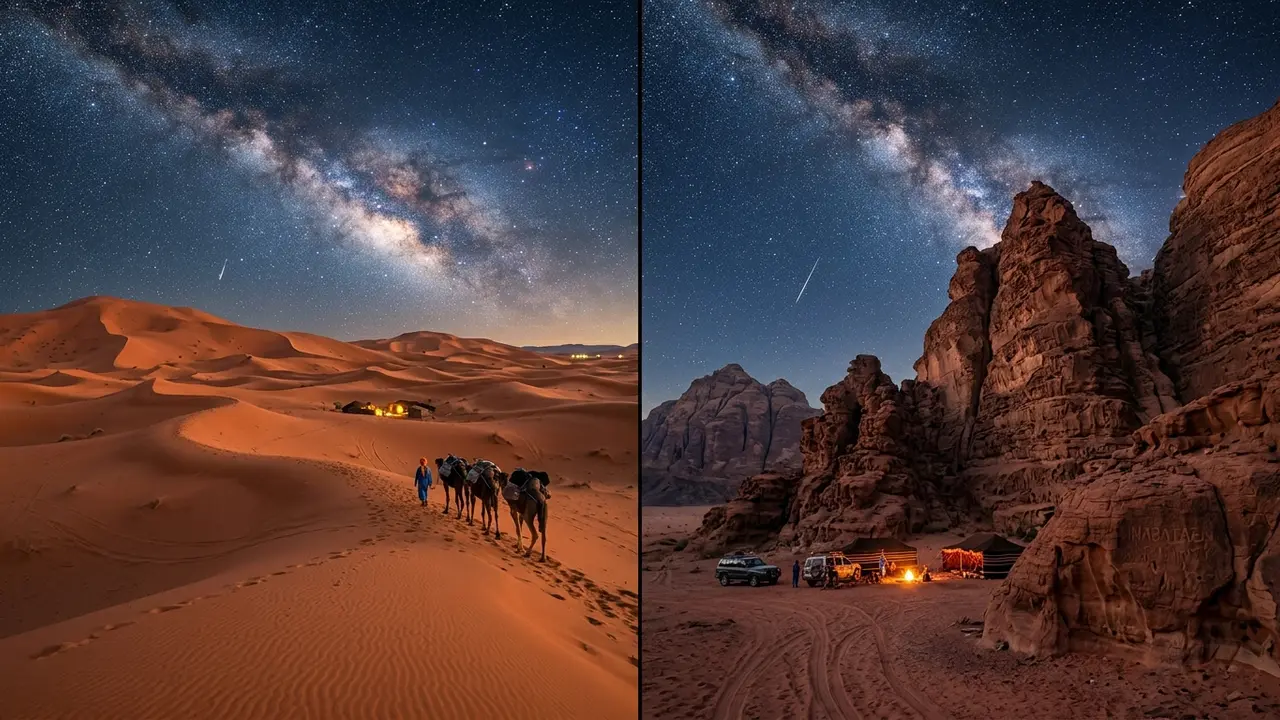
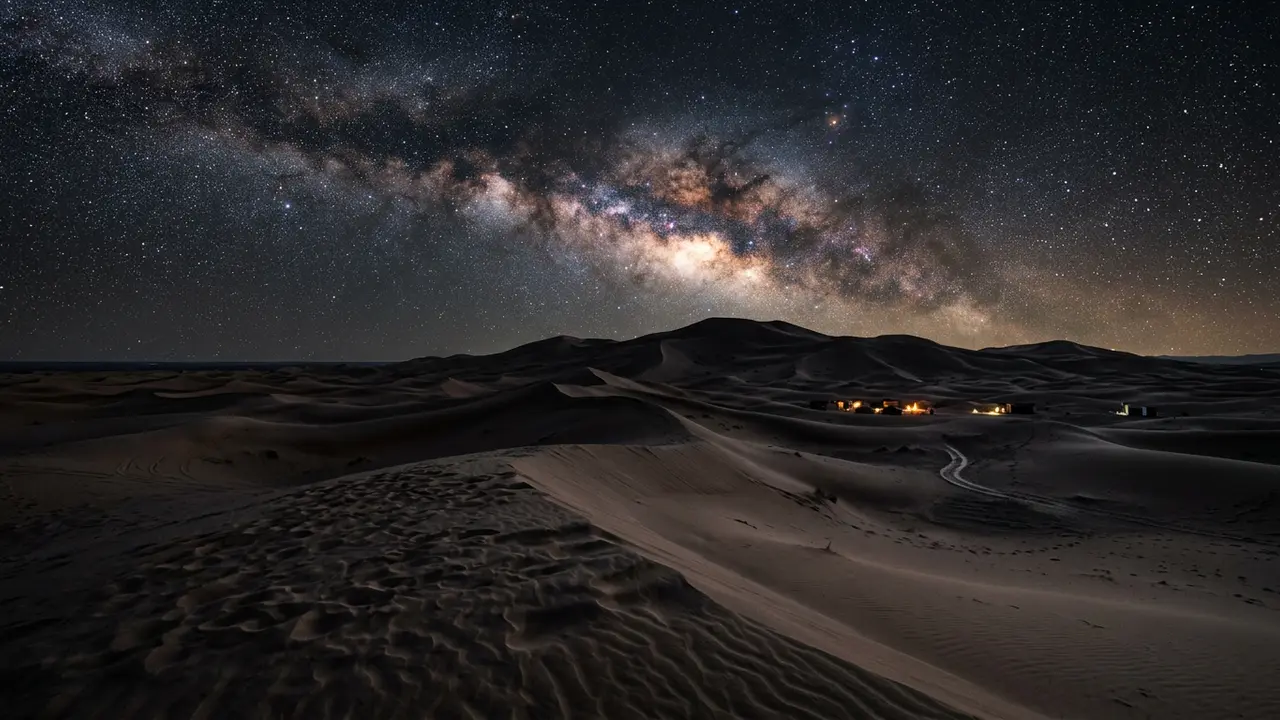
Merzouga and Wadi Rum land on the same shortlist for a reason: both put a stargazer under a wide, unlit desert sky with a camel and a 4x4 waiting nearby. Stand in either place at sunset, though, and the resemblance stops fast. Erg Chebbi, the dune field Merzouga sits against, is a pure dune sea, no rock, no canyon wall, just sand rising in long orange ridges up to 150 meters above the surrounding hamada, spanning roughly 28km north to south and 5-7km east to west near the Algerian border[1]. Wadi Rum isn't sand in the same sense at all. It's a valley of sandstone massifs and granite-and-basalt-striated mountains, towering rock formations and narrow valleys rising straight out of a red-sand floor[2].
The scale reads differently through a camera, too. Wadi Rum's walls are described as sandstone formations "the size of city blocks," weathered over millennia into natural arches and freestanding pillars, a landscape of vertical red-rock canyons rather than rolling dunes[3]. Erg Chebbi has nothing comparable to climb against; its whole appeal runs the opposite direction, a smooth, climbable dune crest with no hard edge anywhere in view, better suited to a wide-open horizon shot than a foreground silhouette. For the fuller picture of what that darkness looks like on the ground, see Merzouga's stargazing page. Neither landscape wins as a stargazing platform on paper; both put you far from ambient light under a wide horizon. The dune crest and the canyon floor are simply different vantage points, and which one you'd rather sit on for three hours after dark comes down close to personal taste.
| What you see | Merzouga (Erg Chebbi) | Wadi Rum |
|---|---|---|
| Landscape type | Dune sea, rolling sand ridges | Sandstone rock valley, vertical canyons |
| Tallest features | Dunes up to 150m above the hamada | Rock massifs the size of city blocks |
| Best vantage point | Dune crest, climbable on foot | Canyon floor or a rock outcrop |
Amazigh Camps vs Zalabieh Bedouin Camps: Two Distinct Cultures
The people running these camps aren't interchangeable "desert guides," and treating them that way flattens two real, distinct cultures into a marketing trope. Around Merzouga, desert-camp tourism is led by Amazigh (Berber) families and cooperatives, a North African indigenous culture with its own language, Tamazight, and its own long history in this stretch of the Sahara. A night at an Amazigh-run camp near Erg Chebbi typically means a shared tagine dinner and drumming that runs past midnight, hosted by families who grew up in the region rather than a company running an imported script.
Wadi Rum's camps are led by a different community entirely: the Zalabieh Bedouin tribe, who make up the majority of Rum Village's population and are largely responsible for the area's tourism services, operating most of its jeep and camel tours through the locally run Rum Tourism Cooperative[4]. A night at a Zalabieh-run camp usually means sweet Bedouin tea poured over an open fire, goat-hair tents pitched right against a rock wall, and a campfire that doubles as the only light source for miles. Zalabieh hospitality carries its own distinct traditions, Bedouin Arab rather than Amazigh Berber, with its own dialect and desert customs built around generations of herding and guiding in this specific valley.
Neither culture stands in for the other, and neither is more authentic than the other. They differ in language, history, and social organization, and a comparison that blurs them into one generic "desert people" narrative does a disservice to both. A camp operator's own name and community affiliation is worth confirming directly before you book either trip, rather than assuming a booking site's generic "Berber camp" or "Bedouin camp" label is accurate.
Getting There: A Multi-Day Morocco Loop vs a Short Jordan Hop
Trip logistics are where these two destinations diverge hardest, and it's worth knowing before you book flights. Reaching Merzouga essentially always means committing to a multi-day loop. Private tours from Marrakech or Fez build in overnight stays at desert camps near Merzouga as a matter of course, not an optional add-on[5], because there's no realistic shortcut: the drive from Marrakech alone runs 9 to 10 hours, and virtually every operator splits it across two days with a stop in the Atlas Mountains or a gorge town along the way[6]. You're not deciding on a whim whether tonight looks clear enough for a quick drive out to Erg Chebbi. You're picking a departure date weeks in advance as part of a longer southern Morocco itinerary. For the full route breakdown, see Getting to Merzouga.
Wadi Rum asks for none of that planning. It sits close enough to Jordan's main hubs that a visit slots into an existing itinerary almost as an afterthought: about an hour from Aqaba's airport, an hour and a half from Petra, and roughly four hours by road from Amman[7]. A traveler already touring Petra can add a Wadi Rum night with a short domestic drive and a single evening's notice, something no version of a Merzouga trip allows.
Featured · Destination
Merzouga Stargazing
Erg Chebbi's dunes rise 150m above Morocco's Sahara, hours from city light. Stargaze from Berber-led desert camps: when to go, where to stay, how to get there.
That's not a minor scheduling detail. It changes what kind of trip each destination fits, and what it costs in travel days alone. Merzouga rewards travelers who've already built two to four days around a Morocco desert loop; Wadi Rum rewards travelers bolting one extra night onto a Jordan itinerary they were taking anyway. Budget accordingly: a Merzouga night is one piece of a much longer trip, while a Wadi Rum night can be the whole point of a short weekend away from Amman.
UNESCO Status vs Genuine Remoteness: Which Sky Is Officially Dark?
On paper, Wadi Rum holds the stronger credential. It's an inscribed UNESCO World Heritage Site[8], recognized for a mix of natural and cultural criteria, and Jordan's tourism board actively promotes it as a dark-sky destination in its own marketing. That marketing even quotes T.E. Lawrence, in words widely attributed to him and repeated across the country's own promotional material, describing Wadi Rum as "vast, echoing and God-like," a line worth reading as tourism-board framing rather than a rigorously sourced citation, since it hasn't been independently traced back to Lawrence's own writing for this piece.
Recommended tours
Tours are selected for quality, not commission. I earn a small fee if you book — at no extra cost to you.
Merzouga holds no equivalent designation, and it's worth being direct about that rather than inventing one. No IDA Dark Sky Park plaque marks the edge of Erg Chebbi, and no UNESCO reserve boundary has ever been drawn around it. What Merzouga has instead is genuine distance: hundreds of kilometers of hamada between the dunes and any town bright enough to matter, doing roughly the same job a certification would, without the paperwork or the independent audit behind it. No formal Bortle-scale survey exists for Erg Chebbi either, so treat any specific darkness rating quoted by a tour operator as marketing shorthand rather than measured fact.
Wadi Rum's darkness is an audited, third-party fact; Merzouga's is an honest claim resting on distance alone. That's a real asymmetry, and it should factor into how much weight you put on each destination's "dark sky" marketing. It doesn't mean Erg Chebbi's sky reads any less dark in practice, only that one of these two places can prove it with a certificate, and the other can't.
Wadi Rum's darkness is an audited, third-party fact; Merzouga's is an honest claim resting on distance alone.
Which One Should You Book?
Neither destination is objectively better, and treating this like a contest misses the point. The right pick depends on which trade-offs matter to you and what else is already on your itinerary.
Both places reward travelers willing to vet a specific camp before they book, but the shape of that homework, and the shape of the trip around it, looks different enough that the decision usually makes itself once you lay it out side by side.
Book Merzouga If...
You've already built, or want to build, a longer southern Morocco loop, and you want Amazigh hospitality and a dune-sea horizon with no equivalent anywhere in Jordan. It suits travelers willing to spend two to four days on the journey itself and vet a specific camp by name rather than trust a resold listing, a real risk in Merzouga's camp market that Is Merzouga Worth It for Stargazing? covers in more depth. It also suits astrophotographers who want a genuinely climbable dune foreground in their Milky Way shots, something Wadi Rum's vertical rock walls don't offer in the same way.
Book Wadi Rum If...
You want a short, low-friction add-on to a Petra or Amman-based Jordan trip, and you'd rather visit a UNESCO-recognized site with an established, audited profile than rely on a remoteness argument alone. Zalabieh-run camps and the valley's rock-canyon scenery reward a single overnight far more easily than Merzouga does, with none of the multi-day overland commitment a Sahara trip demands. It also suits travelers who want a documented dark-sky credential to point to, rather than a remoteness argument they have to take on faith.
Can You Visit Both?
Not on the same trip, realistically. Morocco and Jordan aren't adjacent, and each destination already demands its own dedicated travel days: Merzouga's overland loop and Wadi Rum's short domestic hop don't combine into one itinerary without turning the whole trip into a geography lesson. Treat them as two separate desert-stargazing trips worth taking on their own terms, not a two-for-one. If Merzouga's camp market is the deciding factor, Best Desert Camps in Merzouga for Stargazing ranks the options already vetted for cultural authenticity and bookability.
The Honest Verdict
Merzouga and Wadi Rum land on the same "which desert" shortlist because they solve a similar problem, a dark sky reachable with a jeep and a camel, but they solve it in almost opposite ways. One is a dune sea reached by a multi-day Moroccan overland loop, hosted by Amazigh families, with a remoteness-only darkness claim. The other is a rock-canyon valley reached by a short Jordanian domestic hop, hosted by Zalabieh Bedouin cooperatives, backed by an actual UNESCO inscription.
Pick Merzouga for the dune-sea scale and the multi-day Morocco trip it comes bundled with. Pick Wadi Rum for the easier logistics and the certified credential. Either way, book a specific, named camp rather than an unnamed reseller, and confirm the season and moon phase before you commit to a date. If you're still deciding on timing once you've picked a destination, best time to stargaze in Merzouga is worth checking before you book, since a good desert night depends as much on the calendar as it does on which country you fly into.
Featured · Article
Uluru Cultural Significance and Visitor Etiquette
Uluru is Anangu land under joint management. Here's why the 2019 climb closure is settled policy, what you can't photograph, and real visitor etiquette.