What you're actually signing up for
Merzouga sells itself on one pitch: the darkest, most dramatic dune-sea sky reachable in Morocco. What that pitch tends to skip is how much travel stands between you and it. There is no version of this trip that fits into a single day out of Marrakech or Fez. Every credible route into Erg Chebbi runs through a multi-day overland loop, not a flight-and-taxi hop the way a national-park dark-sky site closer to a major airport might be.
That remoteness cuts both ways. The same distance that keeps Merzouga's sky dark also means budgeting real time and money before you see a single star. Rissani, the nearest market town, sits roughly 40 km away; Erfoud, the closest place large enough to register on a light-pollution map, sits about 60 km to the north. Between the dune field and the Algerian border there's open hamada (rocky plain), holding almost nothing that runs on electricity after dark.
Featured · Destination
Merzouga Stargazing
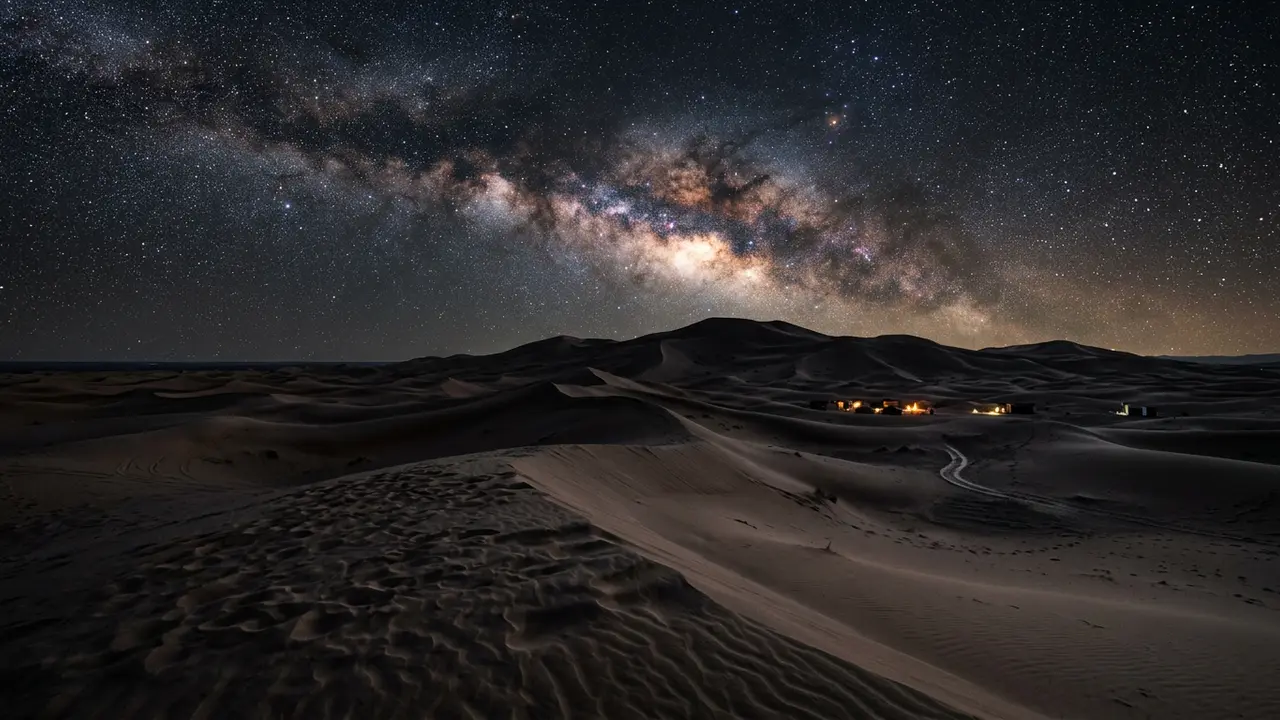
Erg Chebbi's dunes rise 150m above Morocco's Sahara, hours from city light. Stargaze from Berber-led desert camps: when to go, where to stay, how to get there.
No IDA or DarkSky International designation covers this stretch of Sahara, and no Bortle-scale reading has been published for it either. Nobody has measured Erg Chebbi's darkness formally; distance from the nearest towns is doing all the work a certification would do elsewhere. That is a genuinely honest starting point for a 'worth it' question, not a marketing shortcut. For the full picture of what that darkness looks like on the ground, see Merzouga stargazing.
The overland trip: two to four days from Marrakech or Fez
The road distance from Marrakech runs roughly 500 to 560 km depending on the exact route measured, and one reported driving leg alone took 6 hours[1]. Fez sits closer, cutting a couple of hours off the drive along the N13 through Midelt and Errachidia. See Getting to Merzouga for exact airport options and drive times before you book flights.
Almost nobody drives it nonstop. Most tours split the route into 2 or 3 legs, crossing the Tizi n'Tichka pass through the High Atlas, stopping at Ait Ben Haddou or the Dades Valley, and reaching Merzouga on day two or three rather than day one. Independent travelers who've made the trip from Fez tend to describe the long drive as worth it despite the effort, a sentiment that shows up more in personal travel blogs than in official tourism copy.
500-560 km
That structure is a feature, not a compromise. The same trip that gets you to the dunes also runs through some of Morocco's most striking mountain and gorge scenery, and operators selling 'Marrakech to Merzouga' packages build the itinerary around that fact rather than pretending the drive is dead time.
What this means for a worth-it calculation: you are not paying two to four days of travel purely for one desert night. You're paying it for a loop that happens to end at Erg Chebbi. If your Morocco itinerary already covers the Atlas Mountains and the gorge towns, the marginal cost of adding a Merzouga night is smaller than it looks in isolation. If you were hoping to bolt a quick desert side-trip onto a short Marrakech city break, the math is far less forgiving. For the fuller night-count math, from a single desert night to a four-day loop, see How Many Nights in Merzouga for Stargazing.
The tourist-trap risk: pricing games and camps that aren't as isolated as advertised
Merzouga's camp market has a real quality-control problem, and pretending otherwise does readers a disservice. Some travelers report being reshuffled into a different tour group than the one they booked, with luggage tossed into another vehicle and dozens of strangers driven out to the desert together[2]. That gap between the marketing photo and the actual tent isn't universal, but it shows up often enough in independent travel writeups to take seriously.
Pricing compounds the problem. Prices for outwardly similar two-night camp stays can vary enormously, with camps that look nearly identical charging wildly different rates. Third-party booking sites often assign travelers to camps by commission, not by fit, which is part of why the same-looking tent can cost far more depending on which site you booked through. Bottled water and other drinks are frequently left out of the base price too, a small but recurring hidden cost worth budgeting for[3].
Isolation is the other claim worth checking before you buy it. Some critiques of the Merzouga camp scene argue that most camps aren't genuinely isolated at all, that from many dune-side tents you can see rows of other permanent tourist camps just over the next ridge[4]. That doesn't mean every camp is compromised. It does mean 'private desert camp, miles from anyone' is a claim worth confirming with actual guest photos rather than taking on faith from a booking listing.
| What the listing promises | What travelers often find |
|---|---|
| Private 4x4 luxury camp | Minivan transfer, shared camp, dozens of other groups |
| All-inclusive package | Bottled water and drinks billed separately |
| Isolated desert camp, miles from anyone | Other permanent tourist tents visible just over the dunes |
Before paying a deposit, do three things:
- Read the camp's own reviews and recent guest photos of the actual tent you'd sleep in
- Confirm the price includes drinking water and camp transfers
- Book directly with a named, verifiable operator rather than an unnamed reseller or riad intermediary
The genuine payoff: Erg Chebbi's dark, the dune-sea scale, and Amazigh-run camps
None of that cancels out the reason people make this trip. Erg Chebbi is a real, singular landscape: a compact dune field roughly 28 km long, with individual dunes rising close to 150 meters above the surrounding hamada, an amphitheater of sand with no close equivalent anywhere else in Morocco[5]. Climb one of those dune crests before dark and you're not just watching a sunset. You're watching stars come up from a hundred meters above the plain, with the whole erg spread out flat and increasingly dark below you.
Recommended tours
Tours are selected for quality, not commission. I earn a small fee if you book — at no extra cost to you.
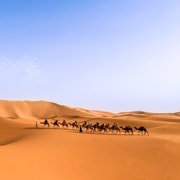
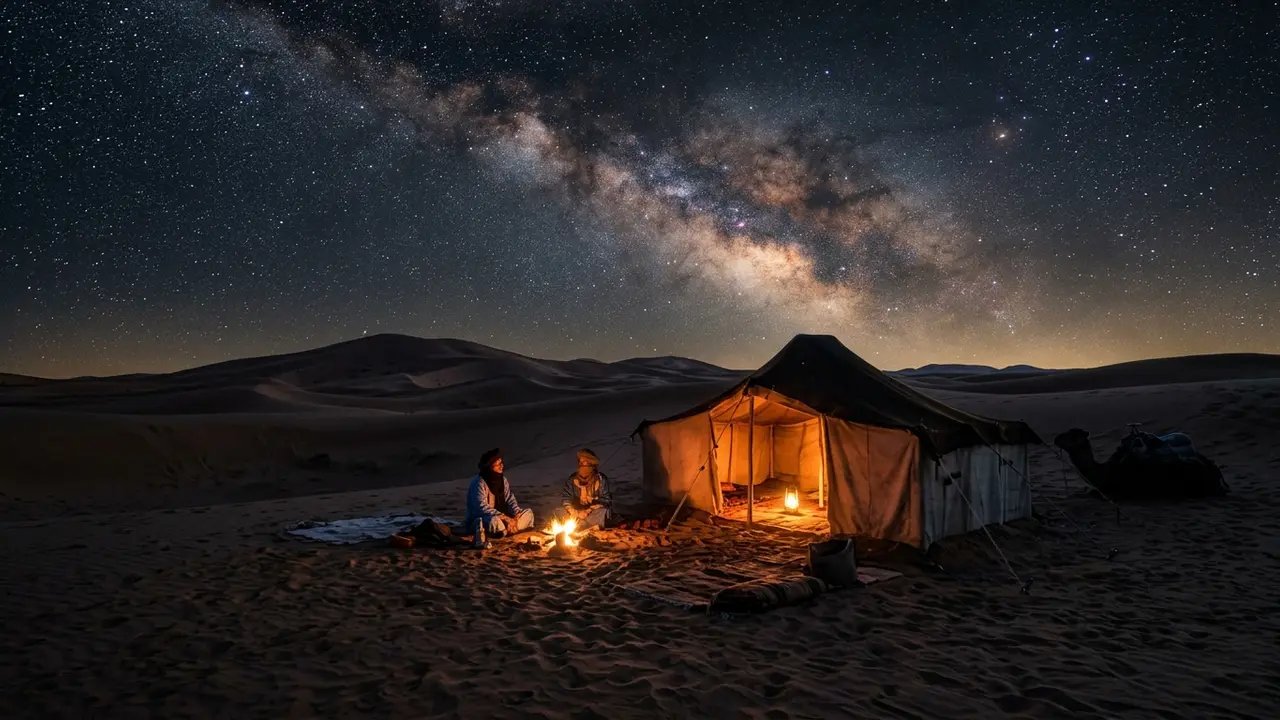
The camps that host that night are, at their best, run by Amazigh (Berber) families rather than a generic desert-tourism script borrowed from somewhere else. That's worth naming precisely: this is Amazigh hospitality, not a Bedouin stand-in, even though Merzouga and Jordan's Wadi Rum get lumped together on the strength of dunes-plus-camels-plus-stars alone. A well-run camp means a shared tagine dinner, drumming and singing that runs past midnight, and then a short unlit walk from the fire pit to a spot where the Milky Way is the brightest thing in view.
Erg Chebbi is a real, singular landscape: a compact dune field roughly 28 km long, with individual dunes rising close to 150 meters above the surrounding hamada, an amphitheater of sand with no close equivalent anywhere else in Morocco.
Sandboarding and a camel trek round out the daytime version of the same terrain, and neither requires stargazing to be the whole point of your visit. Plenty of travelers add one night in the dunes onto a longer Atlas-and-gorges loop and count the sky as a bonus rather than the headline. What you can't get anywhere closer to a major Moroccan city is this specific combination: true Saharan sand at this scale, this dark, with Amazigh guides who grew up in the region rather than a company that flew in a script.
For travelers who want the darkness without a saddle, the overnight camel trek into Erg Chebbi and the Merzouga 4x4 dune tour both build a full night at camp into the itinerary rather than a sunset-and-drive-back version of the same trip.
Who should go, and who should skip it
Merzouga suits a specific traveler: someone building a genuine multi-day southern Morocco loop who wants one or two nights in the desert as part of it, who's willing to vet a camp directly rather than trusting a resold listing, and who treats Amazigh cultural access and true Saharan darkness as worth the overland cost. It suits astrophotographers chasing a genuinely dark, unlit horizon, and travelers who'd rather spend two extra travel days than settle for a lesser sky closer to home.
It suits this traveler far less: anyone hoping to bolt a one-day desert side-trip onto a short Marrakech city break, anyone unwilling to research a specific camp by name before booking, and anyone expecting a guaranteed five-star private-tent experience without confirming photos and reviews first. Easier-to-reach dark-sky destinations exist closer to a major international airport for travelers who want a dark night with less logistics attached; Merzouga isn't competing on convenience, and shouldn't be booked expecting it to.
Booking directly with a named, verifiable operator is the single biggest lever travelers have over which side of the tourist-trap gap they land on. Best Desert Camps in Merzouga for Stargazing ranks four camps that already clear that bar, from a Dobson-telescope program to a family-run Berber camp at a lower price point.
The verdict on Merzouga
Is Merzouga worth it for stargazing? Yes, for the traveler who commits to it as a multi-day trip and does a little homework on which camp they're actually booking. The payoff, real Saharan dark, Erg Chebbi's dune-sea scale, and Amazigh-run hospitality found nowhere else in Morocco, is genuine, and it doesn't require pretending the camp market is problem-free to enjoy it.
The friction is real too: a full day or more of driving in each direction, a camp market where pricing and isolation claims don't always match the listing, and no shortcut version of the trip for a traveler with only a day or two to spare. Neither side cancels the other out.
Featured · Article
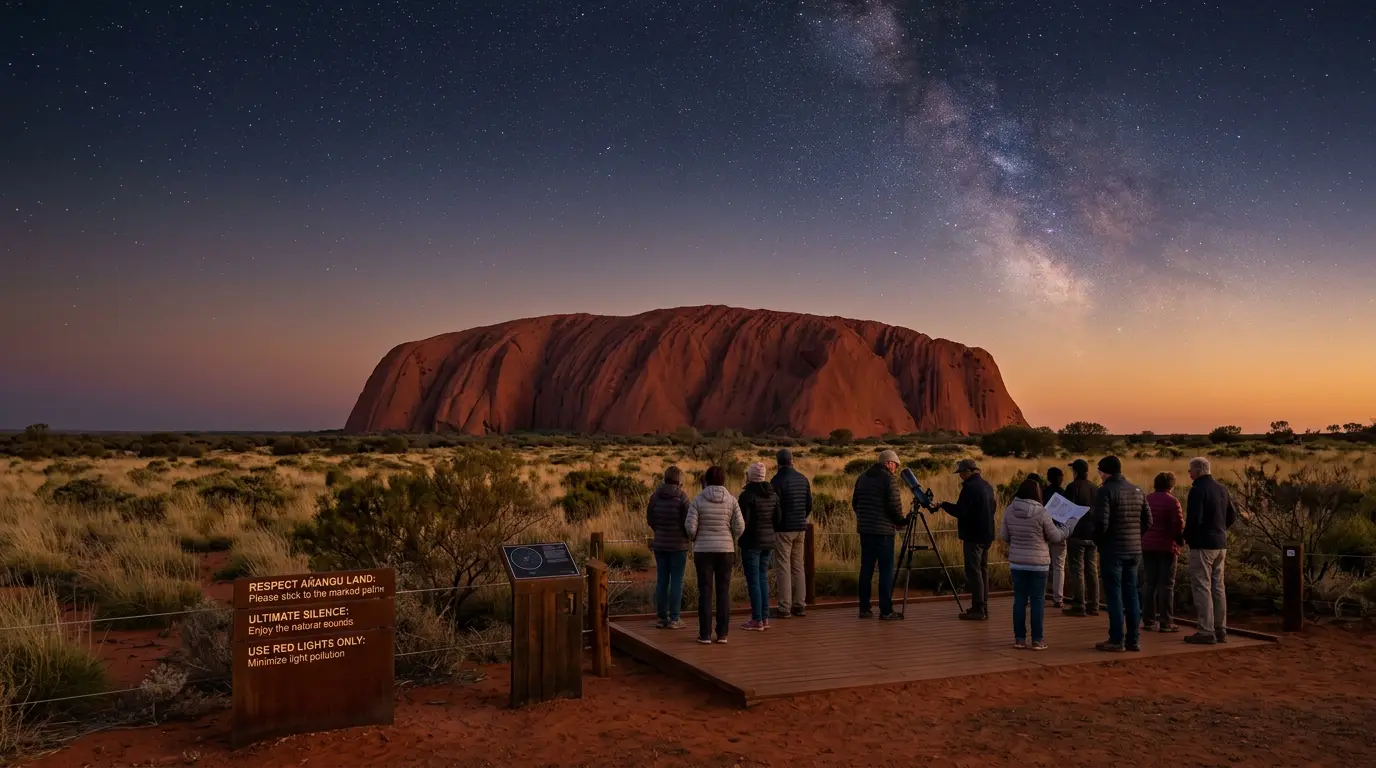
Uluru Cultural Significance and Visitor Etiquette
Uluru is Anangu land under joint management. Here's why the 2019 climb closure is settled policy, what you can't photograph, and real visitor etiquette.
Book Merzouga for the dune-sea sky and the Amazigh camps that host it, not because it's the easiest or cheapest dark-sky trip on this site. Pick a specific, verifiable camp, plan at least one full night in the desert itself, and go in knowing which parts of the trip, the drive, the camp market, are worth the extra planning they demand.