
Why Merzouga Isn't a Quick Day Trip
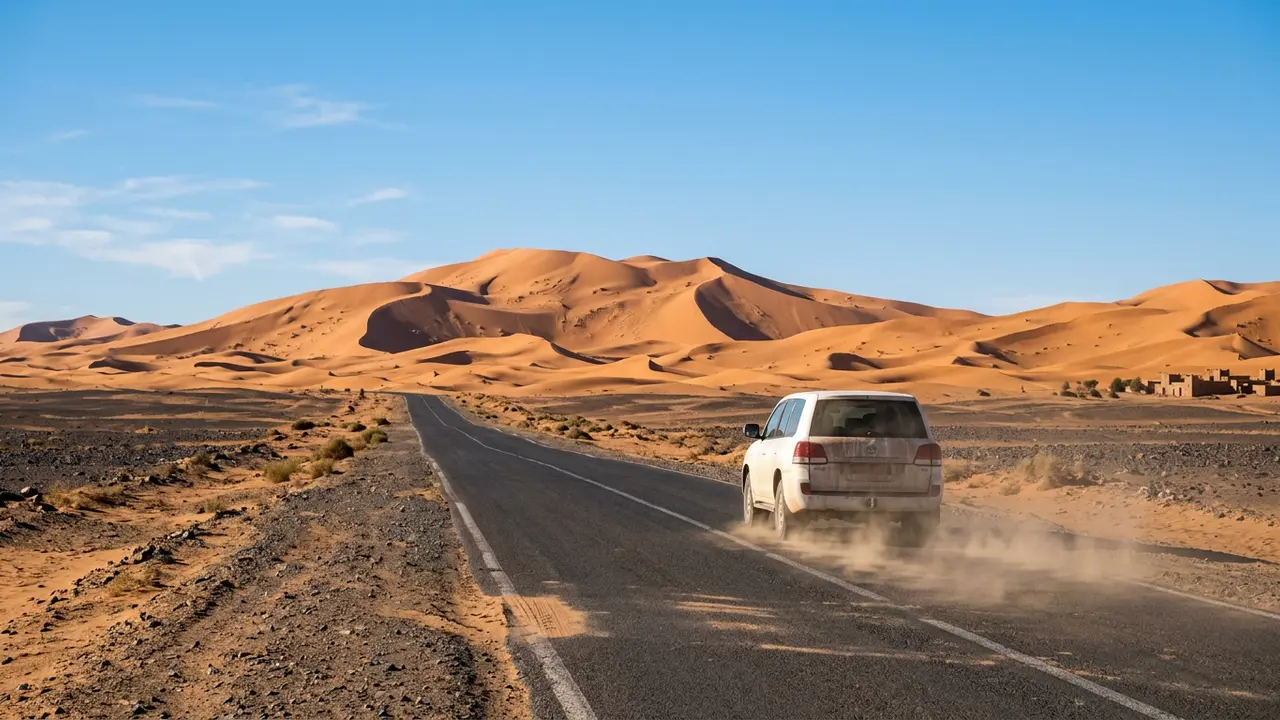
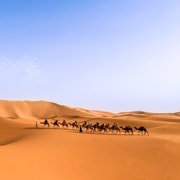
Merzouga sits at the edge of Erg Chebbi, deep in the country's southeast, where dunes rise as high as 150 meters from the surrounding hamada[8]. That remoteness is exactly what keeps its night sky dark, but it also means there's no commercial airport anywhere near the dunes themselves. Every visitor arrives by road, whether that road starts at a domestic terminal two hours away or a major international hub nine hours away.
Most travelers reach the Merzouga stargazing destination as part of a longer trip built around Marrakech or Fez rather than a single flight-and-taxi hop. That changes the planning math. You're choosing a route and a departure date weeks in advance, not deciding on a whim whether tonight's sky looks clear enough for a quick drive.
Four routes cover nearly everyone's trip:
- Fly to Errachidia (ERH), then a short final drive
- Fly to Ouarzazate (OZZ), then a longer final drive
- Fly to Marrakech and drive, or join a tour, the whole way
- Fly to Fez and take a faster overland route
Which one makes sense depends more on the rest of your Morocco itinerary than on Merzouga itself.
The Two Closest Airports: Errachidia and Ouarzazate
Errachidia's Moulay Ali Cherif Airport (ERH) is the closest airport to Merzouga by a wide margin, about 150km away and roughly a two-hour drive along the N13[1][2]. It runs limited domestic connections, mostly routed through Casablanca, so arriving here usually means a connecting flight rather than a direct international one. What it lacks in flight options it makes up for by cutting the final overland leg down to almost nothing.
Ouarzazate Airport (OZZ) is the second-closest option, around 365km away, working out to roughly a five-hour drive[3]. Ouarzazate carries more international charter and seasonal service than Errachidia, partly thanks to its film-studio tourism, so for some travelers a longer drive buys a noticeably more convenient flight schedule.
150 km
Neither airport puts you anywhere close to Merzouga itself. Budget for a pre-arranged camp transfer, a rental car, or a grand taxi from either one; public transport thins out fast once you're off the N13.
Reaching Merzouga from Marrakech
Marrakech Menara Airport (RAK) is Morocco's busiest international gateway and the most common starting point for a Merzouga trip, but it's also the furthest by road: about 560km and 9 to 10 hours of nonstop driving[4]. Almost nobody actually drives it nonstop, and for good reason.
Featured · Destination
Merzouga Stargazing
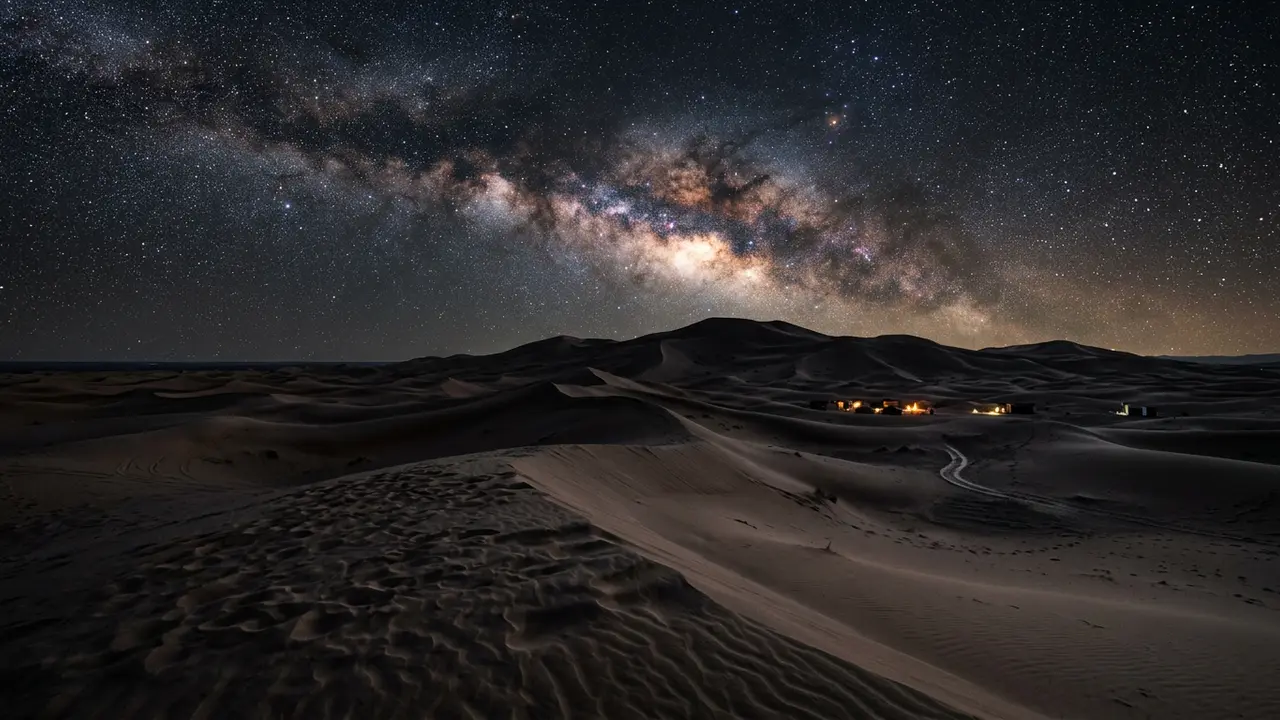
Erg Chebbi's dunes rise 150m above Morocco's Sahara, hours from city light. Stargaze from Berber-led desert camps: when to go, where to stay, how to get there.
The Two-Day Overland Route
Most tour operators split the Marrakech-Merzouga drive over two days, crossing the High Atlas at the Tizi n'Tichka Pass[4] and stopping overnight around Ouarzazate or the Dades Valley before continuing east through Erfoud and Rissani on the final stretch. It's slower than pushing straight through, but it turns one grueling day into two manageable ones and adds a genuine sightseeing leg through kasbah country along the way.
If you'd rather not drive the pass yourself, hairpin turns and all, a guided multi-day option like the Marrakech to Merzouga desert tour covers the same ground with a driver who already knows every switchback.
Fly-and-Drive via Ouarzazate
The other Marrakech-based option skips most of the overland haul in favor of a short domestic flight to Ouarzazate, then the roughly five-hour final drive from there. It usually costs more than the pure overland route and depends on whether a convenient Marrakech-Ouarzazate connection happens to be flying that week, but it trims two driving days down to one afternoon on the road.
Reaching Merzouga from Fez
Fez is the faster overland option from any major Moroccan city, and it's worth considering seriously if your itinerary allows starting there instead of Marrakech. The drive is about 470km and 7 to 8 hours, following the N13 south through Midelt and Errachidia rather than crossing the High Atlas[5].
The route itself is part of the appeal. It runs through the Middle Atlas cedar forests and the mountain town of Ifrane, then down through Midelt and Errachidia before the landscape turns properly desert around Erfoud. It's a genuinely different Morocco than the kasbah route out of Marrakech, and for travelers who've already spent a few days around Fez or Chefchaouen, it's the more efficient way in.
Fes-Saïss Airport sits about 455km and 7 hours from Merzouga along the same route, roughly comparable in driving time to flying into Marrakech and taking the shorter Ouarzazate leg instead[6], so the choice mostly comes down to which city fits the rest of your Morocco trip.
Morocco Visa and Entry Requirements
Morocco's entry rules are more straightforward than many travelers expect, with one important caveat: they can and do change, so treat everything below as a starting point for your own check rather than the final word.
Citizens of the EU, the UK, the US, Canada, and a number of other countries can currently enter Morocco visa-free for stays of up to 90 days[7]. That covers the large majority of travelers heading to Merzouga for a stargazing trip. The full list of eligible nationalities, and any shorter day-allowances that apply to specific countries, is longer and more detailed than fits neatly into a travel article, and it's exactly the kind of detail that shifts without much notice.
Recommended tours
Tours are selected for quality, not commission. I earn a small fee if you book — at no extra cost to you.
A passport valid for at least six months beyond your travel dates is commonly recommended by airlines and travel guides, though this isn't a rule I could independently confirm on any government visa-policy page. Treat it as sensible travel practice rather than settled Moroccan law, and check both your airline's own boarding requirements and your passport's actual expiry date well before you book flights.
Featured · Article
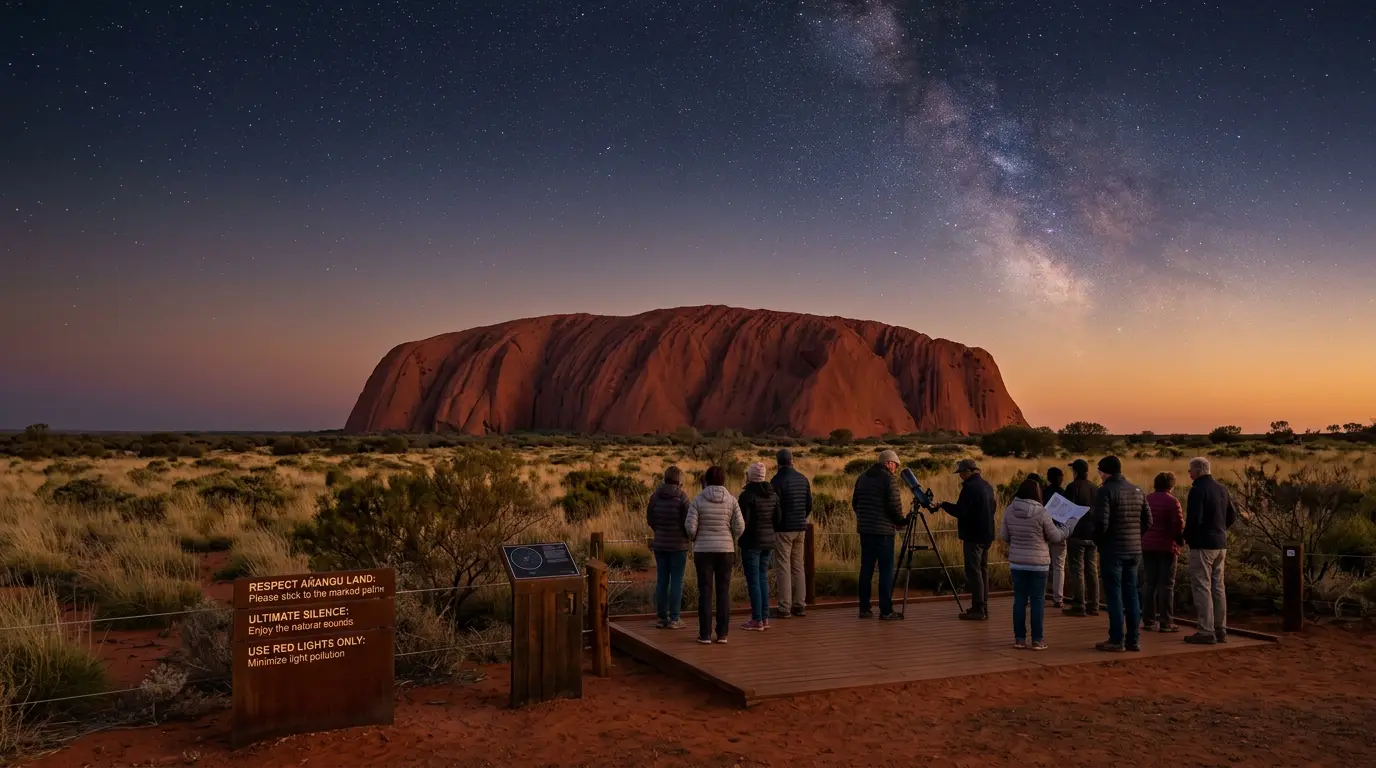
Uluru Cultural Significance and Visitor Etiquette
Uluru is Anangu land under joint management. Here's why the 2019 climb closure is settled policy, what you can't photograph, and real visitor etiquette.
Entry rules can change without notice. Before you book anything, confirm the current requirements for your nationality with your government's travel advisory service and, if you're unsure, the nearest Moroccan consulate.
Planning Your Route: What Actually Works
There's no universally correct choice among these four routes, only trade-offs that matter differently depending on the rest of your trip. If cutting driving time is the priority, fly into Errachidia and accept a shorter, more restrictive flight schedule. If you want the classic Morocco road-trip experience and don't mind two long driving days, the Marrakech overland route earns its reputation. If your itinerary is already built around Fez, the faster N13 route from there is hard to beat.
A few practical notes that apply no matter which route you pick:
- Book any camp transfer or grand taxi in advance rather than assuming one will be waiting; the Merzouga area sees heavy demand around new-moon weekends, when the sky is at its darkest
- Check seasonal driving conditions before a spring trip, since the same Sirocco winds that can dull stargazing also reduce visibility on desert roads, covered in more depth in the best time to stargaze in Merzouga guide
- Confirm with your camp, such as this astronomy-focused camp, whether airport or Rissani-town pickup is included, since it often is for multi-night stays
- Fill your fuel tank at Erfoud or Rissani; options thin out fast past that point
| Route | Distance | Driving time | Best for |
|---|---|---|---|
| Fly to Errachidia (ERH) | ~150 km final leg | ~2 hours | Shortest transfer, fewer flight options |
| Fly to Ouarzazate (OZZ) | ~365 km final leg | ~5 hours | More flight choices, moderate drive |
| Overland from Marrakech | ~560 km | 9-10 hours, usually split over 2 days | Classic road trip through kasbah country |
| Overland from Fez | ~470 km | 7-8 hours | Fastest single-city overland option |
However you get there, the last stretch is the same for everyone: a final unpaved run to camp, engine off, and a sky that's been waiting the whole drive to be worth it. Once you're there, things to do in Merzouga beyond stargazing covers how to fill the daylight hours between desert nights.