Why Merzouga's Sky Stays Dark Every Month
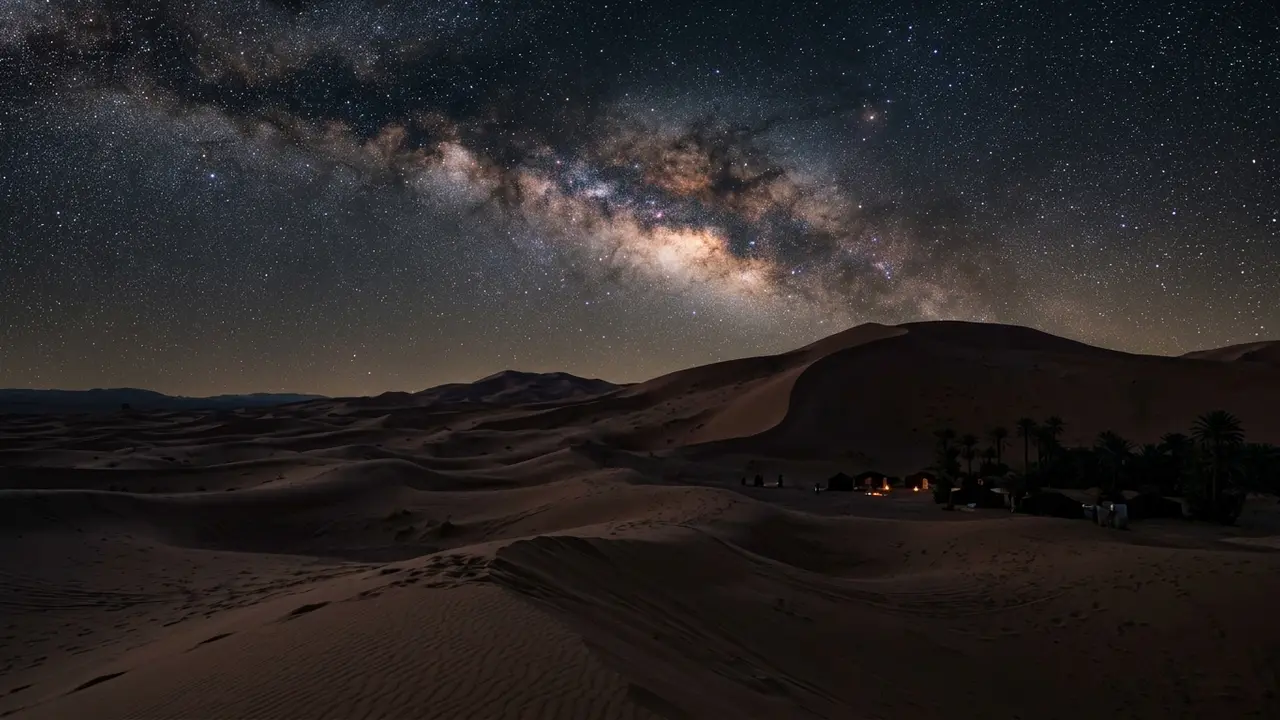
Merzouga has no dark-sky certification. There's no IDA Dark Sky Park plaque at the edge of the dunes and no UNESCO reserve boundary drawn around Erg Chebbi, nothing like the badge you'll find at most of the best dark sky parks in the world. What it has instead is distance: Erg Chebbi sits deep in Morocco's eastern desert, far past the last string of streetlights, and that remoteness does roughly the same job a certification would, without the paperwork.
Nobody has run a formal sky-quality survey of the dune field itself, so treat any specific darkness rating you find online, including the Bortle 1-2 figure a few tour operators use, as marketing shorthand rather than an audited number. The honest version of the claim is simpler: check a light-pollution map before you book, and you'll see Merzouga sitting in one of the last light-pollution-free horizons left on a map of Morocco.
What that isolation buys you is consistency. Merzouga receives roughly 63mm (2.5in) of rain a year[1], desert-dry almost every month, which means clouds are the exception here, not the rule. The variable that actually changes month to month isn't sky quality. It's whether you can stand outside comfortably long enough to look up.
63mm
Summer: The Boldest Milky Way Against the Harshest Heat
This is the trade-off that defines astro-tourism in Merzouga. Morocco's latitude puts the Milky Way's galactic core highest in the sky and up longest roughly between April and September, the same general window most Northern Hemisphere desert sites follow. Peak summer is when the core sits boldest overhead after dark, no telescope needed to pick out its dust lanes against the naked-eye stars.
It's also when the desert stops being merciful. July is Merzouga's hottest month, with daytime highs around 43°C (109°F)[2], and the ground holds onto that heat long after sunset. Nighttime lows only drop to about 29°C (84°F) in July[3], so there's no real cooling-off period before a session even starts. Independent verification for this piece stops at that number, but several tour operators describe summer daytime highs pushing past 50°C in the worst weeks. Treat that as anecdotal until you confirm it yourself, and plan for genuinely extreme heat either way.
Featured · Destination
Merzouga Stargazing
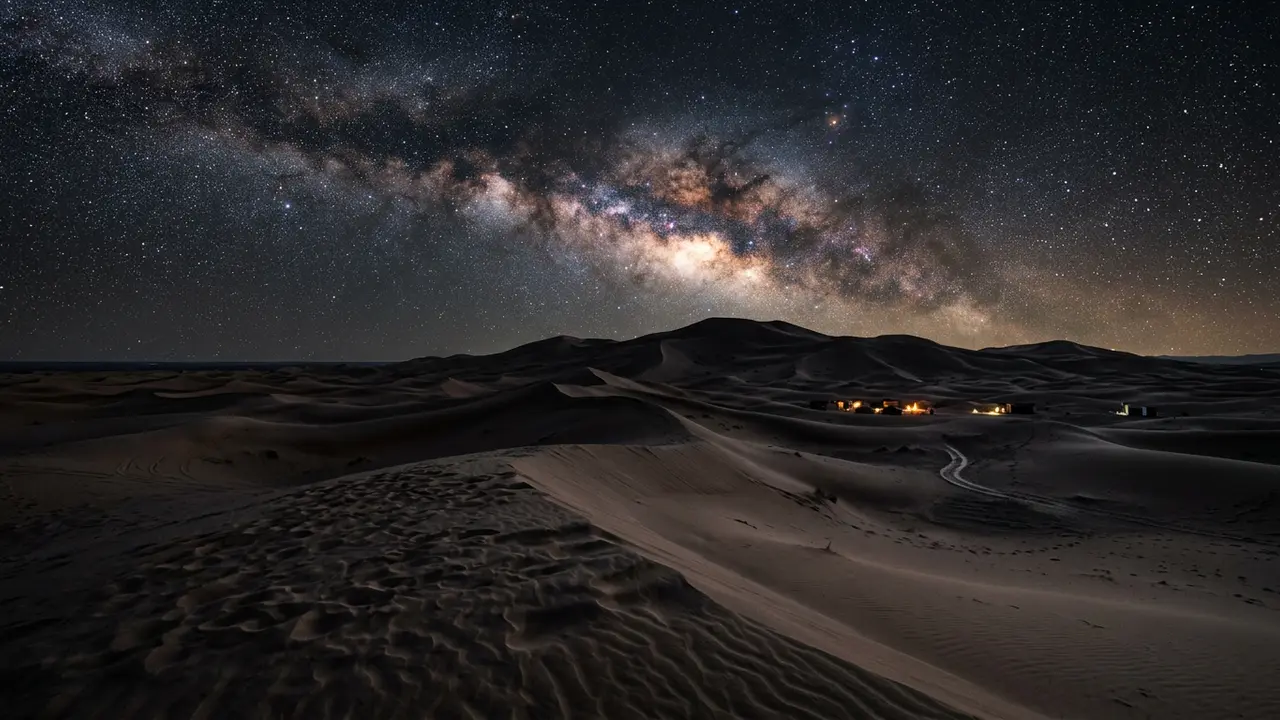
Erg Chebbi's dunes rise 150m above Morocco's Sahara, hours from city light. Stargaze from Berber-led desert camps: when to go, where to stay, how to get there.
A practical summer session looks different from a spring one. Skip the exposed dune crest at midday entirely, save any walking for the two hours after sunset once the sand starts releasing its heat, and build in real water and shade breaks before dark rather than after you're already overheated. A Milky Way core that needs no assistance to find is a real reward. The daytime cost of getting there is just as real.
Winter: Cold Clear Nights and the Earliest Darkness
Winter flips the calculation entirely. January is Merzouga's coldest month, with daytime highs around 19°C (66°F)[4], mild enough for a light jacket at midday and nowhere near summer's punishing sun. The catch shows up after dark.
Desert nights lose heat fast once the sun drops, and Merzouga is no exception: winter nights fall to around 6°C (43°F)[5], cold enough that a dune-crest camp stargazing session needs real cold-weather layers, not just a fleece. Pack for a night colder than the daytime forecast suggests, because Merzouga's diurnal temperature swing between 2pm and 2am is bigger than most travelers expect from a desert.
What winter gives back is time. Darkness settles in early and the dry winter air tends to run clearer than the hazier months, so a session that would need to wait until well after 9pm in June can start right after dinner in December. The sky above camp stays sharp for longer, without the shimmer that summer heat puts into the lower atmosphere.
Pack for a night colder than the daytime forecast suggests, because Merzouga's diurnal temperature swing between 2pm and 2am is bigger than most travelers expect from a desert.
Shoulder Season: Spring and Autumn's Comfort Trade-off
Spring and autumn are the months most experienced desert travelers quietly pick to sidestep Merzouga's thermal extremes in either direction. Weather data for Merzouga's cooler stretch puts the most comfortable window, roughly January through April and November through December, with daytime highs no longer at July's brutal 43°C peak nor January's cooler 19°C floor[6], wide enough to hike a dune at midday and still stand outside comfortably three hours after sunset.
Recommended tours
Tours are selected for quality, not commission. I earn a small fee if you book — at no extra cost to you.
Third-party travel guides describe spring and autumn daytime highs closer to 25-35°C (77-95°F) with nights around 10-20°C (50-68°F). Those figures weren't independently verified for this piece, but they line up with the general shoulder-season pattern, so treat them as a planning estimate rather than a guarantee, and check a current forecast before you commit to packing.
| What matters | Summer (Jun-Aug) | Winter (Dec-Feb) | Shoulder (Mar-May, Sep-Nov) |
|---|---|---|---|
| Daytime comfort | Around 43°C, plan around the heat | Around 19°C, mild and manageable | Roughly 25-35°C, the easiest daytime window |
| Night comfort | Still near 29°C after sunset | Drops to about 6°C, pack real layers | Around 10-20°C, a light jacket usually covers it |
| Best for | Milky Way core season | Longest, clearest dark hours | A comfortable all-around visit |
| Watch for | Extreme daytime heat | Cold desert nights | Possible Sirocco dust in March-April |
The one real caveat: some sources flag March and April as carrying extra risk from the Sirocco, a hot, dust-laden wind that can degrade sky transparency for a night or two even when the forecast reads clear. That claim isn't verified at the level of a specific statistic, but airborne dust is a genuine stargazing hazard, so it's worth checking conditions a day out rather than assuming spring is automatically the safe choice.
Rain, Dust, and the Moon: What Actually Blocks the View
Season decides comfort, not darkness. Merzouga's sky reads dark on almost any clear night regardless of month, so the two variables that actually block a good view are weather noise and moonlight, and only one of those follows a predictable calendar.
The single biggest lever, more than the month you pick or the exact dune you climb, is the new moon window. Aim for the five or six nights centered on a new moon, when the sky stays dark from dusk until whatever hour the moon eventually rises. A bright moon flattens the Milky Way's core the same way it dulls a meteor shower: full detail disappears into a wash of scattered light regardless of how clear or cold the night is.
Cross-check that new-moon window against the season you've chosen rather than treating them as separate decisions. A perfect new-moon night in July still means standing on hot sand after a 43°C day, and a perfect new-moon night in January still means dressing for 6°C. The calendar tells you what kind of night you're signing up for. The moon phase tells you which specific night inside that window is actually worth losing sleep over.
Planning the Trip: The Comfort Window and What to Pack
Most trips to stargazing in Merzouga arrive as part of a multi-day desert tour out of Marrakech or Fez rather than a short local drive, which changes how you should think about timing. You're not deciding whether to drive out on a clear night. You're picking a departure date weeks in advance and hoping the season and moon line up once you get there.
Featured · Article
Uluru Cultural Significance and Visitor Etiquette
Uluru is Anangu land under joint management. Here's why the 2019 climb closure is settled policy, what you can't photograph, and real visitor etiquette.
Best Overall Window
If flexibility allows only one choice, late October through early April covers the coldest nights and the most comfortable days, minus the deep midwinter cold of January. It skips summer's Milky Way core entirely, which is the real cost of choosing comfort. There's no way around that trade-off, only a decision about which side of it matters more to you.
Camp choice can soften either extreme, too: an air-conditioned stay like this equipped desert camp takes some of the edge off a summer visit, while a fireplace-equipped camp such as this top-ranked dune camp makes a cold winter night at the fire pit more bearable before you head out to look up.
What to Pack for Either Extreme
Desert nights swing harder than the daytime forecast suggests, whatever month you land in. A few non-negotiables:
- A warm base layer and an insulated jacket, even for a summer trip, since 29°C nights still feel cold once you've stopped moving after a hot day
- A headlamp with a red-light mode, so you don't wreck your own night vision setting up gear
- Sand-specific camera protection for anything electronic near Erg Chebbi's fine, wind-blown dunes
- A basic star chart or phone app, since there's no ranger talk or visitor center display out here the way there is at a designated dark-sky park
The stargazing gear guide covers the rest in more depth. Most of it doubles for a Sahara camp trip without extra buying.