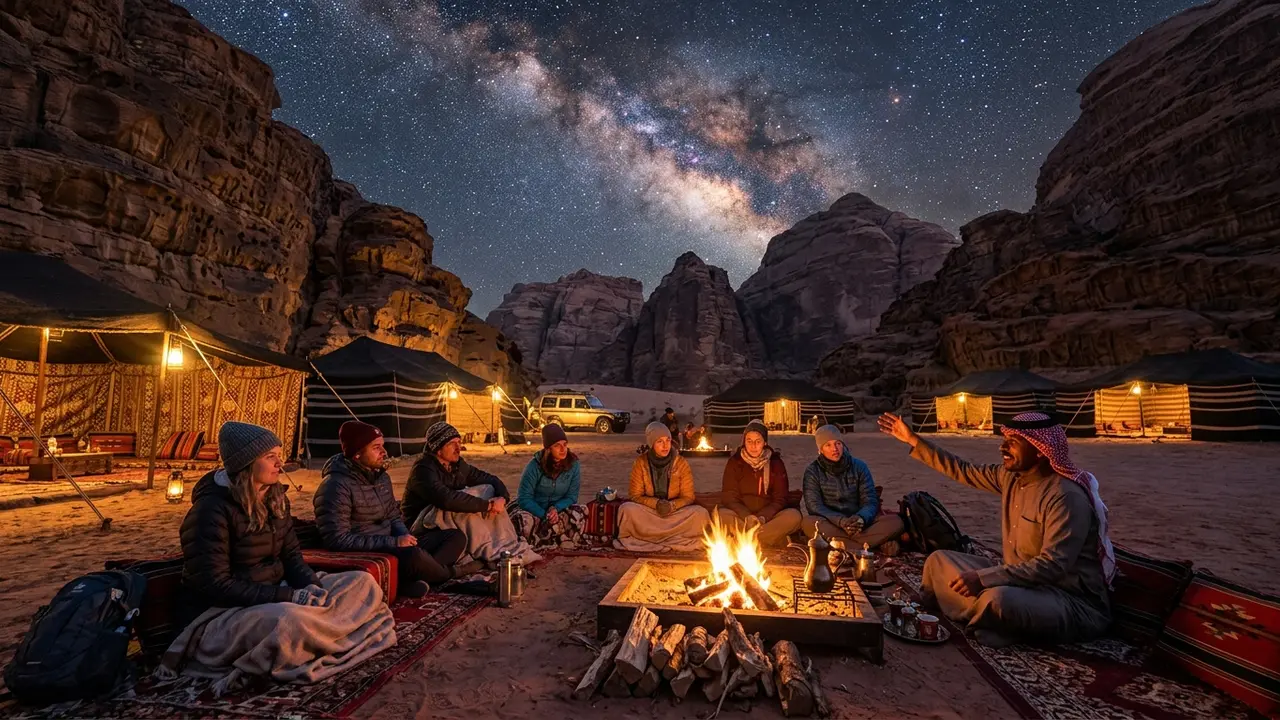
When to Go, and Whether the Moon Matters More Than the Month
Wadi Rum's darkness comes from remoteness, not seasonal weather, so the honest answer to when is straightforward: any month works if you pick your week around the moon instead of the calendar. Spring (March-May) and autumn (October-November) give the most comfortable temperatures for a night outside, which is why camps fill up fastest in those windows. Summer (June-August) is marketed by local operators as the season with the most reliably clear skies, and it covers the Perseid meteor shower's mid-August peak. Winter (December-February) is the quietest at most camps, genuinely cold once the sun goes down.
None of those four seasons beats the effect of moon phase on a single trip. A night near new moon shows far more sky than a night near full moon, whatever month it falls in, so check the new-moon window before locking in dates, the same advice the best time for stargazing in Wadi Rum breakdown covers in full, including a season-by-season temperature table.
Wadi Rum's darkness comes from remoteness, not seasonal weather, so the honest answer to when is straightforward: any month works if you pick your week around the moon instead of the calendar.
That comfort-driven demand has a real trade-off worth knowing before booking: shoulder-season crowds. A camp that feels wonderfully isolated in a hot July can have several other groups' fires visible across the valley in a mild April. If solitude matters as much as the sky itself, ask your camp directly how full they expect to be on your dates rather than assuming a comfortable month automatically means an empty desert.
Do You Need a Guide in Wadi Rum?
In practice, yes, for anything short of an experienced, fully self-sufficient wild-camping trip. Nearly everyone who stays overnight books through a Zalabieh Bedouin-run camp or a licensed local operator, and jeep tours, camel treks, and protected-area access typically bundle through that camp rather than a standalone ticket bought at a gate.
Wild camping without a guide is technically permitted inside the protected area[1], but that's a narrower fact than it sounds. Tour operators actively encourage booking with a guide rather than requiring one by law, and the same remoteness that keeps Wadi Rum's sky dark also makes an unguided night riskier if weather turns or a vehicle gets stuck. For a typical stargazing visit, arranging a camp is the realistic path, not a formality to work around.
- A basic Bedouin camp with a guide built into the package price
- A licensed local operator running jeep or camel excursions from the camp
- Independent wild camping, allowed but recommended only for experienced desert travelers
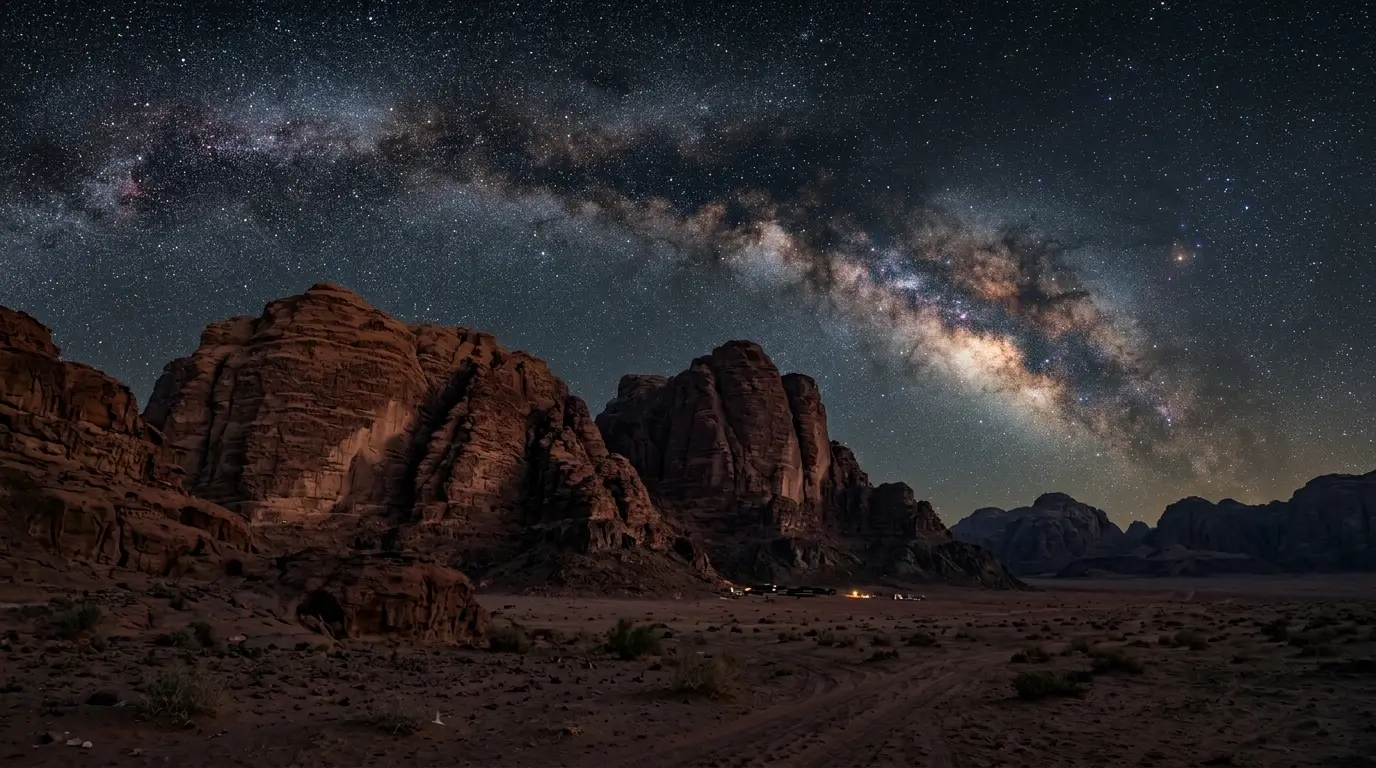
Featured · Destination
Wadi Rum
See the Wadi Rum night sky from a Zalabieh Bedouin camp in Jordan's UNESCO desert: bare tents to glass domes, Bortle 2-3 skies, and year-round stargazing.
None of this comes with a single published price tag either. Camp packages typically bundle protected-area access, a guide, and the jeep or camel excursion into one nightly rate that varies by operator and season, rather than a separate ticket sold at a gate.
Camps like the dome-tent camp near Wadi Rum village build the guide and jeep excursion into the overnight price by default, the norm across nearly every option in the best desert camps in Wadi Rum for stargazing ranking.
How Hot and Cold Does Wadi Rum Actually Get?
Sharp day-to-night swing, year-round, no matter which season lands on your itinerary. Spring (March-May) days run 20-31°C (68-88°F) with nights at 8-16°C (46-61°F)[2]. Summer (June-August) days climb to 34-36°C (93-97°F), with nights cooling to 21-23°C (70-73°F)[3] — July's mean daily maximum runs about 34.6°C (94.3°F) per Wikipedia's climate data for the site[4]. Winter (December-February) days settle at a mild 14-17°C (57-63°F), but nights drop to 3-5°C (37-41°F)[5], cold enough that a proper down layer matters as much as sunscreen does in July.
That's the same diurnal temperature swing in every season: hot or mild days, followed by a sharp overnight drop as the desert loses its stored heat. That kind of clean, cold night air is also part of why stargazers rate Wadi Rum's winter sky so highly despite the cold: less atmospheric turbulence generally means steadier, sharper viewing through a telescope or camera lens.
- Spring/autumn: mild days, cool nights, the easiest packing list
- Summer: brutal midday heat, genuinely pleasant nights
- Winter: mild days, sharply cold nights, the season most people underpack for
| Season | Daytime highs | Night temps | Best for |
|---|---|---|---|
| Spring (Mar-May) | 20-31°C (68-88°F) | 8-16°C (46-61°F) | Comfortable days, mild nights |
| Summer (Jun-Aug) | 34-36°C (93-97°F) | 21-23°C (70-73°F) | Clearest-sky reputation, Perseids |
| Winter (Dec-Feb) | 14-17°C (57-63°F) | 3-5°C (37-41°F) | Quiet camps, cold nights |
Pack real cold-weather layers for after dark regardless of month. The desert loses its daytime heat fast once the sun goes down, and that's as true in July as it is in January.
Is Wadi Rum Safe, and What About the Visa?
Safety questions about Wadi Rum are less about the desert itself and more about which corner of Jordan an itinerary touches. Petra, Wadi Rum, Aqaba, and the Dead Sea all sit inside Jordan's general tourist circuit, distinct from the specific border-proximity restrictions official advisories name. Wadi Rum itself is far from any border areas with active government travel advisories, a straightforward geographic fact rather than a security judgment call. Advisory levels and specific-area guidance shift, so check your own government's current travel advisory (Canada's travel.gc.ca or the equivalent US, UK, or Australian site) directly before finalizing a booking, the same pre-trip step worth taking for the visa.
Beyond checking advisories, ordinary travel precautions apply here the same way they would in any remote desert destination: share your itinerary with someone before an overnight stay, confirm your camp has a way to reach help if needed, and treat a guide's judgment about weather or terrain as the final word.
On the visa: most nationalities get a visa on arrival for a published fee of 40 JOD[6] at time of research, treat that figure as indicative rather than current, since visa fees change without much notice. Jordan also runs an e-Visa program arranged in advance for most nationalities; holders of passports from a longer list of countries and territories are excluded from visa-on-arrival or e-Visa and must instead apply for approval through the Jordan Ministry of Interior's E-Services[7]. Confirm both the fee and your eligibility directly with Jordan's official e-Visa portal before booking flights, since the exact list is subject to change; stargazing in Wadi Rum covers the fuller logistics picture, including airport options and drive times.
40 JOD
Is Wadi Rum Actually a Certified Dark Sky Site?
No, and this is worth correcting directly since it's the single most repeated inaccuracy about this destination. Wadi Rum Protected Area was inscribed on the UNESCO World Heritage List in 2011[8], a real, checkable designation covering both its natural landscape and its archaeological record. That's a heritage designation, not a night-sky one.
DarkSky International's own directory of certified Reserves, Sanctuaries, and Parks doesn't list Wadi Rum at all[9]. No formal dark-sky certification exists here, full stop. What does exist is a Dark Sky Sanctuary that happens to share the name: the Isle of Rum, a small island off Scotland's west coast, an entirely different place on a different continent[10]. If a search result or a camp's marketing copy calls Wadi Rum a certified Dark Sky Sanctuary, it's very likely conflating the two.
The confusion is an easy one to make. Both places share the same three-letter name, both trade on remoteness and a dark night sky, and search engines don't always distinguish a Jordanian desert from a Scottish island. Checking DarkSky International's own places directory directly, rather than trusting a camp's marketing copy, is the fastest way to settle the question for good.
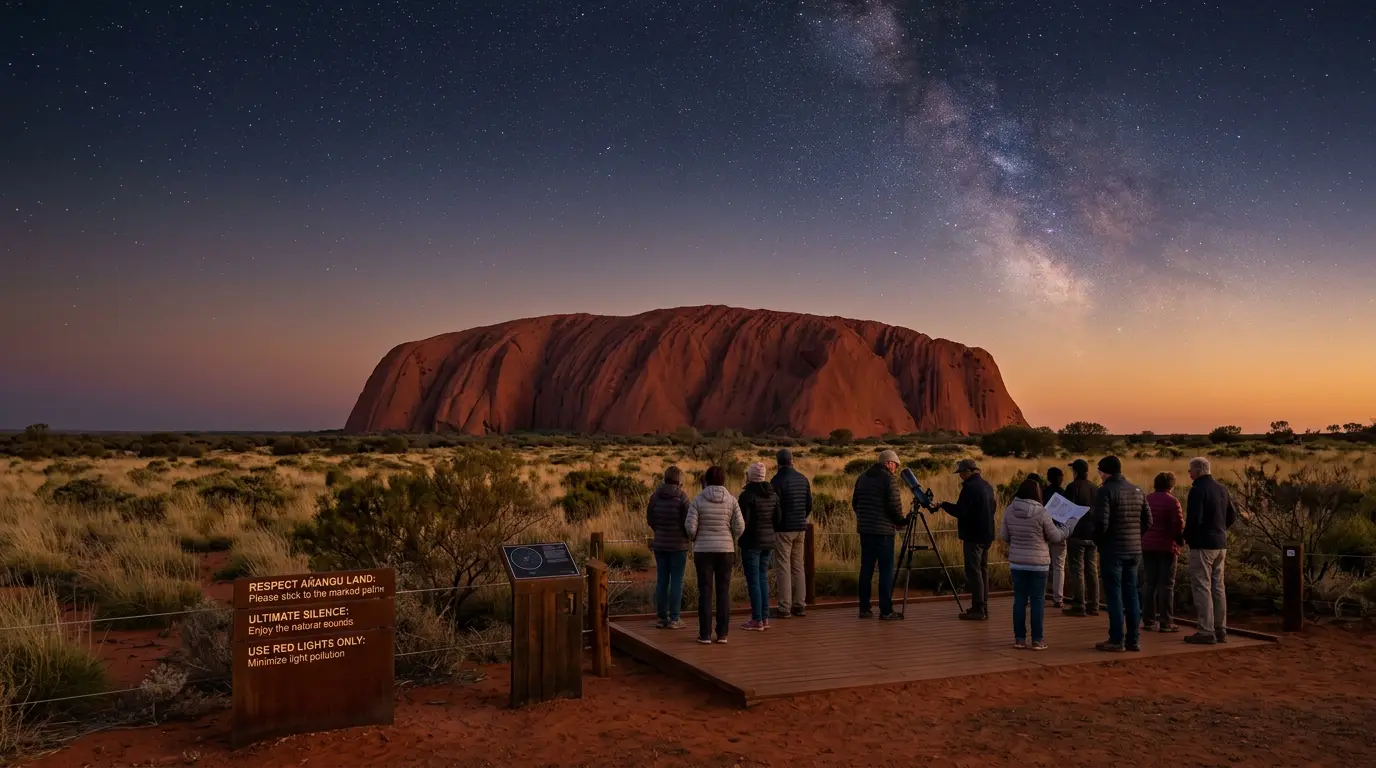
Featured · Article
Uluru Cultural Significance and Visitor Etiquette
Uluru is Anangu land under joint management. Here's why the 2019 climb closure is settled policy, what you can't photograph, and real visitor etiquette.
None of that makes Wadi Rum's sky any less genuinely dark. The darkness here is a byproduct of real remoteness and low population density, not a marketing claim borrowed from a certification it doesn't hold. Both facts can be true at once: no certificate, and a sky worth building a trip around.
Putting a Wadi Rum Stargazing Trip Together
Every answer above points toward the same shape of trip: book a Bedouin-run camp rather than trying to arrange access independently, confirm your jeep or camel excursion is bundled into that booking, check current visa and advisory details directly before locking in flights, and pack for a temperature swing wider than most travelers expect.
None of it requires chasing a certification Wadi Rum doesn't have. The valley's reputation rests on genuine remoteness, not a plaque, and that reputation holds in every season once camp lighting and moon phase are accounted for.
A short checklist before booking:
- Camp first: arrange your Bedouin-run camp before arrival, since guide, jeep, and protected-area access typically bundle through that booking
- Visa and advisory: confirm current visa fees and your government's travel advisory directly, not from a blog post
- Layers for both extremes: pack for the day's heat and the night's cold, whatever season you land in
- Moon phase: check the new-moon window for your travel dates before locking anything in
Start with stargazing in Wadi Rum for the full destination picture, work outward to best stargazing spots in Wadi Rum for exactly where to set up once a camp is booked, and confirm the specifics above directly with your chosen operator before finalizing anything.