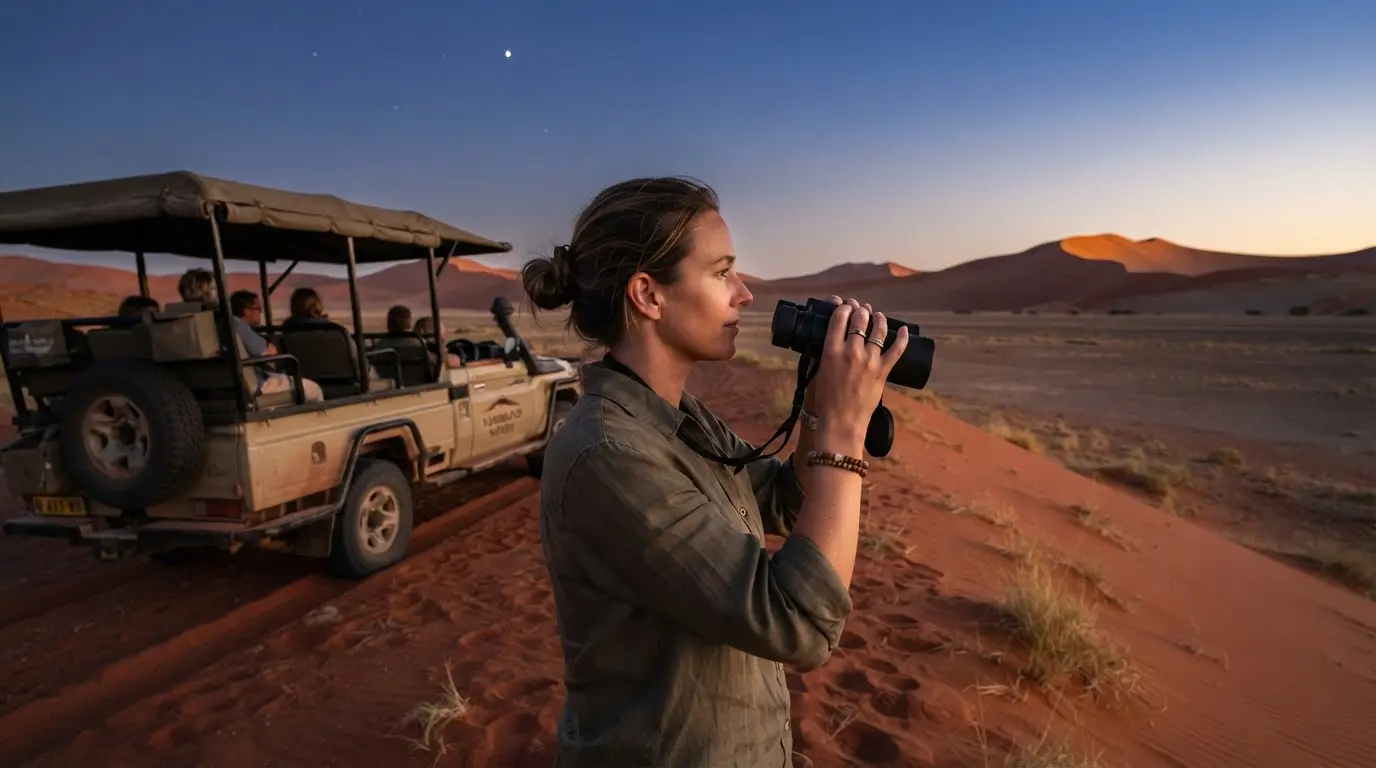

Why NamibRand asks one pair to do two jobs
NamibRand Nature Reserve demands more from a pair of binoculars than almost any other dark-sky destination on this site, because the same land runs two completely different shows. By day it is a working game reserve: the latest census counted 3,200 oryx and 12,400 springbok, with kudu, zebra, and giraffe behind them[6]. By night it is a Bortle 1 sky, the darkest rung of the nine-level scale[4], under Africa's first International Dark Sky Reserve designation, only the second place on Earth ever inscribed at Gold Tier[5].
The two halves never blur. Night drives are not permitted inside the reserve, so once the sun drops the wildlife stops being the show and the sky takes over[7]. Your binoculars therefore get used for game-viewing by day and stargazing after dark, with zero overlap in what each job asks of them. One pair has to do both, and the specs that win each half point in opposite directions: the daytime half wants a wide, easy-to-hold view, while the night half wants every photon of light it can collect. That conflict is the whole buying problem here, and it has a clean answer.
The numbers behind 8×42 and 10×50
The first number to learn is the exit pupil, the diameter of the beam of light leaving the eyepiece, which is the objective lens divided by the magnification. The 8×42 delivers a 5.25 mm beam[1]; the 10×50 delivers 5.0 mm[8]. For night-sky use, 5 mm and up is the target, because that is roughly what a dark-adapted eye actually accepts: a young pupil opens to 6-7 mm, but most adults past their thirties dilate closer to 4-5 mm, and any light the binoculars gather beyond your pupil's opening is wasted[9]. That is why the classic astronomy pair is a 10×50 and not a 10×30: the exit pupil, not the magnification number, is what the night sky actually reads.
That math kills half the classic marketing argument. The claim that 8× is brighter at dawn and dusk was built against the 10×42, whose exit pupil falls to 4.2 mm; against a 10×50 the edge mostly disappears, because the beam climbs back to 5.0 mm, right on the pupil it needs to meet[11]. The brightness difference between these two pairs is real but small, and it narrows the closer you get to your own pupil's limit.
What does not narrow is the hand-hold limit. Ten power sits at the practical ceiling for hand-held observing; past it, the gain in detail is rendered unusable by your own tremor[10]. The 8×42 lives comfortably inside that ceiling. The 10×50 rides right on it, and from a moving vehicle it gets worse, because the vehicle adds a second layer of shake on top of yours. Optics catalogues quote a twilight factor for exactly this trade-off, an index of low-light reach that climbs with magnification and objective size; it is a useful shorthand, but it assumes a perfectly still observer, which a game vehicle is not.
| What you're choosing | 8×42 | 10×50 |
|---|---|---|
| Daytime game viewing | Best: wide field, steady in a moving vehicle | Workable, but shake amplifies at 10× |
| Hand-held steadiness | Solid, well inside the ceiling | Sits right on the practical hand-hold limit |
| Dawn and dusk brightness | Bright: large exit pupil | Bright too: the beam climbs back up at 50 mm |
| Night-sky detail | Great Milky Way and Cloud views | More resolution, needs a brace to show it |
| Best for | The one pair that does both jobs | Stargazing-only packs with a tripod |
The daytime half: safari realities
For the daytime half the guidance from safari circles is blunt: 8×42[12]. Moving vehicles add body shake that 10× amplifies, and a pair that feels steady on a lodge deck turns jumpy on a gravel track. The wider field of view matters just as much: a guide points at a distant springbok, and an 8× brings it into frame before the vehicle rolls past, where a 10× asks you to pan and hunt. Over a full day of driving, that difference is the one you feel in your arms and your patience.
NamibRand has run exclusive safaris since 1994, guided on foot, by cross-country vehicle, or from a hot-air balloon[19]. The vehicle drives are the meat of the daytime experience: open-sided 4x4s that stop for sightings and roll on when the moment passes. You rarely get a second chance at an animal, which is why the pair in your hand has to work the first time. Desert-adapted game at NamibRand often sits far out on open plains, and the difference between finding an oryx in the view and panning past it is measured in the seconds before the driver moves on.
Featured · Destination
NamibRand Nature Reserve
NamibRand is Africa's only Gold Tier Dark Sky Reserve: extreme Namib Desert isolation, the Southern Cross, Magellanic Clouds, and luxury safari lodges.
Lodge drives run at first light and dusk, when the game is most active. Morning light is low and orange, and the oryx and springbok of the census spend those hours feeding before the heat builds. Bring the pair that is easiest to hold during that early-morning hour, because a shaking 10× at first light shows you less than a steady 8×. Afternoon drives are the opposite problem: heat haze shimmers across the plains and makes high magnification work against you, softening the same detail 10× promises.
The night half: what the sky pays you back for
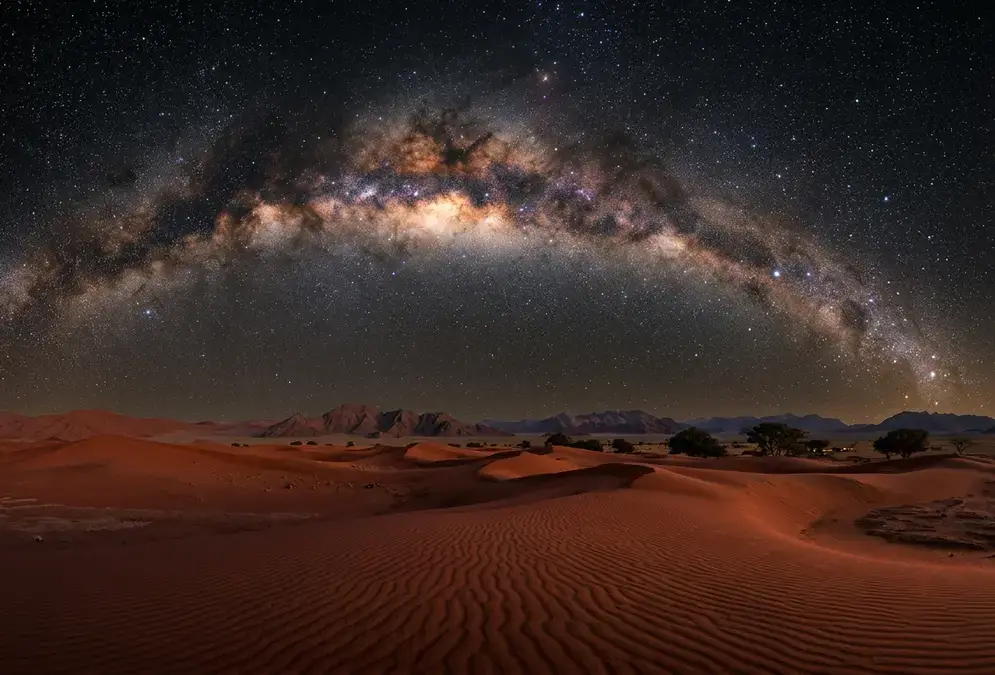
Under a moonless NamibRand sky the naked eye already sees thousands of individual stars and the full sweep of the Milky Way[14]. Binoculars add the layer on top: the Magellanic Clouds stop being two pale smudges and start showing their separate bodies, and a red-light headlamp keeps your night vision intact on the walk back from the viewing spot[13]. What you are really buying with a night pair is resolution at the faint end, and under Bortle 1 the sky has plenty of faint end to resolve.
The southern sky was a genuine learning curve on my own nights here, and a low-power pair is the fastest way through it. The constellations you grew up with sit somewhere else, upside down or absent, and scanning with an 8× wide field lets you build the new map in minutes instead of squinting at a star chart. That alone is a quiet argument for the wider pair.
For the night half on its own, the 10×50 is the astronomer's top pick: more magnification and more total light resolve fainter detail[15]. The catch is the brace. Hand-held at 10× you are at the ceiling[10], and under a Gold Tier sky the faintest targets will not hold still for you. Brace the barrels against a vehicle door, a deck railing, or a beanbag on any flat surface and the 10×50's extra reach becomes usable. Red-light discipline matters more than either pair: walk to your spot, let your eyes adapt for twenty minutes, and keep every light source on its dimmest red setting. A white phone screen at 9 p.m. costs you more sky than any binocular spec.
Packing, dust, and the one-pair verdict
Whatever you choose, treat dust as the real enemy of the trip. Fine Namib sand rides the wind into eyepieces and focus wheels, and it ends more observing sessions than the cold ever does. Pack a lens pen and a rocket blower, and clean optics only after blowing grit off, never by wiping. For the full kit rundown, the NamibRand stargazing gear guide covers camera bodies and lighting as well as optics.
The single-pair discipline is also what the experts recommend when one binocular must cover multiple activities: the 8×42 roof-prism model is the classic all-rounder, compact, easy to hold, and largely immune to image-shake[16]. If you already own a good 10×50, the counterpoint from experienced observers is fair: it gives a closer view while still being steady enough to hand-hold from a static spot[18]. It stops being fair the moment a game vehicle starts moving, which is most of your day at NamibRand.
The one caveat that outranks every magnification argument: the performance gap between 8× and 10× at the same optical quality is smaller than the gap between budget and mid-range glass[17]. Buy the best multi-coated optics you can afford and let the magnification follow. A cheap 10×50 will disappoint you under a Gold Tier sky more than a mid-range 8×42 ever will, and if the tripod route pulls you toward the wider kit, astrophotography gear for NamibRand is the crossover read.
Recommended tours
Tours are selected for quality, not commission. I earn a small fee if you book — at no extra cost to you.

Keep the rest of the carry short and dust-proof:
- A neck strap that survives a full day of driving without sawing at your neck
- A lens pen, a rocket blower, and a cloth reserved for smudges only
- A dry bag for the pair whenever it is not in use, since a lens cap alone will not keep Namib dust out
The verdict and how to buy for your actual trip
Buy the 8×42. It is the one pair that serves both halves of a NamibRand day without asking you to hold your breath at 10×, and it carries over to birding and general travel once you are home. If you already own a good 10×50, keep it, brace it, and accept the daytime compromise rather than buying a second pair for the trip. If you are buying one pair, the 8×42 is the answer, and the money you save on the second pair should go into better glass on the first.
Pair the purchase with the right window. Namibia's dry season, May through October, is the safer stargazing bet: reliably clear nights, daytime highs of 20-28°C, and nights dropping to 7°C out in the open desert[3]. It is also the best season for the daytime half, which is the whole point of the one-pair plan. Book inside the reserve rather than outside it, since the best stargazing lodges at NamibRand put your deck under the same Gold Tier sky you are buying glass for.
Featured · Article
Uluru Cultural Significance and Visitor Etiquette
Uluru is Anangu land under joint management. Here's why the 2019 climb closure is settled policy, what you can't photograph, and real visitor etiquette.
And if the trip is still in the planning stage, the NamibRand stargazing FAQ answers the practical questions this guide skips, from moon phase to what the reserve expects of you. The binocular decision is settled: one good 8×42, bought well, beats two compromised pairs.