Why Erg Chebbi Needs Dedicated Camera Gear
Point a phone at the Milky Way from a dune crest above Merzouga and you'll get a smear of gray noise, if the sensor picks up anything at all. A dedicated camera does what a phone cannot: hold a long exposure open at a wide aperture long enough to pull real structure out of a galactic core the naked eye only sees as a hazy band. Erg Chebbi earns that kind of shot. No official body has measured or certified this stretch of Sahara for darkness, and this guide won't invent a Bortle rating or a dark-sky designation Merzouga doesn't hold. What it does have is genuine remoteness: hundreds of kilometers separate the dunes from any city bright enough to blur the horizon, and the flat hamada between them and the nearest town holds almost nothing that runs on electricity after dark.
That combination, a sky this dark and a landscape built from rippled sand and dune ridgelines rather than boulders or trees, is why gear suited to this specific ground can outperform the same camera pointed at a flat, featureless desert floor. A dune crest silhouetted against the core, or a rippled slope catching the day's last color before full dark, gives a frame something to hold onto besides stars; a flat horizon usually doesn't.
What follows works through camera and lens choice, the tripod and dune-crest framing decisions that turn Erg Chebbi's sand into a real foreground rather than a dark smudge at the bottom of the frame, the manual settings and optional star tracker that separate a sharp Milky Way shot from noise, and the sand, dust, and heat protection a long night out here actually demands. For the wider trip-planning picture beyond gear, the Merzouga stargazing hub covers when to go and where to camp. Traveling without a dedicated camera? Smartphone astrophotography in Merzouga covers what a recent phone can still capture out here.
Camera and Lens: Aperture, ISO, and Shutter for the Milky Way
Aperture is the one spec worth spending real money on. For untracked wide-field shots at Erg Chebbi, the standard approach is a lens near wide open, roughly f/2.8 or wider, paired with an ISO in the 3200 to 6400 range, and a shutter speed of 10 to 25 seconds, adjusted for focal length and how tightly your sensor packs its pixels[1]. A kit lens that tops out at f/4 or f/5.6 will still record the core on a clear, new-moon night here, just with more visible grain and less shadow detail in the dune ripples below it.
None of that matters without something worth pointing the lens at. A strong foreground subject turns a plain star field into an actual composition, and Erg Chebbi hands you two for free: the sharp line where one dune's crest cuts against the sky, and the rippled sand patterns wind carves into the slope below it. Dune shadows fall long and hard-edged even under starlight alone, once your eyes adjust, which is exactly the kind of graphic foreground a flat urban-fringe desert rarely offers.
f/2.8-f/4
Tripod Stability on Sand and Dune-Crest Composition
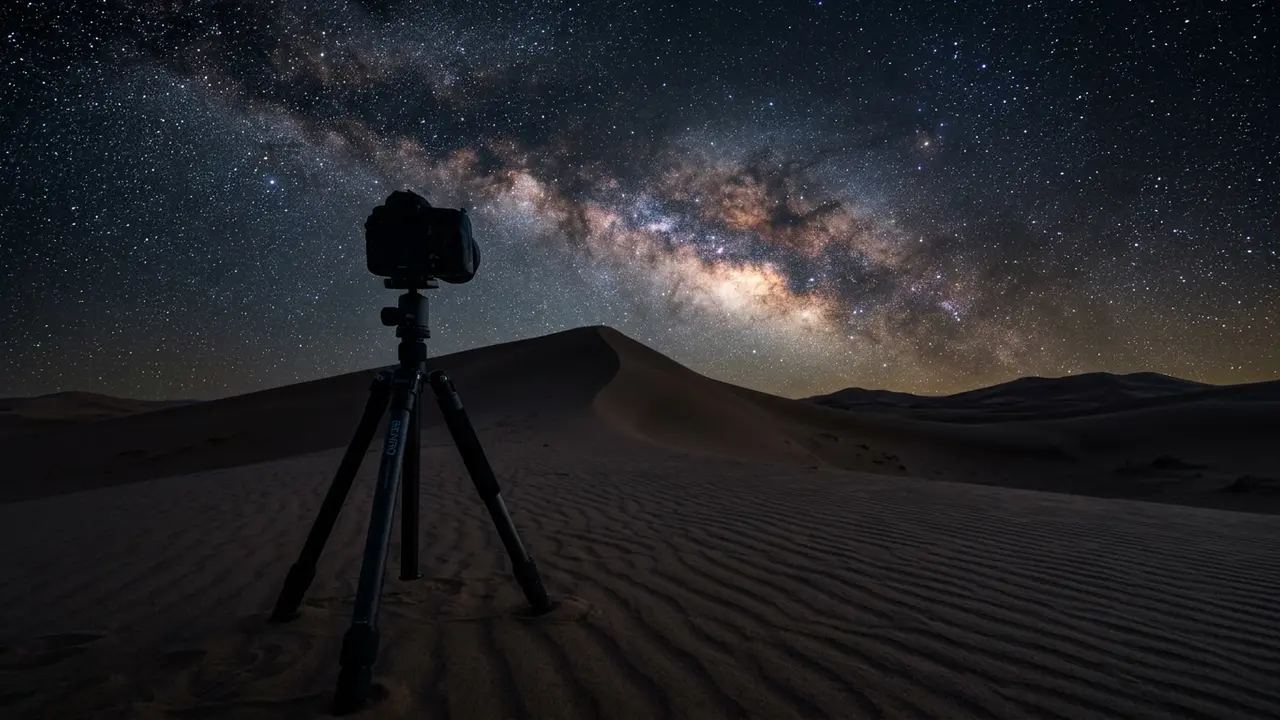
A tripod is not optional anywhere on Erg Chebbi's open sand. A long exposure held for ten, twenty, or thirty seconds turns the smallest wobble, a gust off the dune crest, a boot shifting on loose sand, into a smear across every star in the frame[2].
Sand changes the job a tripod has to do compared to a firmer desert floor. Legs sink unevenly on a soft dune face, footing shifts underfoot in a way a rock trail never does, and wind runs stronger and more exposed along a dune crest than it does lower down in a wadi or a flat stretch of hamada. Lock every leg joint fully before starting a real sequence, and keep twist or flip locks clear of where sand can work its way in and jam them. Some photographers drive a stake into the sand near the base and tie it to the center column for extra wind stability; there's no single agreed angle or amount of ballast that reliably works across every dune's sand, so treat it as a trick worth trying on a gusty night rather than a guaranteed fix.
Scout the dune crest for composition before dark. Climbing a loaded dune at night, camera bag on your back, is harder footing than a rock trail, and a ridge that looks flat and obvious to the eye in daylight reads completely differently once the light has gone. A wide-angle lens in roughly the 12mm to 24mm range holds both a meaningful stretch of the Milky Way and enough of the dune below it to matter[3], wide enough to capture the ridgeline without bending it into a fisheye curve.
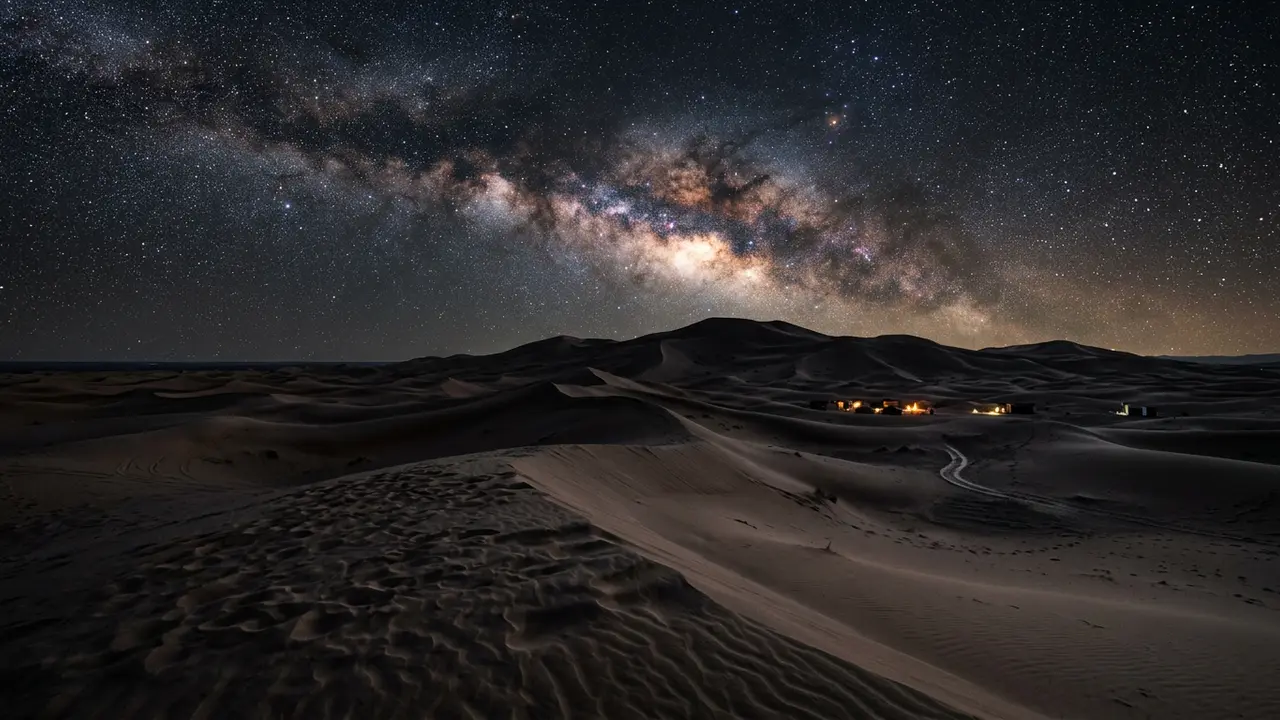
Featured · Destination
Merzouga Stargazing
Erg Chebbi's dunes rise 150m above Morocco's Sahara, hours from city light. Stargaze from Berber-led desert camps: when to go, where to stay, how to get there.
None of this needs to be complicated. A single dune crest cutting a hard diagonal across the frame, or a rippled slope catching the last color of dusk before the core rises, does more work than a wide shot of stars with nothing below them to anchor the eye. Best stargazing spots in Merzouga covers which of the village's four viewpoints give a clean sightline to the core without another camp's lights bleeding into the shot.
Manual Settings and the Optional Star Tracker
Once aperture and focal length are set, the rest of the dial falls into place fairly quickly. Start within the ISO 3200 to 6400 range covered above, near wide-open aperture, and a shutter speed of 10 to 25 seconds, then adjust depending on how bright the sky actually looks on the rear screen.
Two habits matter more than any single number on the dial. Shoot RAW, not JPEG, so the shadow and color detail in the dune ripples survives editing afterward; a compressed file throws that detail away before you're back at camp. And switch to manual focus locked at true infinity before the first frame. Autofocus hunts uselessly in near-total darkness on an unlit dune, and a lens's marked infinity point is rarely exact, so zoom in on a bright star on the rear screen and turn the focus ring by hand until it collapses to a sharp point rather than a soft blob.
An intervalometer, or a camera's built-in interval-shooting mode, gives precise control over when the camera fires, how often, and how much gap to leave between exposures, going well beyond what a simple remote shutter release can do[4]. It matters more than its size suggests once you're shooting a stack of frames to blend or reduce noise later, and it's one less thing to fumble for by headlamp light with sand already working into your pockets.
A star tracker is the one piece of gear on this list that's genuinely optional. A basic tracker follows the sky's rotation and lets a camera hold a much longer exposure than any tripod alone can manage before stars start trailing, which means a lower ISO and a cleaner final file. It adds setup time, a polar-alignment step, and one more delicate part to carry across sand that gets into everything, so it's worth adding on a second or third desert trip rather than a first one. The trade-off in plain terms:
| Setup | Typical exposure limit | Trade-off |
|---|---|---|
| Untracked (tripod only) | 10-25 seconds before trailing | Simple, no extra precision parts exposed to sand, more frames to stack for lower noise |
| Basic star tracker | Several minutes per frame | Sharper core detail and lower ISO, but adds polar alignment and one more delicate part sand can work into |
Sand and Dust Protection: Lens Changes, Filters, and Cleaning
This is where a night at Erg Chebbi asks something a cold, dry desert never quite does. Fine, wind-blown sand gets into gear here in a way that dew and cold simply don't, and the fix starts with changing lenses as rarely as possible. When a swap is unavoidable, get out of the wind first: behind a dune's lee slope, inside a parked vehicle, or under a camp tent, rather than swapping glass in the open on an exposed ridge. A camel trek deep into the dunes (see the Merzouga camel trek into Erg Chebbi) kicks up exactly this kind of fine sand around gear that never sees pavement, one more reason this routine matters more here than almost anywhere else on this site's roster.
A UV or clear protective filter screwed onto the front of every lens earns its keep out here. Filters are far cheaper to replace than the lens glass itself if a gust drives grit hard enough to scratch the front element[5]. A rain sleeve or a simple dry bag wrapped around the camera body and lens barrel, cinched loosely enough to still reach the controls, does most of the rest of the work: one of the cheapest ways to keep a body's dial seams and a lens barrel from filling with fine dust during a long session on an open dune.
Cleaning matters as much as prevention. After any session, work a squeeze-type blower over the body and lens first to knock loose whatever's sitting on the surface, then follow with a soft brush for the fine residue a blower alone won't shift. Skip the compressed-air can some photographers reach for out of habit: a hard blast can drive fine sand deeper into a seam or focus ring rather than out of it. Between sessions, keep gear zipped into a sealed bag or case rather than left assembled on a camp table overnight, where blowing sand settles into every gap it can find while you sleep.
Tripod joints take the same abuse as glass. Extend the thickest, lowest-friction leg sections first and keep twist or flip locks above the sand line rather than letting them sink into it, since a lock buried in sand jams before it wears out. A blower-and-brush pass on the tripod's leg joints belongs in the same after-session routine as the camera body itself.
Desert Heat, Battery Care, and Planning a Night Shoot
Heat, not cold, is Erg Chebbi's electronics problem. Daytime temperatures out here climb hard even in the cooler travel season, and a battery or camera body baked in a vehicle's trunk or left in direct sun during the day performs differently once you ask it to hold a charge through a long night session. Keep spare batteries in a shaded bag or an inner pocket during daylight hours, not in a hot vehicle or a bag left sitting on sand in full sun, and let a body that's spent the day in the heat cool to ambient temperature before starting a long exposure sequence rather than shooting the moment you set up.
Carry two or three spares regardless, and swap the active battery out once it's noticeably depleted rather than running it flat, the same discipline that matters in a cold climate for the opposite reason. A camera that's spent all day inside a hot tent or vehicle also benefits from a few minutes acclimating in open air before you start shooting, since a sudden swing between a hot interior and a cooler dune-crest night can fog a lens element on the way out, not just a cold one warming back up.
Gear alone doesn't guarantee a shot. Best time to stargaze in Merzouga covers the seasonal detail, but the short version matters here: aim for a new moon window for the darkest possible sky, and check the Merzouga stargazing forecast for cloud cover and wind before committing a whole evening to a dune-crest climb. Erg Chebbi's skies run dark most nights of the year; timing decides how much of that darkness you actually get to shoot.
Featured · Article
Stargazing Gear for Beginners: Binoculars to Telescopes
New to stargazing gear? This guide breaks down binoculars, telescopes, and smart telescopes, so you know what to buy first and what to skip for right now.
Recommended tours
Tours are selected for quality, not commission. I earn a small fee if you book — at no extra cost to you.
A basic kit checklist covers most of what a first Erg Chebbi night shoot needs:
- A mirrorless or DSLR body with manual mode, set to shoot RAW
- A fast wide-angle lens, roughly f/2.8 or wider, in the 12-24mm range
- A sturdy tripod with sand-tolerant locks, kept out of the sand between uses
- An intervalometer or built-in interval timer for longer sequences
- A UV or protective filter on every lens, plus a rain sleeve or dry bag
- A squeeze blower and soft brush for after-session cleaning
- Two or three spare batteries, kept shaded and cool during the day
If you're building a kit from nothing rather than adapting one you already own, stargazing gear for beginners covers the tiers below a dedicated camera, worth knowing before deciding a full astrophotography setup is what a Merzouga trip actually needs. For everything else that belongs in the bag beyond the camera itself, see the Merzouga stargazing packing list.