
The nearest big light source is 465km away
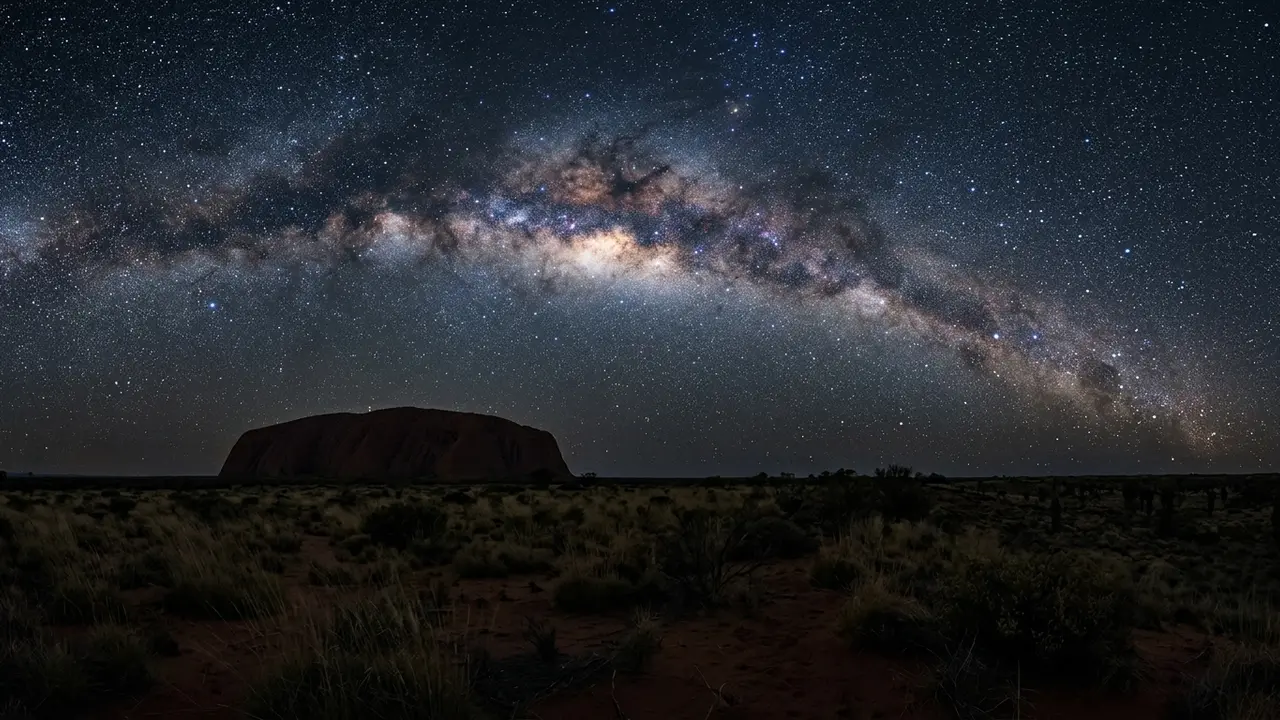
Uluru sits about as far from a city-sized light source as a stargazer could reasonably ask for. By road, Alice Springs, the nearest town of any real size, is 465km away[1], a 5.5-hour drive across open desert with little between the two but red sand and spinifex. That distance matters more for stargazing than any single number about the sky itself. It's the reason no city-scale light dome washes out the horizon here, the kind of orange glow that sits over most capital cities and erases everything below third magnitude before you've even set up a tripod.
The Red Centre's dry climate does the rest of the work. This is a desert in the true sense: low humidity and cloud cover that stays minimal through most of the year, both of which help the sky stay transparent rather than hazy. None of that makes the trip itself easy. Reaching somewhere this remote takes real planning, and getting to Uluru covers exactly what that involves.
465km
What actually keeps the sky this dark comes down to a short list:
- 465km of open desert between the park and Alice Springs, the nearest sizeable town[1]
- A dry, low-humidity climate that keeps atmospheric haze and cloud cover down most of the year
- A small, contained resort footprint at Yulara rather than a sprawling regional city
A 1985 handback put Anangu in charge of what gets built here
On 26 October 1985, Australia's Governor-General returned the title deeds for Uluru-Kata Tjuta National Park to its Anangu Traditional Owners[2], a formal legal return of land Anangu had been pushing for over years, not a symbolic gesture. In the same ceremony, Anangu leased the land back to what is now Parks Australia for 99 years[3], creating the joint-management arrangement that still runs the park today.
That structure matters for a stargazer's specific concern: light. The park answers to a 12-member Board of Management with an Anangu majority, eight Aboriginal members nominated by Traditional Owners alongside government-nominated members and the Director of National Parks[4]. Decisions about what gets built, lit, or expanded near the rock go through a board where Anangu hold the numbers, not a resort developer chasing occupancy rates. Plenty of dark-sky destinations keep their darkness despite the tourism industry around them. Uluru's comes, in part, from who actually makes the calls.
Featured · Destination
Uluru
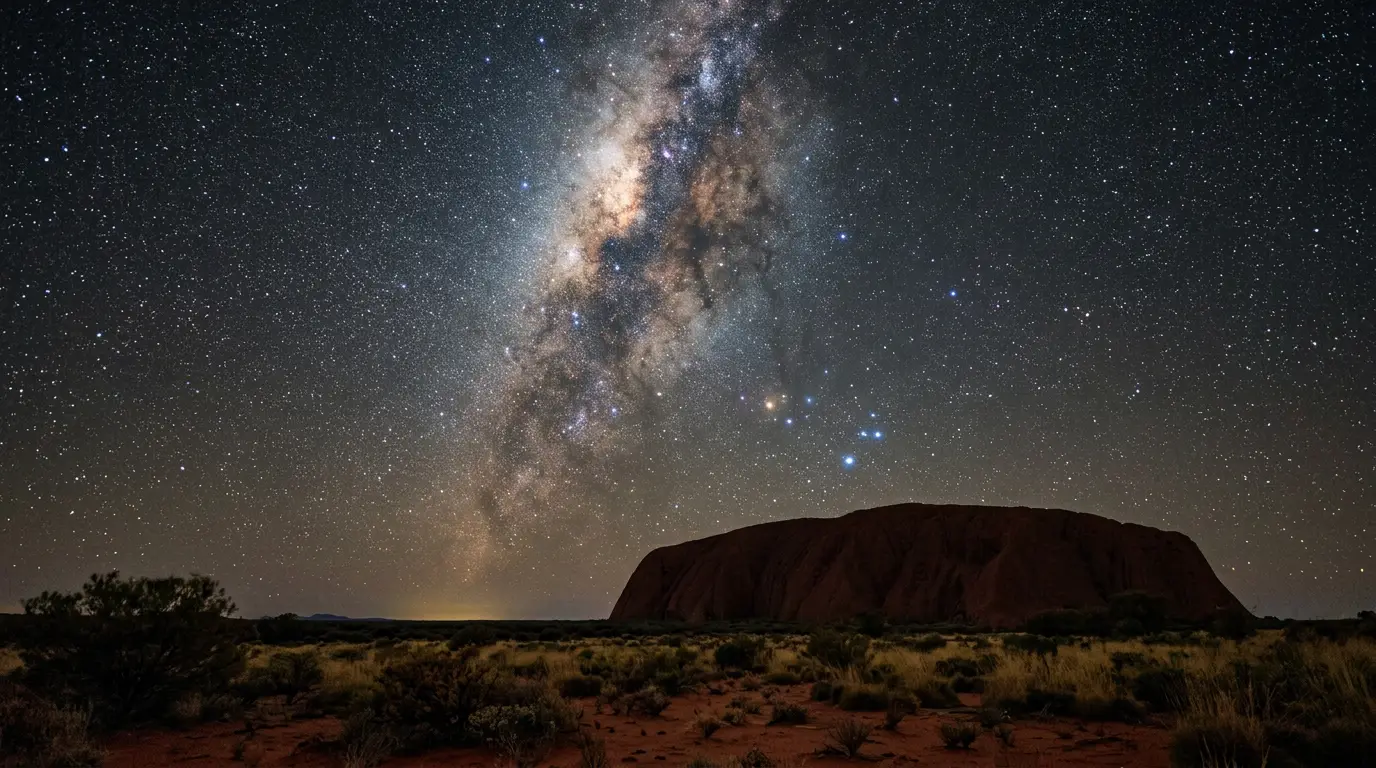
Stargaze at Uluru on Anangu-owned, jointly managed land: the Milky Way's core, Magellanic Clouds and Southern Cross over Australia's red-centre outback.
The park's dual UNESCO World Heritage listing tells the same story from another angle: added in 1987 for its natural values, then relisted in 1994 specifically as a living cultural landscape[5], one of a small number of sites recognized for both. Joint management is the reason that second listing means anything at all.
Tjukurpa: sky knowledge as law, not folklore
Anangu law and culture is called Tjukurpa, and it is worth being precise about what that word covers, since it comes up in nearly every serious account of why this landscape works the way it does. The National Portrait Gallery describes Tjukurpa as 'a conceptual atlas and astronomical chart, a glossary, cookery book, medicine chest, code of ethics, body of law, hunting manual, and the basis of ceremonies'[6]. Astronomical knowledge sits inside the same body of law that governs land, family, and ceremony. It is not set apart as a separate 'sky story' for visitors.
That distinction changes how a visitor should think about it. Tjukurpa isn't folklore layered on top of the landscape for tourists. Anangu describe it as an entire cosmology, 'a body of knowledge, not belief'[7]. Treat it with the seriousness you would give any specialist body of knowledge, because that is how it is meant to be read.
This article won't try to reconstruct specific Anangu star lore. That knowledge belongs to Anangu to share on their own terms, and much of what circulates online about 'ancient Aboriginal astronomy' at Uluru blurs distinct traditions together in ways no credible institutional source backs up. What's verifiable is simpler, and arguably more useful: the same governance structure that keeps development minimal here also treats sky knowledge as part of a living legal and cultural system, not a museum exhibit.
Tjukurpa isn't folklore layered on top of the landscape for tourists.
No certification, and what the Bortle reading near Yulara actually shows
Search for 'Uluru Dark Sky Reserve' and plenty of travel blogs will imply one exists. It doesn't. DarkSky International's list of certified places doesn't include Uluru-Kata Tjuta National Park: no Dark Sky Park, Reserve, or Sanctuary designation here, unlike Arkaroola Wilderness Sanctuary in South Australia, which holds that state's first Sanctuary status. That isn't a mark against Uluru's sky. It just means every claim about its darkness rests on remoteness and management, not a badge, and it's worth saying plainly rather than letting the assumption slide.
Recommended tours
Tours are selected for quality, not commission. I earn a small fee if you book — at no extra cost to you.
The actual sky-quality picture near Uluru is more textured than 'pristine desert dark' anyway. One astrophotographer who checked a light-pollution map before visiting expected a Bortle 4 reading and got exactly that[8], surprising for somewhere this remote until you look at where the reading came from. The same visitor pinned the cause specifically on Yulara's own hotel lighting: 'the localized light pollution at the resort was awful. All the hotels had outward-facing lighting that was way brighter than necessary'[9]. That is a resort problem, not a desert problem. Walk even a short distance from the hotel strip toward the licensed stargazing sites and the sky improves fast.
Bortle 4
The honest version of Uluru's dark-sky pitch, then, isn't 'certified dark sky destination.' It's a genuinely remote desert sky, undercut right at the resort by lighting nobody has fixed yet, and excellent everywhere you walk away from it. If you're weighing Uluru against somewhere that does hold formal certification, Uluru vs Aoraki Mackenzie stargazing covers exactly what a designation adds and what it doesn't.
The 2019 climb closure and stargazing done right
Uluru's climb closed permanently on 26 October 2019[10], chosen deliberately as the 34th anniversary of the 1985 handback. Climbing had never sat comfortably with Tjukurpa in the first place. Traditional Owners had asked visitors not to climb since the 1990s, well before the formal closure, because 'climbing Uluru was not generally permitted under Tjukurpa'[11]. The rock is a sacred site, and the closure formally settled a question that had been open, informally, for decades.
None of that changes what a stargazer actually does after dark here. Nobody climbs the rock at night, on a stargazing tour or otherwise. What it does change is the frame you bring to the whole visit, including the hours after sunset. A licensed night tour, a quiet viewing platform, and the etiquette that goes with either one deserve more detail than fits here. visiting Uluru respectfully, and what its cultural significance actually means covers all of it, and it's worth reading before you book, not after.
Planning a trip around why Uluru's sky is dark
Put the two mechanisms together and Uluru's dark sky stops being a mystery. 465km of genuinely empty desert[1] separates the park from the nearest sizeable town, and a governance structure keeps Anangu Traditional Owners in the room for every decision about what gets built or lit near the rock[4]. Neither one is a certification. Both are harder to fake than a plaque at a park entrance.
What that means for planning a trip:
- The sky itself needs no forgiveness. It's the resort lighting at Yulara that varies, so build in time to get away from the hotel strip
- Timing still matters more than the destination's reputation; best time to stargaze at Uluru covers moon phase and season
- Named viewing spots inside the park differ in how exposed they are to that resort glow, covered in best stargazing spots at Uluru
- The practical basics, getting there, staying nearby, and booking a licensed night tour, start at Uluru stargazing
Featured · Article
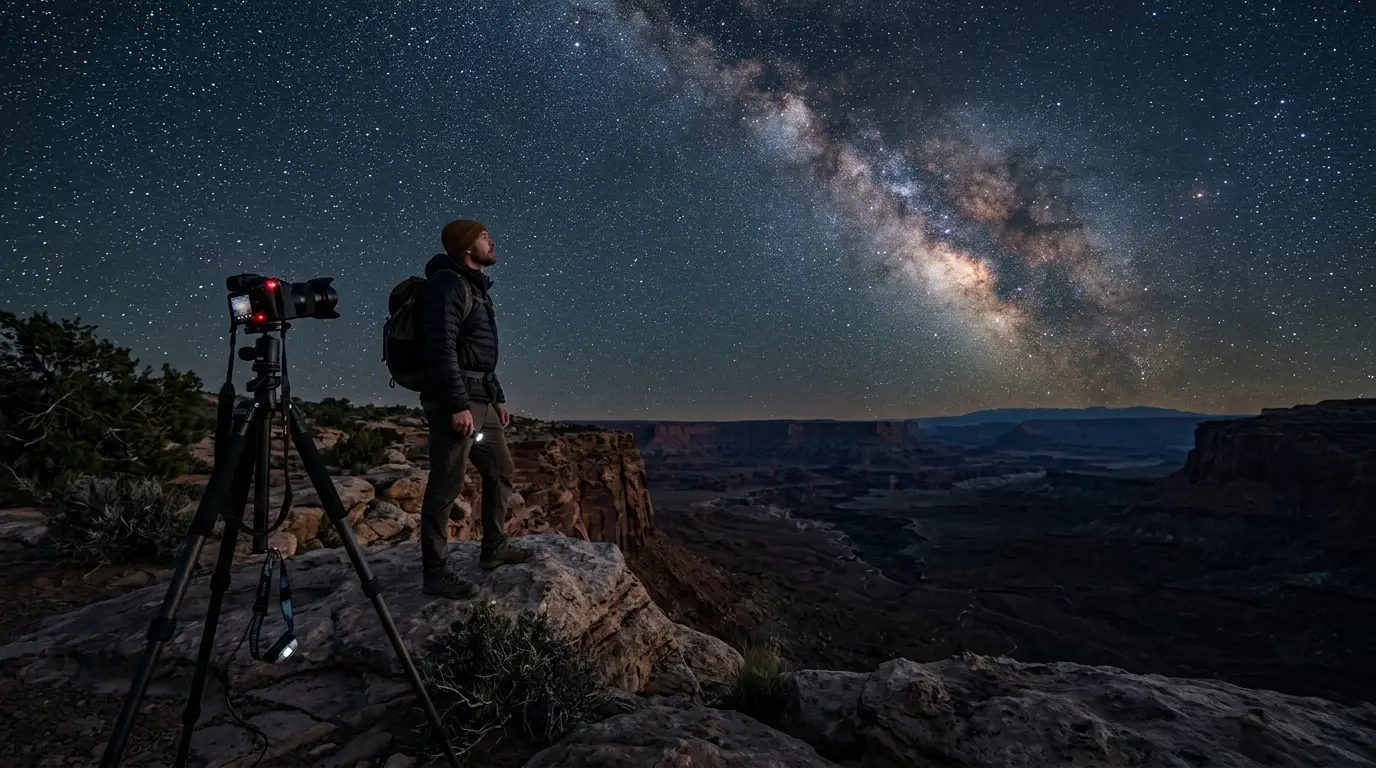
What Is Astrotourism? The Complete Beginner's Guide
Astrotourism means travel built around dark skies: meteor showers, auroras, the Milky Way. What it means, where to go, and how to plan your first trip.
Come for the remoteness and the governance, not a certificate that doesn't exist. The sky earns its reputation on its own terms.