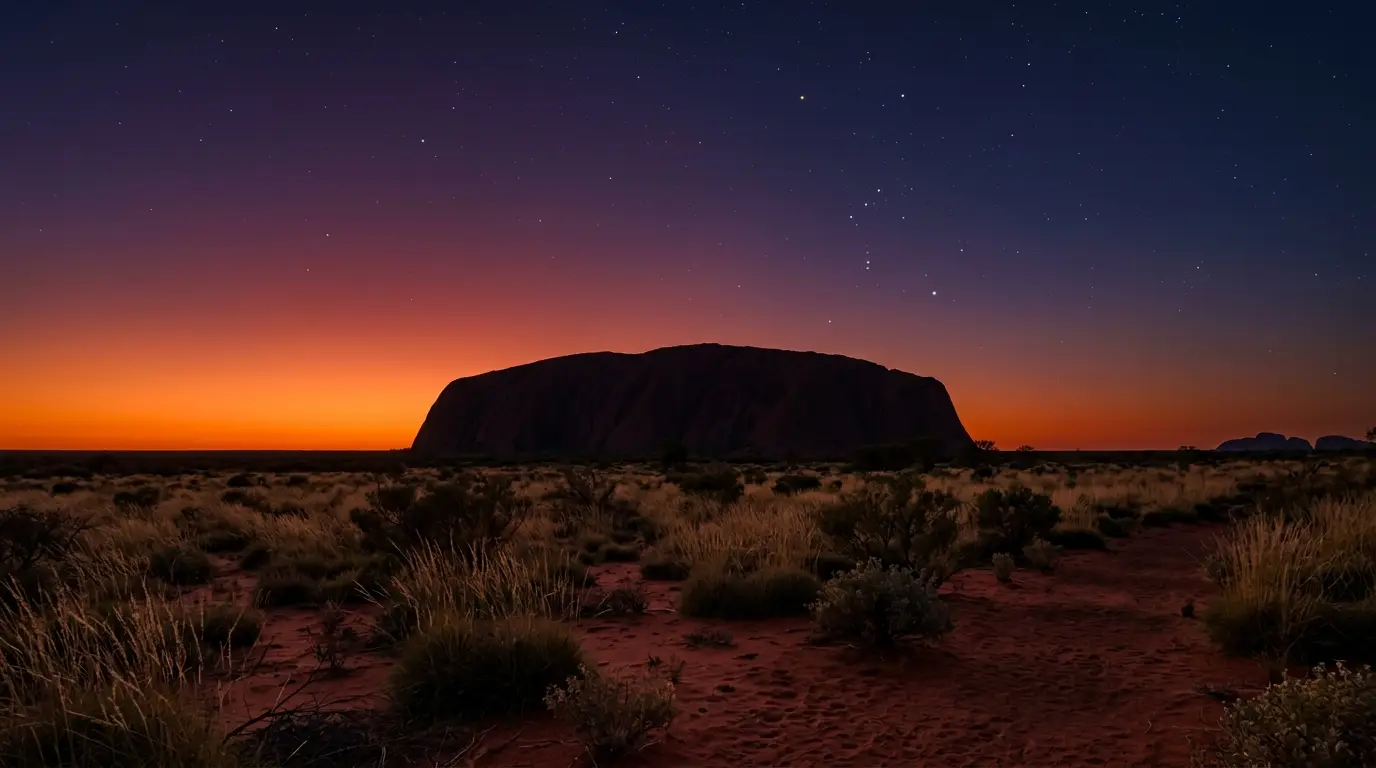

Uluru's viewing areas were built for sunset, not for stargazing
Search "best stargazing spots at Uluru" and the same five names turn up everywhere: Talinguṟu Nyakunytjaku, the Uluru car and bus sunset viewing areas, and the Kata Tjuṯa dune and sunset viewing areas, all part of Uluru-Kata Tjuta National Park. All five are real, official, and worth building an evening around. Parks Australia positions each one so the sun's rays hit the rock formations directly at sunrise or sunset, making the surface change colour[1], and that's the entire design brief, with nothing to do with what happens once the sky goes properly dark.
Here's the catch most lists skip: Uluru-Kata Tjuta National Park closes at night, and every visitor has to be out of the gate by closing time[2]. There's no lingering at Talinguru Nyakunytjaku until the galactic core climbs overhead, and no staying put at the Kata Tjuta dune platform to watch the Magellanic Clouds come out. Gate times shift through the year, earlier in the cooler months and later during the Southern Hemisphere summer, with Parks Australia setting the schedule month by month rather than running one fixed closing time all year. Anyone planning a trip around the night sky needs to build the calendar around that schedule, not just the season.
So what these five named areas actually give you is the dusk window: the stretch after sunset and before the sky is fully dark, when the brightest stars start to punch through before you have to leave. Getting past that window for something closer to real stargazing means one of two things, and this guide covers what each viewing area is good for before it gets to both.
5
Talinguṟu Nyakunytjaku: the pick of the five for an evening sky
Talinguṟu Nyakunytjaku is the park's main sunrise viewing area, a run of shaded shelters and viewing platforms along a wheelchair-accessible walking track, with sightlines that take in both Uluru and Kata Tjuta from the same spot, a rare double for a single viewpoint anywhere in the park.
Most visitors treat it strictly as a sunrise stop, and the crowds back that up: this is where the tour buses gather before dawn, headlamps and camera flashes scattered across the platforms in the dark. Come back at sunset instead and the equation flips. Day-trippers are already heading to the Uluru sunset areas or back to Yulara for dinner, so the platforms empty out just as the sky starts to hold its colour and the desert air cools enough to need a jacket.
Featured · Destination
Uluru
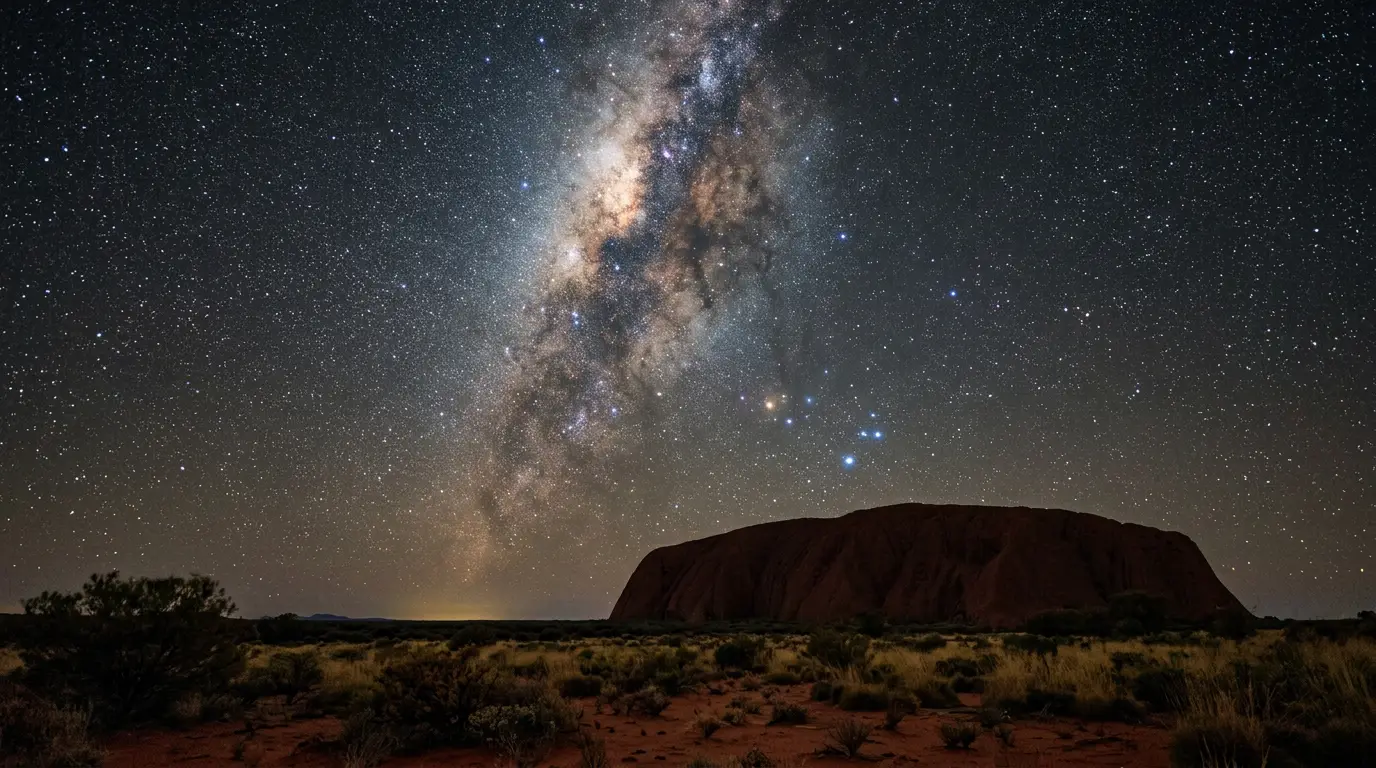
Stargaze at Uluru on Anangu-owned, jointly managed land: the Milky Way's core, Magellanic Clouds and Southern Cross over Australia's red-centre outback.
- Multiple platforms along an accessible walking track, so a wheelchair or a stroller isn't a barrier here the way it is at some outback lookouts
- Views of both Uluru and Kata Tjuta from the same vantage point
- Quietest right around sunset, once the sunrise crowd has already left for the day
The Uluru sunset viewing areas: one for cars, one for coaches
Uluru's dedicated sunset viewing spot isn't one area, it's two: a car park for private vehicles and a separate coach park across the road for tour buses. Splitting the two keeps a line of buses from blocking the view for everyone who drove themselves, and it's a small piece of crowd management that actually works. Arrive early enough and either side gives an unobstructed, straight-on view of the rock as the light goes from gold to red to grey.
The car-park side is centered on the viewing platform itself, with no dedicated dune walk of its own. The dune walk belongs to the coach side instead: a 500-metre, 30-minute return stroll from the bus sunset viewing area that puts real distance between you and the crowd, though it's explicitly not wheelchair accessible[7]. It's the better option if the bus-side viewing area feels packed and you'd rather watch the sky darken without someone else's phone flash in the frame.
Once the colour show ends and the crowd starts filtering back to their cars, the same dusk window applies here as everywhere else in the park: a few minutes of darkening sky before gates close, not a stargazing session. If a proper night sky under the rock is the actual goal, this is the moment to start thinking about booking a guided telescope session, the one operator that keeps going once everyone else has to leave.
Kata Tjuṯa's dune and sunset viewing areas: quieter, and worth the drive
Kata Tjuṯa sits about 45 minutes' drive from Yulara[8], and that extra distance does real work: it thins the crowd noticeably compared to Uluru's own viewing areas. The Kata Tjuṯa dune viewing area offers a short walk to the platforms and a panoramic angle that puts Kata Tjuta's domes in the foreground with Uluru visible on the horizon behind them, a combination no single Uluru-side viewpoint can match. A separate Kata Tjuṯa sunset viewing area covers the same golden-hour window from a slightly different angle nearby, and either one rewards the extra drive time with noticeably fewer people around you.
What stands out here isn't a feature on a map, it's the quiet. Fewer tour groups make the trip out compared to the crowds funnelling into the Uluru areas at the same hour, so a sunset visit here tends to feel like a smaller, more private version of the same experience, right down to the sound of wind through the spinifex once the last car doors close. Bring a torch for the walk back to the car park; there's no ambient light out here once the colour fades, and that absence of light is exactly why the drive out pays off once the sky starts to darken.
Recommended tours
Tours are selected for quality, not commission. I earn a small fee if you book — at no extra cost to you.
How the five official areas stack up against each other for an evening visit:
| Viewing area | Best for | Distance / access | Crowd level |
|---|---|---|---|
| Talinguṟu Nyakunytjaku | Sunrise, or sunset once the crowd clears | Wheelchair-accessible platforms near Yulara | Busy at sunrise, quiet at sunset |
| Uluru car sunset area | Sunset views for private vehicles | Viewing platform, no dedicated walk | Busy |
| Uluru bus sunset area | Sunset views for tour groups | Across the road from the car area; 500m dune walk (not wheelchair accessible) | Very busy |
| Kata Tjuṯa dune viewing area | Panoramic views of both rock formations | About 45 minutes from Yulara | Quiet |
| Kata Tjuṯa sunset viewing area | Sunset colour on Kata Tjuta | Near the dune viewing area, wheelchair-accessible | Quiet |
What you can and can't point a camera at
None of the five sunrise/sunset viewing areas shows up on Parks Australia's list of no-photography sacred sites. That's worth stating carefully: it's an absence of restriction, not a blanket clearance. The specific places where a camera is off-limits sit elsewhere on Uluru and Kata Tjuta, marked on signage and on the visitor maps handed out at the Cultural Centre, and taking photos of those places is prohibited outright because it's considered inappropriate for images of sensitive sites to circulate outside the community[3].
One stretch of rock carries a specific, milder request rather than an outright ban. Along Uluru's north-east face, between Kantju Gorge and Kuniya Piti, Anangu ask photographers to take only wide shots from a distance and avoid framing detail on the top-left side of the rock[4]. None of the five named viewing areas sit directly on that face, so it's not something you'll run into by accident at Talinguru Nyakunytjaku or the Kata Tjuta platforms, but it matters if your evening plan includes walking closer to the rock itself before or after the viewing-area stop.
Featured · Article
What Is Astrotourism? The Complete Beginner's Guide
Astrotourism means travel built around dark skies: meteor showers, auroras, the Milky Way. What it means, where to go, and how to plan your first trip.
A night shoot doesn't change any of this, and if anything makes it more relevant. A long exposure captures more detail than a daylight snapshot, so the marked restrictions matter just as much after dark as they do at noon. If you're genuinely unsure whether a spot is fair game, the Cultural Centre keeps the sensitive-sites map on hand during its own opening hours, and checking there before you set up a tripod costs a few minutes against a much bigger mistake.
Getting an actual night sky: the dusk window, one licensed tour, and Field of Light
Once you've worked through what each viewing area offers at dusk, the real question is where the night goes from there. There are three honest answers, and only one of them gets you back inside the park after the gates close. For the full season-by-season breakdown of when that dusk window is darkest and driest, best time to see stars at Uluru covers more ground than this guide needs to.
The first answer is the one you already have: stand at Talinguru Nyakunytjaku, the Kata Tjuta dune platform, or either Uluru sunset area and take the dusk window for what it is, a genuinely good, free look at the first stars over the rock before the gates shut. The second and third answers both cost money and both need booking ahead, and they solve two different problems. One puts you back inside the park after dark with a telescope pointed at something specific. The other gives you a lit-up desert to walk through, with the night sky as a backdrop rather than the point of the evening. Treat the choice as a matter of what you actually want from the night, not which one sounds more impressive on a trip itinerary.
Read next · Tour
Uluru Astro Tours
Uluru Astro Tours is the only operator licensed for night astronomy access inside Uluru-Kata Tjuta National Park. What's included, price, and how to book.
Booking the one licensed night tour
Uluru Astro Tours holds the sole license Parks Australia issues for guided night access inside the park[5]. Session timing varies by source — the resort booking page lists a start around two hours after sunset with a roughly three-hour total including the transfer from Ayers Rock Resort, while the operator's own site quotes a start closer to one hour after sunset; check the current schedule when booking[6]. Either way, expect naked-eye orientation mixed with real telescope time on planets and deep-sky objects. It's the only way to trade the dusk window's few darkening minutes for an actual multi-hour night sky from inside the park boundary, so book ahead rather than assuming a same-day slot during the May-September peak season.
Where Field of Light and Sounds of Silence fit in
Field of Light at Uluru and the resort's Sounds of Silence dinner both market themselves as after-dark Uluru experiences, and both are worth doing on their own terms, but neither is one of the five named viewing areas or a substitute for a dedicated night-sky tour. Field of Light is a walk through Bruce Munro's illuminated desert installation that happens to look better once full dark sets in behind it; the sky above is a bonus, not the program, and the installation's own lighting works against any serious stargazing nearby. Treat it as a different kind of evening entirely. If a proper look at the Milky Way is the actual goal, pair Field of Light with an Uluru Astro Tours booking on a separate night rather than expecting either one to cover both jobs.