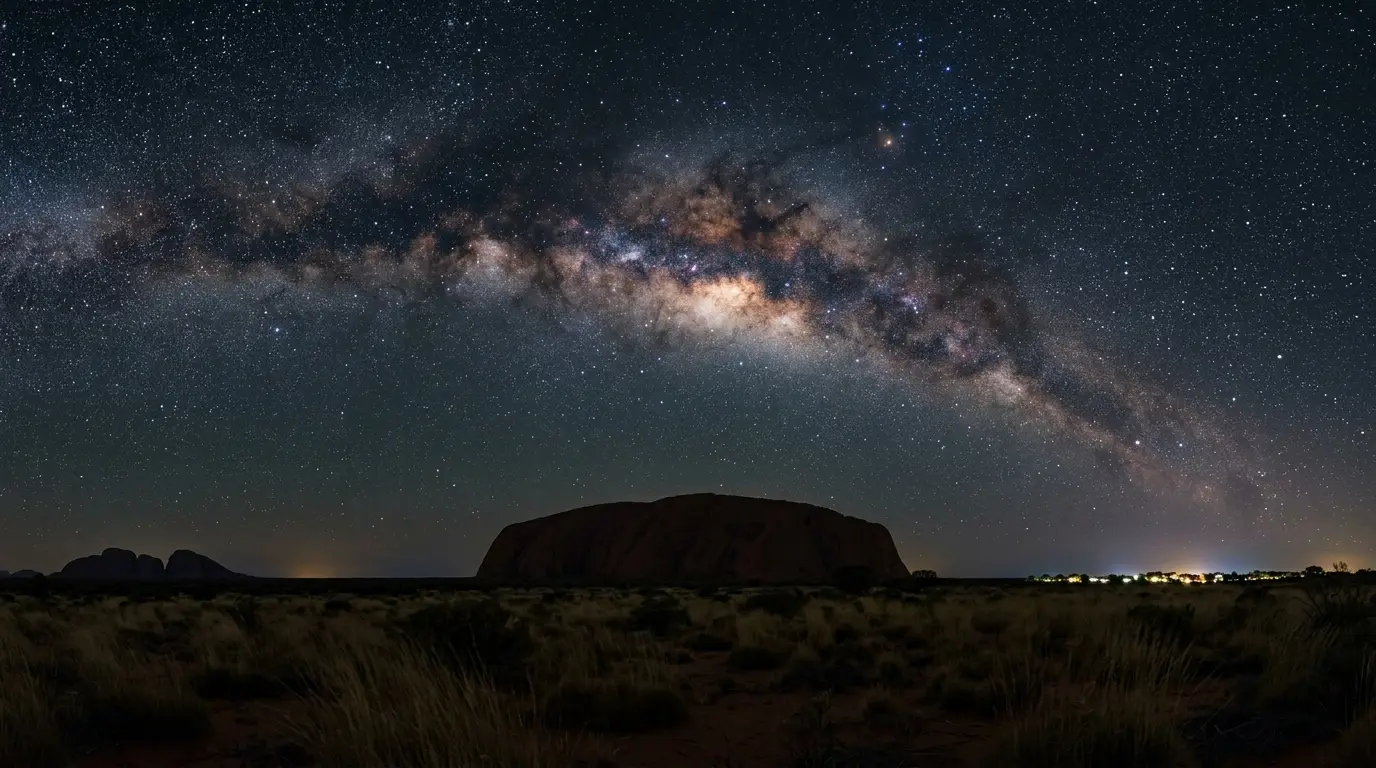

When to go: season, moon phase, and the forecast check that matters
Winter, June through August, is the answer most sources converge on, and for a specific reason beyond comfort: it's generally the coolest and driest stretch of the year in Central Australia, and that same stretch is when the Milky Way's galactic core rides highest overhead after dark. Cooler air also means less atmospheric shimmer, so telescope views hold steadier than they do on a humid summer night.
That doesn't make winter the only workable month. The park's night sky doesn't switch off in December; it just competes with hotter, more humid air and a lower galactic core. What actually moves the needle regardless of season is the moon phase — a bright moon within a few days of full washes out the fainter stretches of the Milky Way no matter how dry the air is, so check a lunar calendar for your actual travel dates before locking anything in.
Featured · Destination
Uluru
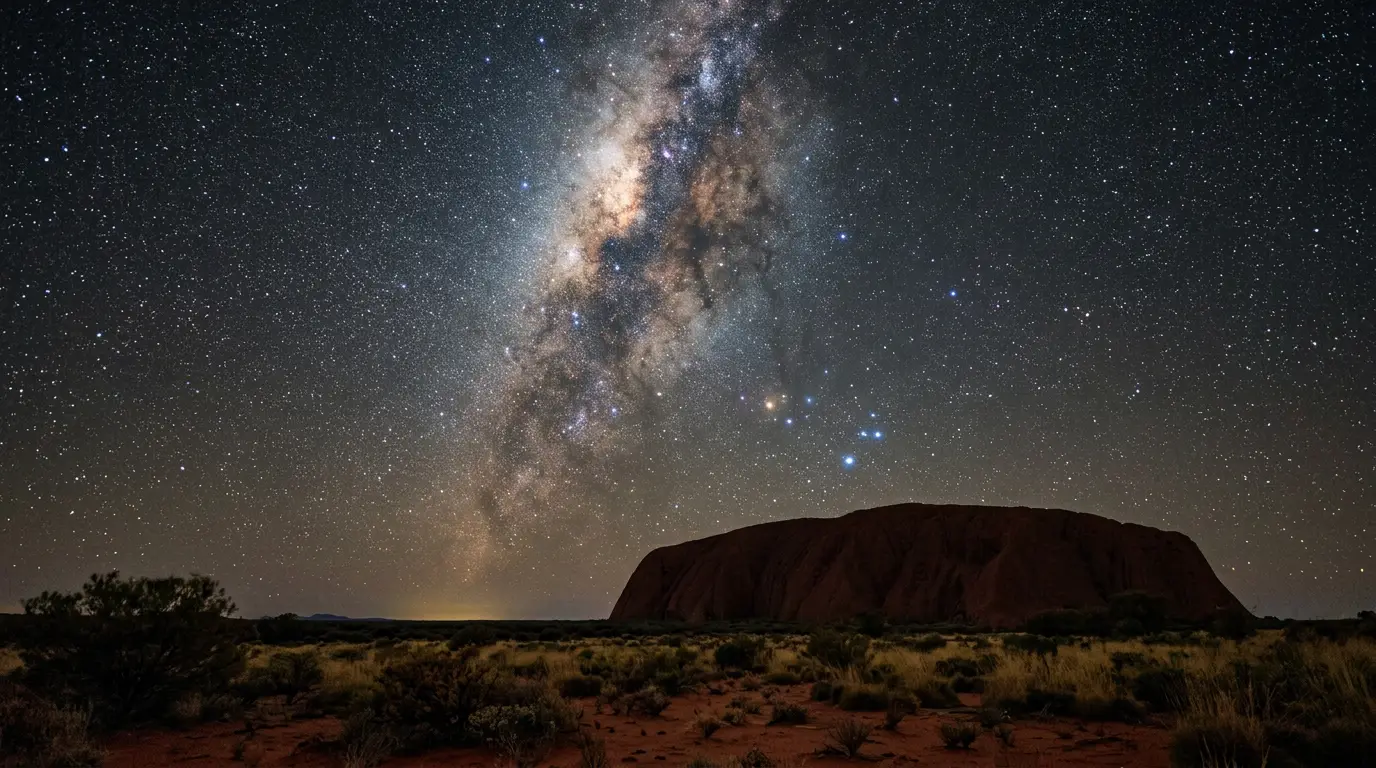
Stargaze at Uluru on Anangu-owned, jointly managed land: the Milky Way's core, Magellanic Clouds and Southern Cross over Australia's red-centre outback.
Weather is the other variable, and it's worth checking twice, not once. The Bureau of Meteorology (BOM) is blunt about how far its own forecasts can be trusted: the first week or fortnight typically has higher accuracy than the second[1]. Re-check BOM's Yulara forecast in the final days before you fly rather than trusting whatever the outlook said a month out; the full walkthrough of which page to open is in Uluru Stargazing Weather Forecast. For the season-by-season case, including why the park's night closure narrows the practical window further than the weather alone would, see Best Time to See Stars at Uluru.
Booking the licensed night tour, or skipping it
There's only one operator to call. Uluru Astro Tours states plainly that it is the only stargazing tour licensed to operate inside Uluru-Kata Tjuta National Park at night[2], departing roughly an hour after sunset for a 2.5 to 3 hour session that includes the transfer from Ayers Rock Resort. Expect naked-eye constellation orientation first, then telescope time on whatever's highest that night, the Magellanic Clouds most evenings, the galactic core specifically in winter. There's no second company to price-compare against, and no way to book a generic astronomy tour and expect it to actually enter the park after dark.
Can you skip the tour entirely? Only partly. The park itself closes at night, and every visitor, ticketed or not, has to be out by closing time[3], so there's no unsupervised option to walk in after dark and set up a tripod. What you can do without booking anything is watch the sky from Yulara itself, or from a designated sunset viewing point before the gates close, which still delivers a genuinely dark sky even without a telescope pointed at a specific target.
2.5–3 hours
- Book two to three months ahead during the May–September peak; small group sizes fill fast.
- Confirm current pricing directly with the operator rather than trusting an old quote.
- Pair the tour with a full day of park entry; the ticket alone doesn't cover daytime access.
If a clouded-out night is a real risk for your dates, ask the operator directly about rebooking before you pay. Their current cancellation policy isn't published anywhere reliable enough to state as a guarantee here.
Park pass, access rules, and what your money funds
Yes, and the pricing is simple. A Uluru-Kata Tjuta National Park entry pass costs $38 AUD for a 3-day block, or $50 AUD for an annual pass, and anyone under 18 is admitted free[4]. The same pass covers Uluru itself and the drive-in dusk viewing areas, so there's no separate ticket for a sunset lookout before your tour. Buy it online before you fly rather than assuming you can sort it out at the gate.
That fee doesn't go to a private operator. Pass revenue funds Traditional Owner lease payments, park operations, ranger and cultural activities, and heritage preservation, so the pass is a direct line to the people whose land this is, not an abstract entry toll.
Three days, not one, is also the practical minimum if a stargazing tour is the point of the trip. A single night leaves no room for a clouded-out evening: book across at least two nights and treat the third as a buffer, not a bonus. For the full logic on why two nights is the floor, see How Many Days: Uluru Stargazing.
Getting to Uluru and where to stay in Yulara
Two realistic routes get you there. Fly directly into Ayers Rock Airport, code AYQ, which has direct flights from several Australian capitals, or drive from Alice Springs: it's 465 km by road, about 5.5 hours on sealed highway[5], no 4WD required.
There's nowhere to sleep inside the park itself. All visitor accommodation sits at Ayers Rock Resort in Yulara, about a 10-minute drive from both the park entrance and the airport[6], covering everything from a hostel bed to a five-star room. Book that room at the same time as the astro tour; Yulara's stock doesn't expand to match the same May–September demand the clear skies create.
Beyond the astro tour itself, Yulara has one signature after-dark experience worth knowing about even if astronomy isn't the point: Sounds of Silence, an evening of dining under the open outback sky[7], run by the resort rather than a licensed park operator. It's not a substitute for a dedicated stargazing tour, but it's a reasonable way to spend a first evening before one.
Featured · Article
What Is Astrotourism? The Complete Beginner's Guide
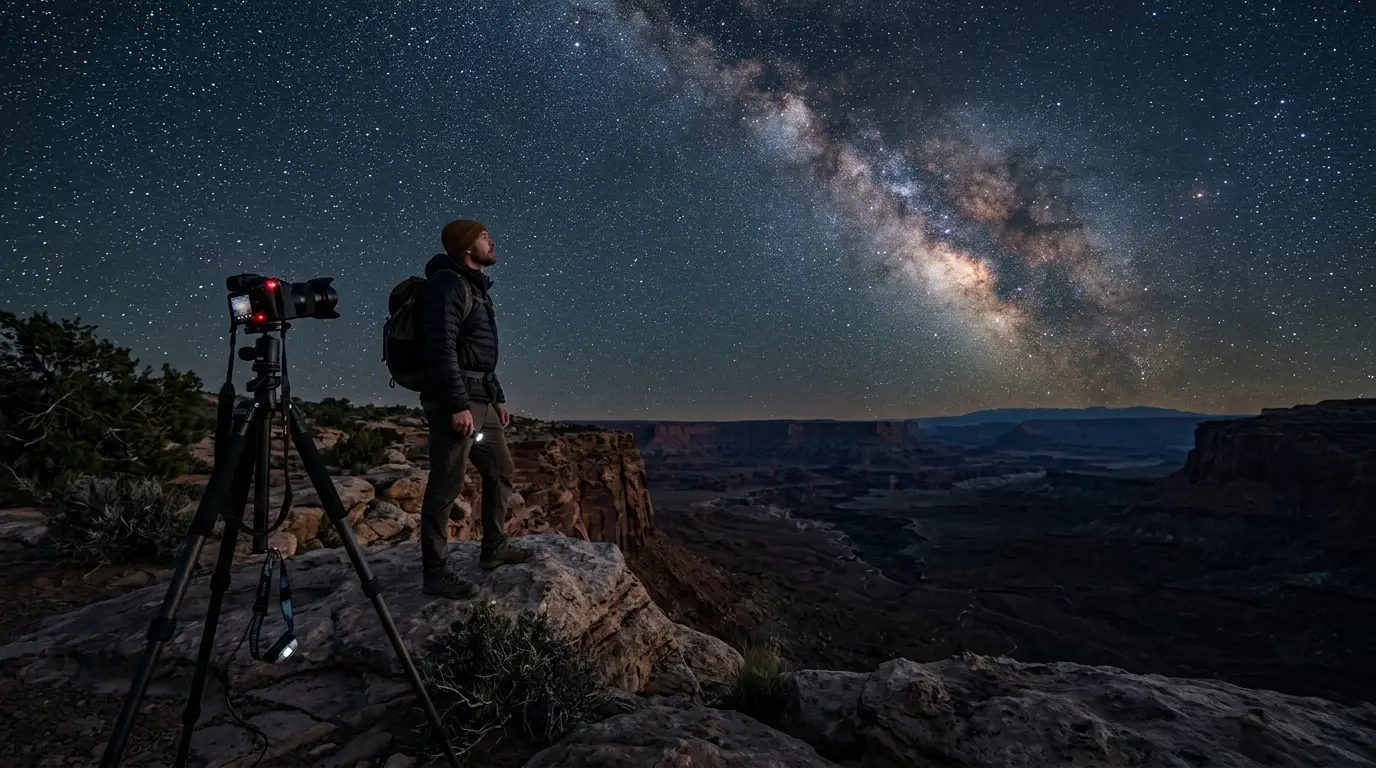
Astrotourism means travel built around dark skies: meteor showers, auroras, the Milky Way. What it means, where to go, and how to plan your first trip.
For the full flight, drive, and coach-transfer breakdown, see Getting to Uluru.
Respectful visitor etiquette: Anangu land, the climb closure, and photography rules
Start here, not with the sky. Uluru-Kata Tjuta National Park is Anangu land, run under joint management between Anangu Traditional Owners and Parks Australia since the park was returned to them in 1985. Every rule below traces back to that fact, not to a generic park regulation.
Climbing Uluru is no longer an option, and it isn't a temporary restriction waiting to be lifted. The climb closed permanently on 26 October 2019, timed deliberately to align with the anniversary of the 1985 Handback. Anangu leadership described the closure not as a loss to mourn but as a long-sought outcome worth celebrating[8]. Arriving hoping to hear about a lost tourist activity misreads the moment; this was Anangu's own long-standing request, finally granted.
- 1985
Handback
Title to Uluru-Kata Tjuta National Park returns to Anangu Traditional Owners, establishing joint management with Parks Australia.
- 26 October 2019
Climb closes permanently
The Uluru-Kata Tjuta Board of Management closes the climb for good, deliberately choosing the 34th anniversary of Handback.
Photography rules matter more here than almost anywhere else on this site, because a night-sky trip is, by nature, a photography trip. A handful of marked, culturally sensitive rock features are treated as equivalent to sacred scripture, and photographing them outright is prohibited[9]. Along the rock's north-east face, between Kantju Gorge and Kuniya Piti, Anangu ask visitors to take only wide shots from a distance and avoid capturing detail on the top-left side of the rock. None of this requires guesswork: restricted sites are clearly signed and shown on visitor maps, so check at the Cultural Centre near the base of the rock if a formation's status is unclear. A simple courtesy applies everywhere in the park, not just at marked sites: ask before photographing people, and treat a ranger's guidance as final, not a suggestion to negotiate.
- Never photograph a marked sacred site, day or night, phone camera or tripod.
- Stick to wide shots from a distance along the north-east face.
- Ask at the Cultural Centre if a formation's status is unclear.
- Treat the climb closure as settled, not a rule to test after dark when rangers aren't visible.
Recommended tours
Tours are selected for quality, not commission. I earn a small fee if you book — at no extra cost to you.

For the fuller cultural context behind all of this, including Tjukurpa and the Board of Management structure, see Uluru Cultural Significance and Visitor Etiquette.
What you'll actually see in the night sky
Skip the checklist mentality and look for four things specifically. The Milky Way stretches across the sky in bold contrast under Uluru's dark conditions, and naked-eye observers can also pick out zodiacal light, a faint cone of sunlight scattered by interplanetary dust, airglow, a subtle high-atmosphere haze, and even the distant galaxy M33[10], genuinely faint targets that only show up where light pollution isn't competing for the same sky.
- Milky Way: bold, high-contrast band, strongest during the dry winter months
- Southern Cross: low on the horizon, useful for orienting once you know where to look
- Zodiacal light and airglow: faint, naked-eye phenomena that need genuinely dark conditions
- M33: a distant galaxy, visible without a telescope under Uluru's sky
None of this needs a booking to notice from Yulara itself on a clear night, though the licensed astro tour is still the only way to get a telescope pointed at the fainter targets from inside the park. None of it depends on a clear forecast for the whole trip either, only for the specific night you're outside, which is exactly why a two-to-three-night stay beats a single overnight bet. Whatever night you land on, the trade-off across this whole FAQ stays the same: the sky rewards patience and the right season, and the land it sits over asks for the same respect regardless of what's overhead.