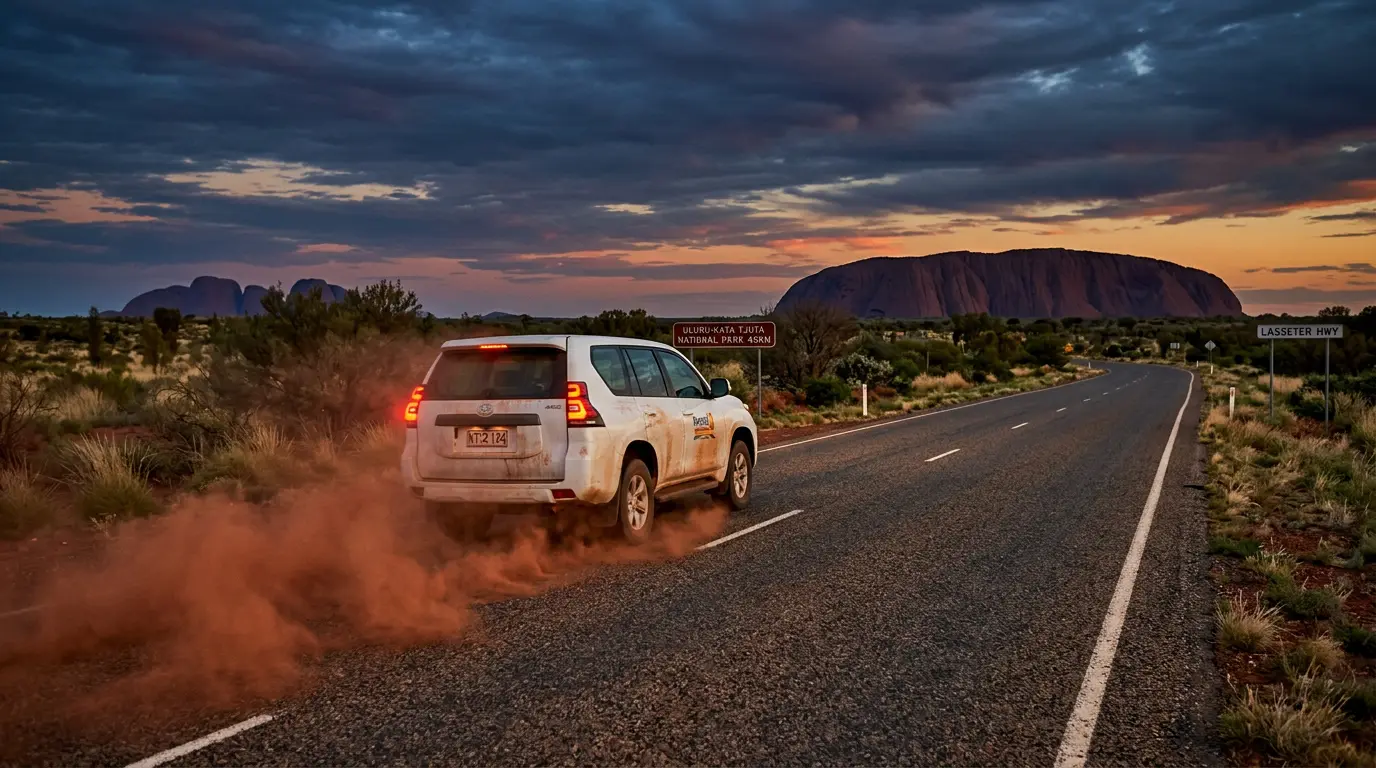

Why getting to Uluru takes more than one flight
No airline anywhere sells a single ticket from a foreign capital straight to Uluru. Every trip funnels through an Australian domestic connection first, into Sydney, Melbourne, or another state capital, before a flight or a long drive into the Red Centre. That's simply geography: Uluru sits deep in the Northern Territory's interior, hundreds of kilometres from any coastline, and the nearest town of real size, Alice Springs, is itself a small outback settlement rather than a transport hub.
For a stargazing trip specifically, that isolation is the whole point. The same emptiness that keeps flights indirect is what keeps the sky black once the sun goes down, and the getting-there logistics deserve their own plan rather than an afterthought squeezed in after booking a night at the Uluru stargazing hub. There are two realistic ways to close the final leg: fly into the local airport, or drive in from Alice Springs. A coach transfer covers the same ground as the drive, minus the driving.
Flying into Ayers Rock Airport (AYQ)
The airport code alone carries a small piece of history. Ayers Rock Airport uses the IATA code AYQ and ICAO code YAYE[1], but locals still call it Connellan, after Edward Connellan, who founded the outback carrier in 1939 as Survey & Inland Transport, formally registering it as Connellan Airways on 23 July 1943[2]. The current terminal and runway, built specifically to move tourist arrivals away from the base of the rock itself, became fully operational in late 1984[3], and the airport now handles just under 300,000 passengers a year[4], a modest figure by international standards but a large one for a facility this far from anywhere else.
Land here and you're close: Ayers Rock Airport is about a 20-minute drive from Uluru itself[5], and the Uluru-Kata Tjuta National Park entrance sits roughly the same distance from Ayers Rock Resort[6]. Several Australian domestic carriers serve the airport from state capitals, though routes shift with the season; check current schedules directly with the airline before locking in dates rather than trusting an old route list. There's no international arrivals hall here. Every visitor connects through a domestic flight from within Australia first.

Featured · Destination
Uluru
Stargaze at Uluru on Anangu-owned, jointly managed land: the Milky Way's core, Magellanic Clouds and Southern Cross over Australia's red-centre outback.
Driving from Alice Springs: the Stuart and Lasseter Highways
Driving is the other real option, and it's a genuine outback road trip rather than a shortcut. The self-drive distance from Alice Springs to Yulara (Ayers Rock Resort) runs about 444km, a trip of roughly five hours door to door[8][9], on a road that's fully sealed the entire way: no 4WD or high-clearance vehicle needed. Uluru itself sits a further 20km past Yulara, about 20 minutes deeper into Uluru-Kata Tjuta National Park[16]. Two highways make up the route, starting on the Stuart Highway and switching to the Lasseter Highway[7], meeting at a single junction town partway along.
444 km
Alice Springs to Erldunda: the Stuart Highway
Heading south out of Alice Springs, the Stuart Highway runs through open desert to Erldunda, a tiny highway township about 200km and two and a half hours away[8]. There's little to see along this stretch beyond red dirt and scrub, but it's also where fuel stops thin out. Top off the tank in Alice Springs before you leave; Erldunda's roadhouse is the only reliable stop for a while after.
Erldunda to Yulara: the Lasseter Highway
At Erldunda, the route turns onto the Lasseter Highway heading west, and this is the more interesting half of the drive: another 244km[9] and roughly two hours and thirty-eight minutes to Yulara[15], much of it past Mount Connor, a flat-topped red mesa that first-time visitors regularly mistake for Uluru itself from a distance. Watch for kangaroos at dawn and dusk on this stretch, and budget an extra hour if you want to stop at the roadside lookouts.
Car rental and getting around once you land
Whichever way you arrive, you'll want a car once you're on the ground, unless you're joining a fully guided tour package. Avis and Hertz both run rental desks with pickup and drop-off at either Ayers Rock Airport or the resort itself[10], so flying in doesn't lock you into resort transport for the whole stay. A free shuttle bus circulates Yulara daily, leaving roughly every 20 minutes between 10:30am and 12:30am[11], but it stays inside the resort loop. It does not enter Uluru-Kata Tjuta National Park, so it won't get you to the rock, a sunset viewing point, or a night-tour meeting spot.
Recommended tours
Tours are selected for quality, not commission. I earn a small fee if you book — at no extra cost to you.




That distinction matters more for a stargazing trip than a daytime one. Sunset and after-dark activities happen inside the park boundary, and guests at Longitude 131° can usually arrange transfers through the front desk, but independent travelers staying at the budget-friendly lodge option or elsewhere in Yulara should plan on either a rental car for the whole stay or a booked seat on a tour operator's own transport, since the resort shuttle won't take you there after dark.
The coach transfer: skip the driving, keep the flexibility
If neither flying nor self-driving appeals, a coach transfer covers the same Alice Springs-to-Uluru ground without putting you behind the wheel. Emu Run Experience runs a scheduled transfer between Alice Springs accommodation and Ayers Rock Resort, departing around 7am from March to November, or 8am during the December-to-February peak[12], and arriving at the resort around 12:30pm or 1:30pm respectively, a journey of five to five-and-a-half hours[13]. That's slower than self-driving, since the coach makes stops along the way, but it turns a full day of desert road into a seat you can sleep, read, or watch the Mount Connor mesa go by from.
The coach itself carries up to 52 passengers, with air-conditioning and an onboard toilet[14], a genuinely comfortable option for travelers who'd rather not drive an unfamiliar rental through kangaroo country at dusk. It also solves the one-way problem: fly in, coach out, or the reverse, without ever needing to return a rental car to the airport you didn't start from.
Featured · Article
Uluru Cultural Significance and Visitor Etiquette
Uluru is Anangu land under joint management. Here's why the 2019 climb closure is settled policy, what you can't photograph, and real visitor etiquette.
Timing your arrival around the night sky
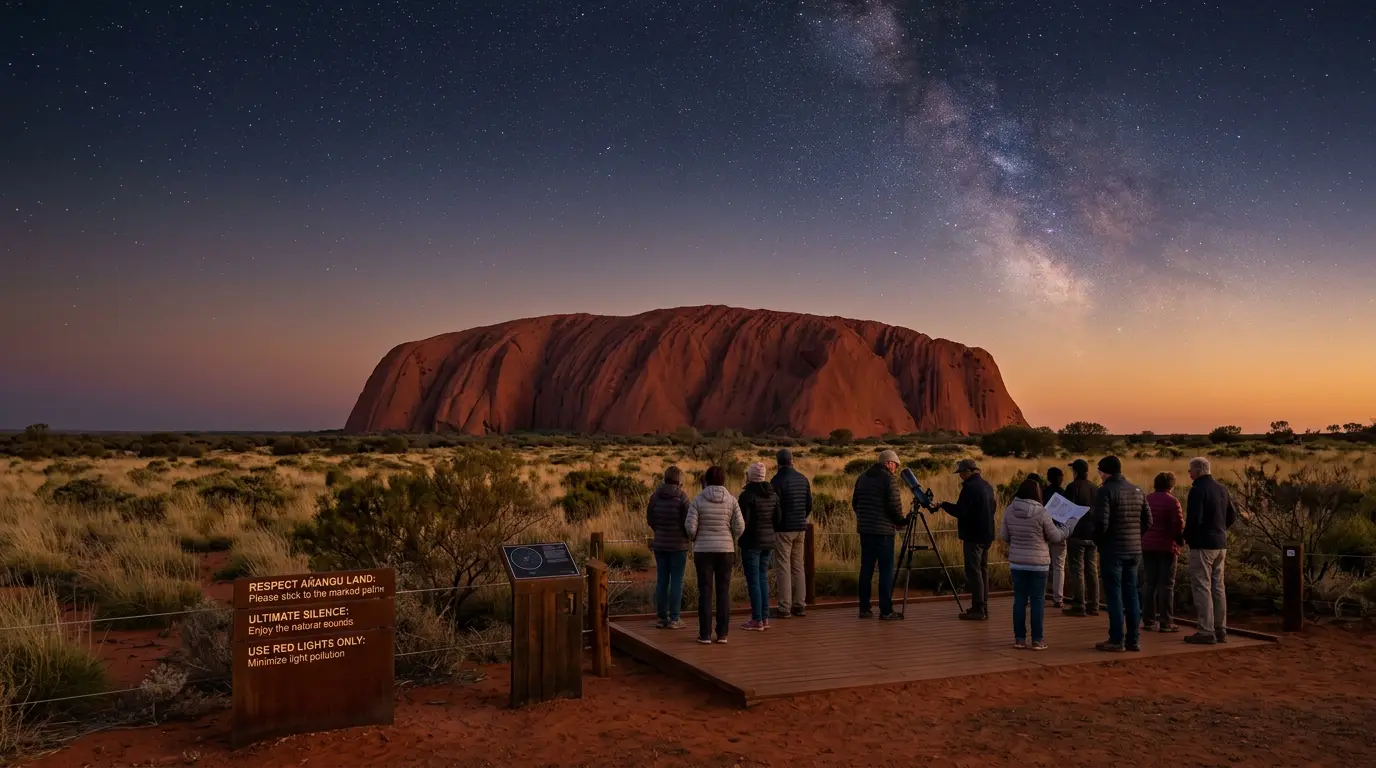
Once the logistics are sorted, timing is the last piece, and it matters more here than at most destinations this site covers. The best stargazing window at Uluru runs May through September, the Southern Hemisphere dry season, when the Milky Way's galactic core rides highest overhead after dark and the desert air runs at its clearest. That's also peak tourist season for exactly the same reason, so flights, rental cars, and rooms at Yulara all tighten up months in advance.
Work backward from the sky itself once your dates are close: check the moon phase before locking in a night, since a bright moon washes out the Magellanic Clouds regardless of how clear the air is. Build in at least two nights at Uluru if the schedule allows it. A single night leaves no room for a dust storm, an unexpected cloud bank, or a delayed connecting flight eating into your one shot at a dark sky. And if a guided night out matters more than going it alone with a star chart, book this guided desert astronomy tour well before you land, not after; sessions run small by design, and the May-to-September slots sell out fastest of the year. Still deciding whether the flight and the logistics above are worth it at all? Is Uluru Worth It for Stargazing? breaks down the honest costs and payoff.
| Route | Time | Best for |
|---|---|---|
| Fly into Ayers Rock Airport (AYQ) | ~20 minutes to Uluru after landing | Shortest door-to-door time, flexible dates |
| Self-drive from Alice Springs | ~5.5 hours (~464km) via the Stuart and Lasseter Highways to Uluru | Road trippers, one-way flexibility, a stop at Mount Connor |
| Coach transfer (Emu Run) | 5 to 5.5 hours, fixed daily departure | No driving required, comfortable, budget-friendly |