
What you're actually signing up for
Uluru sits deep in Australia's Red Centre, inside Uluru-Kata Tjuta National Park, land the Anangu have never stopped calling home. Before you plan a single night of stargazing, you need a park pass: $38 AUD for three consecutive days as an adult, or $50 AUD for an annual pass, with children under 18 free[1]. That's the first real cost of the trip, and it's a small one next to the flight.
The pass money isn't a tourist tax dressed up as conservation funding. A quarter of that revenue goes directly to supporting Anangu homelands, training, and business development[2]. The park has been run under joint management between Anangu and Parks Australia since the Handback returned title to its traditional owners, and that arrangement, not the sky, is where a visit here actually starts. Read Uluru for the fuller picture of what that means day to day, and visiting Uluru respectfully for the etiquette this article only has room to gesture at. You're a guest here. The rock was never waiting for you to arrive. Every guidebook covers the drive in and the sunset photo. Fewer cover what you owe the place once you're actually standing in front of it.
Featured · Destination
Uluru
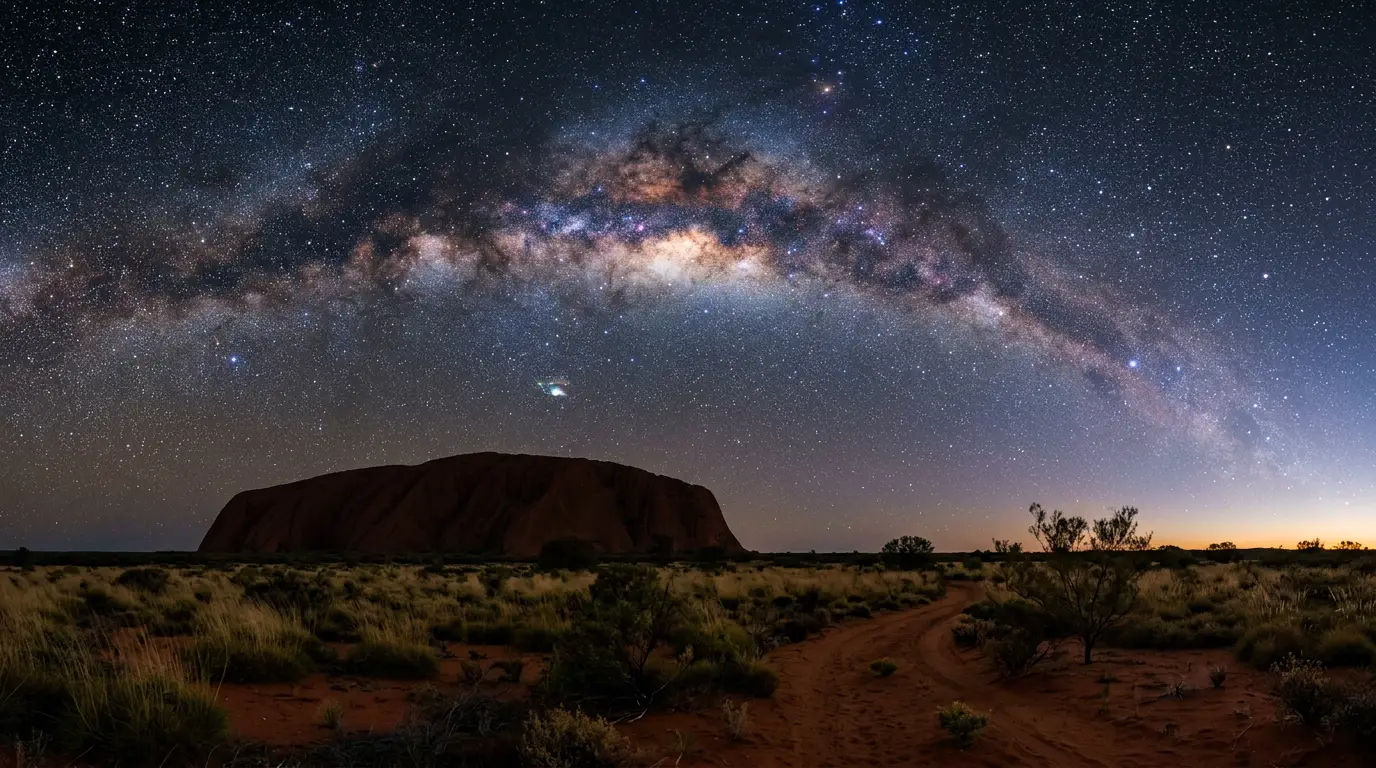
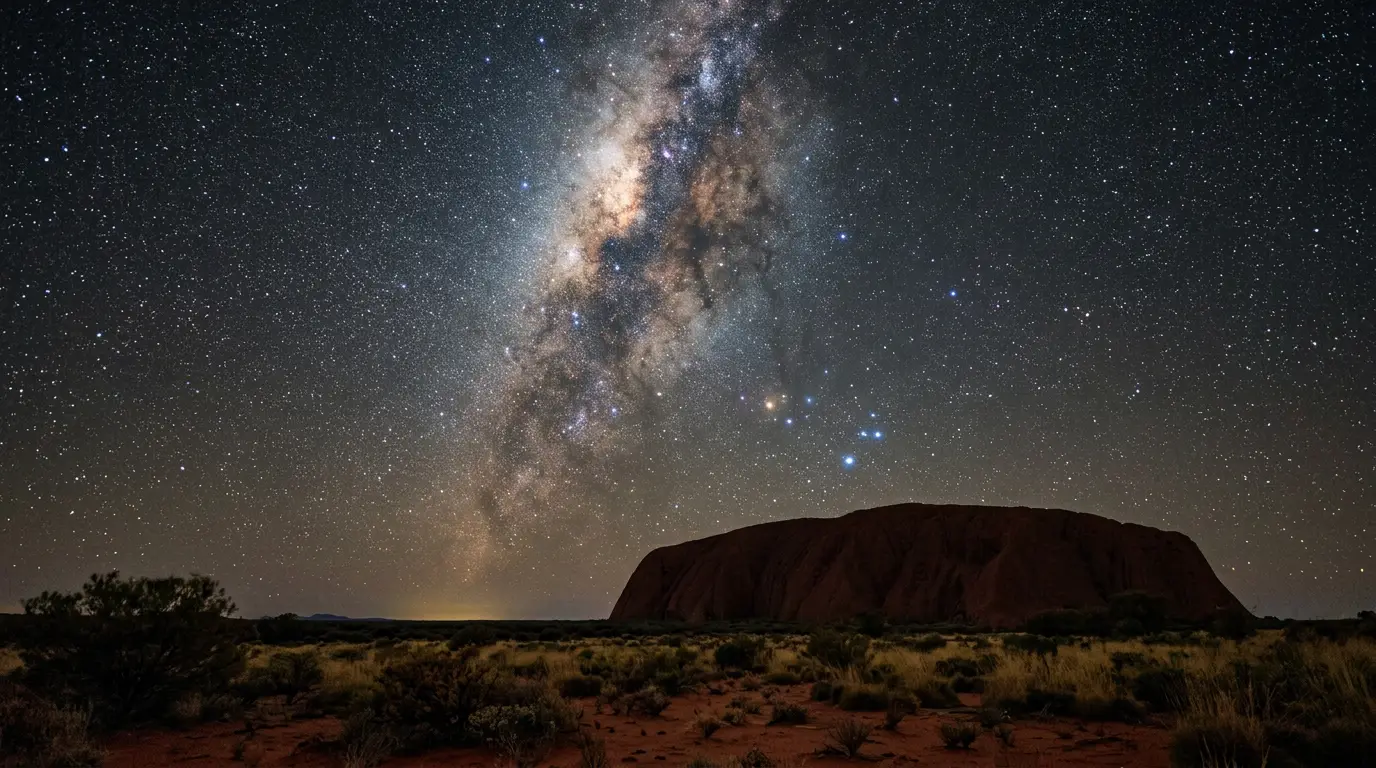
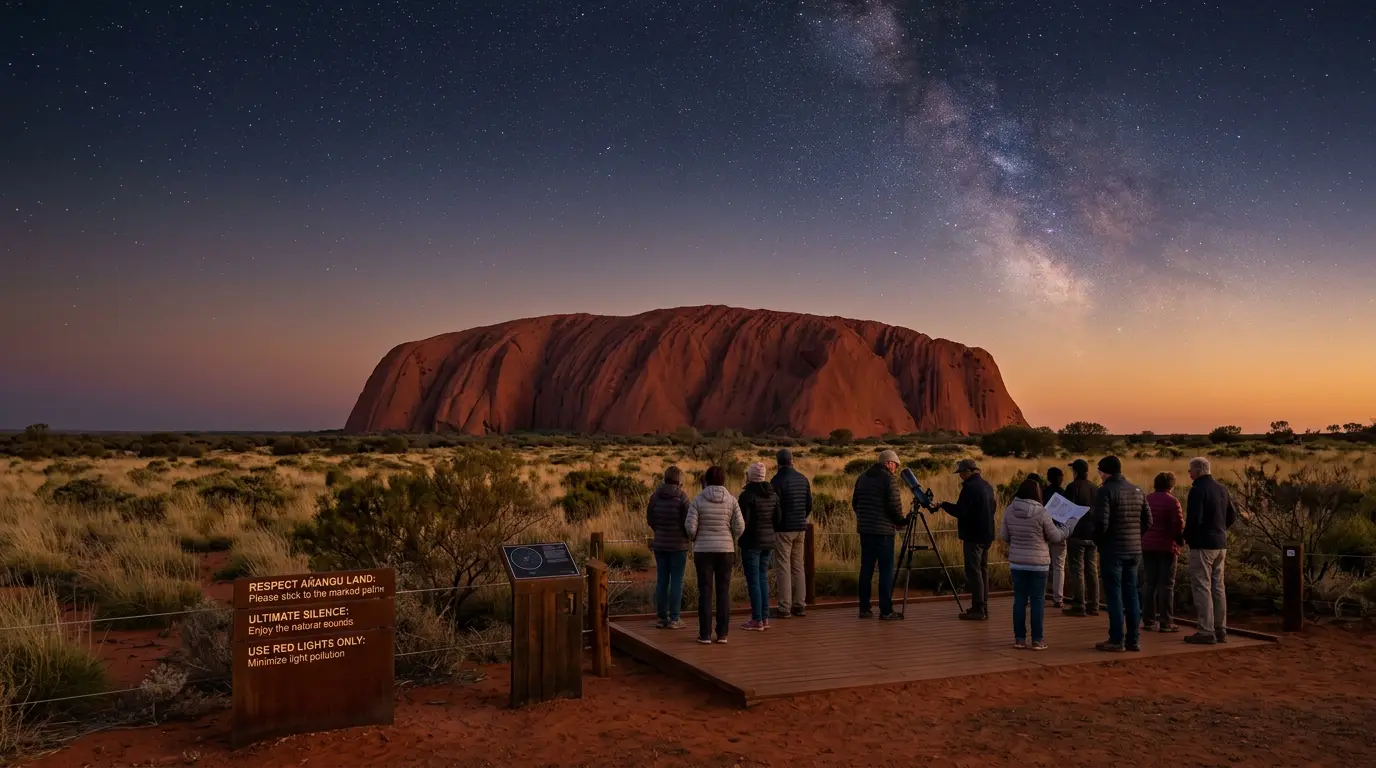
Stargaze at Uluru on Anangu-owned, jointly managed land: the Milky Way's core, Magellanic Clouds and Southern Cross over Australia's red-centre outback.
The sky: what actually separates Uluru
None of this needs a telescope to feel enormous. Uluru is a Southern Hemisphere destination, and during the dry season, roughly May through September, the Milky Way's galactic core climbs directly overhead instead of skimming the horizon the way it does for most travelers north of the equator. You're not craning toward a glow on the edge of the sky. You're looking straight up into the densest part of our own galaxy.
There's no certified Bortle rating for Uluru on record from a dark-sky authority, so treat any specific number you read elsewhere with some skepticism. What holds up is the practical case: the desert around Uluru sits far enough from any sizeable town that a clear night barely takes a dent, and what shows up overhead reads like a different sky entirely to anyone arriving from Europe or North America.
- The Large Magellanic Cloud, a companion galaxy visible to the naked eye as a faint, cloud-like smudge
- The Small Magellanic Cloud, its dimmer companion, low but steady on a clear night
- The Southern Cross (Crux), doing the orientation work the North Star does up north
- The galactic core itself, riding highest through the winter dry season
Desert nights drop toward freezing well before dawn, even in a country famous for its heat, so pack a proper jacket regardless of what the daytime thermometer read. Anyone who shows up for a 40-degree afternoon in a t-shirt is usually the same person shivering through the best hour of the night an hour later.
Beyond the stars: the rock, the land, and Tjukurpa
Field of Light, the after-dark installation of tens of thousands of solar-lit glass spheres spread across the desert near the rock, is worth building an evening around even though it isn't astronomy. In 2026 it marks its tenth anniversary: more than 50,000 glowing stems across an area bigger than seven football fields[3]. Walk it once the Milky Way is out behind it, not before. The stars do more work once it's properly dark.
Anangu law and belief, known as Tjukurpa, isn't a museum exhibit or a preamble to skip on the way to the rock. It's a living framework that governs how this land is read, used, and spoken about, and it's why the rules that follow aren't arbitrary tourist etiquette. Start at the Cultural Centre near the base before you go anywhere near Uluru with a camera. It's the honest way in, not a detour.
50,000+
Two rules matter more than any packing list. Anangu ask visitors not to enter or photograph restricted areas, including sacred sites, ceremonial sites, burial grounds, and people's homes[4]. And everyone is asked to stay on marked tracks and paths, never climbing onto rock formations or boulders, so as not to wander into a sacred area without meaning to[5]. Neither rule is complicated. Both take about thirty seconds to learn at the Cultural Centre and considerably longer to undo if you ignore them.
In daylight, the Mala Walk and the Kuniya Walk trace the rock's base along paths Anangu are happy to share, each stopping at waterholes and rock art panels with signage explaining what you're looking at, and why some panels stay deliberately uninterpreted. Walk one of them before your night tour. It's the difference between seeing a rock formation and seeing a place with a name.
The real costs and friction points
Cost is the honest objection most people raise before they raise the distance. The park pass is the smallest line in the budget. Everything else adds up faster once you're actually pricing a Red Centre trip rather than reading about one.
Getting to the Red Centre means a flight into Ayers Rock Airport or a longer routing through Alice Springs, and either way you're budgeting a meaningful transport cost on top of everything else, well before you've paid for a single night's stay. Guided tour packages out of Alice Springs span a wide range, from a single budget-focused day trip to a multi-day premium camping circuit, depending entirely on how much comfort and how many days you want. There's no rail line into the Red Centre and no meaningful public transport once you land, so factor a hire car or a resort shuttle into the budget alongside the flight itself. Yulara is the only accommodation and services hub for the whole park, so wherever you end up staying, you're staying there.
Recommended tours
Tours are selected for quality, not commission. I earn a small fee if you book — at no extra cost to you.
For the night sky specifically, Uluru Astro Tours is the operator worth knowing by name: it's the only licensed night stargazing operator inside the UNESCO World Heritage-listed Uluru-Kata Tjuta National Park[6]. Book directly with the operator and you may see a different rate quoted; the resort's own experiences page lists the same style of session from $119 AUD per adult and $80 AUD per child for a roughly three-hour outing[7]. Worth comparing both before you pay.
Accommodation at Ayers Rock Resort spans the same range as the rest of the trip, from Outback Pioneer Lodge's dorm beds and self-cook barbecue up to Longitude 131°'s all-inclusive tented pavilions facing the rock itself. The table below is the honest version of that spread; a five-star room and a hostel bed put you under the same sky, at very different prices.
| Accommodation tier | Example property | Typical rate |
|---|---|---|
| Budget | Outback Pioneer Lodge | AUD $185-350/night |
| Mid-range | Desert Gardens Hotel | AUD $420-600/night |
| Luxury | Sails in the Desert | AUD $475-1,100/night |
| Ultra-luxury (glamping) | Longitude 131° | From ~AUD $1,000+/person/night (twin share) |
Who Uluru suits, and who it doesn't
Uluru rewards a specific kind of traveler: someone who wants a genuinely Southern Hemisphere sky, treats the Anangu's rules as the terms of the visit rather than an inconvenience, and doesn't need a guaranteed clear night to feel like the trip paid off. For that person, a stay of two or three nights inside Yulara, paired with one booked session with Uluru Astro Tours, delivers real, uncommon detail: the Magellanic Clouds, a low bright Southern Cross, and a galactic core directly overhead.
It also works for general Central Australia travelers building stargazing into a bigger itinerary, one strong night among a Kings Canyon day trip or an Alice Springs stopover, rather than the entire reason for the flight. Even a night that clouds over doesn't sink the visit if the rest of the trip is doing its share of the work. Astrophotographers get an extra reason to book: a foreground this recognizable, paired with a galactic core riding this high, is a rare combination to frame in a single image, and one most Northern Hemisphere shooters never get the chance to try.
Featured · Article
Uluru Cultural Significance and Visitor Etiquette
Uluru is Anangu land under joint management. Here's why the 2019 climb closure is settled policy, what you can't photograph, and real visitor etiquette.
Who should think harder before booking: anyone who wants Uluru purely as a photo to check off, without engaging with whose land it actually is; budget travelers for whom the flight, pass, and tour stack is genuinely prohibitive; and anyone chasing a formally certified Bortle-1 sky, who is better served by the Atacama or NamibRand, both of which carry ratings Uluru doesn't.
The verdict on Uluru
Uluru is worth it for stargazing if you do the planning most bucket-list itineraries skip: budget honestly for the flight, the pass, and a proper night tour, aim for the dry season between May and September, and go in as a guest rather than someone conquering a landmark. Check when the sky here is actually worth the trip before you lock in dates, since the calendar month matters here as much as the moon phase does.
What you get in return isn't a marginally better version of a dark-sky trip closer to home. It's a galactic core riding directly overhead, a Southern Cross bright enough to navigate by, and Magellanic Clouds that most travelers from the Northern Hemisphere have never once seen, all set against one of the most recognizable landforms on Earth and the living culture that's never stopped belonging to it.
The cost is real, the flight is long, and a cloudy night is always possible. None of that makes the trip a mistake. Book the pass, book Uluru Astro Tours ahead of the May-September peak, and let the rock do the rest. Slots fill fastest during the July-August school holiday stretch, so lock in dates a few months out if those weeks are your only option.