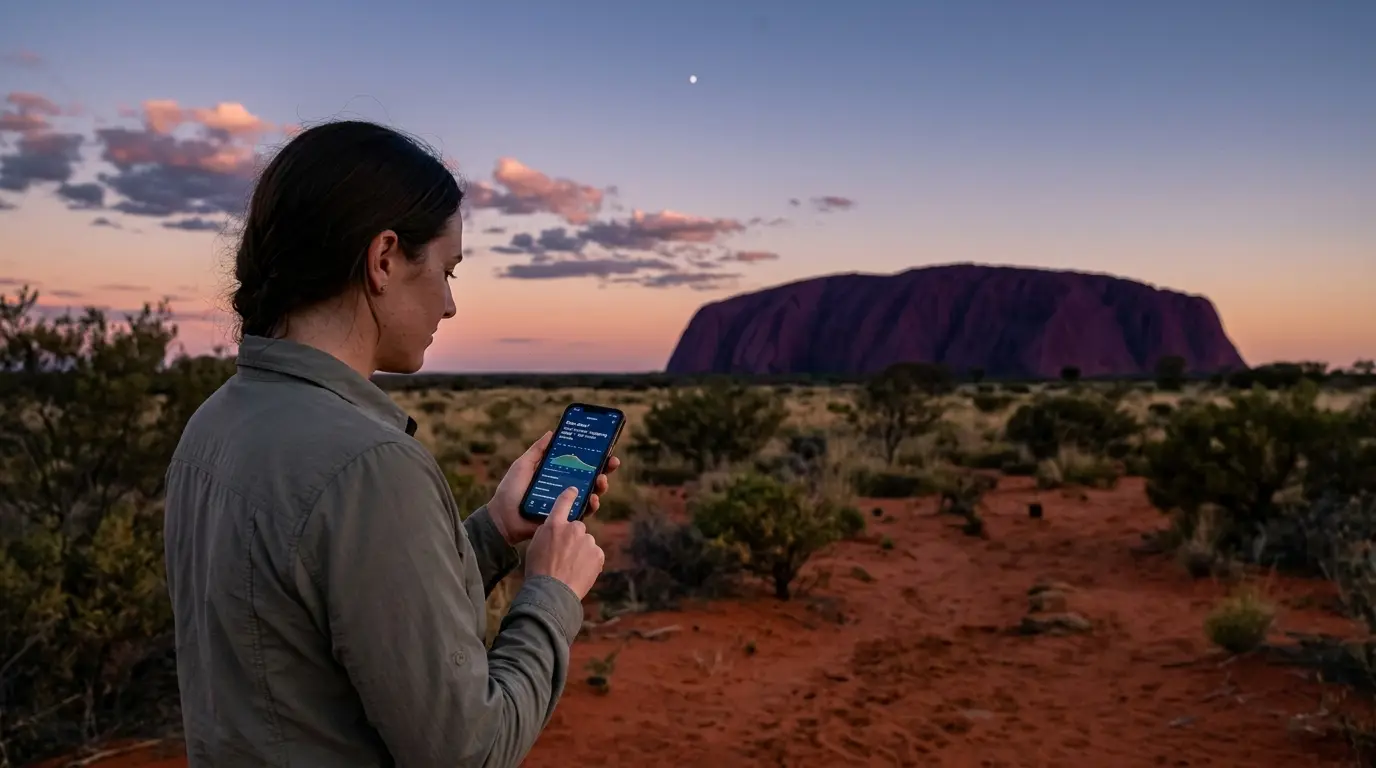

How to check the Uluru stargazing weather forecast
Search «Uluru weather» the week before a trip and most top results are built for hikers checking daytime heat, not for someone deciding whether tonight's sky will be clear enough for the Milky Way. The tool built for that second question is the Bureau of Meteorology's dedicated forecast page for Yulara, the gateway town for Uluru-Kata Tjuta National Park, rather than a generic national weather app tuned for capital cities.[1]
That distinction matters more than it sounds. Aggregator sites and default phone weather apps often pull from a different, less precise data source than BOM's own page, and bookmarking the specific Yulara forecast, rather than hunting for a fresh search result every trip, is the single habit that makes the rest of this guide worth reading.
The next section breaks down exactly what that page shows day by day, and the section after that covers something almost no «best time to visit» guide mentions: how far ahead you can actually trust any of it. For the full trip-planning picture beyond the forecast itself, see Uluru stargazing.
Reading BOM's 8-day forecast, and where MetEye fits in
BOM's Yulara page runs an 8-day outlook, today plus the next seven, and each day carries a short condition descriptor, Clear, Sunny, Partly cloudy among them, alongside a chance-of-rain percentage.[1] That's the whole toolkit for the cloud-cover half of a stargazing forecast. No separate astronomy page, no dedicated dark-sky index, just the same official forecast a farmer or a road-tripper would check, read for what it says about tonight's ceiling rather than tomorrow's heat.
On a genuinely dry stretch, the run of tiles across a whole week can read almost identically: Sunny, Sunny, Clear, chance of rain sitting at zero percent day after day. Don't mistake that pattern for a permanent climate fact. It's a live snapshot of one particular week, not a standing statistic about Uluru's sky, and it reads differently the next time you check it.
Featured · Destination
Uluru
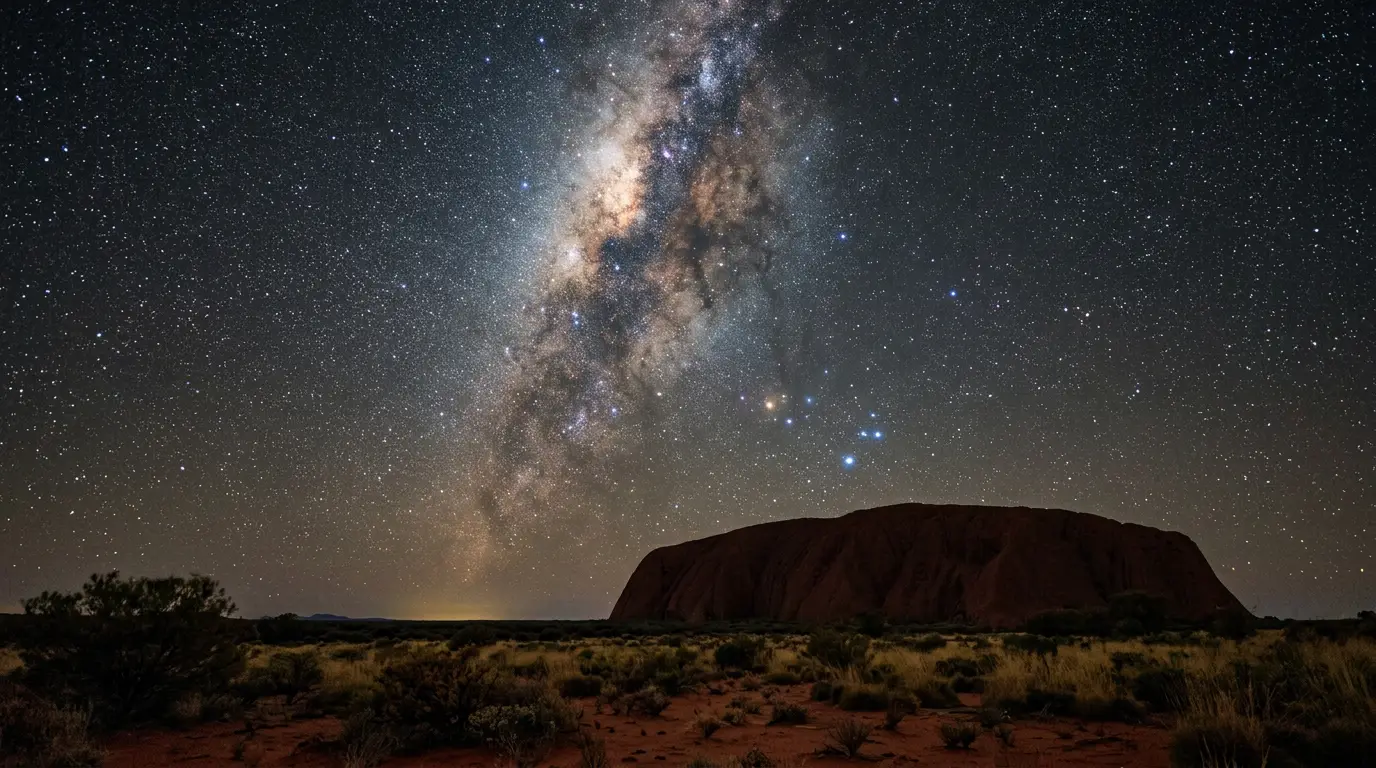
Stargaze at Uluru on Anangu-owned, jointly managed land: the Milky Way's core, Magellanic Clouds and Southern Cross over Australia's red-centre outback.
BOM also runs MetEye, a graphical forecast tool with a cloud and satellite overlay, as a companion to the standard text page. It's worth knowing the tool exists if you want a visual read on cloud movement across the wider region, though the Yulara text forecast alone covers most trip-planning decisions on its own.
- BOM Yulara forecast page: the 8-day text outlook, the first thing to bookmark
- MetEye: a graphical, map-based view of the same underlying data, useful for watching cloud move rather than reading a single word per day
- A generic weather app: fine for daytime packing decisions, not built with Uluru's night sky in mind
None of these tools replace judgment on the ground. A tile that reads «Partly cloudy» could mean patchy cloud that clears by 9pm or a low band that sits all night, and only the actual sky, checked an hour after sunset, settles which one you got.
How accurate is the forecast, and how far ahead can you trust it?
Accuracy is where most «best time to check the forecast» advice goes vague, so it helps to put real numbers against it. BOM reports that its next-day maximum temperature forecasts were accurate 91.3 percent of the time across 2024-25, within a 2°C tolerance.[2] That's a genuinely strong hit rate for anything checked the afternoon before a trip out.
Night comfort depends on temperature too, not just cloud cover. How reliable BOM's overnight figure is compared to the daytime one is worth knowing before you decide how many layers to pack for a session that runs well past dark, and the routine at the end of this guide puts a real number against it.
Both daytime and overnight numbers describe next-day forecasts specifically. BOM draws an explicit line between short-range forecasts, which can specify tomorrow's temperature and rain with real confidence, and long-range forecasts, which cannot be nearly that specific.[3] A monthly outlook glanced at three weeks before a trip is a different tool entirely from the 8-day page you'd check the week you actually travel, and treating the two as equally trustworthy is the single most common forecast-reading mistake.
Lead time decays accuracy on a curve, not a cliff, and that curve is exactly why «best time» advice given weeks out deserves less trust than a check made the week you fly. Translated into a travel habit: an 8-day check made the morning you land is worth trusting. The same check made three weeks out, before you've even booked flights, is closer to a seasonal guess than a real forecast, and it's worth knowing which one you're looking at before you build a night around it.
Checking the moon phase for your exact travel dates
Cloud cover is only half the forecast. The moon runs on its own calendar entirely, and no weather page factors it in, which is why a genuinely clear night can still deliver a washed-out sky if a bright moon happens to be sitting overhead. Best time to see stars at Uluru covers why the moon matters and which week of the month to favor. This piece is about the practical step: checking it for your specific dates rather than relying on a general rule of thumb.
timeanddate.com runs a lunar calendar built specifically for Uluru's coordinates, giving moon phase, moonrise, and moonset times adjusted for the location and corrected for atmospheric refraction rather than a generic global figure.[4] Enter your actual travel dates and it returns the exact illumination percentage and moonrise time for each night, precise enough to tell whether the moon will already be up when you head out or still below the horizon.
Recommended tours
Tours are selected for quality, not commission. I earn a small fee if you book — at no extra cost to you.



WillyWeather runs a comparable Uluru moon-phase page as a second source, worth a quick cross-check if the two disagree on a borderline night. Either tool takes under a minute to read once you know your dates.
If a licensed night session is part of the plan, the moon check and the booking decision are really the same decision. Uluru Astro Tours is the only operator licensed to bring visitors inside Uluru-Kata Tjuta National Park after the gates close,[5] and choosing a departure date near a new moon rather than a full one is the single biggest lever a traveler controls over how much of the Milky Way actually shows up that night. Cloud and moon are not the only variables, and seeing vs transparency explains why a clear, dark night can still look poor.
Why Uluru's dry desert climate keeps the odds in your favor
None of this forecast-checking habit exists because Uluru's sky is unreliable. Yulara, the gateway town, sits in a genuinely arid stretch of desert; nearby Uluru-Kata Tjuta National Park receives an average of just 284.6 mm of rain a year[8], low enough to rule out the kind of persistent cloud cover that disrupts stargazing across tropical or coastal destinations. Most weeks of most months, the 8-day page is going to read some version of «Sunny» straight down the line.
That's exactly why checking still matters. «Usually clear» describes a climate, not a guarantee for one specific Tuesday night, and the travelers who get caught out are the ones who reasoned from the desert's general reputation instead of glancing at the actual page the day before. The seasonal breakdown, winter's cooler, drier stretch against summer's longer daylight, matters for comfort more than for whether you'll see stars at all; this guide's job is narrower, the specific night, not the broader season.
Treat the dry climate as background confidence, not a reason to skip the check entirely. A five-minute look at the Yulara page the afternoon before costs nothing and catches the rare night the odds don't hold.
Putting it together: a forecast-checking routine before you fly to Yulara
Turn all of this into one short routine rather than a pile of separate tools to remember:
- Bookmark BOM's Yulara forecast page and check it in the final week before you travel, not three weeks out while you're still booking flights, since the first week or fortnight of any outlook typically runs more accurate than the second.[6]
- Trust next-day and 2-3 day figures most; treat anything past the 7-day window as a rough guide rather than a firm forecast.
- Check the overnight low, not just the daytime high: BOM's overnight minimum temperature forecasts run accurate 82.8 percent of the time,[7] a useful gauge for how many layers to bring on a session that runs well past dark.
- Check timeanddate.com's Uluru lunar calendar for your exact travel dates when you book, not the night before, since moon phase is a booking-time decision the same way flight dates are.
- Cross-check WillyWeather if a specific night's moon reading looks borderline.
- Book Uluru Astro Tours around a new-moon week if a genuinely dark sky is the point of the trip, and hold that booking until the forecast firms up closer to departure.
- Recheck the Yulara page again the afternoon you arrive, since conditions this close to a desert can still shift inside a single day even during the driest months.
Featured · Article
Uluru Cultural Significance and Visitor Etiquette
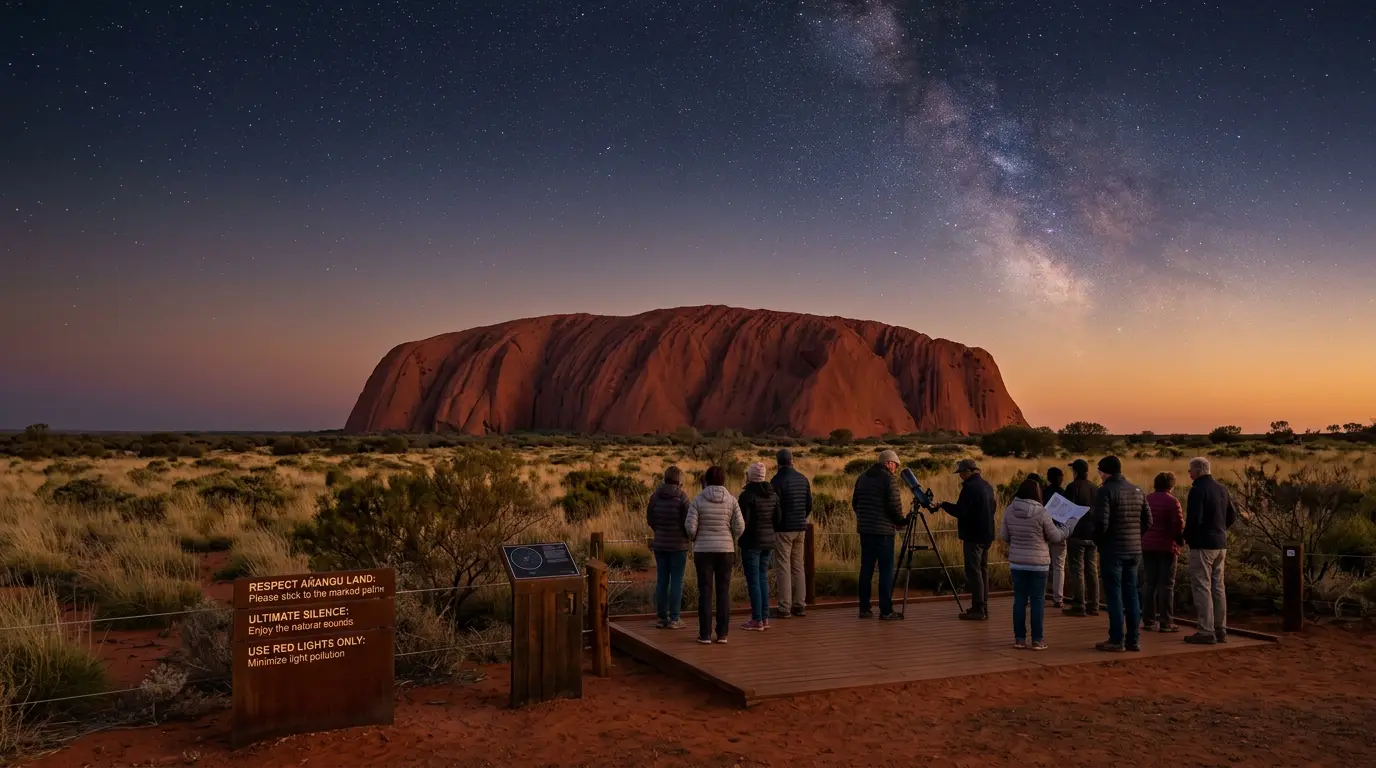
Uluru is Anangu land under joint management. Here's why the 2019 climb closure is settled policy, what you can't photograph, and real visitor etiquette.
Most travelers land at Ayers Rock Airport after a long-haul flight and a fair amount of planning already sunk into the trip, which makes the temptation to trust an early forecast check and stop thinking about it understandable. Do the opposite. The whole value of a short-range forecast is that it's accurate close to the date and gets progressively less useful the further out you check it, so the single best habit for Uluru stargazing is checking again once you're actually there, phone in hand, the afternoon before you head out toward the rock.