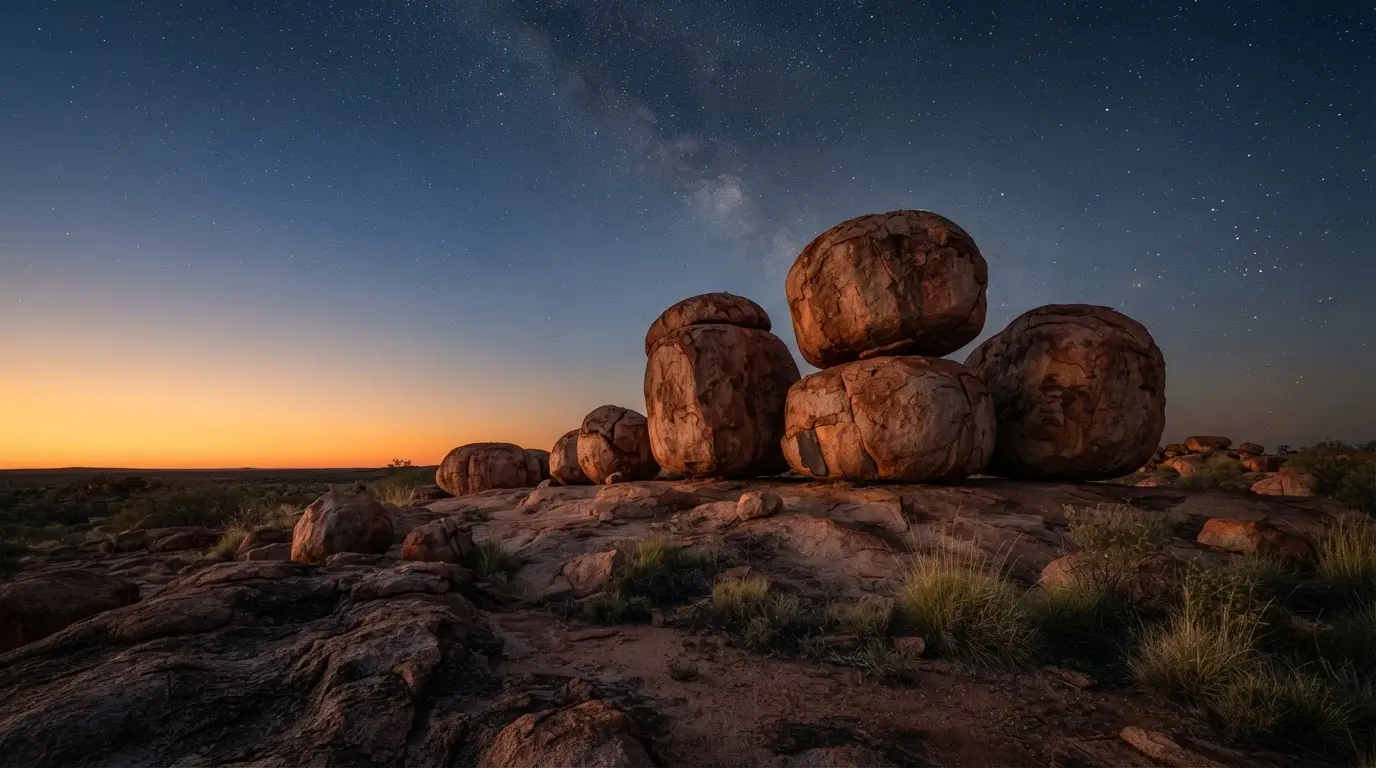
A sanctuary is not a park, and this one shows the gap
DarkSky International gives the Dark Sky Sanctuary tier to places it describes as typically very remote, with few if any nearby threats to the night sky, that do not otherwise meet the requirements of a park or reserve.[4] Karlu Karlu sits 100 km south of Tennant Creek off the Stuart Highway, which is remote by any road-trip standard.[5]
Nothing I found says why the nomination went for a sanctuary rather than a park, so treat the tier as DarkSky's choice of category, not a ranking. The NT Government calls Karlu Karlu the first in the Territory and only the third in Australia.[6] Parks are the better-known tier; the best dark-sky parks guide compares them, and Bryce Canyon's certification shows what that route asks for, so I won't repeat it here.
A year of measuring came before the label
The designation was not a form filled in over a weekend. NT Parks and Wildlife led a year-long process, and the Territory lists three pieces of work inside it:[7]
- Six months of night-sky readings, the evidence of how dark the reserve actually is. I could not find the readings themselves published.
- A lighting audit, an inventory of what already shines after dark.
- A future-risk assessment, which asks what could shine later.
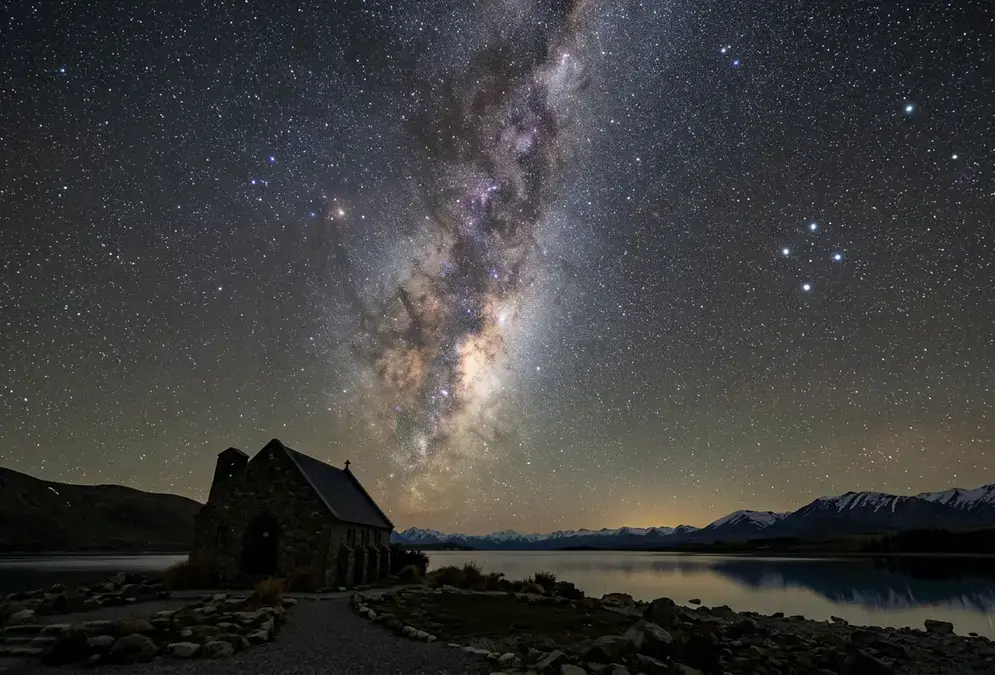
Featured · Destination
Aoraki Mackenzie Stargazing
Aoraki Mackenzie is one of only four Gold Tier Dark Sky Reserves on Earth: Bortle 2 skies over Lake Tekapo, the Southern Cross, and Mount John Observatory tour.
Tourism, not parks, led the paperwork. The Department of Tourism and Hospitality ran the submission, backed by Traditional Owners, the Central Land Council and three local bodies, one of them the Devils Marbles Hotel.[8] That sits on top of an existing arrangement: the reserve is jointly managed by Traditional Owners and Parks and Wildlife rangers.[9]
What the label changes, and what it leaves alone
Two changes are on record. NT Parks and Wildlife's Philip Cowan says any future development "must adhere to strict lighting guidelines."[2] And interpretive signage on night-sky viewing is to be developed, so it does not exist yet.[10] A separate report says the department also intends formal viewing infrastructure and signage that tells the night sky through Aboriginal-led storytelling.[11] The announcements give no date for either the signage or the viewing infrastructure, so do not expect them on your visit.
Neither is a visitor restriction. The reserve's park page lists booking, pass and rules (next sections) without a sanctuary-specific condition, and no announcement I read adds a permit, curfew or access limit for stargazers. That is my reading of what is missing, not a statement from the Territory. Check the park page before you go.
The land brings its own conduct. The reserve covers 1,800 hectares, about 18 square kilometres, and almost all of it is a registered sacred site, significant to the Kaytetye, Warumungu, Warlpiri and Alyawarra Traditional Owners.[12] DarkSky calls it a cultural landscape central to Traditional Owners' identity.[13] I won't retell any of the stories; they are not mine to tell.
Featured · Article
What Is Astrotourism? The Complete Beginner's Guide
Astrotourism means travel built around dark skies: meteor showers, auroras, the Milky Way. What it means, where to go, and how to plan your first trip.
22 July 2028: 4m50s at the boulders, 5m10s in the Kimberley
The eclipse path crosses the Kimberley, then the Northern Territory, passing over Tennant Creek and the Devils Marbles.[16] Spot matters, because totality is not the same length everywhere on the line.
The AAQ eclipse guide tabulates it for named sites, and three rows tell the story:
Official copy rounds the reserve's figure to almost five minutes.[19] The table's 4m50s comes with a start time and a Sun height attached, which is why it is the number to plan around.
The Sun will be high, and the NT's tourism copy says the timing, between 12.45pm and 1pm, keeps atmospheric distortion minimal.[20] Eclipsophile's satellite record shows cloud amounts below 10 percent from the Western Australian coast to Karlu Karlu.[21] That is climatology, not a forecast. Nobody can promise a clear sky.
New to chasing totality? Eclipse chasers and their habits explains what veterans build in as margin. The nearer date is the 2027 total solar eclipse, a different eclipse entirely.
Booking, rules and the season before you go
Camping at Karlu Karlu is booked and paid for online in advance.[22] The park page adds a warning in plain words: you can't pay at the site.[23]
Book before you drive in
Do the booking from a town with signal, not at the gate. The reserve's page says camping is booked and paid online and that you can't pay at the site.[22]
Visitors from outside the NT also need an NT Parks Visitor Pass for this park.[24] Camping fees are paid separately on top of it.[25] I am not quoting prices, because the NT Parks Visitor Pass and camping fees pages are the ones that stay current.
The rules that matter for a night camp:
Go between April and September. The NT's page calls those the cooler months,[30] while temperatures can exceed 40°C between October and April.[31] A campground host is on site from May to September.[32]
Recommended tours
Tours are selected for quality, not commission. I earn a small fee if you book — at no extra cost to you.
The New Daily puts the reserve 4½ hours north of Alice Springs.[33] If it is one stop on a Red Centre loop, the Uluru stargazing page covers the other big outback sky, and when to stargaze at Uluru handles the season logic.
What nobody has published yet is the 2028 booking picture. I found no official camping-capacity or booking-window policy for July 2028, so the camping page is the one to watch.