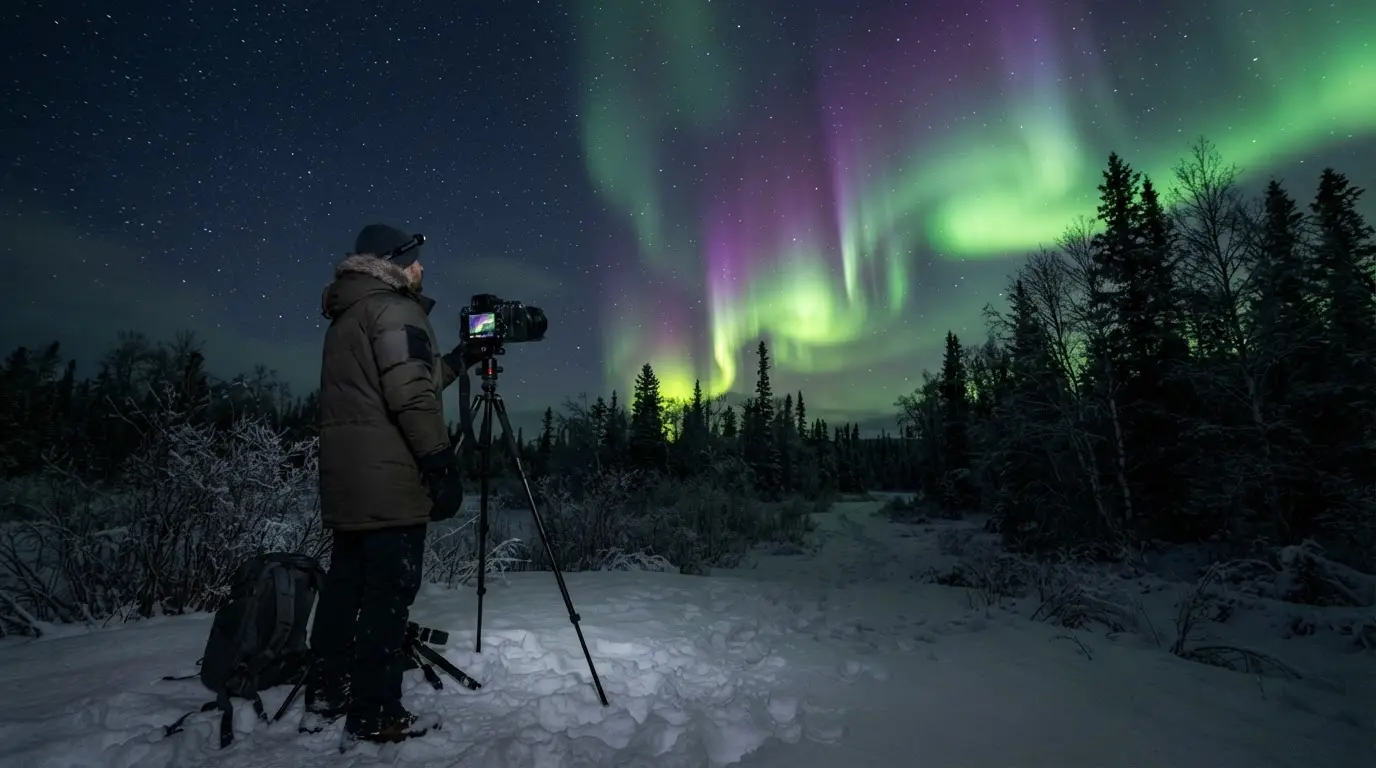

Why your eyes and a camera don't build the same picture
The aurora's color comes from oxygen and nitrogen molecules releasing light as they collide with charged particles from the solar wind. Oxygen roughly 60 miles up produces the familiar green-yellow glow; oxygen closer to 200 miles up produces the rarer all-red curtains, and nitrogen contributes the blue[6]. All of that light exists in the sky whether or not you can perceive its color.
What you actually see depends on which photoreceptors are doing the work. Cone cells handle color but need relatively bright light to fire. Rod cells take over once your eyes adjust to darkness and can register far fainter light than cones, but they can't distinguish hue — only intensity, on a black-to-white scale. A quiet or moderate aurora often sits right at the edge of what rods alone can resolve, so it reads as a pale, colorless smear even though the same light, captured on a sensor, would show clear green.
How a camera builds the photo your eyes never see
A camera sensor doesn't have to work within the eye's real-time limits. Left open anywhere from 1 to 30 seconds depending on how bright the display is[4], it keeps collecting photons the entire time, stacking faint light into a single frame that looks far brighter and more saturated than anything visible in the moment. That's the same dynamic range advantage that lets a sensor register a barely-there arc long before a viewer standing in the same spot would call the sky anything more than slightly hazy[2].
A well-exposed Fairbanks aurora shot typically runs about 20 seconds at ISO 400 with a fast lens during a strong display[7]. That's long enough to gather color information rods can't extract on their own, but it comes at a cost: detail starts to blur after as little as 5 seconds of exposure during moderate activity, because the aurora keeps moving the whole time the shutter is open. The photo you post afterward isn't a snapshot of one instant, it's an average of everything the sky did over several seconds, compressed into a single, unmoving image. For the lens, tripod, and battery setup that make long exposures workable in Fairbanks cold, the aurora photography gear guide for Fairbanks covers the specifics.
| Human eye | Camera sensor | |
|---|---|---|
| How it gathers light | Continuous, real time, no accumulation | Collects photons for up to 30 seconds per frame |
| Color in dim light | Rod cells register intensity only, no hue | Full color range regardless of brightness |
When your eyes do see real color
Plenty of aurora guides flatten this into one rule: cameras see color, eyes see gray, end of story. That's not the full picture. Cameras genuinely register more red than a viewer standing in the same spot ever perceives, because sensors and human color vision aren't tuned to the same wavelengths in the same proportions. But a strong enough display overrides the limits of rod-only vision entirely.
Moonlight is the clearest example, and it works backward from what most visitors expect. A bright moon activates cone cells, the same receptors that give you daytime color vision, so a moonlit night can actually show more aurora color to the naked eye than a pitch-dark one, not less. Moonlight isn't required, though: when a display is bright enough — a strong substorm, an unusually intense show — cone cells switch on with no moon at all, and viewers do see real color overhead[8].
The pattern holds well south of Fairbanks too. One photographer in Maine, at roughly 44°N, reported seeing the aurora's purple spikes with the naked eye during an unusually intense display, proof the aurora had "cranked up" well beyond a typical mid-latitude night[9]. Contrast that with an observer at a weaker Southern Hemisphere display in New Zealand, who described seeing only "a faint green glow" with the naked eye, even while the same display produced saturated color on camera[10]. Neither is a Fairbanks-latitude display, but both make the same point: the strength of the aurora, not the camera, decides whether your cones ever turn on. That's the same logic behind Fairbanks northern lights viewing odds through the season.
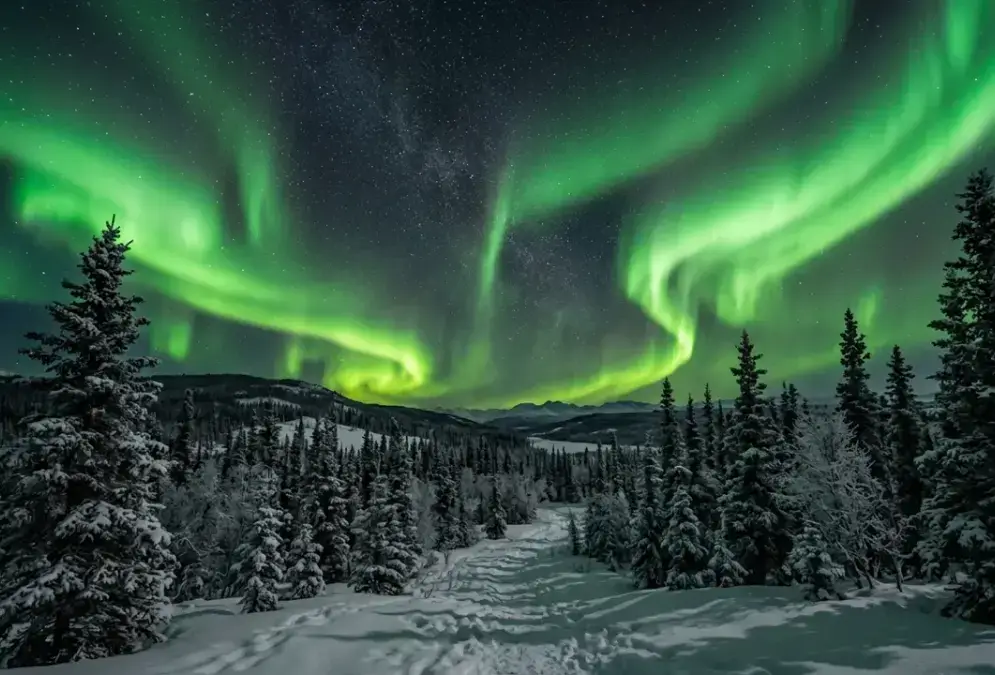
Featured · Destination
Fairbanks Northern Lights
Fairbanks sits directly under the auroral oval at 64.8°N. Aurora season runs Aug 21–Apr 21, peaking Feb–Mar, with roughly 90% odds if you stay 3+ nights.
When Fairbanks aurora is strong enough to show color
Fairbanks' aurora season runs August 21 to April 21[5], and inside that window, timing still matters. The city sits under the auroral oval for much of the season, but sightings over Interior Alaska are still roughly twice as likely around the spring and fall equinoxes than around the solstices[11], for reasons researchers still don't fully pin down, likely tied to how Earth's magnetic field lines up with the solar wind at those points in the orbit. Check the Fairbanks aurora forecast a few days out rather than betting on a single date.
Strength matters as much as timing. The Kp index measures geomagnetic activity on a 0-to-9 scale, and because Fairbanks sits inside the auroral oval, even modest geomagnetic activity can produce a visible display there — unlike mid-latitude locations, which typically need a major storm to show anything at all. What you need past a quiet arc is enough activity for your cones to have a real chance of switching on. Plan for several nights rather than one: the best time to see the northern lights in Fairbanks is as much about staying long enough as picking the right month.
Featured · Article
What Is Astrotourism? The Complete Beginner's Guide
Astrotourism means travel built around dark skies: meteor showers, auroras, the Milky Way. What it means, where to go, and how to plan your first trip.
How to give your eyes the best chance at real color
Get away from town lighting and give your eyes the full 10 to 15 minutes before judging what's overhead. Resist checking your phone once you're out there: a single bright flash from a screen or a headlamp resets your dark adaptation completely, handing control back to your cones, and you have to start the adjustment over from zero[12].
If you brought a camera, use it as a second opinion, not a replacement for looking. A short test exposure will confirm a display is active well before it looks like much to the eye, which is useful: it tells you to stay out and keep watching, because the aurora is often ramping up toward the kind of strength that does show real color overhead. Budget more than one night for this if you can. How many days you need in Fairbanks for northern lights walks through the math on why a single night is a gamble.