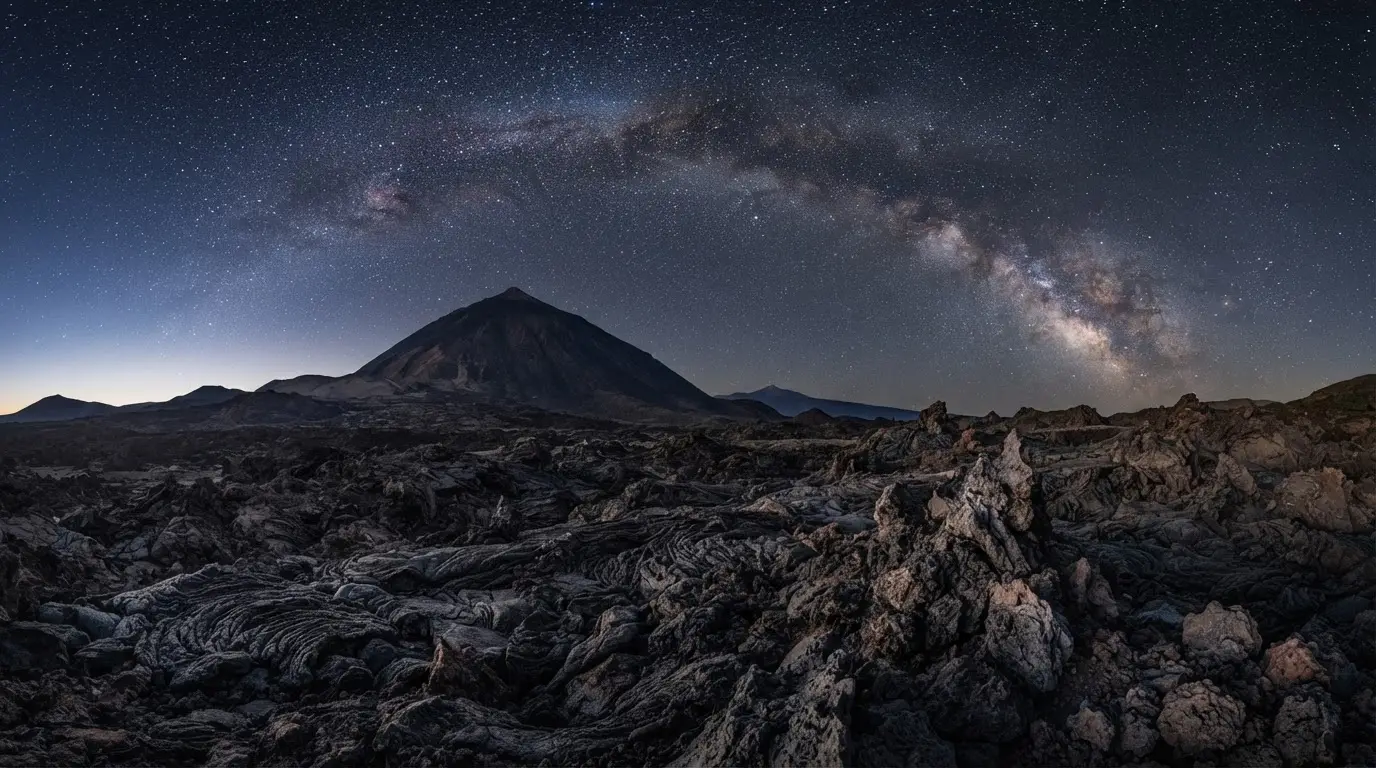

Meet Chinyero: Tenerife's youngest volcano
El Chinyero rises to 1,560 metres[1] on Tenerife's northwest flank, a black cinder cone barely more than a century old by geological standards. It is the youngest of the island's volcanic features and, more usefully for anyone planning a shoot, the last place on Tenerife where lava actually flowed. Stand at its base and the terrain tells the whole story: loose black scoria, twisted ropes of solidified lava, and almost nothing green for as far as the eye reaches.
The eruption that built it lasted nine days. It began on 18 November 1909 and produced a cone roughly 80 metres high, along with a blanket of lava that reshaped the surrounding terrain[4]. More than a century later, that eruption is still the most recent volcanic event anywhere on Tenerife, which makes Chinyero less a curiosity and more a genuine landmark in the island's geological record.
Chinyero is classified as a monogenetic volcano, one built by a single eruptive episode rather than repeated activity from the same vent, and it is currently inactive. The ground beneath it isn't finished, though: eruptions have been recorded along the same volcanic system since 1393[5], and geologists treat 1909 as the most recent entry in an ongoing sequence, not a closing chapter.
None of this makes Chinyero the island's dominant landmark. That title belongs to Mount Teide, the 3,718-metre stratovolcano and UNESCO World Heritage Site that anchors Tenerife's dark-sky reputation[7]. Chinyero is smaller, younger and far less visited, which, for a photographer after an uncluttered foreground rather than a crowded viewpoint, is closer to an advantage than a shortcoming.
Inside the Chinyero Special Nature Reserve
The volcano sits inside its own protected area, the Chinyero Special Nature Reserve, covering roughly 24 square kilometres (6,000 acres) across the municipalities of Santiago del Teide, El Tanque and Garachico[8]. It's one of the more overlooked protected areas on an island where most attention goes to the national park higher up the mountain.
Featured · Destination
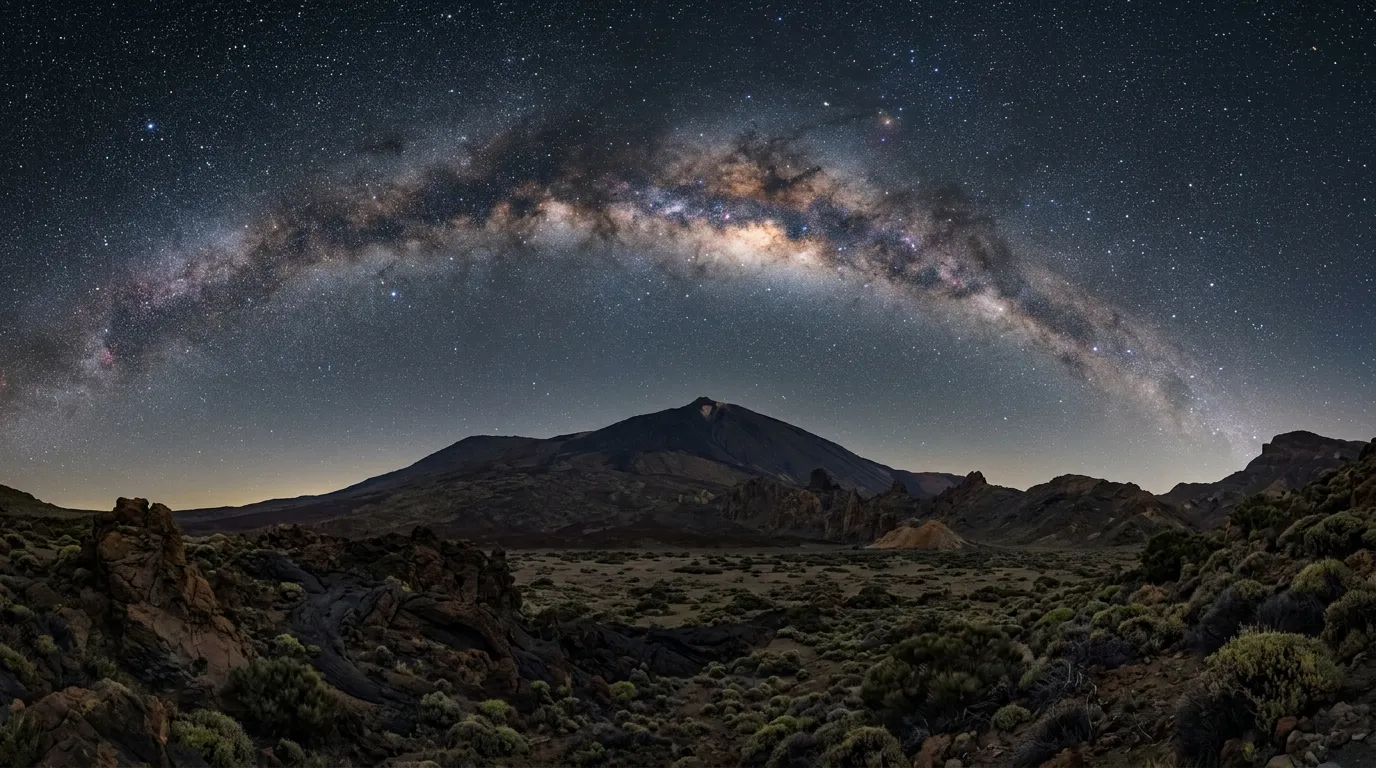
Tenerife Stargazing
Tenerife stargazing guide: Teide National Park's UNESCO Bortle-2 skies, 83 constellations visible. Observatory visits from €21, Parador hotel, and best tours.
Inside the reserve are 14 volcanic cones in total, the most representative cluster of recent volcanic activity anywhere on Tenerife[9]. Three of them are off-limits to visitors entirely[9]:
- Montaña Garachico
- Montaña Chinyero
- Montañas Negras
Everywhere else, the rule is the one that applies to any fragile volcanic landscape: stay on the marked trails. The malpaís, the rough, unvegetated badlands left behind by a lava flow, looks sturdy enough to walk anywhere on. It isn't, and it takes decades to recover from a boot print in the wrong place.
A small visitor centre near Santiago del Teide covers the reserve's volcanic history in more depth. It won't take long, but it's worth the stop if the trip is built around understanding what you're standing on rather than just photographing it.
Why Chinyero's lava fields work for night photography
A good astrophotography foreground needs two things: nothing tall enough to break the horizon, and nothing bright enough to compete with the sky. Chinyero's malpaís, the black, unvegetated lava badlands left by the 1909 flow, delivers both. There are no streetlights, no buildings, and past the reserve boundary, barely a fence line to frame around. A tripod set low against the scoria, aimed north across the flow, turns an otherwise flat lava field into genuine foreground texture once the stars come out.
The reserve borders the Corona Forestal Natural Park to the south and southeast[10], the buffer zone that wraps around Teide National Park's summit. That's worth getting right: Chinyero has no separate dark-sky certification of its own. It sits immediately outside the area the Teide Observatory guide covers in detail, not inside it. What that proximity does buy you is the same regional protection regime, the same laws and the same low ambient light, without the crowds or the entry gate.
That protection extends this far because of legislation, not goodwill. The Canary Islands' Ley del Cielo (Sky Law), passed in 1988, is one of the first legal frameworks in the world built specifically to protect a night sky, covering light pollution, radio-spectrum interference, air pollution and flight paths across the whole island[11]. The sky above Teide National Park itself carries a formal Starlight Destination designation, accredited in 2013 and formally presented in January 2014[12]. Chinyero doesn't hold that title. It benefits from sitting inside the same legal shield.
How dark is it, exactly?
No source I could find publishes a Bortle-scale or SQM (sky quality meter) reading specific to Chinyero itself. What can be said honestly is comparative: Chinyero sits outside any coastal light dome, on the same protected volcanic system as one of Europe's most legally shielded skies, at an elevation high enough to clear most low haze. That's a qualitative case for darkness, not a number, and it's worth being upfront about the gap rather than repeating an unsourced class rating as if it were measured.
Framing the shot
Two compositions do most of the work here. Low and wide, with the cone's silhouette anchoring the bottom third of the frame and the Milky Way's core arching above it, works well June through September, when the galactic core sits higher after dark. Or shoot toward Teide itself: from the right vantage point inside the reserve, the stratovolcano's outline sits on the horizon beyond Chinyero's own cone, giving a genuine sense of scale between Tenerife's newest volcanic feature and its oldest, tallest one. Bring a wide-angle lens; there's no zoom substitute for a foreground this open.
Getting to Chinyero and the reserve's rules
There's no single trailhead. The reserve is reached from several points depending on which side you're approaching from. From the north, drive to El Tanque; a paved road there turns into a dirt track as it enters the reserve. From the south, take the TF-82 from Santiago del Teide up to Valle de Arriba, then continue about 400 metres on a paved road to the reserve boundary[13]. Additional access points exist near Garachico's San Juan del Reparo neighbourhood and from San José de Los Llanos to the west. The northern approach turns to a dirt track before it reaches the boundary; the southern route via Valle de Arriba stays paved the whole way in[13].
None of these roads are complicated, but none of them are signed for tourists either. A basic map or an offline GPS route saves real time, especially if you're arriving in the dark for a night shoot and don't want to be finding a dirt track by headlamp.
Stay on the marked trails
Access to the volcanic cones themselves, Montaña Garachico, Montaña Chinyero and Montañas Negras, is forbidden. Bring a headlamp with a red-light mode for the walk in if you're arriving before dawn or shooting after dark; there's no lighting anywhere in the reserve, on the trail or off it.
Once inside, the rules are worth repeating: marked trails only, and the three named cones, Montaña Garachico, Montaña Chinyero and Montañas Negras, are closed to entry. If you're combining the visit with Teide National Park itself, the drive up and the permit system there are different enough to warrant their own planning; Getting to Teide from Tenerife Airport covers the roads, fuel stops and summit-access rules in detail.
Planning your shoot: timing and gear
Plan around the new moon for the darkest possible sky, and if the Milky Way's core is the target, aim for June through September, when it sits highest after dark. Outside that window, Chinyero is still a legitimate wide-field and star-trail location; the malpaís foreground doesn't need the galactic core to be interesting. A star-trail composition, camera locked down for an hour or more, doesn't care what month it is or where the galactic core happens to sit.
Meteor showers are worth building a trip around specifically. The Geminids peak each December at over 100 meteors per hour[14], the most reliable major shower of the year; the Quadrantids peak in January with bright fireballs, and the Perseids peak in August. A wide-open foreground like Chinyero's, with nothing to block a low horizon-to-horizon shower, suits all three better than a viewpoint hemmed in by terrain.
Featured · Article
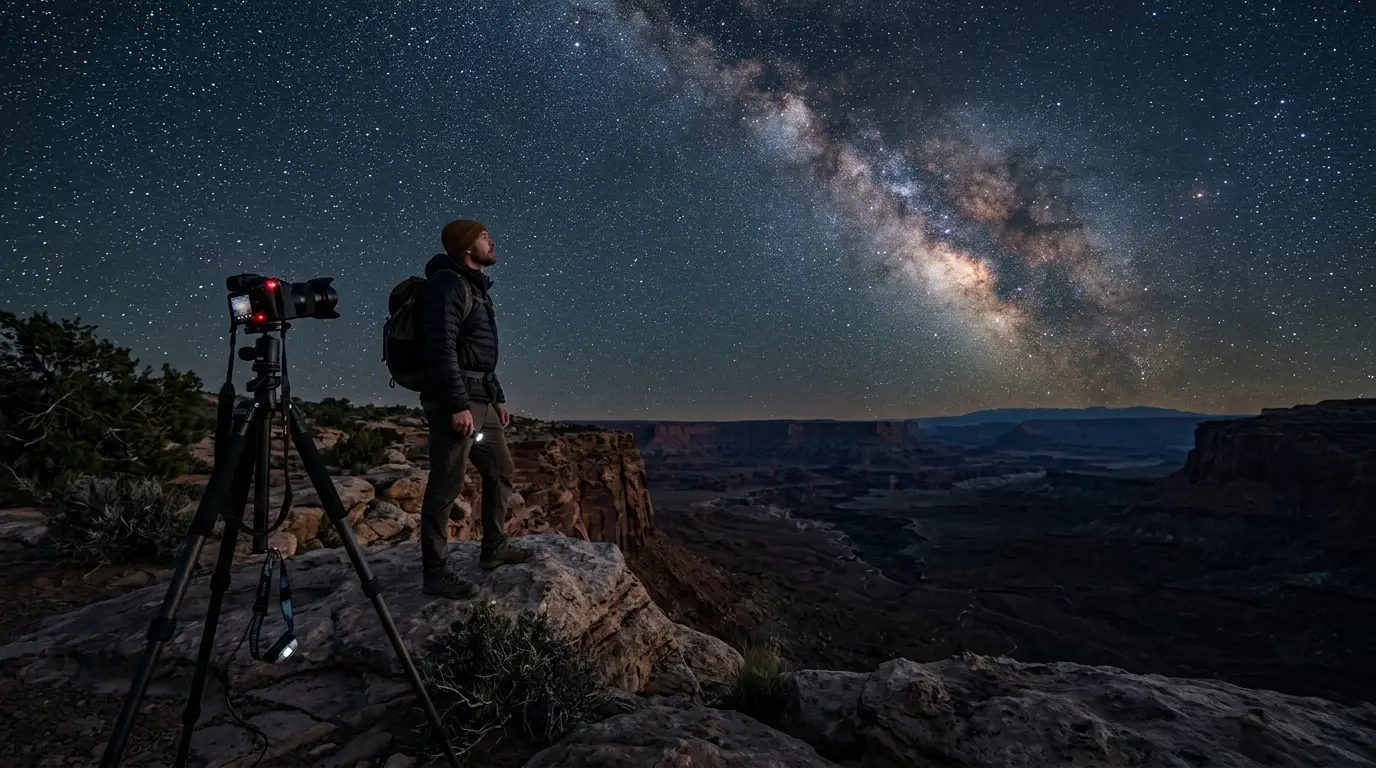
What Is Astrotourism? The Complete Beginner's Guide
Astrotourism means travel built around dark skies: meteor showers, auroras, the Milky Way. What it means, where to go, and how to plan your first trip.
For the camera side of the trip, from a body and lens that can hold a 15 to 25-second exposure without excessive noise to a tripod that survives the reserve's exposed, occasionally windy terrain, see astrophotography gear for Teide. And if Chinyero is one stop on a longer Tenerife trip rather than the whole plan, best stargazing spots in Tenerife covers the seven established viewpoints this profile deliberately leaves out.