Teide Observatory Guide: Telescopes, Science & How to Visit
Visit Teide Observatory at 2,390m in Tenerife. See GREGOR, Europe's largest solar telescope, learn about helioseismology, and book the daytime tour from €21.
I've seen dark skies firsthand in the Atacama altiplano, Namibia's NamibRand Nature Reserve, and Morocco's Merzouga dunes; every other destination I write about is built from measured Bortle and SQM data, cloud climatology, and primary sources like park services and the International Dark-Sky Association.
Updated Published
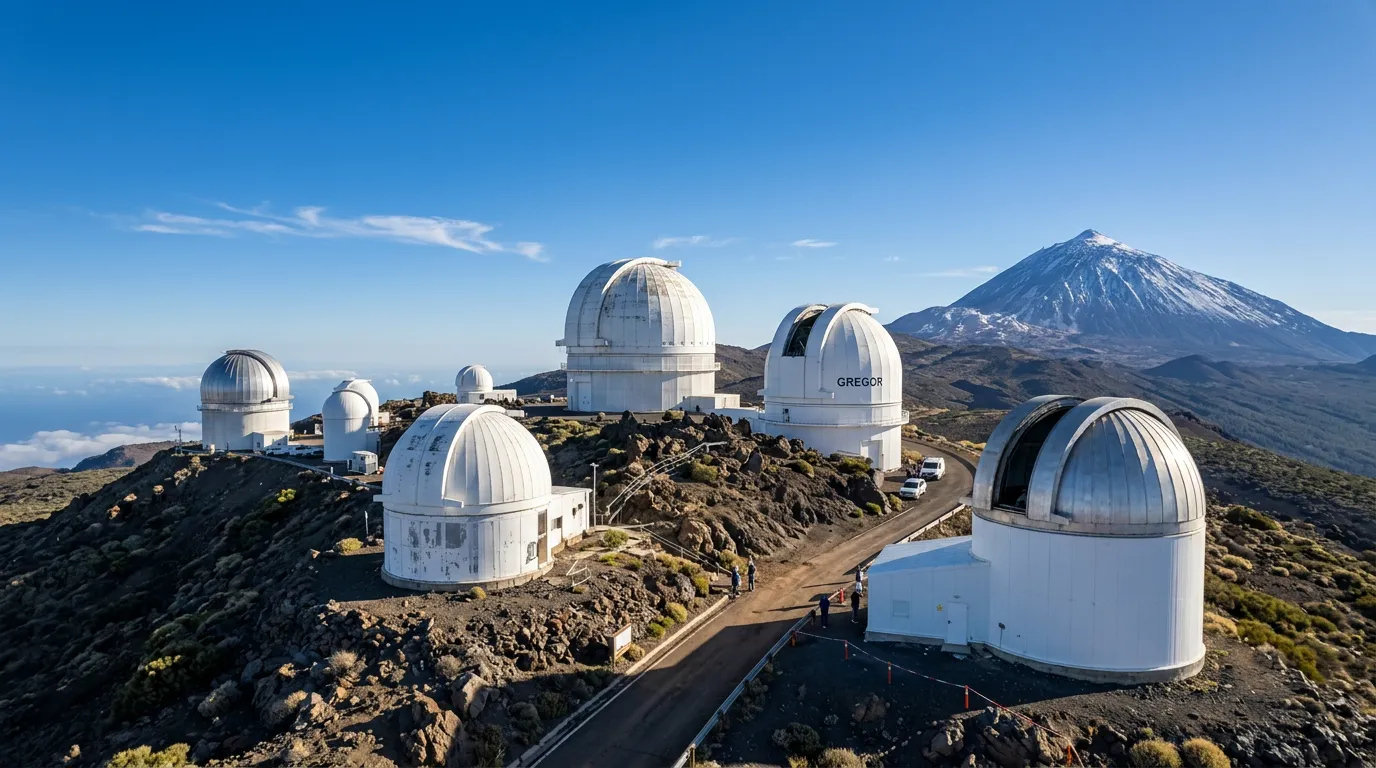
The Teide Observatory at Izaña, Tenerife, is the world's largest solar observatory, a working research facility perched at 2,390 metres above the Atlantic trade-wind clouds since 1964. It houses GREGOR, Europe's largest solar telescope, and is the site where helioseismology was born and where the first confirmed brown dwarf was detected in 1994.
The daytime tour is booked online only and runs April to November, and the observatory sits under some of the most legally protected skies on the planet, skies you can see for yourself from the caldera the same night.
In this article
Jump to a section
⌄
A French telescope on a Spanish volcano: the founding of Teide Observatory
In 1964, the University of Bordeaux installed a small telescope on the Izaña ridge in Tenerife with a single research goal: studying zodiacal light, the faint cone of sunlight scattered by interplanetary dust that glows in the western sky after dusk[1]. The Bordeaux team picked this spot for reasons that still matter today: elevation high enough to rise above the trade-wind inversion layer, air dry enough to minimise infrared absorption, and a location inside Spanish territory that offered political stability during the Cold War.
That first instrument measured zodiacal light intensity across the ecliptic plane. It was modest by modern standards, but the data it produced confirmed that the Izaña ridge offered exceptional atmospheric transparency, the same quality that now draws solar physicists and exoplanet hunters to the site six decades later. For the sky stories that predate the telescopes, see our piece on the Guanche star myths of Tenerife.
2,390 m
Elevation of the Teide Observatory at Izaña. High enough to sit above the trade-wind cloud inversion for most of the year, but low enough to avoid the severe winter conditions that close Roque de los Muchachos on La Palma (2,396 m) more frequently.
The observatory grew in stages rather than by grand design.
The Instituto de Astrofísica de Canarias (IAC) was founded in 1975 and took over management of Teide Observatory, consolidating what had been a loose federation of international instruments into a single coordinated research facility. In 1982, Royal Legal Decree 7/1982 gave the institute its current status as a Spanish Public Consortium, formalising the funding and governance structure that still runs the site today. Today the observatory operates as one of two nodes of the European Northern Observatory, the other being the Roque de los Muchachos Observatory on La Palma, with more than a dozen active telescopes run by institutions from Spain, Germany, the United Kingdom, Belgium, France, Italy, and beyond.
What started as a single French zodiacal-light experiment at 2,390 metres now fields solar telescopes, infrared reflectors, cosmic-microwave-background instruments, and robotic survey cameras. The site has accumulated over six decades of continuous astronomical observation, making it one of the longest-running high-altitude observatories in the world.
The neighbouring island of La Palma hosts the night-time optical and infrared telescopes for the same reason: stable, dry air above the cloud layer, but Teide's specialisation in solar physics exploits an additional advantage: an island peak in the morning generates less daytime turbulence than a continental mountain range, giving the solar telescopes steadier air to work through during the hours when the Sun is their target.
The telescopes at Teide: four instruments that define the site
Teide Observatory operates more than a dozen instruments, but four telescopes embody what the site does best: high-resolution solar physics and precision infrared astronomy from a stable, dry mountaintop.
Telescope
Aperture
Installed
On tour?
GREGOR (solar)
1.5 m
2012
Exterior only
VTT (solar, vacuum)
70 cm
1989
Exterior only
Carlos Sánchez (infrared reflector)
1.52 m
1971
Dome interior
IAC-80 (optical reflector)
82 cm
1991
Dome interior
GREGOR is the flagship. This 1.5-metre solar telescope, the largest of its kind in Europe, began science operations in May 2012[2]. It uses adaptive optics to correct for atmospheric distortion in real time, achieving a spatial resolution of roughly 70 kilometres on the solar surface, fine enough to image individual magnetic flux tubes and the fine structure of sunspot penumbras. The dome is visible from the TF-24 road on the approach to Izaña, a white cylinder on the ridge that tourists photograph from the mirador but which the public never enters: GREGOR is a working research instrument, and the guided observatory tour views it from the outside only.
The Vacuum Tower Telescope (VTT) predates GREGOR by two decades. Installed in 1989 by the Kiepenheuer Institute for Solar Physics in Freiburg, Germany, it uses a 70-centimetre primary mirror inside an evacuated tube to eliminate internal air turbulence, a design that was innovative at the time and that has produced high-resolution solar oscillation data for helioseismology research in the decades since. The VTT is still operational, though GREGOR has largely taken over the high-resolution solar imaging role.
The Carlos Sánchez Telescope was the site's first major infrared instrument. Installed in 1971 with a 1.52-metre primary mirror[3], it was built in the United Kingdom and optimised for infrared photometry, measuring the heat of stars rather than their visible light. This is the telescope most visitors walk inside during the guided tour. Its dome is cramped, its paint is peeling in places, and the control system runs on electronics that predate the internet. It is exactly what a working research telescope looks like: functional, maintained, and thoroughly unglamorous.
The IAC-80 is the observatory's workhorse. Installed in 1991 by the IAC itself, this 82-centimetre reflector has produced data for hundreds of research papers across stellar physics, exoplanet transit photometry, and asteroid tracking. It is the telescope that visiting students and PhD researchers are most likely to train on, and its long operational history makes it valuable for time-domain astronomy, studies that require decades of consistent observations of the same targets.
GREGOR: 1.5 m solar, adaptive optics, 2012, exterior view only on tour
VTT: 70 cm solar, vacuum tube design, 1989, Kiepenheuer Institute
Carlos Sánchez: 1.52 m infrared reflector, 1971, UK-built, dome interior on tour
IAC-80: 82 cm reflector, 1991, IAC-built, student training and time-domain surveys
What Teide Observatory has discovered: from the Sun's heartbeat to a failed star
Teide Observatory's scientific legacy rests on a handful of discoveries that shaped entire fields of astrophysics. Three in particular stand out.
Helioseismology was born here in 1979. Researchers from the Birmingham group used the Mark-I sodium resonance-scattering spectrometer, which had been operating at Teide since 1975, to measure periodic oscillations on the solar surface. The Sun, it turned out, rings like a bell at frequencies determined by its internal structure[4]. Before this, astronomers could only study the Sun's visible surface. Helioseismology opened a window into the solar interior: the rotation rate of the convective zone, the depth of sunspot-producing magnetic fields, the density profile of the core. The technique has since been applied to other stars under the name asteroseismology, and the Nobel Prize in Physics has been awarded for related work. The foundational data came from Izaña.
Timeline
1964
Observatory founded
University of Bordeaux installs first telescope for zodiacal light studies.
1971
Carlos Sánchez Telescope
1.52-metre infrared reflector installed; opens the site to stellar infrared astronomy.
1975
IAC founded
The Instituto de Astrofísica de Canarias is founded and takes over management of the observatory.
1979
Helioseismology born
Solar oscillations measured with the Birmingham group's Mark-I sodium resonance-scattering spectrometer, creating the field of helioseismology.
1982
IAC becomes a Public Consortium
Royal Legal Decree 7/1982 grants the IAC its current status as a Spanish Public Consortium.
1989
VTT installed
Vacuum Tower Telescope (70 cm) begins operations for high-resolution solar physics.
1991
IAC-80 installed
82-centimetre reflector becomes the observatory's research workhorse.
1994
Teide 1 discovered
First confirmed brown dwarf imaged in the Pleiades cluster using the IAC-80, confirmed by spectroscopy that December; the discovery paper was published in Nature in September 1995.
2012
GREGOR operational
Europe's largest solar telescope (1.5 m) begins science operations with adaptive optics.
2013
Starlight Reserve
Teide National Park designated a Starlight Reserve, formalising sky-quality protection.
Teide 1, the first confirmed brown dwarf, was imaged here in January 1994 and confirmed by spectroscopy that December. A brown dwarf is a substellar object too small to sustain hydrogen fusion (below roughly 80 Jupiter masses) but too massive to be a planet. Teide 1, located in the Pleiades star cluster at about 400 light-years, was the first object confirmed to fit that definition[5]. The IAC-80 telescope captured the discovery images, and the result was published in Nature in September 1995, marking the beginning of brown-dwarf astronomy as a distinct discipline. It also settled a long-running theoretical debate: do objects of intermediate mass between planets and stars actually exist, or is there a clean gap? The answer, from Izaña, was that they are real and plentiful.
Zodiacal light studies remain an active area at the observatory, six decades after the Bordeaux team started them. The same interplanetary dust that scatters sunlight into the zodiacal glow is also a foreground contaminant for cosmic microwave background (CMB) experiments: you cannot study the early universe's faint radiation without first subtracting the dust signal. Teide's COSMOSOMAS experiment, which ran from 1998 into the 2000s, mapped CMB anisotropies at centimetre wavelengths, contributing to the global effort that eventually produced the Planck satellite's definitive CMB map.
Teide has also contributed to exoplanet transit surveys. The observatory's stable photometric conditions, 78% useful observing time annually, median seeing of 0.76 arcseconds FWHM, make it well-suited for detecting the tiny dips in brightness that occur when a planet crosses the face of its star. Multiple exoplanet candidates confirmed by follow-up observations at Teide have since been added to the NASA Exoplanet Archive.
How to visit the Teide Observatory: the daytime tour
The Teide Observatory runs a guided daytime visit that is the only way for the public to enter the research facility. It is not a stargazing tour, and night access has never been open to the public[6]. The tour lasts 1.5 hours and costs €21 per person (children aged 8 to 16 enter free; children under 8 are not permitted at all).
Booking is online only through VolcanoTeide, the IAC's official partner for visitor management. There is no ticket desk at the observatory gate. If you arrive without a reservation, you will not get in, and the gate is unstaffed outside tour time slots, so there is nobody to ask. Book at least a week ahead in summer; morning English-language slots fill first.
The tour has three parts. First, solar observation: the guide sets up a portable hydrogen-alpha telescope that isolates the Sun's chromosphere, letting you see sunspot filaments, prominences arcing from the solar limb, and the granulation pattern of plasma cells on the surface. If clouds block the Sun, this segment becomes a spectroscopy demonstration, splitting white light into its component wavelengths with a handheld diffraction grating.
Second, you walk inside a nocturnal telescope dome, either the Carlos Sánchez Telescope (1.52 m, infrared) or the IAC-80 (82 cm, optical). The guide explains how the dome rotates to track a celestial target, how the primary mirror cools to ambient temperature after sunset, and what the telescope is scheduled to observe that night. You do not look through the telescope; you stand inside the dome and understand how it works.
Third, a 30-minute astrophysics workshop covers helioseismology, the Teide 1 brown dwarf discovery, and how the observatory contributes to solar space-weather monitoring. It is delivered at an adult level, curious teenagers follow it, but restless children will struggle.
Recommended tours
Tours are selected for quality, not commission. I earn a small fee if you book — at no extra cost to you.
The tour is suspended entirely from December through March due to winter conditions (snow, ice on the access road, and reduced staffing). Do not plan a winter trip around an observatory visit: it will not happen. The season runs April through November, with June and July offering the most reliable weather.
Getting there requires a rental car. There is no public bus, no taxi rank, and no rideshare service to the Izaña ridge. The drive from Costa Adeje takes roughly 50 minutes via the TF-1 and TF-24. From Puerto de la Cruz, allow about 40 minutes via the TF-21 and TF-24. The access road is paved and well-maintained but exposed to high winds on the final approach. For a detailed guide to routes, parking, fuel stops, and the summit permit system, see Getting to Teide from Tenerife Airport.
Altitude matters. At 2,390 metres, most people experience mild shortness of breath but nothing worse. If you have heart or respiratory conditions, the operator advises against the visit. Driving directly from sea level to the observatory can cause light-headedness. Spend the night before at altitude if possible. The Parador de Las Cañadas del Teide sits at 2,150 metres inside the caldera and is the best place to acclimatise before a morning tour.
Once a year, the observatory runs Open Days (Jornadas de Puertas Abiertas) with free entry and access to telescope interiors not normally open to visitors. The 2026 event runs June 20–21, is conducted in Spanish, and was fully booked within hours of announcement. If you want Open Day tickets, follow the IAC's social media and be ready to book the moment registration opens. There is no waiting list.
Observatory tour vs. night stargazing: two different experiences, both worth doing
The Teide Observatory daytime tour and the night stargazing tours that operate from the Las Cañadas caldera are complementary experiences, not competing ones. Confusing them is the single most common planning mistake visitors make.
The observatory tour is a science visit. You walk inside a telescope dome, you observe the Sun through a hydrogen-alpha filter, and you attend a workshop on helioseismology and brown-dwarf detection. You do not look at stars, planets, or the Milky Way through a telescope. It runs in daylight, costs €21, and lasts 90 minutes. Book it for the morning, then spend the rest of the day at altitude exploring the national park.
The Teide Stargazing & Astronomy Tour runs at night from the caldera and cable-car base station. You look through long-range telescopes at planets, nebulae, star clusters, and the Milky Way under Bortle 2 skies. Depending on the tier you book, it lasts one to eight hours and costs from €42 to €182 per person. This is the experience most people mean when they say they want to "stargaze on Teide."
The two tours complement each other. Do the observatory visit at 09:30, have lunch at the Parador, walk the Roques de García trail in the afternoon, and join the stargazing tour after dark. By the time the night guide starts explaining helioseismology and adaptive optics, you will already know what those terms mean, which puts you ahead of everyone else in the group.
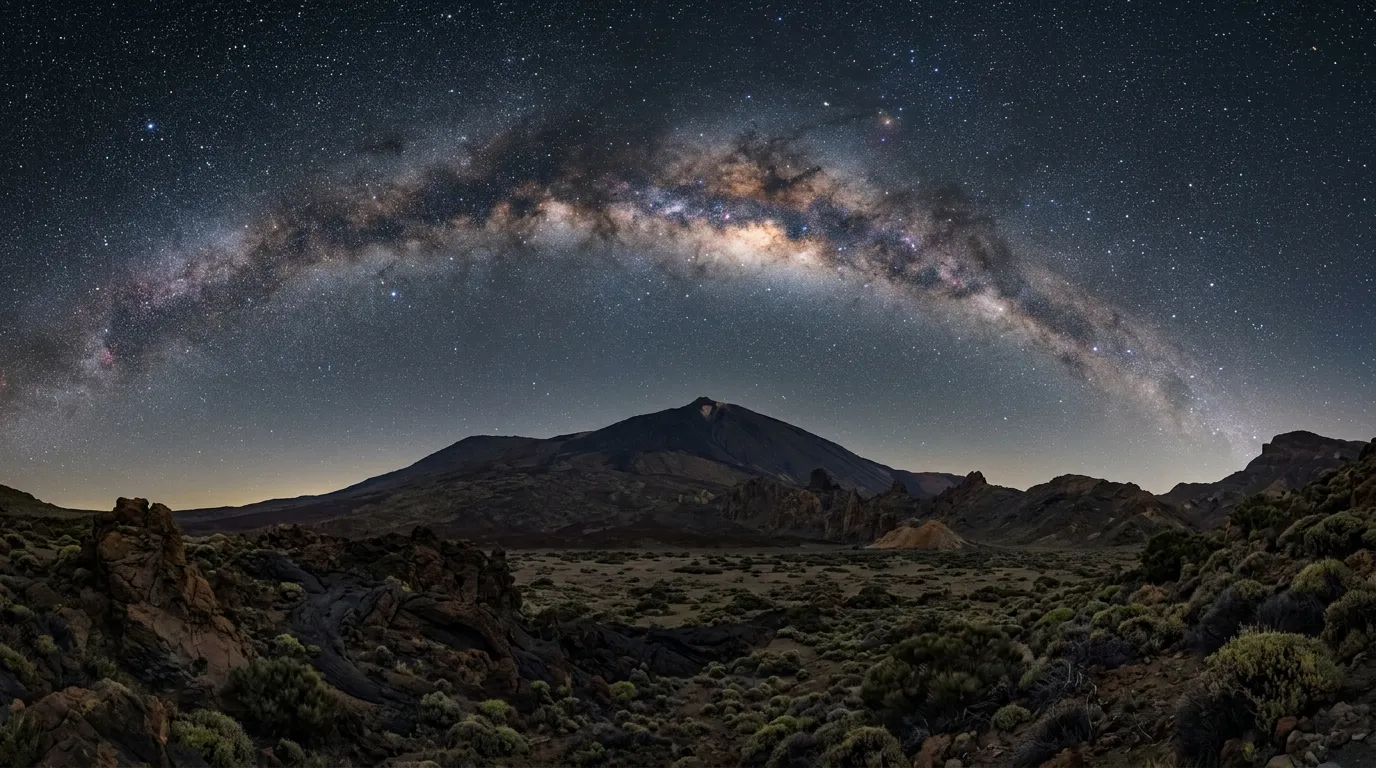
One thing the observatory tour will teach you that no stargazing brochure mentions: the mountain sky at night is not empty. From the caldera after dark you can see the observatory domes on the Izaña ridge, their slit windows glowing faintly as researchers inside collect data. The two experiences, the daytime science visit and the nighttime sky, complete the same picture.
For guidance on picking the right month to maximise your chances of a clear night at Teide, the best time for stargazing in Tenerife guide covers the month-by-month calendar, moon-phase alignment, and the trade-wind inversion in detail.
If you are new to dark-sky observing, a quick read of the stargazing for beginners guide will save you from the most common first-timer mistakes: red-light headlamps, dew on your lens, and overestimating what a small telescope can show.
Why Teide Observatory matters: the infrastructure behind the sky
Teide Observatory is not simply a collection of telescopes on a mountain. It is the anchor of a legal and physical infrastructure that protects the night sky over the entire island, and the numbers that justify that protection are worth understanding.
The sky quality is exceptional by any measure. The median seeing at Izaña is 0.76 arcseconds FWHM, with 78% useful observing time annually[7]. July, the driest month, records a relative humidity of 25% and effectively zero precipitation (0.0 mm on average). Those figures are not tourist-brochure claims; they are continuously measured by the IAC's sky-quality monitoring station and published in peer-reviewed site-characterisation papers. For comparison, continental European observatories typically report median seeing of 1.0 to 1.5 arcseconds and useful-time fractions below 50%.
The trade-wind inversion is the physical mechanism behind these numbers. Moist north-easterly winds strike Tenerife's northern slope, rise, cool, and condense into a persistent cloud layer between roughly 800 and 1,600 metres. Above that band, where the observatory sits, the air is dry, stable, and largely free of particulate haze. The inversion layer is most reliable from April through October and strongest in July, when the humidity at Izaña bottoms out at 25% and clear-sky probability approaches 99%.
The Ley del Cielo (Sky Law), enacted by the Spanish government in 1992, controls outdoor lighting across the island and restricts flight paths near the observatory. Tenerife's municipalities are legally required to use low-pressure sodium streetlights with downward-directed shields. It is not a guideline; it is enforced by the Oficina Técnica para la Protección de la Calidad del Cielo (OTPC). The law also restricts radio-frequency emissions near the observatory, protecting the microwave instruments that study the cosmic microwave background.
In 2013, Teide National Park was designated a Starlight Reserve by the Starlight Foundation[8], formalising what astronomers had known for decades: the sky above the caldera is among the darkest and most stable in Europe. The designation carries tourism obligations, guided stargazing activities, public outreach, and infrastructure that balances access with protection, which is why you can now book a night tour from the same caldera where professional telescopes have been operating since the 1960s.
The observatory also anchors the local research economy. The IAC employs several hundred scientists, engineers, and support staff across its two observatories, and GREGOR itself is proof of that reach: the telescope was built by a consortium of German institutes, the Kiepenheuer Institute for Solar Physics, the Leibniz Institute for Astrophysics Potsdam, and the Max Planck Institute for Solar System Research, working alongside the IAC. When a new adaptive-optics system is tested on GREGOR, or a new exoplanet-transit survey runs on the IAC-80, the data flows into the global astrophysics literature, and the site's reputation reinforces the protection regime that keeps the sky dark.
Understanding why the observatory is here helps you get more out of being here. The same air that lets GREGOR resolve 70-kilometre features on the Sun is the air you are looking through when you set up a telescope at the Mirador de Chío after dark. The same Sky Law that shields the IAC-80 from light pollution is the reason you can see the Milky Way's dust lanes from a roadside pullout on the TF-21. You are observing under the same protected sky that professional astronomers fought to preserve.
Frequently asked questions
Can you visit the Teide Observatory at night?
No. The Teide Observatory conducts active astronomical research every clear night of the year. The telescopes are operated by scientists and students, not by tour guides. There has never been a public night-visit programme at the observatory, and the IAC has given no indication that one is planned. The only exception is the annual Open Days event in June, which operates during daylight hours. If you want to look at the night sky through a telescope at Teide, book one of the stargazing tours that operate from the Las Cañadas caldera, not from the observatory itself.
How much does the Teide Observatory guided tour cost?
The Teide Observatory daytime tour costs €21 per person. Children aged 8 to 16 enter free. Children under 8 are not permitted. Booking is online only through VolcanoTeide, the IAC's official partner. There is no ticket desk at the observatory gate. Cancellation is free up to 24 hours before your time slot. The tour is suspended from December through March, and no winter bookings are possible regardless of weather.
What telescopes can you see on the Teide Observatory tour?
The tour visits one of two nocturnal telescope domes: either the Carlos Sánchez Telescope (1.52-metre infrared reflector, installed 1971) or the IAC-80 (82-centimetre optical reflector, installed 1991). You stand inside the dome while the guide explains how the instrument works. You do not look through the telescope. GREGOR, the 1.5-metre solar telescope that is the observatory's flagship, is visible from outside only; its dome is restricted to IAC researchers. The VTT (70-centimetre vacuum solar telescope) is also viewed from the exterior.
Is the Teide Observatory tour suitable for children?
Children aged 8 to 16 are permitted and enter free, but the tour content is pitched at an adult level. The 30-minute astrophysics workshop covers helioseismology, brown-dwarf detection, and solar space-weather monitoring. A curious teenager will follow it; a restless eight-year-old will not. Children under 8 are not permitted, for safety reasons and because the workshop assumes an adult attention span. There are no children's activities or simplified versions of the tour.
Do I need a car to reach the Teide Observatory?
Yes. There is no public bus, taxi rank, or rideshare service to the Izaña observatory at 2,390 metres. A rental car is the only practical option. The drive from Costa Adeje takes roughly 50 minutes via TF-1 and TF-24. From Puerto de la Cruz, allow about 40 minutes via TF-21 and TF-24. The access road is paved and well-maintained but exposed to high winds on the final approach. Arrive 30 minutes before your time slot; late arrivals are not admitted.
What scientific discoveries were made at the Teide Observatory?
Three discoveries stand out. Helioseismology, the study of solar oscillations that reveal the Sun's internal structure, was born here in 1979 using the Birmingham group's Mark-I sodium resonance-scattering spectrometer. Teide 1 — the first confirmed brown dwarf, a substellar object between planet and star — was imaged using the IAC-80 telescope in January 1994 and confirmed by spectroscopy that December, with the discovery paper published in Nature in September 1995. And the observatory's original research programme on zodiacal light, the sunlight scattered by interplanetary dust, laid the groundwork for cosmic microwave background foreground-subtraction techniques still in use today.
When is the best time to visit the Teide Observatory?
June and July offer the most reliable clear-sky conditions above the trade-wind inversion, with July humidity dropping to 25% and 99% clear-sky probability at altitude. September and October have crisp mornings and fewer visitors after the summer peak. Book a morning slot (09:30–11:00) for the smallest tour groups. Avoid the Open Days weekend in late June, when the site is crowded and regular tour availability is reduced. The tour is suspended entirely from December through March.
Is Teide Observatory part of a Starlight Reserve?
Yes. Teide National Park was designated a Starlight Reserve by the Starlight Foundation in 2013, formalising the sky-quality protection that the Ley del Cielo (Sky Law) had enforced since 1992. The reserve status requires municipalities to use shielded low-pressure sodium lighting, restricts flight paths near the observatory, and mandates public stargazing outreach. The result is that the sky above the caldera at 2,000 metres is among the darkest and most protected in Europe.
Can you combine a Teide Observatory tour with a stargazing tour on the same day?
Yes, and it is the best way to experience Teide. Book the 09:30 observatory tour in the morning, spend the afternoon at altitude — lunch at the Parador de Las Cañadas, the Roques de García walk, sunset at Mirador de Chío — and join a night stargazing tour from the caldera after dark. You will be acclimatised to altitude and will understand what the night guide is explaining about helioseismology, adaptive optics, and brown dwarfs better than anyone else in the group.